


I remember staring at my screen in late 2024, watching a slick YouTube video promise a 'guaranteed' strategy for USD/NGN.

Olumide Adeyemi
Pionier des Tradings in Westafrika ·  Nigeria
☕ 11 Min. Lesezeit
Was Sie lernen werden:
- 1Why Videos Are the Nigerian Trader's Classroom
- 2Spotting Quality Content vs. Get-Rich-Quick Noise
- 3Building Your Own Curriculum From Videos
- 4The Broker Connection: Practical Execution
- 5Integrating Video Lessons Into a LIVE Strategy
- 6Top Video Formats and Where to Find Them
- 7Common Pitfalls and How to Avoid Them
- 8Your Action Plan Starting Today
I remember staring at my screen in late 2024, watching a slick YouTube video promise a 'guaranteed' strategy for USD/NGN. The guy had all the graphics, the confident tone, the Lamborghini thumbnail. I followed his setup, entered a short on the Naira at what seemed like a perfect resistance level. Two hours later, I was down ₦45,000. The market had completely ignored his 'secret indicator'. That loss, more than any win, taught me the real value - and danger - of forex trading videos. For us in Nigeria, with the second-biggest retail market in Africa, videos are a primary learning tool. But without a filter, they're a fast track to blowing your account.
Let's be real, most of us didn't learn forex in a formal school. We learned on our phones, during 'owambe' lulls, or in between lectures. Forex trading videos fill that gap. They're accessible, often free, and visual - which is crucial for understanding chart patterns and order execution. With Nigeria's huge, young, tech-savvy population hungry for financial opportunity, YouTube and Telegram channels have become the de facto universities of trading.
But here's the catch. The very thing that makes them great - being easy to consume - also makes them dangerous. Anyone with a screen recorder and some jargon can pose as an expert. The market doesn't care about how convincing the presenter is. I learned this the hard way with that USD/NGN trade. The strategy worked in the video's backtest, but it fell apart in real-time market conditions, which were being rocked by CBN policy whispers I hadn't even considered.

Warning: A video's production quality has zero correlation with the profitability of its advice. Some of the most valuable lessons I've learned came from grainy, poorly edited streams by actual floor traders.
The key is to shift your mindset. Don't watch to copy trades. Watch to understand the process. How does the presenter analyze liquidity? How do they manage a trade when it goes against them? That's the gold.
The Red Flags You Must Ignore
If you see these, click away. Seriously.
- "Guaranteed Profits" or "Risk-Free": The forex market is the definition of risk. Anyone saying otherwise is lying.
- The Lamborghini/Private Jet Thumbnail: This is pure marketing targeting your emotions, not your intellect.
- Pressure to Join a Paid "Signal Group": Often the signals are just copied from free sources or made up. Their real business is your subscription, not your trading success.
- No Discussion of Losses: Every real trader has losing trades. If a channel only shows wins, they're hiding the full picture. A credible educator will dissect their losers more than their winners.
The Green Flags to Look For
- Focus on Risk Management: The first thing they talk about is position size, stop-loss placement, and risk-reward ratios. This is non-negotiable. I'd recommend using a position size calculator religiously, a habit any good video should encourage.
- Transparency with Live Accounts: They show the full trade lifecycle, including the drawdown and the emotional struggle. It's messy, and that's honest.
- Teaching Concepts, Not Just Calls: Instead of "buy GBP/USD now," they explain why - maybe discussing Bank of England vs. Fed policy divergence, or showing a key support level on the chart.
- Admits Mistakes: I respect a trader ten times more when they say, "I messed up my entry here because I ignored the higher timeframe trend."

Pro Tip: Search for videos on specific, technical topics like "how to use RSI indicator divergence on USD/NGN" instead of generic "forex trading for beginners." You'll find more focused, useful content.

💡 Winstons Tipp
The most valuable forex trading videos are the boring ones. The ones about logging your trades, calculating position size, and reviewing your weekly P&L. Glamour doesn't pay the bills; process does.
“You can't just watch randomly. You need a plan, like a university syllabus.”
You can't just watch randomly. You need a plan, like a university syllabus. Here’s how I structured my learning after my early failures.
Phase 1: The Absolute Basics (2-3 Weeks) Don't skip this. Watch videos explaining:
- What a pip definition is and how to calculate its value in Naira.
- What bid/ask prices and the spread definition mean for your costs.
- How use works and how it can lead to a margin call.
- The structure of the Nigerian forex market: the role of the CBN, SEC, and why we mostly use international brokers like Exness or IC Markets.
Phase 2: Market Analysis (1-2 Months) Now, get into the how of decision-making.
- Technical Analysis: Find separate, deep-dive series on core indicators. Don't just learn what the MACD indicator line is; watch videos showing it failing and succeeding in different market conditions (trending vs. ranging).
- Fundamental Analysis for Nigeria: This is critical. Follow channels that break down CBN monetary policy announcements, oil price impacts on the Naira, and inflation data releases. A trade on USD/NGN lives or dies by this news.
- Price Action: Search for videos on reading candlestick patterns and support/resistance. This is the foundation of many a scalping strategy.
Phase 3: Strategy & Psychology (Ongoing)
- Watch videos where traders walk through their full strategy, from scanning markets to closing a trade.
- Consume content on trading psychology - handling greed after a win, fear after a loss, and the boredom of discipline. This is 80% of the game.

Example: My own weekly review includes re-watching one educational video on a concept I'm struggling with (like false breakouts), and one video review of a live trading session from a trusted source. It keeps me learning and grounded.
All the video knowledge in the world is useless if you can't execute properly on your platform. This is where many Nigerian traders get tripped up. You'll watch a video showing a perfect entry on a demo account, then struggle to replicate it live with real money and potential slippage.
Look for forex trading videos that are platform-specific. A video titled "Placing a Limit Order and Setting TP/SL on MT5 with XM" is infinitely more valuable than a generic one. You need to see the exact clicks. Many top brokers for Nigerians, like XM and Pepperstone, have their own tutorial channels. Use them.
Pay close attention to videos discussing order types (market, limit, stop) and how spreads vary. A strategy shown on a commission-free account with a 1-pip spread might not be viable on a raw spread account with a commission, or during volatile news times when spreads on brokers like IC Markets can widen. That's a cost that eats directly into your profit, measured in precious Naira.
Also, watch deposit/withdrawal tutorials for your specific broker and payment method. Knowing how long a bank transfer to your Exness account takes, or the fees for using a Naira card, is part of your operational risk. Manage your money as seriously as you manage your trades.
“Their business model is selling dreams, not generating consistent trading profits.”
This is the final, hardest step. Moving from passive watching to active, disciplined trading. Here's my method.
First, I paper trade any new concept for a minimum of two weeks. If I watch a video on a scalping strategy using the 1-minute chart, I don't touch my live account. I practice it in a demo, logging every trade, noting where it felt different from the video.
Second, I break down the strategy into a checklist. The video might show a trader's intuition, but you need a rigid process. My checklist for a simple swing trading setup based on a video lesson looks like this:
- Identify the overall trend on H4 chart (Aligned with video's trend filter).
- Wait for pullback to key moving average or support (As shown in the example).
- Check for bullish/bearish candlestick pattern on H1 (Specific pattern taught).
- Enter on confirmation candle close.
- Set stop-loss below recent swing low (Using the exact method demonstrated).
- Set take-profit at 1:1.5 risk-reward minimum.
Third, and most importantly, I adapt. A video might use EUR/USD examples. I have to test if the same logic holds for the pairs I trade, like GBP/NGN or even XAU/USD guide (Gold). Markets have different personalities. I once tried a range-trading strategy from a video on EUR/USD directly on USD/NGN. The Naira pair was in a firm CBN-driven trend and just ripped through the supposed range boundaries. Lost ₦30,000 learning that lesson in adaptation.
💡 Winstons Tipp
If a video makes you feel excited and rich, it's entertainment. If it makes you think and reach for a notepad, it's education. Seek the latter.
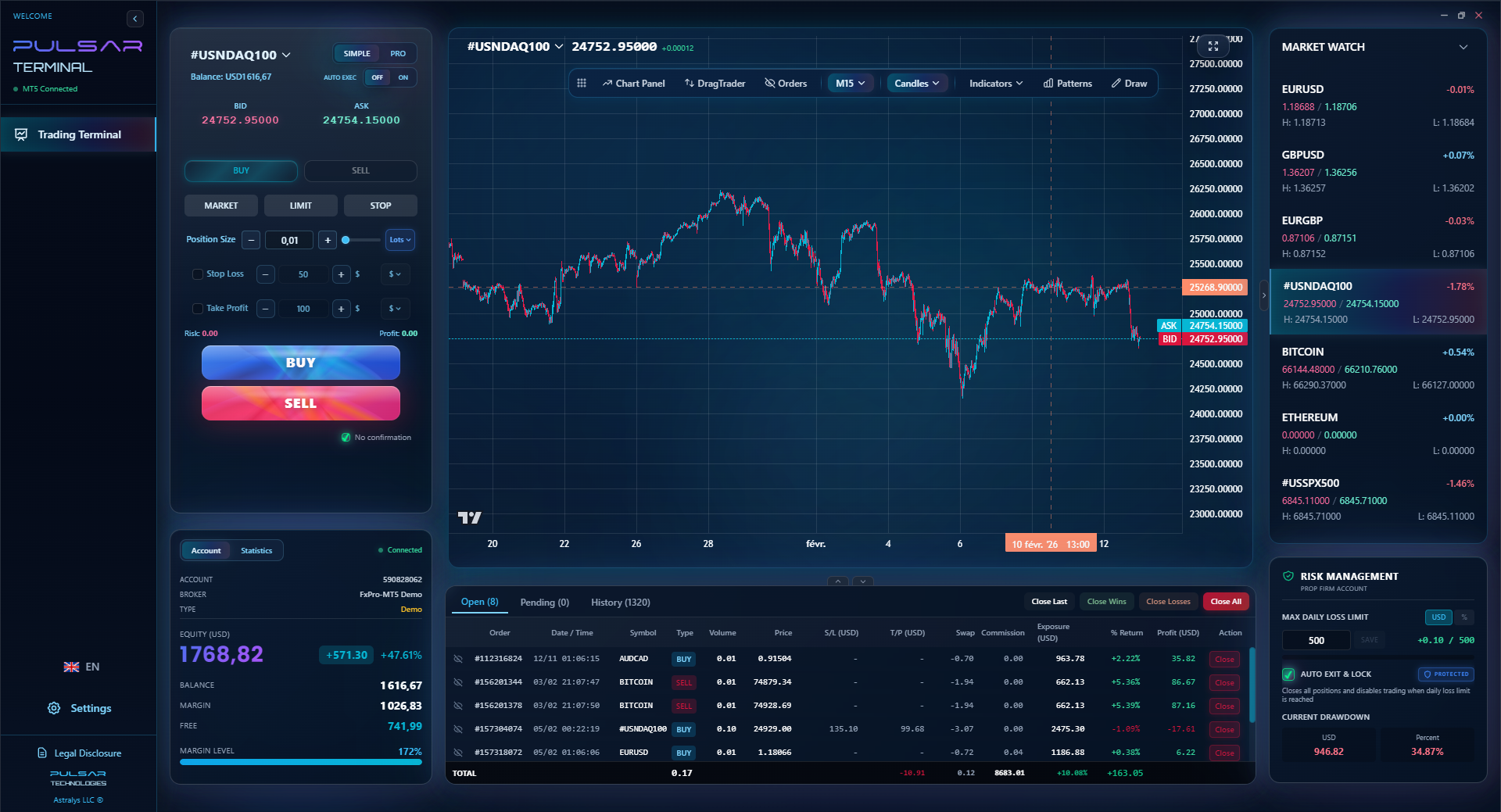
Building a disciplined strategy from videos is one thing; executing it flawlessly on MT5 is another. Pulsar Terminal's drag-and-drop orders and one-click stop-loss management turn what you learn into precise, repeatable action.
Pulsar Terminal
Das All-in-One MT5-Tool: Drag-and-Drop-Orders, Multi-TP/SL, Trailing Stop, Grid Trading, Volume Profile und Prop-Firm-Schutz. Täglich von 1.000+ Tradern genutzt.
Not all videos are created equal. Different formats serve different purposes in your learning journey.
| Format | Best For | Pitfalls to Avoid |
|---|---|---|
| Live Trading Streams | Seeing real-time decision-making, pressure, and trade management. | Don't blindly copy trades. The streamer's position size and risk tolerance are different from yours. |
| Recorded Trade Analysis | In-depth post-mortems of trades. Understanding the why behind wins and losses. | Ensure they analyze losing trades with as much detail as winning ones. |
| Technical Tutorials | Deeply learning a single indicator, pattern, or theory. | Don't get lost in complexity. A simple strategy mastered is better than 10 indicators misunderstood. |
| Webinars/Seminars | Broader topics like quarterly market outlooks or psychology deep-dives. | Often include a sales pitch. Extract the educational content and ignore the upselling. |
| Broker Tutorials | Learning the mechanics of your specific trading platform. | Essential for execution but not for strategy development. |
Where to Look (Nigerian Focus):
- YouTube: Use specific search terms. "Forex trading videos" is too broad. Try "Naira volatility trading," "CBN policy impact forex," or "Gold trading during inflation."
- Broker Education Hubs: XM, Pepperstone, and others have extensive free video libraries.
- Paid Platforms (Use Caution): Sites like TraderTV.live or Real Vision offer high-quality content. Always use their free trial first and ensure the content matches your trading style. Never take a loan to pay for a trading course.
“The goal is to become your own guru.”
I've fallen into most of these. Learn from my wasted Naira.
Pitfall 1: Strategy Hopping. You watch a video on Monday about a fantastic breakout strategy. You try it, have two losing trades, and give up. On Wednesday, you see a video on a mean reversion strategy and jump to that. This cycle never ends, and you never master anything. Fix: Pick ONE core strategy from a credible source. Backtest it on Nigerian market hours. Paper trade it for a month. Only then evaluate.
Pitfall 2: Confirmation Bias. You're long on USD/NGN. You unconsciously start only watching videos or seeking out analysts who are also bullish. You ignore contrary evidence. This is how you turn a small loss into a catastrophic one. Fix: Actively seek out opposing viewpoints. Watch videos that make the bearish case for your trade. If their reasoning is stronger, you have your exit signal.
Pitfall 3: The "Guru" Trap. You find a charismatic presenter and outsource your thinking to them. You stop doing your own analysis. Remember, no one cares more about your money than you. Fix: Watch the video, then close it. Open your chart and try to do the analysis yourself. Can you see the setup? If not, re-watch. The goal is to become your own guru.
Pitfall 4: Ignoring Costs. A video shows a scalping strategy taking 5-pip profits. Looks easy. But if your broker's spread is 2 pips and you pay commission, you need a 7-pip move just to break even. That changes the math completely. Fix: Always, always factor in your actual trading costs from brokers like IC Markets or Exness before adopting a short-term strategy.
Enough theory. Let's get practical. Here’s what you can do in the next 7 days.
Day 1-2: Audit Your Viewing. Go through your YouTube history. Unsubscribe from every channel with Lamborghini thumbnails and 'guaranteed' in the title. Search for and subscribe to 3 new channels focused on risk management and market fundamentals.
Day 3-4: Skill Drill. Pick ONE technical concept you're weak on (e.g., Fibonacci retracements). Watch 3-4 different videos on it from different educators. Then, open your demo chart on EUR/USD guide and XAU/USD guide and draw the levels yourself on the last 3 months of price action. See where price respected or ignored them.
Day 5-6: Broker Homework. Find and watch the official platform tutorial playlist for your broker. If you use MT5, learn one new feature you've never used, like the depth of market or how to set a trailing stop properly.
Day 7: Review & Plan. Write down one key lesson from the week's videos. Then, write down one trading mistake you've made that the lesson could have prevented. This link between video learning and your personal experience is where true growth happens.
Forex trading videos are a powerful tool, but they're just a tool. You are the craftsman. Your discipline, your risk management, and your ability to learn from both screens and real-world losses are what will determine your success in this massive ₦9.6 trillion-a-day market.
FAQ
Q1Are free forex trading videos on YouTube enough to become a profitable trader in Nigeria?
They can be an excellent starting point for learning concepts and market structure, but no, they are rarely enough on their own. Profitability comes from combining that knowledge with disciplined practice on a demo account, developing your own trading plan, and gaining real-world experience managing emotions and risk with your own capital. Think of videos as the textbook; you still have to pass the practical exam.
Q2I see many forex 'gurus' on Instagram offering signals. Should I pay for them?
I strongly advise against it. In my experience, and from countless stories I've heard, the vast majority are scams. Their business model is selling dreams, not generating consistent trading profits. If they were so successful with their signals, they'd be trading with their own money, not selling subscriptions for ₦20,000 a month. Focus on learning to fish, not buying the fish.
Q3How can I tell if a trading strategy from a video will work with Nigerian brokers?
Test it! But first, check two things from the video: 1) The typical stop-loss and take-profit distances in pips. 2) The time frame (scalping, day trading). Then, compare those numbers to the typical spreads and commissions on your broker (e.g., check our Exness review or IC Markets review for real numbers). If a strategy aims for 5-pip profits but your broker's spread is 2 pips, you're at a huge disadvantage. Always paper trade a strategy with your actual broker's conditions first.
Q4What's the most important thing to learn from a forex trading video?
The thought process, not the specific trade. Watch how the presenter identifies a setup, where they place their stop-loss (and why), how they manage the trade when it's open, and how they react if it hits their stop. This 'trade management' and risk framework is infinitely more valuable than any single "buy here" signal.
Q5How do I manage information overload from watching too many videos?
This is a huge problem. The solution is to get specific and cyclical. Don't just watch randomly. Have a learning goal for the week (e.g., "understand support and resistance"). Watch 2-3 videos on that topic only. Then, stop watching and spend the rest of your time applying it on charts. Come back to videos only when you have a new, specific question. Learning is a cycle of input (video) and practice (chart time), not just constant input.
Q6Do I need to watch videos about the Nigerian economy to trade forex?
Absolutely, especially if you trade USD/NGN or any Naira pair. The Central Bank of Nigeria's (CBN) monetary policy decisions, inflation data, and oil price movements are the primary drivers of the Naira's value. A video explaining how to trade a Federal Reserve announcement is useless if you don't understand the impact of a CBN circular on BDC operations. Local fundamental knowledge is non-negotiable for trading your local currency effectively.
Prof. Winstons Lektion
Wichtige Erkenntnisse:
- ✓Audit your video sources: unsubscribe from hype, subscribe to process.
- ✓Paper trade any new strategy for two weeks minimum before going live.
- ✓Always factor in your real broker spreads and commissions.
- ✓Spend 80% of your time applying video lessons, 20% watching them.
Wie nützlich war dieser Artikel?
Klicken Sie auf einen Stern
Wöchentliche Trading-Einblicke
Kostenlose wöchentliche Analysen & Strategien. Kein Spam.
Über den Autor
Olumide Adeyemi
Pionier des Tradings in Westafrika
Einer der aktivsten Forex-Trading-Ausbilder Nigerias. 8 Jahre Trading-Erfahrung aus Lagos. Spezialisiert auf Strategien mit geringem Kapital und Prop-Firm-Challenges für afrikanische Trader.
Kommentare
Risikohinweis
Der Handel mit Finanzinstrumenten birgt erhebliche Risiken und ist möglicherweise nicht für alle Anleger geeignet. Vergangene Ergebnisse garantieren keine zukünftigen Renditen. Dieser Inhalt dient ausschließlich Bildungszwecken und stellt keine Anlageberatung dar. Führen Sie immer Ihre eigene Recherche durch, bevor Sie handeln.
Das könnte Sie auch interessieren

Cara Trading Forex Sukses: 7 Prinsip dari Trader Profesional
Cara trading forex sukses dengan 7 prinsip trader pro: manajemen modal, disiplin, journal trading, backtest. Data nyata, bukan janji profit palsu.
Jam Trading Forex Terbaik untuk Trader Indonesia: Panduan Lengkap dengan Tabel Waktu
Panduan jam trading forex untuk trader Indonesia. Tabel 4 sesi dunia, jam emas 20:00-00:00, sesi mana yang harus dihindari. Data akurat + tips dari trader berpengalaman.
Top 5 Sàn Forex Uy Tín Nhất 2026: Review Jujur dari Trader Indonesia
Top 5 sàn forex uy tín 2026 untuk trader Indonesia. Review jujur: spread, deposit, withdraw, dukungan lokal. Exness, XM, IC Markets & lebih.
Pulsar Terminal herunterladen
Alle diese Rechner sind in Pulsar Terminal mit Echtzeit-Daten Ihres MT5-Kontos integriert.
Pulsar Terminal herunterladen