


Here's a number that should make you pause: only about 12% of South Africa's estimated 200,000 active forex traders are consistently profitable.

David van der Merwe
Schwellenland-Trader ·  South Africa
☕ 12 Min. Lesezeit
Was Sie lernen werden:
- 1The Durban Forex Scene: What You're Really Getting Into
- 2What Forex Training Actually Costs (And What It Should)
- 3How to Spot a Scam: Durban's Red Flags
- 4What Good Forex Training Actually Covers
- 5The Self-Education Path: It's Possible (And Cheaper)
- 6Choosing a Mentor or Course: Your Due Diligence Checklist
- 7Your First Steps as a Durban Trader
Here's a number that should make you pause: only about 12% of South Africa's estimated 200,000 active forex traders are consistently profitable. Yet in Durban alone, dozens of 'gurus' promise six-figure returns from their training courses. I've seen traders in Umhlanga spend R50,000 on 'elite mentorship' only to blow their accounts in three months. The truth? Most forex training in Durban is either overpriced, dangerously wrong, or an outright scam. But the good stuff does exist if you know where to look and what questions to ask.
Trading from Durban has some unique advantages and headaches. Our time zone means London opens at 10 AM our time, and the New York session kicks off at 3 PM. That's actually perfect for someone with a day job – you can trade the London/US overlap after work. But here's what nobody tells you: liquidity can get weird during our afternoon when Asia hasn't fully woken up yet and London is closing.
I remember placing a EUR/USD trade back in 2019 through a local broker's platform. The spread, which was usually 1.2 pips, suddenly widened to 4.5 pips right at 5 PM SAST. Got stopped out immediately. Learned the hard way that you need to understand session overlaps and when your broker might be pulling liquidity.
The market here is growing fast – we're talking about moving from $3.8 billion in 2024 to nearly $6.9 billion by 2033. But with growth comes parasites. Every shopping mall seminar promising 'financial freedom' usually leads to someone's financial ruin.

Warning: If a 'trainer' shows you screenshots of massive profits but can't show a verified, multi-year track record from a third-party service like Myfxbook, walk away. I've seen Photoshop jobs that would make a graphic designer blush.
What you really need to understand first isn't some secret indicator. It's the regulatory landscape. The FSCA (Financial Sector Conduct Authority) is who you check for broker legitimacy. If your training course recommends an unregulated offshore broker promising 1:1000 use, that's your first red flag.
“Most forex training in Durban is either overpriced, dangerously wrong, or an outright scam.”
Let's talk numbers, because this is where most Durban traders get ripped off. I've seen the full spectrum, from the ridiculous to the reasonable.
The Price Spectrum in Durban:
| Type of Training | Typical Price Range | What You Usually Get |
|---|---|---|
| Online Video Course (Int'l) | R500 - R5,000 | Pre-recorded videos, PDFs, basic community access. Quality varies wildly. |
| Local Weekend Workshop | R2,500 - R10,000 | 2-day in-person event in a hotel conference room. High on motivation, low on actual skill transfer. |
| 'Advanced' Local Mentorship | R15,000 - R50,000+ | Promises of one-on-one time, often delivered as generic group calls. The biggest gamble. |
| University/College Course | R6,000 - R12,000 | Structured theory (like Unisa's course). Strong on fundamentals, weaker on live trading psychology. |
Here's my personal experience: I once paid R18,000 for a 3-month 'mastermind' with a guy who advertised all over Durban. We had weekly Zoom calls with 30 other people. His 'strategy' was basically copying forex signals from a Telegram channel. I lost that R18,000 plus another R40,000 in my trading account trying to follow his advice. The strategy had no clear risk management rules – a surefire way to get a margin call.
What worked? Spending R3,500 on a specific course about market structure and price action from an international trader, then paper trading for six months. The expensive local stuff was mostly fluff.

Pro Tip: Never pay for a mentorship upfront. Ask to pay monthly. If they refuse, they're probably worried you'll quit after seeing the low quality. A real mentor is confident you'll stay.
The best value often isn't the most expensive. It's the training that focuses on the boring stuff: risk management, journaling, and understanding the spread and how it affects your scalping strategy.

💡 Winstons Tipp
The most expensive lesson isn't a losing trade; it's paying for bad education. Vet a mentor's track record more thoroughly than you'd vet a used car.
“The expensive local stuff was mostly fluff. What worked was a specific course on market structure, then six months of paper trading.”
KwaZulu-Natal has become a breeding ground for forex trading scams disguised as education. They follow a pattern. Learn it.
The Guarantee: Any training that guarantees profits or a specific return percentage is lying. The market doesn't give guarantees. I saw a flyer in Gateway promising '90% win rate.' That's mathematically suspicious for any sustained period.
The Lifestyle Marketing: If their Instagram is all rented Lamborghinis on the Umhlanga strip, champagne, and watches, they're selling a dream, not a skill. Their real profit is from selling you the course, not trading.
The Pressure Tactics: 'This offer expires tonight!' 'Only 5 spots left for Durban!' Classic scarcity tactics. Real education doesn't need them.
The Vague Strategy: They talk about 'the system' or 'the method' but never show the exact rules. They'll say it's too valuable to give away. Nonsense. A real teacher shows you the mechanics. Ask them: 'What is your exact risk per trade? What's your entry trigger? What's your profit target and stop loss methodology?' If they dodge, run.
The Broker Kickback: This is a dirty secret. Some 'educators' are actually introducing brokers (IBs) for specific platforms. They get a commission on your losses (via the spread) or your trading volume. Their incentive isn't for you to win, it's for you to trade a lot. Always ask if they receive any compensation from recommending a specific broker. Check our Exness review and IC Markets review for examples of transparent broker structures.
My rule now? If a trainer can't point to at least 2 years of verified, live account statements showing steady growth (not just one lucky month), I don't listen. The proof is in the track record, not the car they're leaning on.
“The expensive local stuff was mostly fluff. What worked was a specific course on market structure, then six months of paper trading.”
Forget the flashy promises. A proper forex training course, whether in Durban or online, should be built like a pyramid. The foundation is everything.
The Non-Negotiable Foundation
- Risk & Money Management: This isn't one module. It should be the theme of the entire course. How to size your positions (use a position size calculator), how to set stop losses, understanding drawdown. This alone will save you more money than any indicator.
- Market Mechanics: What is a pip? How does use actually work? What's the difference between a market and limit order? How do economic events like SARB announcements move the ZAR pairs? Boring, essential.
- Psychology & Journaling: You are the biggest problem in your trading. Good training teaches you to manage fear, greed, and revenge trading. They'll force you to keep a detailed journal for every trade.
The Strategy Layer
Only after the foundation do you add strategy. A good course teaches ONE clear methodology in depth. It could be price action supply/demand, or indicator-based like using the RSI indicator and MACD indicator together. Not ten different confusing systems.
They should give you a complete, rule-based plan: Entry condition, stop loss placement, take profit placement. For example, a simple swing trading plan for XAU/USD might be: 'Buy on a close above the weekly high, stop loss 1.5x the recent average daily range, take profit at 2:1 risk-to-reward.'
The Practice & Feedback Loop
This is where most local courses fail. They give you info but no feedback. Good training includes:
- Guided paper trading sessions.
- Trade plan reviews (where they critique YOUR plan, not just show theirs).
- Q&A sessions about real-time market conditions.
I learned more from a trainer who made me send him my trade journal every Friday for review than from any expensive seminar. He'd point out, 'You're taking profits too early on your EUR/USD trades. Your average winner is 8 pips, but your average loser is 12 pips. That math doesn't work long-term.' That specific feedback was worth thousands.
💡 Winstons Tipp
Your first R10,000 is better spent on 100 carefully journaled demo trades than on any 'secret indicator' course. Experience is the only teacher that sticks.
“Your goal isn't profit on demo. Your goal is to execute your plan perfectly 100 times in a row.”
You don't have to pay R20,000 to learn. Some of the best traders I know in Durban are self-taught. But you need a structured, disciplined approach, or you'll just bounce between free YouTube videos forever.
Build Your Own Curriculum:
- Basics (2-4 weeks): Use free resources from reputable brokers like Pepperstone or XM. Learn the absolute basics: what is forex, currency pairs, how to read a quote.
- Risk Management (Ongoing): Make this your first deep study. Read books like 'Trading in the Zone' by Mark Douglas. It's more important than any strategy book.
- Strategy & Analysis (3-6 months): Pick ONE approach. Want to trade trends? Study moving averages. Want to trade ranges? Study support and resistance. Don't mix them at the start. Practice drawing your levels on historical charts.
- Paper Trading (6+ months): This is non-negotiable. Use a demo account and treat it like real money. Your goal isn't profit. Your goal is to execute your plan perfectly 100 times in a row.
The Community Hack: Find a small, serious online community (Discord, Telegram) where traders share charts and ideas without selling anything. Lurk, learn, ask questions. A good community will call out your bad ideas. I found a group of 10 serious traders online. We share our weekly charts every Sunday. That peer review is useful.

Example: My self-education cost breakdown: Books (R1,200), TradingView Pro subscription (R350/month), a single online course on order flow (R4,000). Total: ~R5,200 for the first year. Compared to the R18,000 mentorship scam? No contest.
The downside of self-education is the lack of a guide. You will make mistakes. You might develop a bad habit, like moving your stop loss, and have no one to point it out. That's why even self-taught traders eventually seek a coach for specific issues.
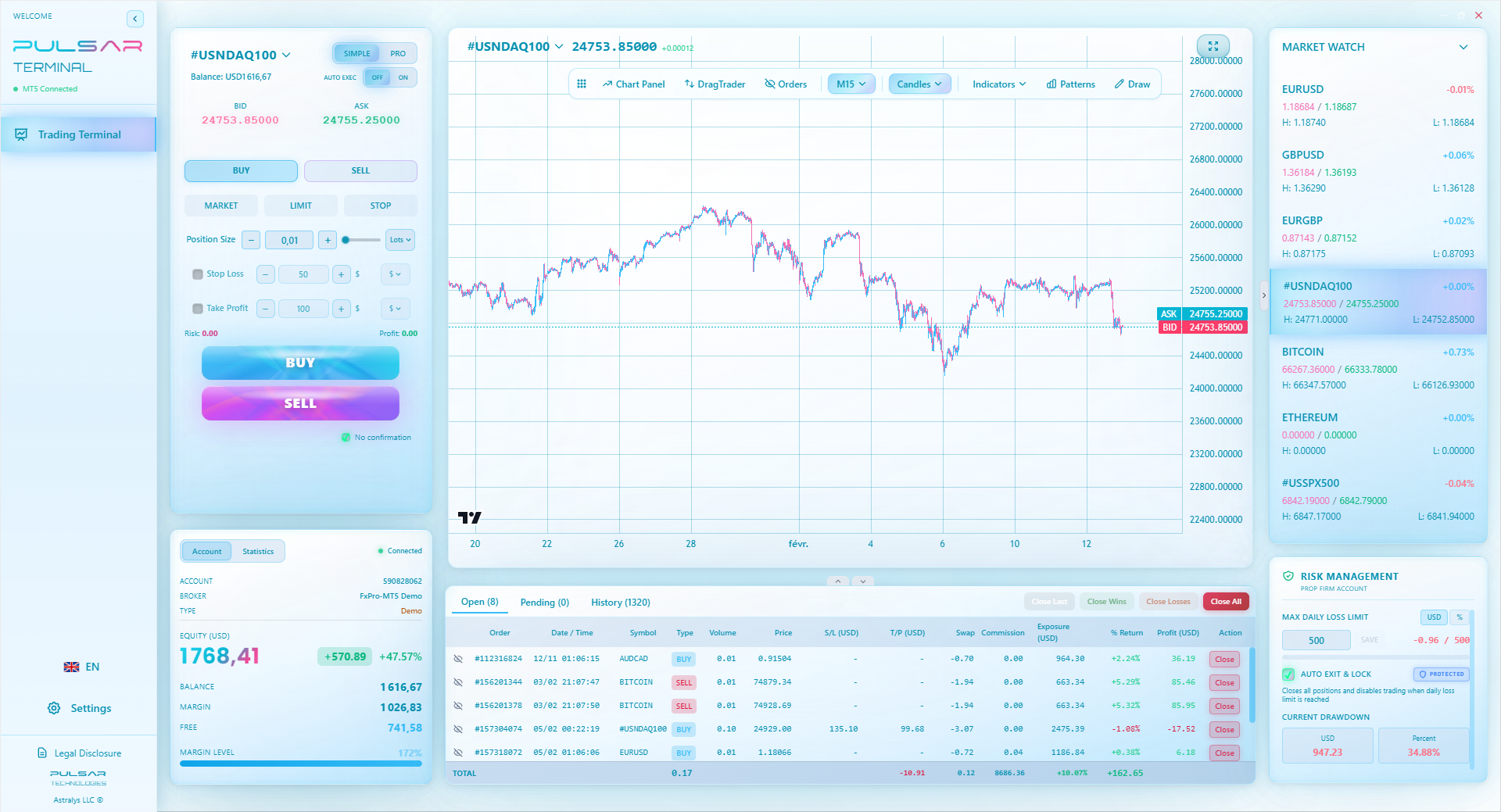
When you're ready to move from theory to disciplined practice, managing multiple trades and protecting your capital becomes critical, which is where tools like Pulsar Terminal automate these tasks directly on your MT5 platform.
Pulsar Terminal
Das All-in-One MT5-Tool: Drag-and-Drop-Orders, Multi-TP/SL, Trailing Stop, Grid Trading, Volume Profile und Prop-Firm-Schutz. Täglich von 1.000+ Tradern genutzt.
“Your goal isn't profit on demo. Your goal is to execute your plan perfectly 100 times in a row.”
If you decide to pay for training, do your homework like you're investing in a business. Because you are.
1. Verify Their Trading:
- Ask for a verified, live account statement for the past 24 months. Not a screenshot, a downloadable report from the broker or a link to Myfxbook/FX Blue.
- Look for consistency, not just high returns. A 5% average monthly return with small drawdowns is more impressive than 80% one month and -50% the next.
2. Interview Their Past Students:
- A legitimate trainer will have past students willing to talk to you.
- Ask the student specific questions: 'Did the training cover loss management?', 'How did the mentor handle it when you had a losing streak?', 'Would you pay for it again?'
3. Audit the Material:
- Ask for a detailed syllabus. What topics, in what order?
- Can you see a sample lesson? If it's just them talking at a camera for an hour with no clear structure, that's a bad sign.
4. Understand the Support Model:
- 'Lifetime access' to a portal is useless if the content never updates.
- How are questions answered? Email? Weekly group call? One-on-one sessions? Get this in writing.
I applied this checklist in 2022. Found a mentor based in Cape Town. He showed me his 3-year track record first thing (steady 3-8% per month). He let me talk to two former students. His syllabus was a 20-page PDF. I paid R8,000 for 3 months. Worth every cent because he fixed one major psychological leak in my trading: I was over-trading on low volatility days. He gave me a simple filter: don't trade if the ATR is below X. Problem solved.
Pro Tip: The best mentors often aren't the best marketers. They might have a small website and no Instagram. They're too busy trading and coaching. You have to dig to find them.
💡 Winstons Tipp
If a training doesn't make you slightly uncomfortable by forcing you to confront your own poor habits, it's not real training. It's entertainment.
“The market isn't going anywhere. Your job is to make sure your capital is too.”
Okay, let's get practical. If you're in Durban and want to start, here's a no-BS, step-by-step plan.
Month 1-2: The Learning Phase
- Open a demo account with a reputable, FSCA-regulated broker. Don't even think about real money.
- Spend 1 hour a day on pure education. Start with broker tutorials.
- Learn one chart pattern and one indicator. That's it. I suggest the pin bar and the 20-period moving average.
- Watch the market without trading. Just observe how price moves around news time (2 PM SAST for European data, 3:30 PM for US data sometimes).
Month 3-4: The Practice Phase
- Start paper trading with a tiny, simulated amount (like $1,000).
- Your only goal: follow your rules. Your rule could be: 'I will only buy if price pulls back to the 20 MA and forms a pin bar. My stop loss is below the pin bar's tail. I will risk 1% of my demo balance.'
- Keep a journal for EVERY trade. Screenshot, write down why you took it, your emotion.
Month 5-6: The Review & Decide Phase
- After 50-100 paper trades, look at your journal. Are you profitable? More importantly, are you consistent?
- If not, you have data. Are you losing because you break your rules? Or are the rules bad? This is the point where you might seek specific training to fix a known problem.
- If you are consistently profitable on demo for 3 months, then consider a small live account. I mean small. R2,000-R5,000. The psychology changes with real money.
The biggest mistake I see in Durban? People go from a weekend seminar to depositing R20,000 on Monday. They're usually broke by Friday. Slow down. This is a skill that takes time to build, like learning to be an electrician or a mechanic. The market isn't going anywhere. It'll be here next month, and next year. Your job is to make sure your capital is too.
FAQ
Q1Is forex trading legal in Durban/South Africa?
Yes, absolutely. It's regulated by the Financial Sector Conduct Authority (FSCA). The key is to use an FSCA-licensed broker to ensure your funds are segregated and you have legal recourse. Trading with unregulated offshore brokers is risky and not recommended.
Q2What is a reasonable amount to pay for forex training in Durban?
For a complete beginner-to-intermediate course, between R3,000 and R15,000 is a common range. Anything over R20,000 should come with extensive one-on-one coaching and verified proof of the mentor's success. Often, the best value is in specific, focused online courses from international traders (R2,000-R8,000) rather than generic local 'masterminds'.
Q3Can I learn forex trading for free?
You can learn the basics for free using broker education centers and reputable YouTube channels. However, becoming consistently profitable usually requires structured learning that free content often lacks. A paid course or mentorship can accelerate the process by providing a clear path, accountability, and feedback, potentially saving you much more in trading losses.
Q4What's the #1 red flag for a scam forex trainer?
Guaranteed profits or a specific win rate. The market is probabilistic, not certain. Any trainer who says 'you will make X% per month' is lying. The second biggest red flag is an inability or refusal to show a verified, long-term live trading track record.
Q5How long does it take to become a profitable trader?
Expect a minimum of 6-12 months of dedicated study and practice (with a demo account) before you should consider yourself competent. Many take 2-3 years. Anyone promising to make you profitable in a few weeks is selling a fantasy. It's a professional skill that requires time to develop.
Q6Should I join a local Durban trading 'signal group'?
I'm very skeptical. Most signal groups create dependency, not skill. You don't learn why a trade is taken. Also,, by the time you get the signal, the move may have already happened. Your goal should be to learn to fish, not to wait for someone to give you a fish every day.
Q7What's more important: the trading strategy or psychology?
Psychology, by a huge margin. You can have the best strategy in the world, but if you can't follow the rules due to fear, greed, or impatience, you'll lose. Good training spends significant time on mindset, discipline, and trade journaling. The strategy is just the vehicle; you are the driver.
Prof. Winstons Lektion
Wichtige Erkenntnisse:
- ✓Verify FSCA registration before paying any broker or trainer.
- ✓Demand a 24-month verified track record, not lifestyle photos.
- ✓Spend 6+ months in demo before risking real capital.
- ✓Risk management is 80% of the game; strategy is the rest.
Wie nützlich war dieser Artikel?
Klicken Sie auf einen Stern
Wöchentliche Trading-Einblicke
Kostenlose wöchentliche Analysen & Strategien. Kein Spam.
Über den Autor
David van der Merwe
Schwellenland-Trader
In Johannesburg ansässiger Trader mit 11 Jahren Erfahrung in Schwellenländerwährungen. Spezialisiert auf ZAR-Paare, FSCA-regulierten Handel und Analyse des südafrikanischen Marktes.
Kommentare
Risikohinweis
Der Handel mit Finanzinstrumenten birgt erhebliche Risiken und ist möglicherweise nicht für alle Anleger geeignet. Vergangene Ergebnisse garantieren keine zukünftigen Renditen. Dieser Inhalt dient ausschließlich Bildungszwecken und stellt keine Anlageberatung dar. Führen Sie immer Ihre eigene Recherche durch, bevor Sie handeln.
Das könnte Sie auch interessieren

Cara Trading Forex Sukses: 7 Prinsip dari Trader Profesional
Cara trading forex sukses dengan 7 prinsip trader pro: manajemen modal, disiplin, journal trading, backtest. Data nyata, bukan janji profit palsu.
Jam Trading Forex Terbaik untuk Trader Indonesia: Panduan Lengkap dengan Tabel Waktu
Panduan jam trading forex untuk trader Indonesia. Tabel 4 sesi dunia, jam emas 20:00-00:00, sesi mana yang harus dihindari. Data akurat + tips dari trader berpengalaman.
Top 5 Sàn Forex Uy Tín Nhất 2026: Review Jujur dari Trader Indonesia
Top 5 sàn forex uy tín 2026 untuk trader Indonesia. Review jujur: spread, deposit, withdraw, dukungan lokal. Exness, XM, IC Markets & lebih.
Pulsar Terminal herunterladen
Alle diese Rechner sind in Pulsar Terminal mit Echtzeit-Daten Ihres MT5-Kontos integriert.
Pulsar Terminal herunterladen