


Everyone's selling you the dream of a funded account, but they're not telling you the whole story.

James Mitchell
Senior Trading-Analyst
☕ 12 Min. Lesezeit
Was Sie lernen werden:
- 1The Regulatory Gray Zone (And Why It Matters)
- 2Breaking Down The Real Costs (It's Never Just The Fee)
- 3Profit Splits, Scaling, and The Payout Truth
- 4The Evaluation Rules That Will Break You (If You're Not Careful)
- 5Platforms, Data, and The Tech You'll Actually Use
- 6Side-by-Side: A Realistic Look at Top Contenders
- 7Who Should Avoid Prop Firms Altogether?
- 8Your Action Plan for 2026
Everyone's selling you the dream of a funded account, but they're not telling you the whole story. The truth is, most futures prop firm comparisons you read are glorified ads, missing the critical details that actually determine if you'll get paid. I've traded with over a dozen of these firms, and I've seen the good, the bad, and the downright shady. Let's cut through the marketing and compare what really matters: your bottom line and your sanity.
Here's the first thing you need to understand: most futures prop firms operate in a legal gray area. They're not your broker. They're not a hedge fund. They structure themselves as educational services or technology platforms that just happen to let you trade their money. This clever setup lets them sidestep direct oversight from the big regulators like the CFTC and NFA.
That means they aren't held to the same capital requirements or client fund protection rules as a registered Futures Commission Merchant (FCM). Your profits? They're often just a line item on the firm's balance sheet, not money sitting in a segregated account with your name on it. The CFTC is starting to ask tough questions about whether these firms should be classified as Commodity Trading Advisors (CTAs), which would force registration, audits, and real rules. But for now, it's the wild west.
What does this mean for you? Your primary protection is the firm's reputation and its desire to stay in business. If a firm blows up or decides not to pay, your recourse is limited. This makes your initial research - these very futures prop firm comparisons - your first and most important line of defense. Always prioritize firms with a long, verifiable track record of consistent payouts.

Warning: A firm not being registered isn't automatically a scam, but it does shift the risk onto you. Your trust is the collateral.

💡 Winstons Tipp
The evaluation isn't a test of your strategy's brilliance; it's a test of your ability to follow someone else's boring, rigid rules. Your genius is irrelevant if you can't comply.
You see a $99 evaluation. Seems simple, right? Wrong. That's just the entry ticket. The real cost of trading with a prop firm is a layered cake of fees that quietly eats your profits. If you don't account for all of them, your shiny 90% profit split turns into 60% real fast.
The Fee Stack
First, the evaluation fee: $100 to $500. Then, if you pass, many firms hit you with an "activation" or "monthly subscription" fee. Apex Trader Funding, for example, charges $85-$105 monthly. Others like TradeDay have scrapped it. You also pay per-trade commissions, usually $0.50 to $2.00 per contract, taken off the top before your split is calculated.
Then come the platform and data fees. If the firm uses Rithmic data, you might need a NinjaTrader license. Go with a Tradovate-backed firm, and you could save $60+ a month on data feeds. CME data is another $10-$15. Suddenly, that "low-cost" evaluation looks different.
A Real Example From My Trading
I took a $50,000 evaluation with a firm (not naming names) that advertised "90% splits." My monthly costs looked like this:
- Platform/Data Fee: $45
- Commissions (avg 10 trades/day): ~$120
- Total Monthly Overhead: $165
I made a $1,500 profit that month. The firm took their 10% ($150). My net before fees was $1,350. Minus the $165 overhead, my real take-home was $1,185. My effective profit share wasn't 90%. It was 79%. I wasn't mad - the math was clear - but most traders never run these numbers. You must use a position size calculator that includes commission costs.

Example: Profit = $2,000. 90% Split = $1,800. Minus Commissions ($200) and Fees ($80) = Real Profit $1,520 (76% effective split).
“The real cost of trading with a prop firm is a layered cake of fees that quietly eats your profits.”
This is where the marketing gets thick. "Up to 90% profit share!" "Scale to $4M!" Let's translate.
Most firms use one of two models: a flat split or a tiered split. Flat splits are straightforward - you get 80%, they get 20%, forever. Firms like Topstep use this. Tiered splits start lower (maybe 70/30) and increase as you hit profit milestones. The highest tier is what they advertise.
The real gem is the initial 100% payout. Some firms, including Topstep and Apex, let you keep 100% of your first chunk of profits (often $10k-$25k). After you bank that, you revert to a 90/10 split. This is a massive advantage if you're confident in your start.
Payout speed and reliability are the ultimate test. In 2026, with 80% splits becoming standard, how fast and easy you get your money is the real differentiator. Some firms promise 1-4 hour approvals. Others take a week. I once waited 11 business days for a payout from a well-known firm during a "system upgrade." Read the independent reviews on sites like Trustpilot, not the testimonials on the firm's site.
Scaling plans sound great, but read the fine print. Hitting a scaling target often requires a new, higher profit target without a drawdown breach. It's another mini-challenge. Don't count on that $4 million account; focus on consistently making money from the $100k one first. The psychology of managing a suddenly larger account is a different beast, as any experienced swing trading professional will tell you.
The challenge isn't about making money. It's about not breaking very specific, often rigid, rules. This is where 90% of traders fail. The industry-wide pass rate is 5-10% for a reason.
The two biggest killers are the daily loss limit and the overall drawdown rule. They are not the same thing, and misunderstanding this is a classic account blow-up.
Let's say you have a $50,000 account with a 5% max daily loss ($2,500) and a 10% max trailing drawdown. The daily loss is simple: lose $2,500 from your starting equity that day, you're out.
The trailing drawdown is trickier. It's usually calculated as a peak-to-trough decline from your highest equity point after the start. If you start at $50,000 and make $3,000, your highest equity is $53,000. Your drawdown limit might now be $53,000 - $5,000 (10%) = $48,000. Your floor has moved up. If you then lose money, your account is liquidated if your equity hits $48,000, even though you're still "up" from your starting point. This rule prevents you from giving back all your profits and then some, but it's brutally unforgiving during normal market pullbacks.
I learned this the hard way in 2021. I passed a challenge trading XAU/USD, got funded, and built a $7,000 profit. I got cocky. A volatile news event hit, my position swung against me, and I froze, hoping it would come back. It didn't. I didn't hit my daily loss, but I watched my equity dip below the trailing threshold. Account closed. All that work for nothing. I broke the cardinal rule: I didn't respect the rules more than I believed in my trade. A tool that could automate a breakeven stop or a trailing stop would have saved me. Managing this manually under pressure is a common failure point.
💡 Winstons Tipp
Calculate your 'effective' profit share by subtracting ALL fees (commissions, data, platform) from your gross profit. If it's below 70%, you're working too hard for the firm.
“The evaluation rules exist specifically to obliterate the 'get rich quick with huge use' mentality.”
Your trading platform is your office. You can't afford for it to be slow, unreliable, or unfamiliar. Most US-focused futures prop firms partner with a few key platforms: NinjaTrader, Tradovate, and Rithmic are the big ones. Your choice here affects your cost and your workflow.
NinjaTrader + Rithmic: This is the professional's combo. Rithmic data is excellent, with fast execution. But you often need to pay for a NinjaTrader license (if you don't own one) plus the Rithmic data feed. It adds up.
Tradovate: This is the all-in-one, cost-effective choice. The platform, data, and execution are bundled. For a trader starting out, a Tradovate-based firm like Apex can save you significant monthly fees. The platform is web-based and simpler than NinjaTrader.
Your decision should be based on your strategy. Are you a scalper needing millisecond-level data and DOM trading? Rithmic might be worth the cost. Are you a swing trader analyzing higher timeframes? Tradovate's simplicity and lower cost are probably better. Don't pick a firm and then adapt to their platform; pick the platform that suits you, then find a firm that offers it.
A 2026 trend is the integration of AI-powered performance tools within these platforms - think of them as digital mentors that flag emotional decisions or suggest optimal position size calculator settings based on volatility. The tech is moving from just providing access to actively helping you keep it.
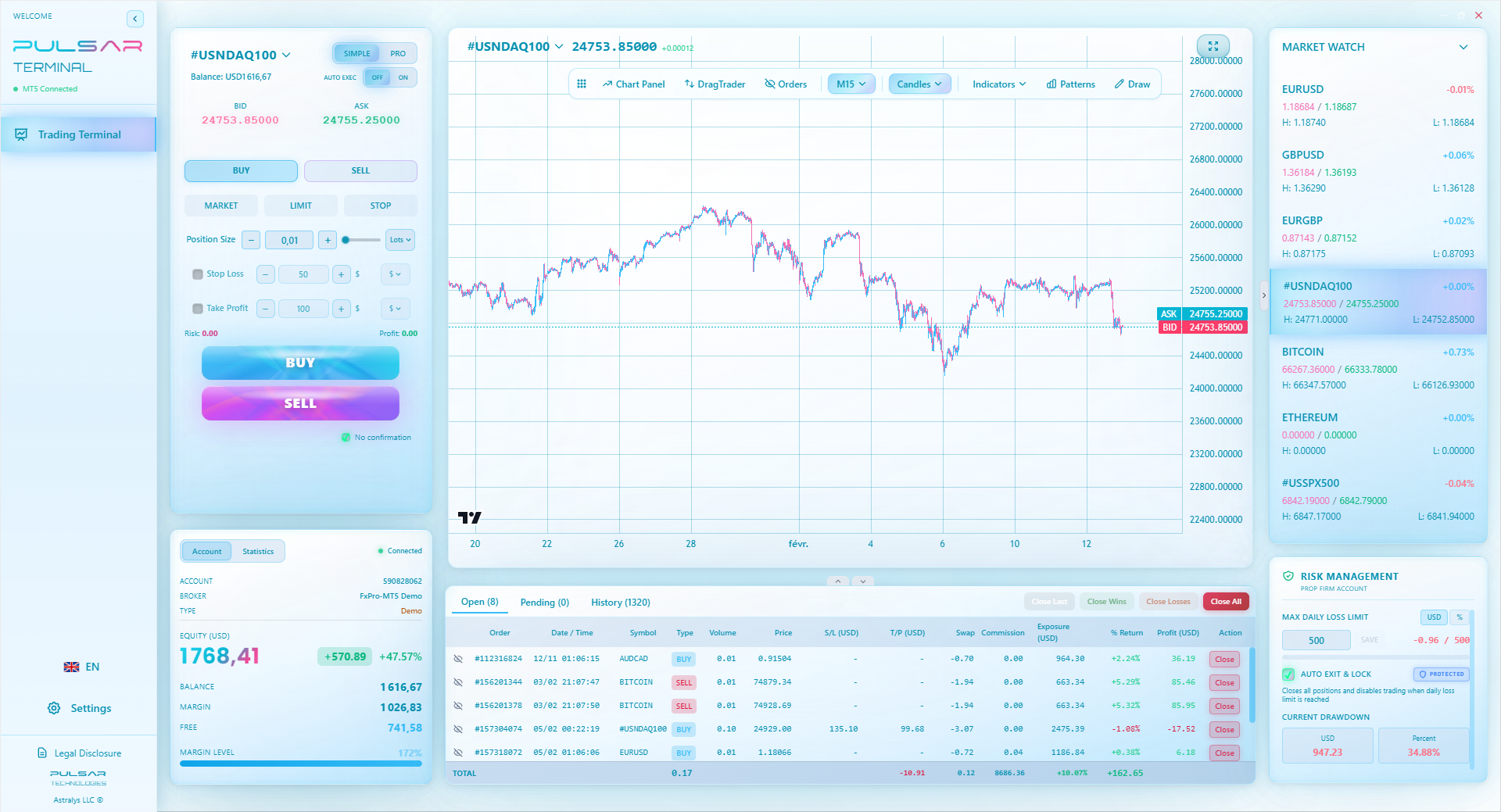
Managing prop firm drawdown rules manually is a common failure point; Pulsar Terminal automates trailing stops and breakeven orders directly on your MT5 chart, enforcing discipline so you can focus on the trade.
Pulsar Terminal
Das All-in-One MT5-Tool: Drag-and-Drop-Orders, Multi-TP/SL, Trailing Stop, Grid Trading, Volume Profile und Prop-Firm-Schutz. Täglich von 1.000+ Tradern genutzt.
Let's put some of the major players on the table. Remember, the "best" firm is the one whose rules best fit your trading style.
| Firm | Typical Evaluation Cost | Profit Split (Standard) | Key Rule / Feature | Best For... |
|---|---|---|---|---|
| Topstep | $165 - $495 | 80% (100% on first $10k) | NFA-registered affiliate. Strong reputation. | Traders who value regulatory peace of mind & a straightforward model. |
| Apex Trader Funding | $85 - $105/month (after pass) | Up to 90% (100% on first $25k) | Huge selection of account sizes. Low-cost evaluations. | Traders who want flexibility and low upfront cost. |
| Earn2Trade | $139 - $499 | 80% | Offers educational pathways (Gauntlet Mini). | Newer traders who want education bundled with the eval. |
| Take Profit Trader | $130 - $375 | 80% (100% on first $6k) | One-step evaluation. Relaxed trailing drawdown. | Traders who hate the standard two-phase challenge model. |
| My Funded Futures (MFFU) | ~$73 | 80% (100% on first $10k) | Very low evaluation fee. No activation fee. | Cost-conscious traders wanting to minimize trial expense. |
My Experience: I've traded live with Topstep and Apex. Topstep's process felt more professional, and their payout was seamless. Apex offered incredible flexibility in account size, which was great for testing strategies with smaller capital. The monthly fee was a drag during break-even months, though. I wouldn't recommend one over the other universally - it depends on your priority: stability or flexibility and cost.

Pro Tip: Before buying an evaluation, google "[Firm Name] payout delay" or "[Firm Name] withdrawal problem." The results are more telling than any sales page.

“If you can't pass your own simulated challenge applying the firm's exact rules, you won't pass the real one.”
Prop firms aren't for everyone. In fact, they're a terrible fit for most retail traders. If you fall into one of these categories, save your money.
1. The Undercapitalized Beginner: If you're using a prop firm because you can't afford to lose $500 in your own account, you're not ready. The pressure of the rules on top of learning to trade is a guaranteed blow-up. You'll learn more (and lose less) trading a micro account with a solid broker like Pepperstone or IC Markets on a demo first.
2. The Huge Lot Size Dreamer: You want a $100k account so you can trade 10 lots on the EUR/USD and get rich quick. The drawdown rules exist specifically to obliterate this mentality. Your position size on a funded account should be the same as if it were your own $10k account. The capital is for diversification, not use insanity.
3. The Inconsistent Trader: If your personal trading journal shows wild swings between big wins and bigger losses, a prop firm will bankrupt you with fees. You need a proven, repeatable edge with positive expectancy first. The evaluation is a test of discipline, not a lottery ticket.
I was category #1 early in my career. I blew two evaluations in a week because I was still figuring out basic concepts like spread and margin call dynamics. I wasted $300 that would have been better spent on books or a course. Build a track record of profitability with your own capital, then use a prop firm to amplify it.
💡 Winstons Tipp
Your first funded account withdrawal should be to reimburse your evaluation fees. Until then, you're an unprofitable client of the prop firm, not a trader.
Ready to give it a shot? Don't just jump in. Follow this plan.
Step 1: Strategy Audit. Backtest and forward-test your strategy for at least 3 months. Know your average win, average loss, win rate, and maximum consecutive losses. If your max drawdown in testing exceeds 8% of your account, your strategy is too risky for most prop firm rules. You might need to refine your scalping strategy or adjust your swing trade exits.
Step 2: The Paper Evaluation. Pick a firm whose rules you like. Take your tested strategy and trade it in a simulated environment, but apply the firm's exact rules (daily loss, trailing drawdown) to your simulation. Do this for the full evaluation period. If you can't pass your own simulated challenge, you won't pass the real one.
Step 3: Start Small. Buy the smallest, cheapest evaluation the firm offers. Your goal isn't to make money on the eval account; your goal is to pass. Trade tiny size - even 1 micro contract. Prove you can navigate the rules.
Step 4: Manage the Funded Account Like a Business. Once funded, your first withdrawal is your ROI on the evaluation fee. Take it. Then, set a consistent monthly withdrawal schedule. This psychologically reinforces that the money is real and prevents you from over-trading to "get it all back" after a loss.
The landscape is changing. Regulation is coming. The firms that survive will be the ones with transparent practices and reliable payouts. Your job is to be so disciplined and professional that you're an asset they want to keep, not a liability they have to manage. Do your futures prop firm comparisons with a skeptic's eye, plan for the real costs, and trade the rules, not just the market.
FAQ
Q1What is the most important thing to look for in futures prop firm comparisons?
Payout reliability and the specific drawdown rules. A great profit split is meaningless if you can't get your money or if the trailing drawdown rule is designed to be nearly impossible to manage. Always search for independent user experiences with withdrawals.
Q2Are futures prop firms legal in the United States?
They operate in a regulatory gray area. Most are not registered with the CFTC or NFA as traditional brokers. They structure themselves as educational or technology services. This isn't illegal, but it means you have less regulatory protection if something goes wrong compared to using a registered broker.
Q3What's the catch with the '100% first payout' offers?
The catch is usually a cap (e.g., first $10,000) and a reversion to a lower split afterwards (e.g., 90/10). It's a fantastic benefit for your initial profits, but you need to read the terms to know the exact cap and what the subsequent split will be.
Q4How much of my own money do I need to start with a prop firm?
You need enough for the evaluation fee ($75-$500), plus potentially a few months of platform/data fees if you don't pass on the first try. You should not use money you can't afford to lose entirely. Consider it the cost of a very intense training program.
Q5Can I trade any futures contract with a funded account?
Most firms allow trading all major CME products (ES, NQ, YM, CL, GC, etc.). However, some may restrict ultra-low liquidity products or have specific rules against holding positions through major news events. Always check the firm's allowed instruments list.
Q6What happens if I break a rule on a funded account?
Typically, the account is immediately liquidated and closed. You lose the funded account. Some firms offer a "reset" option where you can pay a fee (often 50-90% of the original evaluation cost) to restart from your last payout balance or a fresh start, but you must re-qualify under the current rules.
Q7Is it better to go with a firm offering NinjaTrader or Tradovate?
It depends on your needs and budget. NinjaTrader (often with Rithmic) is more powerful for advanced order types and DOM trading but costs more monthly. Tradovate is an all-in-one, cost-effective web platform ideal for most retail strategies. Choose the platform you're comfortable with first.
Prof. Winstons Lektion
Wichtige Erkenntnisse:
- ✓Effective profit share is often 15-20% lower than advertised.
- ✓Trailing drawdown, not daily loss, is the #1 account killer.
- ✓Payout speed is the ultimate firm differentiator in 2026.
- ✓A $100K prop account requires the same risk management as a $10K personal account.
Wie nützlich war dieser Artikel?
Klicken Sie auf einen Stern
Wöchentliche Trading-Einblicke
Kostenlose wöchentliche Analysen & Strategien. Kein Spam.
Über den Autor
James Mitchell
Senior Trading-Analyst
In New York ansässig mit über 9 Jahren Trading-Erfahrung. Fokus auf Haupt-USD-Paare, Prop-Firm-Challenges und die US-Regulierungslandschaft.
Kommentare
Risikohinweis
Der Handel mit Finanzinstrumenten birgt erhebliche Risiken und ist möglicherweise nicht für alle Anleger geeignet. Vergangene Ergebnisse garantieren keine zukünftigen Renditen. Dieser Inhalt dient ausschließlich Bildungszwecken und stellt keine Anlageberatung dar. Führen Sie immer Ihre eigene Recherche durch, bevor Sie handeln.
Das könnte Sie auch interessieren

Cara Trading Forex Sukses: 7 Prinsip dari Trader Profesional
Cara trading forex sukses dengan 7 prinsip trader pro: manajemen modal, disiplin, journal trading, backtest. Data nyata, bukan janji profit palsu.
Jam Trading Forex Terbaik untuk Trader Indonesia: Panduan Lengkap dengan Tabel Waktu
Panduan jam trading forex untuk trader Indonesia. Tabel 4 sesi dunia, jam emas 20:00-00:00, sesi mana yang harus dihindari. Data akurat + tips dari trader berpengalaman.
Top 5 Sàn Forex Uy Tín Nhất 2026: Review Jujur dari Trader Indonesia
Top 5 sàn forex uy tín 2026 untuk trader Indonesia. Review jujur: spread, deposit, withdraw, dukungan lokal. Exness, XM, IC Markets & lebih.
Pulsar Terminal herunterladen
Alle diese Rechner sind in Pulsar Terminal mit Echtzeit-Daten Ihres MT5-Kontos integriert.
Pulsar Terminal herunterladen