


Let's cut through the hype.

David van der Merwe
Schwellenland-Trader ·  South Africa
☕ 10 Min. Lesezeit
Was Sie lernen werden:
- 1What Is Global Forex Institute Sandton? Separating Fact from Fiction
- 2The Real Rules: South Africa's FSCA and How to Check a Broker
- 3The Real Price of Learning: Courses, Fees, and the Free Alternative
- 4Picking Your Platform: A Broker Comparison for South Africans
- 5Forget Get-Rich-Quick: How to Actually Build Trading Skill
- 6Red Flags and Scams: How Not to Get Fleeced
- 7Looking Ahead: The South African Trading Landscape in 2026
Let's cut through the hype. The promise of getting rich quick from a forex seminar in Sandton is, 99 times out of 100, a fast track to losing your shirt. I've seen the ads, heard the stories, and watched too many hopeful traders get burned. This isn't about bashing one outfit; it's about giving you the unvarnished truth about the 'education' game in South Africa's trading scene. I'll show you what to look for, what to run from, and how to build real skill without getting scammed.
The Global Forex Institute (GFI) is a name that pops up a lot in South African trading circles. Co-founded by Sandile Shezi and George Van der Riet, it markets itself as a gateway to forex education, offering free beginner classes in Sandton, Durban, Cape Town, and other major cities. On the surface, that sounds helpful. Who doesn't want free knowledge?
The problem isn't the concept of education. The problem is the environment it exists in. GFI itself has issued public warnings about fraudulent companies and Facebook pages impersonating them to scam people. That should tell you something about the space they operate in. More alarmingly, founder Sandile Shezi has been investigated by the Hawks for allegedly scamming investors who deposited money expecting high returns. Cases were opened at Sandton and Midrand police stations.
Here's the critical distinction you must understand: GFI is an educational institution, not a regulated Financial Services Provider (FSP). They are not regulated by the Financial Sector Conduct Authority (FSCA) to give financial advice or manage your money. They can teach you what a pip definition is, but they shouldn't be telling you where to put your cash.
I once attended a similar 'free seminar' early in my career (not GFI, but a clone). The first hour was basic chart stuff anyone could read online. The second hour was a hard sell for a 'masterclass' costing R15,000. The pressure was immense. They create a feeling that this is your one shot at a better life. It's a classic sales funnel, not a classroom.

💡 Winstons Tipp
If a trading educator's website has more photos of them on a yacht than of actual trade analysis or educational content, close the tab. Your attention is the first thing they're trying to use.
If you remember one thing from this guide, make it this: only trade with an FSCA-regulated broker. Full stop. The Financial Sector Conduct Authority is our watchdog. They're not perfect, but they're the only game in town that forces brokers to follow rules.
What FSCA Regulation Actually Means for You
When a broker like Exness or XM holds an FSCA license, they have to play by a strict set of rules. Your money must be held in segregated accounts. This means it's kept separate from the broker's own operating funds. If the broker goes bankrupt (it happens), your money should be protected and returned to you. They also have to maintain certain capital levels and treat clients fairly.
The landscape is tightening. The FSCA is moving brokers towards an Over-the-Counter Derivatives Provider (ODP) regime. This is a good thing - it means more oversight, better reporting, and a shift away from the wild west days.
How to Verify a Broker in 2 Minutes
Don't take a broker's word for it. Go to the FSCA's website. Use their search tool. Type in the broker's registered name or FSP number. If they don't show up, walk away. It's that simple. I check this every single time I consider a new platform, even for a demo account. A legit broker like IC Markets will proudly display their regulatory info.

Warning: The FSCA has issued over a hundred public warnings in recent years against 'signal' sellers, fake educators, and cloned websites. If an 'institute' or 'mentor' pressures you to deposit money directly with them instead of a regulated broker, that's a massive red flag. You should only ever deposit funds into an account in the broker's name, verified by the regulator.
“Your first goal isn't to make money; it's to survive.”
Let's talk numbers, because this is where the dream gets expensive. According to market data, beginner courses in SA can run from R500 to R2,500. Advanced 'mastermind' programs? I've seen them priced from R2,500 all the way up to R20,000 or more. One outfit in Pretoria charges R15,000 for one-on-one training.
Now, ask yourself: what are you actually buying? Often, it's repackaged information freely available on YouTube, Investopedia, and broker education hubs. I paid R8,000 for a course in 2015 that promised 'institutional strategies.' The main strategy was a basic moving average crossover. I could have learned it from a library book.
The Fees You Can't Avoid (And The Ones You Can)
Your real education costs come from trading, not seminars. Here’s what eats into your capital:
- Spreads: The difference between buy and sell price. On USD/ZAR, a good spread might be 40-80 pips because it's an exotic pair. On EUR/USD, a broker like Pepperstone might offer 0.0 pips on a raw account, but charge a commission.
- Commissions: Often $5-$10 per lot traded.
- Swap Fees: Interest for holding positions overnight. This can be positive or negative.

Example: Let's say you take a course for R10,000. That's your tuition. Now you trade. A single standard lot (100,000 units) trade on USD/ZAR with an 80 pip spread costs you R800 (assuming ZAR14/$1 and a pip is R10). Your course fee just covered the spread cost of about 12.5 trades. That's before you've even made a cent.
The best education is often free. Use a demo account relentlessly. Read the free guides from major brokers. Study price action on your own charts. I built my first profitable scalping strategy by testing hundreds of ideas on a demo, not by paying a guru.
Your broker is your toolbox. You don't want a cheap, rusty one. Here’s a breakdown of what to look for, based on real 2025-2026 data.
| Broker | FSCA Regulated? | Min. Deposit (Approx.) | Key Feature for ZAR Traders |
|---|---|---|---|
| Khwezi Trade | Yes (ODP License) | 500 ZAR | Local broker, ZAR accounts, good for USD/ZAR |
| Tickmill | Yes | $100 | Low effective spreads (0.71 pips on EUR/USD) |
| IG | Yes | £250 (ZAR equiv.) | Massive educational library, trusted brand |
| AvaTrade | Yes (FSP 45984) | $100 | Fixed spreads, good for beginners wary of variable costs |
| Exness | Yes | $10 (Standard) | Very low minimum deposit, flexible accounts |
Local vs. International: The ZAR Account Advantage
A huge tip for South Africans: look for brokers offering ZAR-denominated accounts. Khwezi Trade is a local example. Some international brokers offer this too. Why does it matter? It eliminates currency conversion fees on every deposit and withdrawal. If you fund a USD account with your rand, the bank or payment processor takes a cut (often 1-2%). That's dead money before you even place a trade.
The MT4/MT5 Question
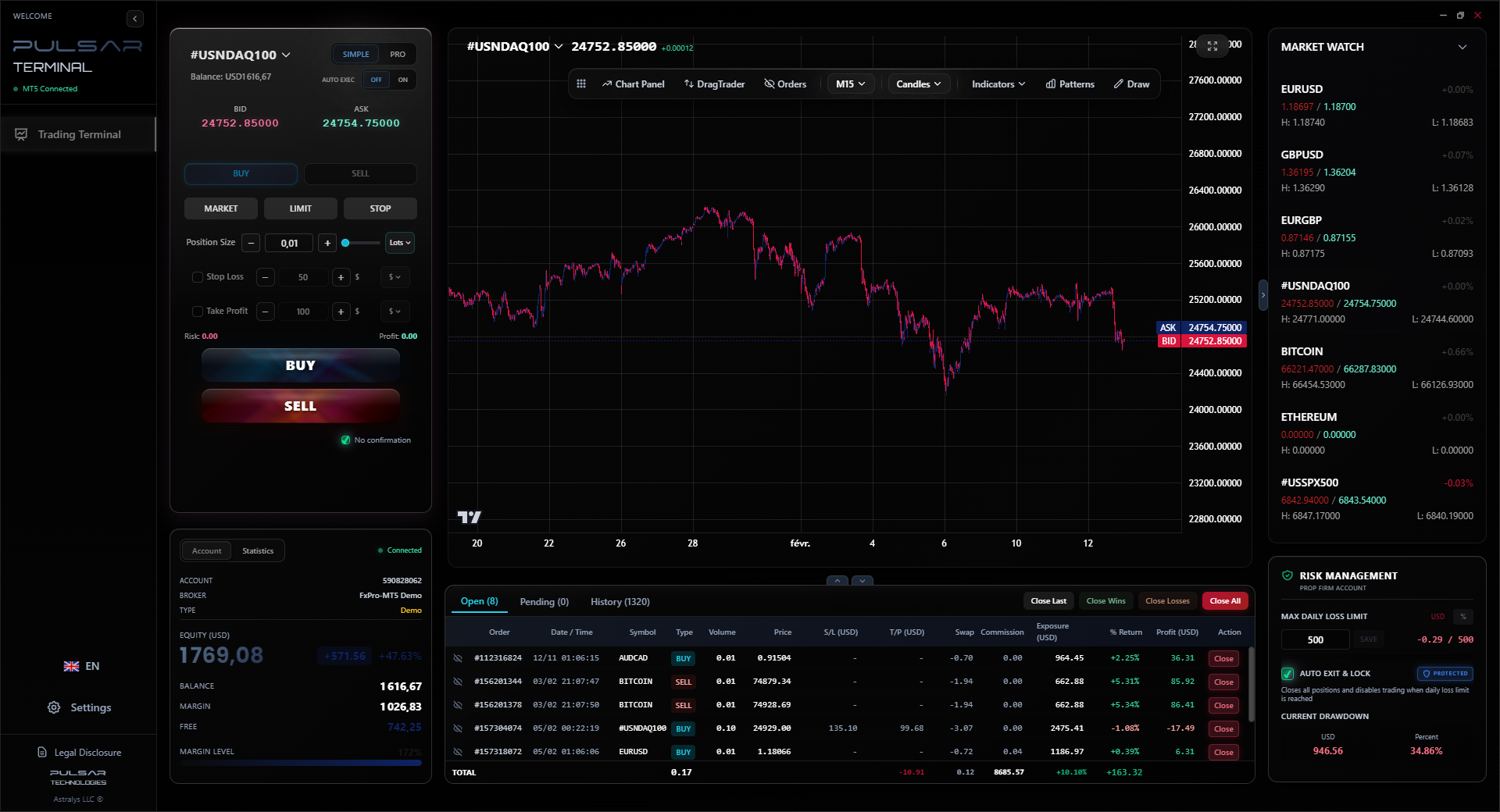
MetaTrader 4 and 5 are the standard platforms here. Most local brokers offer them. MT5 is becoming the norm as it handles more asset types. Don't let a fancy-sounding proprietary platform sway you unless it offers a clear, proven advantage. The community, scripts, and knowledge base around MT4/MT5 are unparalleled. For serious analysis, many traders use tools like Pulsar Terminal alongside MT5 for features like advanced Volume Profile and order management.
💡 Winstons Tipp
The spread isn't just a cost; it's a filter. If your strategy can't overcome the typical spread of your chosen pair, it's not a strategy, it's a donation. Always calculate your edge *after* costs.
“Real trading success is quiet and boring. It's about consistent growth, not flashy cars.”
Trading success is a marathon of discipline, not a sprint fueled by seminar hype. Here’s the real curriculum I wish I’d followed.
Start with the Boring Stuff: Risk Management
This is 80% of the game. Before you learn a single MACD indicator setting, learn how to use a position size calculator. Your first goal isn't to make money; it's to survive. Never risk more than 1-2% of your account on a single trade. I learned this the hard way in 2017. I got confident, risked 5% on a 'sure thing' EUR/USD short. It went against me. A 50-pip move wiped out 10% of my account. The emotional toll was worse than the financial one. I broke my own rule and paid for it.
Develop One Strategy, Not Twenty
New traders jump from strategy to strategy. They see a course on swing trading, then a video on scalping, then a webinar on arbitrage. They become masters of none. Pick one market (start with a major like EUR/USD), one timeframe (like the 4-hour chart), and one core strategy. Paper trade it for at least 100 trades. Record every result in a journal. Only then will you know if it works for you.
Embrace the Drawdown
You will have losing streaks. It's mathematical certainty. A good strategy with a 60% win rate can still have 5-6 losses in a row. If your psychology can't handle that, you'll quit at the worst possible time. My most profitable year followed my worst 3-month drawdown (-15%). I stuck to my plan because I knew the numbers, not because I felt good.

Pro Tip: The best practice is trading a live micro account with real money. Demo accounts lack emotional stakes. Start with a $100 account where 1 pip = $0.10. The psychological lessons you learn from watching that real money fluctuate are worth more than any R20,000 course.
Sticking to a disciplined risk management plan, like the 1-2% rule, is far easier when your trading tools help you execute it flawlessly and without emotional interference.
Pulsar Terminal
Das All-in-One MT5-Tool: Drag-and-Drop-Orders, Multi-TP/SL, Trailing Stop, Grid Trading, Volume Profile und Prop-Firm-Schutz. Täglich von 1.000+ Tradern genutzt.
The trading 'education' space is fertile ground for predators. Here’s what to watch for.
- Guaranteed Profits or High Returns: Anyone promising you monthly returns of 10%, 20%, or more is lying. Period. If they could do that consistently, they'd be managing billions for a hedge fund, not selling courses in Sandton.
- Pressure to Act NOW: 'This offer expires tonight!' 'Only 5 seats left!' This is pure sales manipulation. Real education doesn't have artificial scarcity.
- Vague 'Proprietary' Strategies: If they can't explain the core concept simply because it's a 'secret bank method,' it's nonsense. All price action is based on supply, demand, and psychology.
- Requests for Direct Money Transfers: This is the biggest one. You should only ever deposit funds to your named trading account with the regulated broker. If a 'mentor' asks you to send money to their personal account or a different company to 'manage' for you, it's a scam. This is exactly the type of allegation that has plagued some figures in this industry.
- Testimonials with Lamborghinis: Fake glamour. Real trading success is quiet and boring. It's about consistent growth, not flashy cars. I drive a paid-off Toyota. My trading account does the talking.
The FSCA is actively cracking down. They've issued warnings against cloned websites and fake signal sellers. Always cross-reference any company's contact details with the official FSCA register.
“The market itself is the best teacher, and it charges tuition in pips, not rands.”
The market is changing, and it's mostly changing for the better.
The FSCA's 2025-2028 plan focuses on finalizing the Conduct of Financial Institutions (COFI) Bill. This means more strong, principles-based regulation. For you, this translates to safer brokers and more accountability. The shift to the ODP regime is pushing out the cowboys.
Market-wise, keep an eye on commodities. Gold was South Africa's second-largest export in 2024 (ZAR 150 Billion). Commodity prices are a leading indicator for the rand. If you're trading USD/ZAR, you'd better be watching gold and platinum charts. I often use the XAU/USD guide to inform my ZAR outlook. In 2026, with global growth slowing and interest rates potentially declining, these correlations will be key.
Electronic trading is now the norm. Algorithmic systems and ECNs mean tighter spreads and faster execution, even on the rand. This is good for retail traders. The days of massive dealer markups are fading.
Finally, remember your tax obligations. Profits from trading are considered income by SARS. Keep careful records. The Single Discretionary Allowance (R1 million per year) and Foreign Investment Allowance (R10 million with a SARS pin) are your legal channels for moving money offshore to international brokers if you choose.
💡 Winstons Tipp
Your trading journal is your most valuable tool. Not your indicator setup. Log your rationale, your emotion, and the outcome. After 50 trades, patterns in your own behavior will become clearer than any chart pattern.
FAQ
Q1Is Global Forex Institute Sandton regulated by the FSCA?
No. The Global Forex Institute is an educational entity, not a licensed Financial Services Provider (FSP). It is not regulated by the FSCA to provide financial advice or investment services. You should only take financial product advice from FSCA-licensed individuals or firms.
Q2What is the minimum deposit to start forex trading in South Africa?
It varies by broker. You can start with as little as R500 with some local FSCA-regulated brokers like Khwezi Trade. International brokers like Exness have minimums as low as $10 (roughly R180). However, I recommend starting with at least R5,000 - R10,000 in risk capital. This allows for proper position size management without risking too high a percentage on each trade.
Q3What are the typical spreads for trading USD/ZAR?
USD/ZAR is an exotic pair, so spreads are wider than majors like EUR/USD. Expect spreads in the range of 40 to 80 pips during active hours. This means the trade starts 40-80 pips in the red, so your strategy needs to account for that larger cost. Always check the live spread on your broker's platform before entering a trade.
Q4Can I legally use international brokers like IC Markets or Pepperstone in South Africa?
Yes, absolutely. Many South Africans use top international brokers. The key is to ensure that the broker is regulated by a reputable authority like the FSCA, ASIC (Australia), or FCA (UK). Many, like IC Markets, hold an FSCA license specifically for their South African clients, which gives you local legal recourse.
Q5What's the biggest mistake new South African traders make?
Two things tie for first: 1) Over-leveraging. Using 1:500 use because it's available is a recipe for a margin call. Start with 1:10 or 1:20 max. 2) Chasing 'education' from expensive gurus instead of learning through disciplined demo and micro-account trading. The market itself is the best teacher.
Q6Are there free alternatives to paid forex courses?
Yes, tons. Every major regulated broker (IG, AvaTrade, etc.) has extensive free education sections on their websites. YouTube has credible educators (look for those who focus on risk management, not flashy cars). Websites like Investopedia explain every concept. Combine these with a demo account, and you have a complete, free trading education.
Prof. Winstons Lektion
Wichtige Erkenntnisse:
- ✓Verify FSCA regulation for any broker, always.
- ✓Risk a maximum of 1-2% of your capital per trade.
- ✓Paid courses often sell hope, not edge.
- ✓Master one strategy on one pair before expanding.
- ✓USD/ZAR spreads of 40-80 pips require a larger profit target.
Wie nützlich war dieser Artikel?
Klicken Sie auf einen Stern
Wöchentliche Trading-Einblicke
Kostenlose wöchentliche Analysen & Strategien. Kein Spam.
Über den Autor
David van der Merwe
Schwellenland-Trader
In Johannesburg ansässiger Trader mit 11 Jahren Erfahrung in Schwellenländerwährungen. Spezialisiert auf ZAR-Paare, FSCA-regulierten Handel und Analyse des südafrikanischen Marktes.
Kommentare
Risikohinweis
Der Handel mit Finanzinstrumenten birgt erhebliche Risiken und ist möglicherweise nicht für alle Anleger geeignet. Vergangene Ergebnisse garantieren keine zukünftigen Renditen. Dieser Inhalt dient ausschließlich Bildungszwecken und stellt keine Anlageberatung dar. Führen Sie immer Ihre eigene Recherche durch, bevor Sie handeln.
Das könnte Sie auch interessieren

Cara Trading Forex Sukses: 7 Prinsip dari Trader Profesional
Cara trading forex sukses dengan 7 prinsip trader pro: manajemen modal, disiplin, journal trading, backtest. Data nyata, bukan janji profit palsu.
Jam Trading Forex Terbaik untuk Trader Indonesia: Panduan Lengkap dengan Tabel Waktu
Panduan jam trading forex untuk trader Indonesia. Tabel 4 sesi dunia, jam emas 20:00-00:00, sesi mana yang harus dihindari. Data akurat + tips dari trader berpengalaman.
Top 5 Sàn Forex Uy Tín Nhất 2026: Review Jujur dari Trader Indonesia
Top 5 sàn forex uy tín 2026 untuk trader Indonesia. Review jujur: spread, deposit, withdraw, dukungan lokal. Exness, XM, IC Markets & lebih.
Pulsar Terminal herunterladen
Alle diese Rechner sind in Pulsar Terminal mit Echtzeit-Daten Ihres MT5-Kontos integriert.
Pulsar Terminal herunterladen