


I was staring at my screen in late 2023, watching USD/NGN hit 1,382.95.

Olumide Adeyemi
Pionier des Tradings in Westafrika ·  Nigeria
☕ 12 Min. Lesezeit
Was Sie lernen werden:
I was staring at my screen in late 2023, watching USD/NGN hit 1,382.95. My position was deep in the red, and I remember thinking, 'What would Uche Paragon do right now?' That's when I realized I was asking the wrong question. We obsess over the net worth figures of Nigeria's greatest forex traders - $16 million, $5 million, $1.3 million - but we rarely ask about the specific trades that got them there, or more importantly, the ones that nearly broke them. After 12 years trading from Lagos to London, I've learned their real edge isn't in secret indicators or insider information. It's in how they manage the Naira's wild swings, navigate our unique funding restrictions, and turn local market knowledge into consistent profit. Let me show you what actually matters.
Every article about the greatest forex traders in Nigeria starts with a list of names and estimated net worths. Uche Paragon: $16-20 million. Dapo Willis: $800k to $10 million. Sandile Shezi: $1.3 million by age 23. These numbers are compelling, I get it. But they're also mostly useless to you as a developing trader.
Here's what nobody tells you: these figures are almost always estimates, often inflated for branding, and they combine trading profits with income from courses, mentorship programs, YouTube channels, and other businesses. I'm not saying these traders aren't successful - many are genuinely skilled. I'm saying focusing on the dollar amount misses the point entirely.
What made them among the greatest forex traders wasn't a single lucky trade. It was a system. A repeatable process they could apply through bull markets, bear markets, and the CBN's frequent policy changes. Damilare Ogundare (HabbyFX) didn't build a $5 million net worth by chasing pips. He did it by mastering a specific style - often swing trading - and sticking to it even when it was boring. Patrick Ogagbor turned $200 into wealth by 2007 not through magic, but through brutal risk management that most of us ignore.

Warning: Don't confuse publicity with profitability. Some of the most consistently profitable traders I know in Nigeria operate in complete silence. They don't have Instagram pages flaunting cars. They have spreadsheets tracking their win rate over 500+ trades.
The real lesson isn't in their bank balance. It's in their journals, their rules, and how they adapted global strategies to our local reality. That's what we'll unpack.

💡 Winstons Tipp
Forget net worth. Track consistency. A trader who makes 5% per month for 24 months is far greater than one who makes 120% in one month and blows up the next.
“Their real edge isn't in secret indicators; it's in how they manage the Naira's wild swings.”
Understanding Naira Volatility
International traders look at USD/NGN and see just another exotic pair. We live it. When the CBN unified the forex market in 2023, moving to a 'willing buyer, willing seller' model, it didn't just create a chart pattern. It changed the cost of imports, altered corporate hedging behavior, and shifted liquidity. The greatest forex traders from Nigeria have a visceral understanding of this. They don't just trade the chart; they trade the local economic narrative.
I learned this the hard way in 2021. I was short USD/NGN based purely on technicals, ignoring the clear signals of dollar scarcity and the growing gap between the official and black market rates. That trade cost me over ₦800,000. A mentor who'd been through the 2016 crisis said to me, 'Your chart doesn't know there's a fuel subsidy debate in the Senate.' He was right.
Funding and Withdrawal Savvy
This is a massive, practical edge. While traders in the UK or US worry about spreads, we have to solve the fundamental problem of getting money in and out. The CBN's restrictions on using Naira cards for international broker deposits mean we've become experts in alternative rails.
The pros I know have optimized this process. They use:
- Local bank transfers to broker-affiliated payment processors (like the ones offered by HF Markets or FXTM for NGN accounts).
- E-wallets like Skrill or Neteller, often funding them via Paga or Opay first.
- Cryptocurrency as a bridge asset, especially for faster withdrawals, though they account for the extra volatility.
They've turned a regulatory hurdle into a calculated cost of doing business. They know exactly how much a deposit will cost in fees and how long it will take, and they factor that into their position sizing. They're not surprised by it.

Pro Tip: Always check your broker's local funding options first. Some, like XM or Exness, have integrated local partners that slash transfer times and costs. This isn't just administrative; saving 2% on every deposit and withdrawal directly boosts your bottom line. Use our position size calculator to factor these costs in from the start.
“Focusing on a trader's net worth misses the point entirely. What made them great was a system.”
After meeting and studying several of these successful traders, patterns emerge. They don't have different charts than you. They have different habits.
1. Risk Management as a Religion, Not a Suggestion Chinedu Onuoha is famous for this. I once saw him pass on a seemingly perfect EUR/USD setup because it would have required a stop-loss larger than 2% of his account. He said, 'The market will give me another. My capital won't.' He treats his maximum daily loss limit like a law. This is the single biggest differentiator. They use tools to enforce this discipline. Setting a hard stop-loss isn't a maybe; it's the first step after entering a trade.
2. Specialization Over Diversification Jeffrey Benson built his wealth primarily on synthetic indices. Blessing Ezeako found her groove in gold (XAU/USD). They didn't jump from forex to crypto to stocks daily. They mastered one or two instruments. They learned every quirk of that market - like how gold often reacts to real yields, not just the dollar. You can learn this too in our XAU/USD guide.
3. They Trade Less, Not More This contradicts the 'hustle' narrative. The most profitable traders I know might only take 2-3 high-conviction trades a week. They spend most of their time analyzing, waiting, and managing existing positions. The frantic, screen-glued scalper burning out in six months is a cliché for a reason.
4. Continuous, Structured Education Notice how almost every name on the list runs an academy or mentorship? While it's a revenue stream, it also forces them to structure their knowledge. Teaching a concept like the MACD indicator or a scalping strategy reveals gaps in your own understanding. They don't stop learning.
“Focusing on a trader's net worth misses the point entirely. What made them great was a system.”
The greatest forex traders in Nigeria are ruthlessly pragmatic about their brokers. It's not about flashy ads; it's about execution, cost, and reliability for Nigerian clients specifically.
They prioritize:
- Regulation & Safety of Funds: Even if the broker is offshore, they look for strong international regulation (FCA, ASIC, CySEC). Your money is only as safe as your broker's balance sheet.
- Naira-Friendly Operations: Can you deposit/withdraw in Naira without crazy fees? Does customer support understand our time zone and our common issues? Brokers like XM and Exness have invested heavily here.
- Real Trading Costs: They look beyond the advertised 'tight spreads.' They calculate the all-in cost: spread + commission + any overnight financing (swap). For a high-volume trader, a 0.1 pip difference on EUR/USD adds up to millions of Naira over time.
Here’s a blunt comparison based on my experience and the data from top performers:
| Broker | Why Nigerian Pros Use It | The Catch (What They Watch For) |
|---|---|---|
| IC Markets | Raw spreads, low commissions, great for ECN-style trading. | Withdrawals to Nigeria can take a few business days. Review them in detail here. |
| Pepperstone | Excellent execution speed, trusted globally. | Minimum deposit might be higher for premium accounts. |
| Exness | Instant withdrawals are a game-changer for active traders. | The unlimited use is a double-edged sword; it requires extreme discipline. |
| XM | Very low minimum deposit ($5), great for starting small. | Spreads on standard accounts can be wider than ECN competitors. |
My mistake early on? I chased the highest use (1:2000!). I blew up two small accounts before I realized that use is a tool, not a score. Now, I rarely go above 1:30, even on a volatile pair like GBP/JPY. The pros use high use sparingly, for very specific, small-sized trades.
💡 Winstons Tipp
Your first goal isn't profit. It's surviving 100 trades with your rules intact. That builds the discipline the 'greats' have.
“The frantic, screen-glued scalper burning out in six months is a cliché for a reason.”
Let's get concrete. Here's a real, recent trade I took that embodies the principles I've learned from studying local masters. It's not a 1000-pip home run. It's a disciplined, managed play.
Instrument: EUR/USD (You can learn its specific dynamics in our EUR/USD guide). Date: March 2026 Thesis: ECB rhetoric was turning dovish while US inflation remained sticky. Price was consolidating after a downtrend, showing potential exhaustion. My Setup: I waited for a pullback to a key Fibonacci level (61.8% retracement of the last swing down) where it also met a previous support-turned-resistance zone. The RSI indicator showed bullish divergence on the 4-hour chart.
The Trade:
- Entry: Sell limit order at 1.08250.
- Initial Stop-Loss: 1.08750 (50 pips risk).
- Account Risk: 1.5% of my portfolio.
- Position Size: Calculated using my position size calculator. With a 50-pip stop and a 1.5% risk on a $10,000 account, my position size was 0.30 lots.
Management: This is where the 'greats' separate themselves. I didn't just set and forget.
- Target 1: 1.07750 (50 pips profit). Closed 50% of position. Banked profit and moved stop-loss on remainder to breakeven (1.08250).
- Target 2: 1.07200 (105 pips profit). Closed remaining position.
Outcome: Net profit of ~77.5 pips after accounting for the 2-pip spread. In monetary terms, about $232 on the risk of $150. A 1.54:1 reward-to-risk ratio.
Why does this matter? It was planned, patient, and managed. I used a clear technical premise, defined my risk before entry (crucial to avoid a margin call), and took partial profits. This is the boring, systematic work that builds real wealth, not lottery tickets.
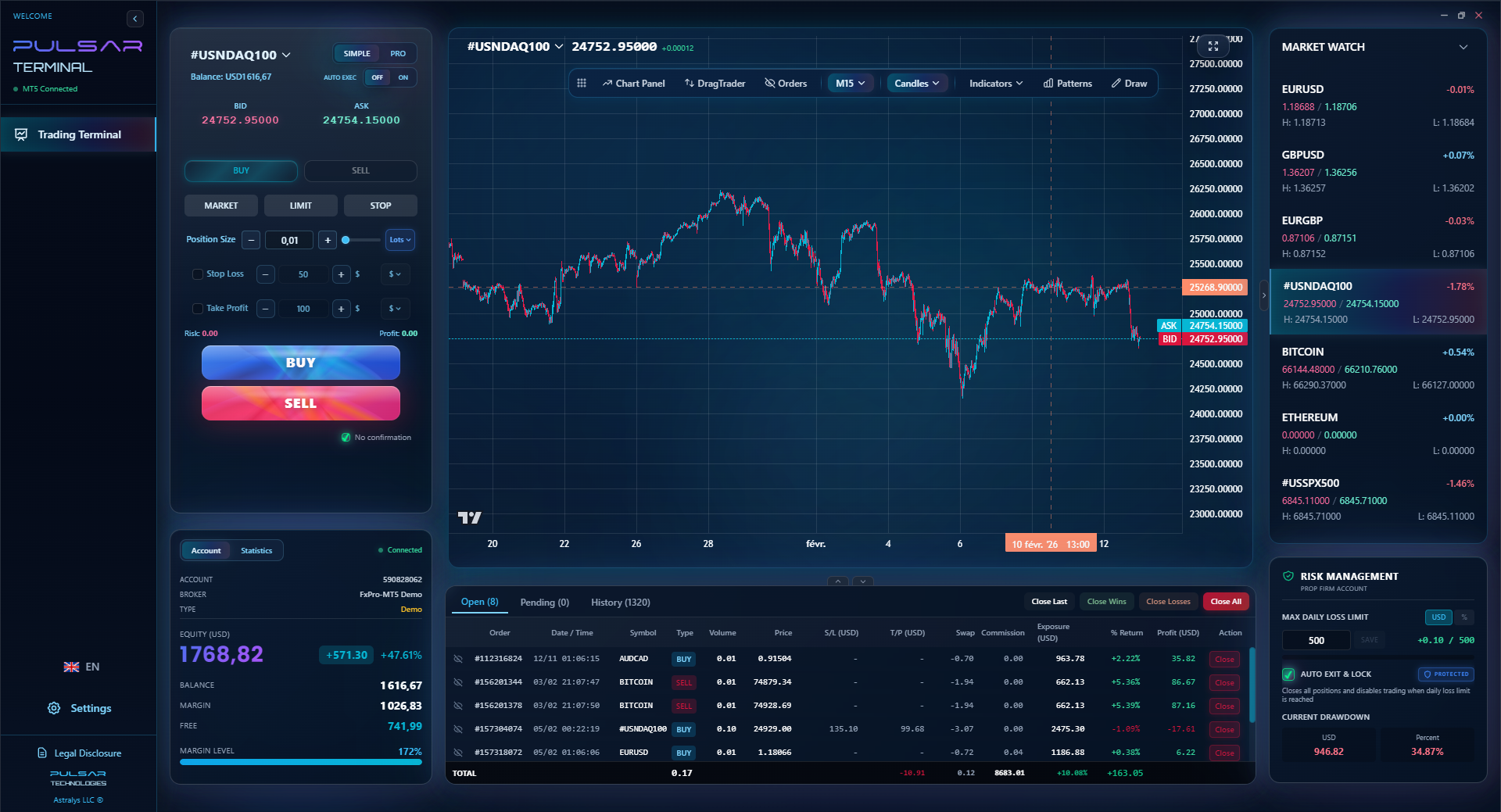
Managing a multi-target trade like the one described requires precision; Pulsar Terminal lets you drag-and-drop all your take-profit and stop-loss levels directly onto your MT5 chart before you even enter the trade.
Pulsar Terminal
Das All-in-One MT5-Tool: Drag-and-Drop-Orders, Multi-TP/SL, Trailing Stop, Grid Trading, Volume Profile und Prop-Firm-Schutz. Täglich von 1.000+ Tradern genutzt.
“The frantic, screen-glued scalper burning out in six months is a cliché for a reason.”
The online persona of success is clean. The reality is messy. Here are the truths you often have to dig for.
The Drawdowns Are Brutal. Even the best have months where nothing works. I've spoken to traders with seven-figure accounts who have endured 20-30% drawdowns. They don't post about that on social media. Their skill isn't in avoiding losses; it's in surviving them psychologically and systematically.
It's Incredibly Lonely. The romantic image is a trader in a sleek office. The reality is you versus your screen, for hours, with no team to blame or celebrate with. The mental stamina required is immense. Many successful traders combat this with small, trusted mastermind groups - not for trade ideas, but for accountability.
'Passive Income' is a Myth. Trading is active. Even swing trading, which holds trades for days, requires constant monitoring of news and market context. The income is only as passive as your last trade, and it can stop at any time.
Their First Accounts Blew Up Too. Almost without exception. Uche Paragon started in 2007. Do you think the markets were easier then? The Naira was volatile, information was scarce, and platforms were clunky. Their advantage was persistence, not a perfect start.
My own 'blow-up' lesson came from overtrading. I had a good week, made 8% on my account, and then proceeded to trade 12 times the next day trying to chase that feeling. I gave back all the profits and 5% more. I violated every rule. The lesson was seared in: discipline is a daily practice, not a one-time achievement.
“Your chart doesn't know there's a fuel subsidy debate in the Senate.”
So, how do you start applying this? Don't try to be Uche Paragon. Be a better version of you, informed by their principles.
1. Find Your Instrument. Start with one major pair. EUR/USD or GBP/USD are great. Learn everything about it - its average daily range, what moves it (interest rate differentials, economic data), when its most active session is. Trade only that for at least three months.
2. Define Your Rules, Write Them Down. Your trading plan must be in writing. It should answer:
- What are my entry conditions? (e.g., Price at support + RSI oversold + bullish candlestick pattern)
- Where is my stop-loss? (Always based on a technical level, not a random dollar amount)
- Where is my take-profit? (Use a risk-reward ratio of at least 1:1 from day one)
- What is my maximum daily loss limit? (Mine is 3%. If I hit it, I shut down the platform.)
3. Journal Relentlessly. For every trade, screenshot your chart at entry. Record your reasoning, your emotional state, and the outcome. Review weekly. This is how you find your personal edge - by seeing what setups you execute well.
4. Start Small, But Start Real. Use a broker with a low minimum deposit like XM or FBS. But trade real money, even if it's just $50. The psychological pressure of real loss and gain is the only true teacher. A demo account teaches you buttons, not fear.
5. Seek Understanding, Not Signals. When you see a successful trader's call, don't just copy it. Ask: Why did they enter there? Where is their stop? How does this fit into their broader view? This turns you from a follower into a thinker.
The path of the greatest forex traders in Nigeria isn't a secret club. It's a well-trodden road of discipline, continuous learning, and adapting global markets to our local context. You can walk it too. Just put one foot in front of the other, and keep your risk managed.
💡 Winstons Tipp
The Naira's volatility isn't just a pair to trade. It's a real-time lesson in macroeconomic forces. Watch it even if you don't trade it.
FAQ
Q1Who is the richest forex trader in Nigeria?
Based on widely reported estimates, Uche Paragon (Uche Chukwu) is often cited as one of the wealthiest, with a net worth estimated between $16 and $20 million. However, 'richest' is fluid and these figures often combine trading profits with income from education businesses, courses, and other ventures. Focus less on the title and more on the consistent processes these traders use.
Q2Is forex trading legal in Nigeria?
Yes, retail forex trading is legal for individuals in Nigeria. The Central Bank of Nigeria (CBN) and the Securities and Exchange Commission (SEC) oversee financial markets. However, there's a key restriction: you cannot use the official CBN foreign exchange window to fund trading accounts. This is why traders use internationally regulated brokers that offer alternative deposit methods like local bank transfers, e-wallets, or cryptocurrency.
Q3What is the best broker for forex trading in Nigeria?
There's no single 'best' broker, as it depends on your needs. For tight spreads and low commissions, consider IC Markets or Pepperstone. For ease of deposits/withdrawals and Naira support, XM and Exness are very popular. For strong regulation and a trusted platform, look at XTB or AvaTrade. Always prioritize regulation, realistic trading costs (spread + commission), and reliable local payment options.
Q4How much do I need to start forex trading in Nigeria?
You can start with a very small amount. Brokers like XM have a $5 minimum deposit, and FBS offers a $1 minimum. However, a more practical starting point for serious learning is between $50 and $200. This allows you to trade micro or nano lots, experience real risk, and learn position sizing without catastrophic loss. Remember, the goal of your first account is education, not getting rich.
Q5How do I fund my forex account from Nigeria?
Due to CBN restrictions on Naira cards for international transactions, the most common methods are: 1) Local bank transfer to a broker's designated Nigerian payment partner, 2) E-wallets like Skrill, Neteller, or Perfect Money (funded via Paga, Opay, etc.), and 3) Cryptocurrency (like USDT). Many brokers have integrated local payment solutions - check their 'Deposit' page for Nigeria-specific options.
Q6What percentage of forex traders succeed in Nigeria?
The global statistic is stark: between 51% and 89% of retail traders lose money. There's no reason to believe Nigeria's success rate is higher, and it may be lower due to added challenges like currency volatility and funding complexities. Success requires treating trading as a skilled profession, not a gamble. This means education, a solid plan, strict risk management, and psychological resilience.
Q7Do I pay tax on forex trading profits in Nigeria?
Yes. Forex trading profits are generally subject to Capital Gains Tax in Nigeria. The standard rate is 10% of your gross profits. You are responsible for declaring this income and paying the tax, regardless of whether your broker is local or international. It's advisable to consult with a local tax professional to ensure compliance.
Prof. Winstons Lektion
Wichtige Erkenntnisse:
- ✓Specialize in 1-2 instruments you truly understand.
- ✓Never risk more than 2% of your capital on a single trade.
- ✓Journal every trade: entry reason, emotion, outcome.
- ✓Factor Nigerian funding costs into your position sizing.
Wie nützlich war dieser Artikel?
Klicken Sie auf einen Stern
Wöchentliche Trading-Einblicke
Kostenlose wöchentliche Analysen & Strategien. Kein Spam.
Über den Autor
Olumide Adeyemi
Pionier des Tradings in Westafrika
Einer der aktivsten Forex-Trading-Ausbilder Nigerias. 8 Jahre Trading-Erfahrung aus Lagos. Spezialisiert auf Strategien mit geringem Kapital und Prop-Firm-Challenges für afrikanische Trader.
Kommentare
Risikohinweis
Der Handel mit Finanzinstrumenten birgt erhebliche Risiken und ist möglicherweise nicht für alle Anleger geeignet. Vergangene Ergebnisse garantieren keine zukünftigen Renditen. Dieser Inhalt dient ausschließlich Bildungszwecken und stellt keine Anlageberatung dar. Führen Sie immer Ihre eigene Recherche durch, bevor Sie handeln.
Das könnte Sie auch interessieren

Cara Trading Forex Sukses: 7 Prinsip dari Trader Profesional
Cara trading forex sukses dengan 7 prinsip trader pro: manajemen modal, disiplin, journal trading, backtest. Data nyata, bukan janji profit palsu.
Jam Trading Forex Terbaik untuk Trader Indonesia: Panduan Lengkap dengan Tabel Waktu
Panduan jam trading forex untuk trader Indonesia. Tabel 4 sesi dunia, jam emas 20:00-00:00, sesi mana yang harus dihindari. Data akurat + tips dari trader berpengalaman.
Top 5 Sàn Forex Uy Tín Nhất 2026: Review Jujur dari Trader Indonesia
Top 5 sàn forex uy tín 2026 untuk trader Indonesia. Review jujur: spread, deposit, withdraw, dukungan lokal. Exness, XM, IC Markets & lebih.
Pulsar Terminal herunterladen
Alle diese Rechner sind in Pulsar Terminal mit Echtzeit-Daten Ihres MT5-Kontos integriert.
Pulsar Terminal herunterladen