


Here's a fact that should make you pause: roughly 70-80% of retail forex traders lose money.

David van der Merwe
Schwellenland-Trader ·  South Africa
☕ 8 Min. Lesezeit
Was Sie lernen werden:
- 1The First Step Isn't a Broker (It's This)
- 2Choosing a South African Forex Broker: The Real Deal
- 3Your First Trading Account: How Small is Small Enough?
- 4A Simple Strategy to Actually Start With
- 5The South African Market Reality: ZAR Pairs & Volatility
- 6Psychology: The Real Battle is in Your Head
- 7Common Beginner Mistakes I Made (So You Don't Have To)
- 8The Path Forward: From Beginner to Consistent

Here's a fact that should make you pause: roughly 70-80% of retail forex traders lose money. In South Africa, with our unique market hours and the ZAR's volatility, that number might even be higher for beginners. I know because I was part of that statistic for my first two years. This isn't a get-rich-quick guide. It's a map of the minefield, drawn by someone who stepped on a few.
Everyone rushes to open an account. I did. It was my first mistake. Before you even think about a broker, you need to understand what you're getting into. Forex trading is a skill, not a lottery ticket. It requires the discipline of an athlete and the patience of an angler.
Your first real step is education and mindset preparation. Commit to at least 3-6 months of learning before risking a single cent of real money. I blew R5,000 in my first month because I thought I could 'figure it out as I go.' The market has no mercy for that attitude.

Warning: If you're trading to solve a financial emergency or pay off debt, stop right now. The emotional pressure will guarantee bad decisions. Trade only with risk capital - money you can afford to lose completely without affecting your life.
Start with the absolute basics. Know what a pip definition is, how use works (and how it can destroy you), and what a spread definition costs you on every trade. This foundation is non-negotiable.

💡 Winstons Tipp
Your first R10,000 in trading isn't capital. It's tuition. Don't expect to get it back. If you do, you're ahead of the curve.
This is where most guides just list brokers. I'll tell you what to actually look for, based on getting it wrong.
Regulation is Your Safety Net
Your broker must be regulated by the Financial Sector Conduct Authority (FSCA). This is not optional. It provides a basic level of protection. Many international brokers also accept South African clients. I've used a few over the years.
For example, IC Markets review shows they offer tight spreads, which is great for a scalping strategy. Pepperstone review highlights their strong reputation and Razor account. Some traders prefer XM review for their bonus structures and educational resources. Do your own deep dive on any broker you consider.
The Hidden Costs
Look beyond the 'commission-free' marketing. The spread is the cost. A broker offering a 0.6 pip spread on EUR/USD is far cheaper than one offering a 1.8 pip spread, especially as you scale up. Also, check deposit/withdrawal fees in ZAR and any currency conversion charges.

Pro Tip: Start with a demo account, but don't stay there forever. Demo trading lacks the emotional weight of real money. Use it to learn the platform, then move to a very small live account as soon as you're consistent on demo for a month.

“The goal of your first year is not to make money. The goal is to not lose your capital while you learn.”
I started with R10,000, thinking it was 'small.' It was way too much. Your first live account should be an amount so small that losing it would be disappointing, but not painful. I now recommend R2,000 to R5,000 max for a complete beginner.
Why? The goal of your first year is not to make money. The goal is to not lose your capital while you learn. You need to experience real losses and wins with real emotion, but at a size that doesn't cripple you psychologically.
This is where a position size calculator becomes your best friend. Never, ever risk more than 1% of your account on a single trade. For a R2,000 account, that's R20. That means your stop-loss distance, multiplied by your lot size, must equal a R20 risk. This rule alone will keep you in the game long enough to learn.
I learned this after a single terrible trade on USD/ZAR. I risked 5% of my account, convinced the rand would weaken. It didn't. I lost R500 in minutes and was so rattled I missed three good setups the next day trying to 'make it back.'
Forget complex indicators with 15 lines on your chart. You'll get analysis paralysis. Start with one thing: price action and support/resistance.
Here’s the brutally simple framework I used to finally become profitable:
- Find the Trend: Use the 4-hour chart. Is price generally making higher highs and higher lows (uptrend), or lower highs and lower lows (downtrend)? Only look for trades in the direction of the trend.
- Find a Level: On the 1-hour chart, identify a clear level where price has bounced before (support in an uptrend, resistance in a downtrend).
- Wait for a Reaction: Wait for price to come back to that level and show a sign of rejecting it again (a pin bar, a bullish/bearish engulfing candle).
- Enter and Manage: Place your entry just beyond that reaction candle. Your stop-loss goes just beyond the level. Your take-profit should be at least 1.5 times your risk (a 1:1.5 risk-reward ratio).
Pair this with one or two indicators for confirmation, not signals. The RSI indicator can show overbought/oversold conditions in a ranging market. The MACD indicator can help confirm trend momentum. That's it. Master this before adding anything else.

Example: You buy EUR/USD at 1.0850 with a stop at 1.0820 (30 pip risk). Your minimum take-profit should be at 1.0895 (45 pip reward). Use your position size calculator to figure out the lot size that makes that 30-pip risk equal to 1% of your account.
💡 Winstons Tipp
The market doesn't know you exist. It doesn't care about your mortgage, your goals, or your analysis. Trade the price, not your hope.
“You don't get paid for activity, you get paid for being right.”
Trading USD/ZAR, EUR/ZAR, or GBP/ZAR is tempting. The moves are big. I get it. But for a beginner, they are account killers.
The spreads are wide (often 50-100 pips on USD/ZAR), which means the price has to move significantly just for you to break even. The liquidity can dry up around local news, causing massive, unpredictable spikes. I've seen USD/ZAR jump 300 pips in minutes during a budget speech.
Stick to the major pairs when you're learning: EUR/USD, GBP/USD, USD/JPY, AUD/USD. The spreads are tight (often under 1 pip), liquidity is enormous, and price action is cleaner. You can find a detailed breakdown in our EUR/USD guide.
Once you're consistently profitable on majors for 6 months, then you can cautiously explore ZAR pairs. Treat them with respect. Use smaller position sizes because the volatility is higher. A margin call comes much faster when the market is moving 100 pips an hour instead of 30.
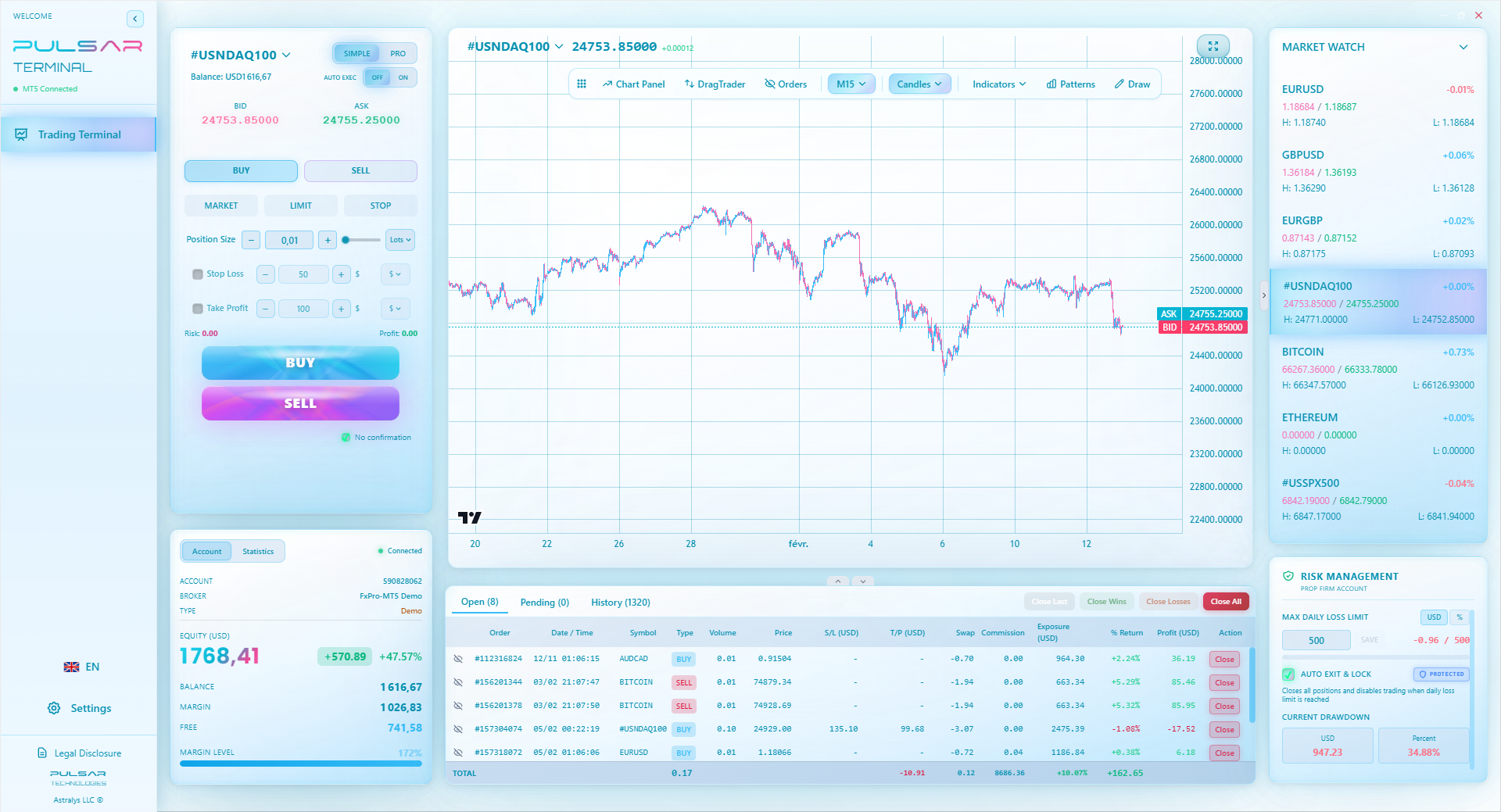
Managing the intense psychology of trading is easier when your trade management—like setting multiple take-profits or a trailing stop—is automated and precise, which is exactly what tools like Pulsar Terminal are built for on MT5.
Pulsar Terminal
Das All-in-One MT5-Tool: Drag-and-Drop-Orders, Multi-TP/SL, Trailing Stop, Grid Trading, Volume Profile und Prop-Firm-Schutz. Täglich von 1.000+ Tradern genutzt.
This is the chapter I wish I had read. Your strategy is only 30% of the game. Your psychology is 70%.
Fear & Greed: They will dictate your actions if you let them. Fear will make you close winning trades too early. Greed will make you hold losing trades, hoping they'll turn around. You must have a written trading plan with fixed entry, stop-loss, and take-profit rules before you enter. Then follow it like a robot.
Revenge Trading: You will have losing trades. It's guaranteed. The urge to immediately jump back in to 'win it back' is overwhelming. This is how you lose your entire account in an afternoon. I've done it. After a loss, walk away. Close the platform. Come back tomorrow.
Journal Everything: Every trade. Entry, exit, why you took it, your emotional state. Review it weekly. You'll see patterns - like losing more on Mondays or after lunch. This self-awareness is more valuable than any indicator. It turns you from a reactive gambler into a proactive trader.
“Discipline is built through routine, not through willpower in the heat of the moment.”
Let me save you some money and heartache.
- Over-leveraging: Just because your broker offers 500:1 use doesn't mean you should use it. I used 100:1 on my first account and wiped it out in a week. Start with 10:1 or less. use amplifies losses faster than gains.
- Trading Too Often: You don't get paid for activity, you get paid for being right. In my first month, I took 87 trades. Most were noise. Now, I might take 2-3 high-quality setups a week. Quality over quantity.
- Ignoring Economic News: Trading around major news (like US Non-Farm Payrolls or SARB interest rate decisions) is gambling, not trading. The spreads widen, and price can whip violently. Either close your positions before the news or stay out entirely.
- No Routine: Waking up and randomly checking charts leads to impulsive trades. Create a routine: analyze the daily/weekly charts in the morning, mark your key levels, and then wait. Discipline is built through routine.
If you're interested in a longer-term approach that avoids the noise of daily charts, the principles of swing trading might suit your personality better.
💡 Winstons Tipp
If you can't explain your trade setup in one simple sentence, you don't understand it well enough to risk money on it.

So, you've learned the basics, chosen a broker, and are trading a small account with a simple plan. What now?
Months 1-6: Survival. Your goal is to end this period with roughly the same capital you started with. If you're down 10%, that's a win. You're learning.
Months 6-12: Refinement. Start tweaking your strategy based on your journal. Maybe you're better at breakouts than pullbacks. Focus on your strengths. Slowly, you might see small, consistent profits.
Year 1+: Growth. Once you have a year of documented, consistent small profits, then you can consider adding more capital. Not before.
Remember, this is a marathon. The traders who blow up are the ones sprinting at the start. The ones who last are the slow, steady, and relentlessly disciplined. It took me 18 months of painful lessons to finally understand that. My hope is that this guide shortens that journey for you.
Pro Tip: Consider gold (XAU/USD) as a complementary instrument once you're comfortable. It often moves inversely to the USD and can provide good trends. We have a dedicated XAU/USD guide when you're ready.
FAQ
Q1How much money do I need to start forex trading in South Africa?
You can technically start with as little as R500 with some brokers, but I strongly advise starting with R2,000-R5,000. This is enough to feel the real emotional impact of trading but small enough that a total loss won't be devastating. The key is proper position sizing, risking no more than 1% per trade.
Q2Is forex trading taxable in South Africa?
Yes. The South African Revenue Service (SARS) views forex trading profits as income, not capital gains, for most retail traders. This means your profits are added to your other income and taxed at your marginal rate. You can deduct trading-related expenses. Keep careful records of all trades and statements. Consult a tax professional familiar with trading.
Q3What is the best time to trade forex from South Africa?
The most liquid and active sessions overlap from 10:00 SAST to 18:00 SAST. This covers the tail end of the Asian session, the full European session opening, and the opening of the US session. This is when spreads are tightest and movement is highest. Avoid trading major ZAR pairs around local political or budget announcements due to extreme volatility.
Q4Can I use a foreign broker as a South African?
Yes, many international brokers like IC Markets, Pepperstone, and XM accept South African clients. However, you must ensure they are reputable and regulated in a strong jurisdiction (like ASIC in Australia or CySEC in Cyprus). Always check their specific terms for ZAR deposits/withdrawals and tax documentation (they may provide you with a foreign income certificate).
Q5How long does it take to become a profitable trader?
This is the hardest truth: expect it to take at least 1-2 years of dedicated practice and study. The first year is primarily about not losing money while you learn. Consistent profitability is a skill that takes time to develop. Anyone promising you profits in weeks or months is selling a fantasy.
Q6Should I start with a cent account?
Cent accounts (where 1 lot = 1,000 units) can be useful for the first few weeks to get used to platform mechanics with real, but tiny, money. However, the psychology is very different from a standard account. Move to a micro or standard account with your small R2,000-R5,000 capital as soon as you're comfortable with the basics.
Prof. Winstons Lektion
Wichtige Erkenntnisse:
- ✓Risk max 1% per trade. Always.
- ✓Master 1 strategy before learning a second.
- ✓Trade majors first, avoid ZAR pairs as a beginner.
- ✓Journal every trade. Your patterns are your roadmap.
- ✓use is a tool, not a shortcut. Use <10:1 to start.
Wie nützlich war dieser Artikel?
Klicken Sie auf einen Stern
Wöchentliche Trading-Einblicke
Kostenlose wöchentliche Analysen & Strategien. Kein Spam.
Über den Autor
David van der Merwe
Schwellenland-Trader
In Johannesburg ansässiger Trader mit 11 Jahren Erfahrung in Schwellenländerwährungen. Spezialisiert auf ZAR-Paare, FSCA-regulierten Handel und Analyse des südafrikanischen Marktes.
Kommentare
Risikohinweis
Der Handel mit Finanzinstrumenten birgt erhebliche Risiken und ist möglicherweise nicht für alle Anleger geeignet. Vergangene Ergebnisse garantieren keine zukünftigen Renditen. Dieser Inhalt dient ausschließlich Bildungszwecken und stellt keine Anlageberatung dar. Führen Sie immer Ihre eigene Recherche durch, bevor Sie handeln.
Das könnte Sie auch interessieren

Cara Trading Forex Sukses: 7 Prinsip dari Trader Profesional
Cara trading forex sukses dengan 7 prinsip trader pro: manajemen modal, disiplin, journal trading, backtest. Data nyata, bukan janji profit palsu.
Jam Trading Forex Terbaik untuk Trader Indonesia: Panduan Lengkap dengan Tabel Waktu
Panduan jam trading forex untuk trader Indonesia. Tabel 4 sesi dunia, jam emas 20:00-00:00, sesi mana yang harus dihindari. Data akurat + tips dari trader berpengalaman.
Top 5 Sàn Forex Uy Tín Nhất 2026: Review Jujur dari Trader Indonesia
Top 5 sàn forex uy tín 2026 untuk trader Indonesia. Review jujur: spread, deposit, withdraw, dukungan lokal. Exness, XM, IC Markets & lebih.
Pulsar Terminal herunterladen
Alle diese Rechner sind in Pulsar Terminal mit Echtzeit-Daten Ihres MT5-Kontos integriert.
Pulsar Terminal herunterladen