


Let's get this out of the way: most people who try to trade forex in Nigeria lose their money.

Olumide Adeyemi
Pionier des Tradings in Westafrika ·  Nigeria
☕ 11 Min. Lesezeit
Was Sie lernen werden:
Let's get this out of the way: most people who try to trade forex in Nigeria lose their money. I'm not saying that to scare you off, but to be brutally honest. The dream of quick riches from your phone is a fantasy sold by too many 'gurus'. But here's the other side of the coin - it is absolutely possible to learn how to trade forex and make profit consistently. The difference between the dream and the reality is treating this like a skilled profession, not a casino. I've been trading for over 12 years, and I've made every mistake in the book so you don't have to. This guide will walk you through the exact legal framework, the real costs, and the disciplined strategy you need to build a real business from trading.
First things first, is this even legal? Yes, forex trading is legal in Nigeria. The Central Bank of Nigeria (CBN) and the Securities and Exchange Commission (SEC) are the main financial watchdogs. However, there's a crucial detail most beginners miss.
There are no specific Nigerian regulations for the online retail forex market. This means you, as a trader, aren't breaking any laws by opening an account. But it also means you have to be extra careful. You'll be using international brokers regulated abroad, not by the CBN. Your protection comes from those foreign regulators, like the FCA in the UK or CySEC in Cyprus.

Warning: Any broker offering you crazy bonuses or 'guaranteed' returns from a Nigerian office alone is a major red flag. Always verify their international license.
Now, the taxman. The Federal Inland Revenue Service (FIRS) expects its share. Profits from forex trading are subject to Capital Gains Tax, which is currently 10%. You are legally required to declare this income. I know, I know - it's tempting to think no one will find out. But if you're serious about building a legitimate, long-term income stream, keeping clean records and paying your dues is part of the game. It also saves you a massive headache down the line.
This is where dreams meet reality. Your profit isn't just the difference between your buy and sell price. It's what's left after all the costs are taken out. Let's break down the numbers you'll actually face.
The Price of a Trade: Spreads & Commissions
Every time you trade, you pay a cost. For most standard accounts, this is the spread - the difference between the buy and sell price. On a major pair like EUR/USD, a good spread might be 0.6 to 1.2 pips. On exotic pairs involving the Naira, spreads can be 5-10 pips or more, eating your profit before you start.
If you trade frequently or with larger sizes, an ECN/RAW account might be better. These offer raw spreads (sometimes 0.0 pips) but charge a commission per lot. For example, a broker might charge $6 per standard lot round turn. You need to do the math to see which is cheaper for your style.
Broker Minimums: The Truth About Starting Capital
You'll see ads screaming "Start with $1!" Technically, yes, some brokers like JustMarkets or XM allow tiny deposits. But let me be straight with you: trading with $1 is a pointless exercise. You can't practice proper risk management, and the psychological pressure is all wrong.
For a real shot at learning how to trade forex and make profit, I recommend a starting capital of at least $500. This lets you open a Cent account or a Mini account, where 1 pip might be worth $0.10 instead of $1.00. You can make real trades, feel real losses and wins, and learn without blowing up in a week. Brokers like HFM offer Naira-denominated accounts, which can simplify things, but always check their spreads.
The use Trap
This is the biggest killer for new traders in Nigeria. use lets you control $10,000 with just $100 (that's 1:100 use). It amplifies both gains AND losses.
Brokers here offer insane use - Exness offers 'unlimited', HFM goes up to 1:2000. It's a tool, not a strategy. Using high use is like driving a Ferrari on your first day with a learner's permit. You will crash. I learned this the hard way in 2015. I put $200 in an account with 1:500 use, got a few small wins, got cocky, and lost the entire account on one bad GBP/USD trade during the Brexit vote. Poof. Gone in minutes.
Stick to low use (1:10 or 1:20) while you're learning. It forces you to be more selective and manage risk properly. You can learn more about the dangers of misused use in our guide on margin call.

Example: You have $500. With 1:100 use, you can control a $50,000 position. If the market moves 1% against you (a normal daily swing), you lose $500. 100% of your account. With 1:20 use, you control $10,000. That same 1% move costs you $100, or 20% of your account - painful, but survivable.
“Using high use is like driving a Ferrari on your first day with a learner's permit. You will crash.”
Forget the complex indicators you see on YouTube. Profit comes from simplicity and discipline. Here’s a foundational strategy I still use for swing trading.
Step 1: Find the Trend
Use the daily chart. Draw a simple 50-period and 200-period Moving Average (MA). If the price is above both MAs and they are sloping up, the trend is up. Only look for buy setups. If the price is below both and they are sloping down, trend is down. Only look for sell setups. If the MAs are tangled, the market is ranging - stay out. This one rule will keep you out of 50% of losing trades.
Step 2: Wait for a Pullback
Markets don't go straight up or down. They move in waves. In an uptrend, wait for the price to pull back (retrace) towards the rising 50-period MA or a key support level. This is your potential entry zone.
Step 3: Confirm with Price Action
Don't just buy at the moving average. Look for a sign that the buyers are stepping back in. This could be a bullish candlestick pattern (like a hammer or engulfing bar) or the price bouncing decisively off the level.
Step 4: Execute with Precision
Place your entry order just above the confirming candle. Your stop loss goes below the recent swing low (for a buy). Your take-profit target should be at least 1.5 to 2 times the distance of your stop loss. This is your Risk/Reward ratio, and it’s non-negotiable.
Real Trade Example: In January 2024, I saw USD/JPY in a clear daily uptrend above its MAs. It pulled back to the 50 MA near 146.80. A bullish pin bar formed. I entered at 147.10, placed my stop at 146.30 (80 pips risk), and took profit at 148.90 (180 pips reward). Risk/Reward: 1:2.25. The trade ran for about a week and hit target. I used a basic position size calculator to ensure my 80-pip risk was only 1% of my account.
This isn't glamorous, but it works. It requires patience. You might only get 2-3 such setups a month per currency pair. That's okay. Quality over quantity.

💡 Winstons Tipp
A trend is your friend, but it's a fickle one. Never assume it will last forever. Always know where your exit is before you enter.
Your strategy is only 30% of the battle. The other 70% is your mind and how you manage your money. This is the secret most people ignore.
Rule 1: Never Risk More Than 1-2% Per Trade. This is the golden rule. If you have a $1,000 account, no single trade should put more than $10-$20 at risk. This means if you hit a losing streak (and you will), you live to fight another day. I once broke this rule, risking 5% on a 'sure thing' in Gold (XAU/USD). It wasn't sure. I lost $500 in a day and spent the next two months emotionally recovering and just trying to get back to breakeven.
Rule 2: Have a Trading Plan & Journal. Before you open a trade, write it down. Why are you entering? Where is your stop? Where is your profit target? What is your risk? After the trade closes, record the outcome and your emotions. Did you follow your plan? This journal is your best teacher.
Rule 3: Embrace Losses. Losses are the cost of doing business. They are not failures. A good trader with a 60% win rate still loses 4 out of every 10 trades. If you can't handle a loss calmly, you can't trade. The goal is to keep your losses small and your winners bigger. Tools like a trailing stop can help lock in profits as a trade moves in your favor, turning a good trade into a great one.

Pro Tip: The moment you feel the urge to 'double down' on a losing trade to 'average your price,' stop. Close your platform. That's not trading, it's gambling. A loss is just a single transaction. A blown account is a career-ender.
“Your strategy is only 30% of the battle. The other 70% is your mind and how you manage your money.”
You don't need expensive software, but you do need the right basics.
Trading Platform: MetaTrader 4 or 5 (MT4/MT5) is the industry standard. It's free, stable, and offered by almost every broker like Exness, IC Markets, and XM. Learn how to draw trendlines, place orders, and set stops on it.
Economic Calendar: You need to know when major news is coming out (like US Non-Farm Payrolls or CBN announcements). News causes volatility. I use ForexFactory.com's free calendar. My rule is to avoid opening new positions 30 minutes before and after a high-impact news event.
A Reliable Internet Connection: This isn't a joke. A power cut or network drop during a trade can be catastrophic. Have a backup - mobile data on your phone.
Charting Tools: Beyond basic lines, understanding where other traders are placing orders can be powerful. Concepts like Volume Profile show you price levels where a lot of trading has happened, which often become support or resistance. While MT5 has basic tools, dedicated trading terminals can offer much deeper analysis and automation for serious traders.
💡 Winstons Tipp
The market doesn't care about your rent, your bills, or your ego. Trade the price you see, not the price you need.
Let's talk about the local traps.
1. The 'Signal Seller' Scam: WhatsApp and Telegram are flooded with guys selling 'signals.' They'll show you fake screenshots of wins. Here's the truth: if their strategy was so profitable, they'd be trading with their own millions, not selling signals for 10k Naira a month. At best, you're copying a stranger's gambling. At worst, you're funding their luxury car.
2. Trading Naira Pairs: Pairs like USD/NGN or EUR/NGN can be tempting. You understand the Naira, right? The problem is liquidity and spreads. These pairs often have very wide spreads (sometimes 50-100 pips!), making it nearly impossible to profit from small moves. Stick to major pairs like EUR/USD or XAU/USD where the spreads are tight and the market is deep.
3. Impatience & Overtrading: You don't get paid for how many trades you make. You get paid for being right and managing risk. Sitting and waiting for your perfect setup is a skill. Forcing trades because you're bored or want to 'make back' a loss is a sure path to ruin. If you struggle with this, a scalping strategy might seem appealing, but it often exacerbates the problem with its high frequency.
4. Ignoring the Global Market: The Naira is weak because of oil prices, US interest rates, and global risk sentiment. If you don't understand why the US Federal Reserve's decisions move the Dollar, you're trading blind. Your education must be global.
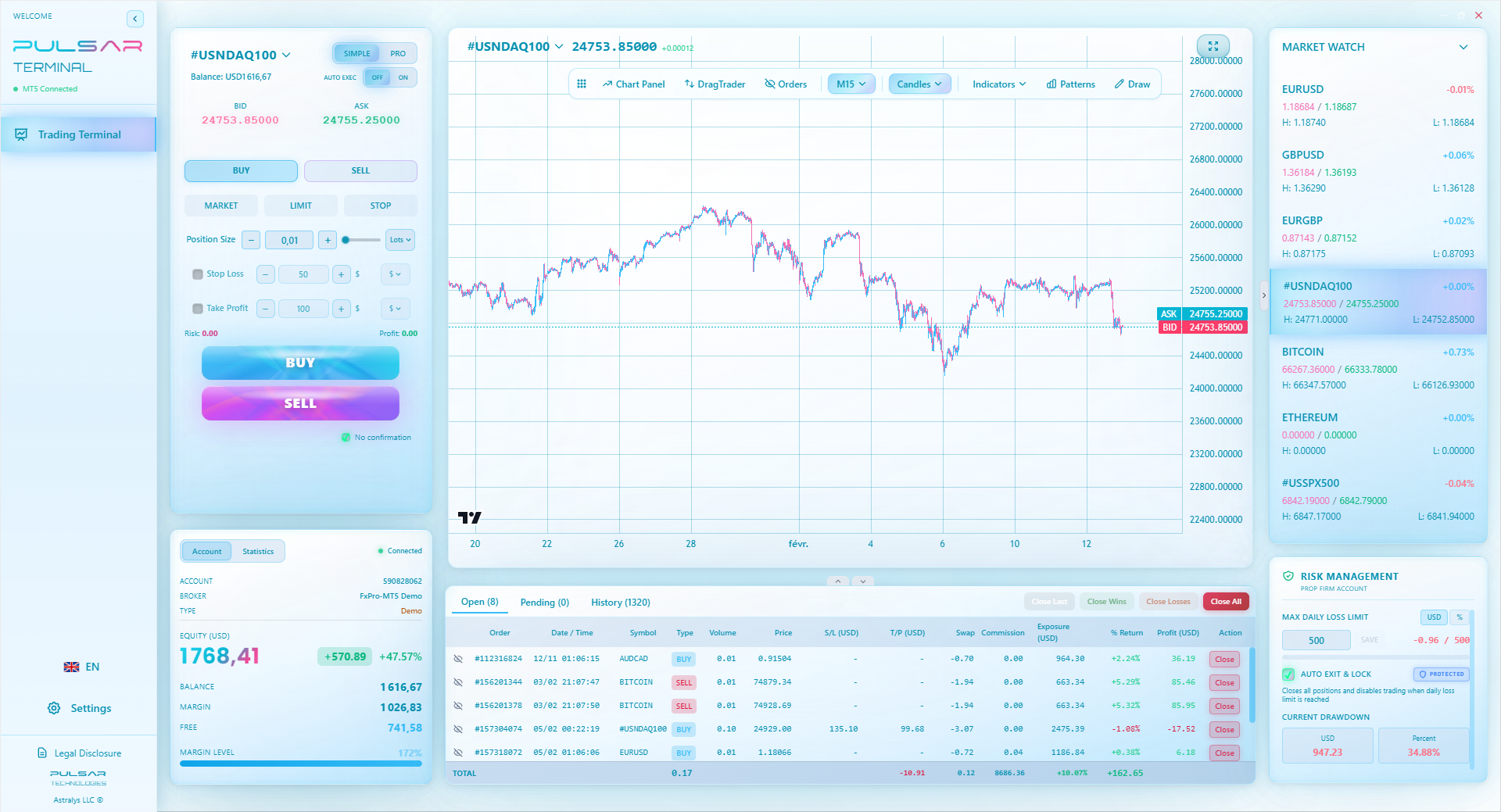
Executing a disciplined plan is easier with tools that let you set multiple take-profit levels and automated trailing stops directly on your MT5 charts, turning your trading rules into automated actions.
Pulsar Terminal
Das All-in-One MT5-Tool: Drag-and-Drop-Orders, Multi-TP/SL, Trailing Stop, Grid Trading, Volume Profile und Prop-Firm-Schutz. Täglich von 1.000+ Tradern genutzt.
“Losses are the cost of doing business. They are not failures.”
Here's exactly what to do, step by step.
Month 1: Education & Paper Trading.
- Open a demo account with a reputable broker (Pepperstone, IC Markets).
- Learn your MT4/MT5 platform inside out.
- Practice the trend-pullback-confirmation strategy on the daily chart. Don't use any other indicators. Just price and moving averages.
- Make 20-30 paper trades. Journal every single one. Your goal is not profit, but consistency in following your rules.
Month 2: Live Trading with Micro Risk.
- Fund a live Cent or Micro account with $100-$200. This is real money, so the psychology is real, but the amounts are small.
- Your only goal is to execute your plan and maintain your 1% risk rule. If you risk $1 per trade, that's fine!
- Focus on one or two major currency pairs.
- Review your journal weekly. What's going wrong? Is it your entries, or are you closing winners too early?
Month 3: Review, Refine, and Scale.
- Analyze your performance. Are you profitable over 20+ trades? If yes, and your psychology is solid, consider adding a small amount more capital.
- If you're not profitable, go back to the demo. The market isn't going anywhere. The problem is in your process, and it's cheaper to fix it there.
- Start studying one additional concept in depth, like the RSI indicator for spotting overbought/oversold conditions within your trend, or the MACD indicator for momentum confirmation.
The path to learning how to trade forex and make profit is a marathon. It's a skill built over hundreds of trades and countless hours of screen time. But if you approach it with patience, discipline, and a relentless focus on risk, you can build something real. I've seen it happen. You can do it too.
FAQ
Q1What is the minimum amount I need to start forex trading in Nigeria?
While some brokers allow deposits as low as $1, that's not practical for learning. To properly practice risk management and trade without excessive pressure, I recommend starting with at least $500. This allows you to use a Cent or Mini account where risk per trade can be kept to 1% ($5), which is a sane amount for a beginner.
Q2Is forex trading taxable in Nigeria?
Yes. Profits from forex trading are considered capital gains and are subject to a 10% tax by the Federal Inland Revenue Service (FIRS). You are legally required to declare this income. Keeping detailed records of all your trades is essential for this.
Q3Which broker is the best for beginners in Nigeria?
Look for brokers with strong international regulation, low minimum deposits, and good educational resources. Brokers like XM ($5 min), Exness ($10 min), and AvaTrade ($100 min) are popular choices. Always prioritize the broker's regulatory license (e.g., CySEC, FCA) over flashy bonuses.
Q4How much can I realistically make from forex trading?
Realistic returns are measured in percentages per month, not fixed amounts. A consistently profitable trader might aim for 5-10% monthly return on their account capital. This is aggressive but possible with good risk management. Aiming for 50% a month is a surefire way to blow up your account. Focus on the process, not a fantasy payout.
Q5What is the most important skill for a forex trader?
Risk management. It's not even close. Knowing how to size your positions and where to place your stop loss is what keeps you in the game long enough to learn and profit. A simple strategy with strict risk management will always beat a complex strategy with poor risk management.
Q6Can I trade forex with my mobile phone in Nigeria?
Yes, you can. MT4 and MT5 have excellent mobile apps. However, I strongly advise against making it your primary method, especially as a beginner. Screen size matters for analysis, and it's too easy to make impulsive trades on a phone. Use it for monitoring, but do your analysis and planning on a computer.
Prof. Winstons Lektion
Wichtige Erkenntnisse:
- ✓Risk a maximum of 1-2% of your capital on any single trade.
- ✓Aim for a Risk/Reward ratio of at least 1:1.5 on every setup.
- ✓Use use as a precision tool, not a blunt weapon.
- ✓The daily chart defines the trend; trade in its direction only.
Wie nützlich war dieser Artikel?
Klicken Sie auf einen Stern
Wöchentliche Trading-Einblicke
Kostenlose wöchentliche Analysen & Strategien. Kein Spam.
Über den Autor
Olumide Adeyemi
Pionier des Tradings in Westafrika
Einer der aktivsten Forex-Trading-Ausbilder Nigerias. 8 Jahre Trading-Erfahrung aus Lagos. Spezialisiert auf Strategien mit geringem Kapital und Prop-Firm-Challenges für afrikanische Trader.
Kommentare
Risikohinweis
Der Handel mit Finanzinstrumenten birgt erhebliche Risiken und ist möglicherweise nicht für alle Anleger geeignet. Vergangene Ergebnisse garantieren keine zukünftigen Renditen. Dieser Inhalt dient ausschließlich Bildungszwecken und stellt keine Anlageberatung dar. Führen Sie immer Ihre eigene Recherche durch, bevor Sie handeln.
Das könnte Sie auch interessieren

Cara Trading Forex Sukses: 7 Prinsip dari Trader Profesional
Cara trading forex sukses dengan 7 prinsip trader pro: manajemen modal, disiplin, journal trading, backtest. Data nyata, bukan janji profit palsu.
Jam Trading Forex Terbaik untuk Trader Indonesia: Panduan Lengkap dengan Tabel Waktu
Panduan jam trading forex untuk trader Indonesia. Tabel 4 sesi dunia, jam emas 20:00-00:00, sesi mana yang harus dihindari. Data akurat + tips dari trader berpengalaman.
Top 5 Sàn Forex Uy Tín Nhất 2026: Review Jujur dari Trader Indonesia
Top 5 sàn forex uy tín 2026 untuk trader Indonesia. Review jujur: spread, deposit, withdraw, dukungan lokal. Exness, XM, IC Markets & lebih.
Pulsar Terminal herunterladen
Alle diese Rechner sind in Pulsar Terminal mit Echtzeit-Daten Ihres MT5-Kontos integriert.
Pulsar Terminal herunterladen