


Here's a fact that should scare you: over 90% of retail traders lose money.

Olumide Adeyemi
Pionier des Tradings in Westafrika ·  Nigeria
☕ 12 Min. Lesezeit
Was Sie lernen werden:
Here's a fact that should scare you: over 90% of retail traders lose money. In Nigeria, where the forex market turnover jumped 56.4% to $8.6 billion in 2025, that means a lot of Naira is changing hands and disappearing. Most of those losses come from traders who think fundamental analysis is just watching the news. They're wrong. It's about understanding why a currency moves, not just that it did. I've blown accounts trying to trade headlines, and I've made consistent returns by learning the real mechanics. This guide isn't about getting rich quick. It's about how to trade fundamental analysis in forex without becoming another statistic.
Forget what you've heard. Fundamental analysis in forex isn't about predicting the future. It's about measuring the pressure building up behind a currency pair. Think of it like checking the weather before you sail. You're not controlling the wind, but you sure want to know if a storm is coming.
Most new traders get this completely backwards. They see a high inflation number and immediately short the currency. That's a great way to lose money. In 2023, I shorted the USD/NGN after a bad US CPI print, thinking the dollar would weaken. I was stopped out for a 2.5% loss in hours. Why? Because the market had already priced in that data, and the reaction was a classic 'buy the rumor, sell the news' event.
True fundamental analysis has two core jobs. First, it identifies the long-term trend or 'theme' driving a currency. Is it a central bank's tightening cycle? A country's deteriorating trade balance? Second, it helps you anticipate shifts in market sentiment before the big moves happen. You're looking for the crack in the dam, not trying to catch the flood after it's already washed everyone away.

Warning: Trading the headline number from an economic calendar is not a strategy. It's gambling. The professional money moves on the deviation from expectations and the future implications, not the raw data point.
This process is why tools like a good position size calculator are non-negotiable. When you're trading fundamentals, positions can be open for weeks. You need to know exactly how much you can afford to lose while waiting for your thesis to play out.

💡 Winstons Tipp
The market can stay irrational longer than you can stay solvent. Your fundamental thesis can be 100% correct in the long run, but if you're over-leveraged, you'll be broke before it plays out. Patience is a position.
“True fundamental analysis is about measuring the pressure building up behind a currency pair, not predicting the future.”
You need to focus on what moves your pairs. Trading GBP/JPY? Nigerian inflation doesn't matter. But if you're trading anything with the US Dollar or the Naira, local and global factors collide. Here’s what to watch, broken down.
Central Bank Policy: The Interest Rate Game
This is the big one. Currencies often follow the path of interest rates. A central bank raising rates (or signaling it will) typically strengthens that currency, as it attracts foreign capital seeking higher yields. Look at the Central Bank of Nigeria (CBN). They hiked the Monetary Policy Rate (MPR) aggressively to 27.5% to fight inflation. On paper, that should be rocket fuel for the Naira. But it's more complex.
The key is the real interest rate: the MPR minus inflation. Even with inflation falling to 15.10% in January 2026, the real rate is positive. That's a fundamental support. Compare that to a country with 2% rates and 5% inflation - its currency is fundamentally weak. Your job is to compare these dynamics between the two currencies in your pair.
Economic Health Indicators
These are the vital signs of an economy.
- Inflation (CPI): High inflation erodes purchasing power. The CBN's fight to bring it down from over 32% is a core market story.
- Gross External Reserves: This is Nigeria's war chest. It climbed to $46.7 billion in late 2025, but then fell by $850 million in three weeks in March 2026. A sustained drop pressures the Naira, as it hints at the CBN's ability to defend the currency is weakening.
- GDP Growth: Is the economy expanding or contracting? Stagflation (high inflation + low growth) is a trader's nightmare.
Geopolitics & Commodity Prices
Nigeria is an oil exporter. When Brent Crude prices rise, Nigeria earns more USD. This should, in theory, strengthen the Naira by improving the trade balance and boosting reserves. Watch the correlation between XAU/USD (gold) and USD pairs during times of crisis, too. I keep a simple correlation table on my screen:
| Asset Pair | Typical Correlation to USD | Why It Matters for NG Traders |
|---|---|---|
| USD/NGN | Direct Quote | The pair itself. Strength = weaker Naira. |
| Brent Crude (Oil) | Inverse (Usually) | Higher oil price → more USD for Nigeria → potential Naira strength. |
| XAU/USD (Gold) | Inverse (Usually) | A 'crisis' barometer. Strong gold often means weak USD sentiment. |

Pro Tip: Don't just look at the Nigerian data in isolation. You must compare it to the data from the other country in your currency pair. Is the CBN hiking while the Fed is cutting? That's a powerful fundamental divergence you can trade.
Understanding these drivers is the first step. The next is learning how to actually structure a trade around them, which is where most swing trading plans fall apart without proper risk rules.
“A fundamental view is not an excuse for poor risk mechanics. It's the reason you need them even more.”
A plan turns observation into action. Here’s how I structure a fundamental trade, from idea to execution.
Step 1: The Thesis Start with a clear, one-sentence thesis. Not "USD will go up." That's useless. Try: "I believe the USD will strengthen against the JPY over the next quarter because the Fed is expected to maintain a hawkish pause while the Bank of Japan remains committed to ultra-loose policy."
Step 2: The Catalyst Timeline Map out the events that will prove or disprove your thesis. Mark the next: Central bank meeting dates, major inflation (CPI) releases, employment data. Your thesis lives or dies on these days. I literally put them in my calendar.
Step 3: Entry, Exit, and Risk This is where you separate the pros from the punters.
- Entry: I rarely enter just before a major news event. The volatility is insane and the spread can widen massively. I look to enter on a pullback after the market has digested the news and the new trend is establishing itself. For example, after a dovish Fed statement causes an initial USD sell-off, I might look for the RSI indicator to show oversold conditions before buying the USD dip.
- Stop Loss: Your stop loss is based on price action, not a random number. Place it beyond a recent swing low (for a long trade) or high (for a short trade) that, if broken, would invalidate your fundamental story. If your thesis is strong USD, and USD/JPY breaks below a key support level that held during the last dovish speech, your thesis is probably wrong. Get out.
- Take Profit: Have a target. Is it a previous resistance level? A 1:2 risk-to-reward ratio? Decide before you enter. Greed kills more accounts than bad analysis.

Example: In early 2024, my thesis was that persistent high inflation would force the CBN into more aggressive hikes. I bought USD/NGN (betting on Naira weakness) at 780. My stop was at 770, a 10 Naira risk. My first profit target was 800, a 20 Naira reward (1:2 R:R). I moved my stop to breakeven at 790 and eventually took partial profit at 810. The trade ran for 6 weeks.
This structured approach prevents you from being a passive victim of the markets. It forces you to define what 'wrong' looks like. Without it, you're just hoping.
“Trading the headline number is gambling. The professional money moves on the deviation from expectations.”
I've made these. You will too. But knowing them in advance might save your account.
Mistake 1: Trading the News Headline, Not the Reaction. The number hits the wire: "US NFP: 300K Jobs Added!" That's huge, right? USD should soar! You buy instantly. Then the USD tanks. Why? Maybe the wage growth component was weak. Maybe the market had priced in 350K. The actual price movement is the only truth. Wait for the initial 5-15 minute spike to settle. See where price establishes itself. Let the market tell you what it thinks of the news.
Mistake 2: Ignoring the 'Whisper Number' and Market Sentiment. The official forecast might be for a 0.3% inflation rise. But all week, analysts on Bloomberg TV have been hinting it could be 0.5%. That 0.5% is the 'whisper number.' If the actual print is 0.4%, it's above the official forecast but below the whisper. The reaction can be a confusing sell-off. You need to gauge the broader market mood.
Mistake 3: No Risk Management on Fundamental Trades. "This is a long-term trade, I don't need a tight stop." This is the most dangerous thought in trading. A long-term trade can go against you for a long time before it's right. If you risk 5% of your account on a 'sure thing' fundamental play and it goes 200 pips against you, you're gone. Use a position size calculator every single time. A fundamental view is not an excuse for poor mechanics.
Mistake 4: Overleveraging on 'Certainty'. You've read all the reports. The rate hike is a lock. So you pile in with 1:50 use. Then the central bank surprises with a dovish hike, and the currency collapses. Your 'certain' trade triggers a margin call. use amplifies gains, but it demolishes accounts faster on bad reads. For fundamental swing trading, I rarely use more than 1:10 use. The goal is to survive being wrong.
Broker choice matters here too. A broker with unreliable execution during news events can turn a good trade into a loss. I've had better luck with the stability of platforms like IC Markets for these volatile periods compared to some others.
💡 Winstons Tipp
Create a 'fundamentals dashboard' - a single page with the key rate, next meeting date, and current inflation for the 3 major currencies you trade. Glance at it every morning. Context is everything.
“Trading the headline number is gambling. The professional money moves on the deviation from expectations.”
You don't need expensive terminals. You need the right free tools and a system.
1. The Economic Calendar: This is your bible. I use Investing.com's calendar. Filter for 'High' impact events for the currencies you trade. Don't clutter your view with medium/low impact for Slovenia. For Nigeria, you must watch:
- CBN Monetary Policy Committee (MPC) Meetings & Decisions
- Nigerian Inflation Rate (CPI)
- Nigerian Gross External Reserves
- US Non-Farm Payrolls, CPI, Fed Meetings (for USD pairs)
- ECB, BoE, BoJ meetings (for EUR, GBP, JPY pairs)
2. The Central Bank Monitor: Create a simple spreadsheet. Track the key rates (MPR for CBN, Fed Funds Rate for the US), the next meeting date, and the current market expectation (e.g., "75% chance of a 25bps hike"). This is your central bank dashboard.
3. Price Action Confirmation: Fundamentals give you the direction. Price action gives you the timing. I use the MACD indicator on the daily chart to confirm trend momentum and spot potential divergences. If my fundamental thesis is bullish, but the MACD is making lower highs while price makes higher highs (bearish divergence), I pause. The story might be changing.
4. Correlation Check: Before entering a USD trade, I glance at DXY (US Dollar Index), US Treasury yields, and sometimes gold. If the USD is weak across the board, but my pair isn't moving, there's a specific reason. I need to find it.
The goal is to synthesize information, not just collect it. A news headline is noise until you connect it to the interest rate path, confirm it with price, and then manage your risk around it.
Pro Tip: For major events like the US NFP or a Fed meeting, I don't trade the first 30 minutes. I watch. I note the high and low of the initial spike. Often, the market will retest one of those levels. That retest, with my fundamental bias in mind, gives a much cleaner, higher-probability entry.
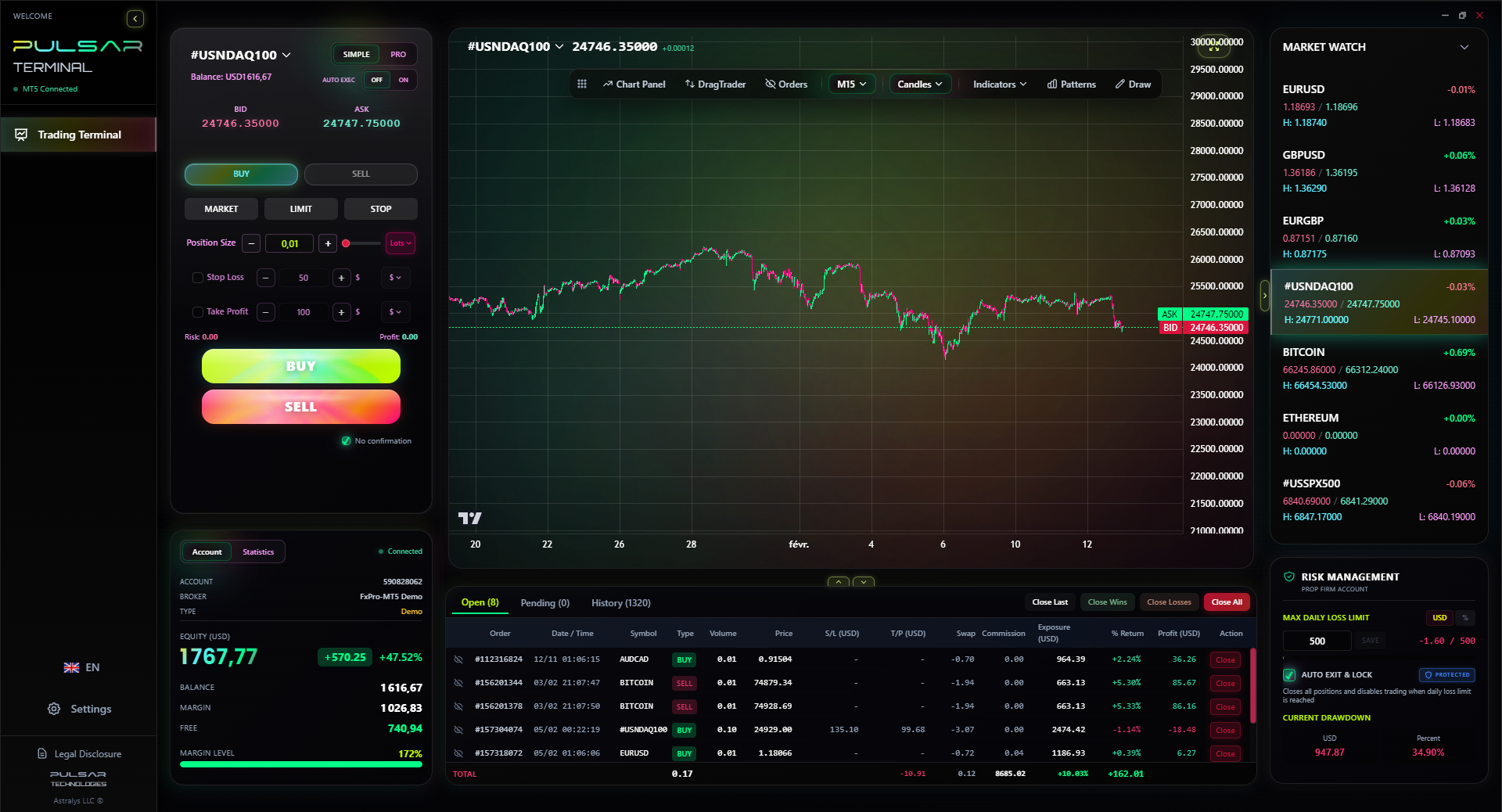
Managing multi-week fundamental trades requires automating your risk rules, which is where a tool like Pulsar Terminal's trailing stop and breakeven functions on MT5 become indispensable for protecting profits.
Pulsar Terminal
Das All-in-One MT5-Tool: Drag-and-Drop-Orders, Multi-TP/SL, Trailing Stop, Grid Trading, Volume Profile und Prop-Firm-Schutz. Täglich von 1.000+ Tradern genutzt.
“You lost 1.5% on a defined risk. That's the cost of doing business. The alternative is the cost of going broke.”
Let's walk through a real-world scenario using late 2025/early 2026 data. This is how the pieces connect.
The Setup (Late 2025):
- Fundamental Backdrop: Nigerian inflation is falling (16.05% in Oct '25). CBN reserves are rising ($46.7bn in Nov '25). The CBN has a high MPR (27.5%). The real interest rate is positive and growing. Fundamentally, this should support the Naira.
- Market Sentiment: However, the parallel market rate is still wildly disconnected from the official rate, showing lingering distrust. Oil prices are volatile.
The Trade Thesis: "I believe that if the CBN can demonstrate consistent reserve accumulation AND a continued drop in inflation, confidence will slowly return, leading to a gradual strengthening of the official Naira rate against the USD over a 3-6 month period."
The Plan:
- Instrument: I'm looking at the USD/NGN pair. A strengthening Naira means USD/NGN goes DOWN.
- Catalyst: The next MPC meeting statement and the subsequent monthly inflation & reserve data.
- Entry: I'm not buying Naira (selling USD/NGN) blindly. I wait for the next inflation print (Jan '26: 15.10%). It's another drop, confirming the trend. Price has been consolidating. I enter a short on USD/NGN on a break below consolidation support.
- Risk Management: My stop loss is placed above the recent consolidation high. My position size is calculated so that if I'm wrong, I lose only 1.5% of my account. My first profit target is the next major support level, giving a 1:2 risk-to-reward.
- Monitoring: I watch the next reserve figure. If it shows another significant drop (like the $850m drop in March '26), that's a red flag for my thesis. I might tighten my stop or exit half my position.
This isn't a guaranteed win. It's a probabilistic bet based on a logical framework. Sometimes the data turns (reserves fall sharply), and you get stopped out. That's fine. You lost 1.5% on a defined risk. That's the cost of doing business. The alternative is watching the news, feeling a hunch, and YOLO-ing a huge position with no plan. That's the cost of going broke.
The final piece is managing these longer-term trades without babysitting them 24/7, which is where the right tools make all the difference.
FAQ
Q1Is fundamental analysis or technical analysis better for forex trading?
It's not an either/or question. That's a rookie debate. Fundamental analysis tells you what to trade and why it might move (the 'why'). Technical analysis tells you when to enter and where to place your stop loss (the 'when' and 'where'). Pros use both. Fundamentals set the direction, and price action provides the entry signal.
Q2How do I start learning fundamental analysis as a beginner in Nigeria?
Start hyper-focused. Pick one major currency pair, like EUR/USD. Follow just two data points for each: the interest rate and the inflation rate. Read the summaries of the last ECB and Fed meetings. Don't get lost in GDP components or manufacturing PMIs yet. Use a simple EUR/USD guide to understand the pair's typical drivers. Consistency beats complexity.
Q3What time do major fundamental news releases come out?
It depends on the country. US data (like NFP, CPI) typically drops at 1:30 PM or 2:00 PM Nigerian time (8:30 AM EST). European data around 9:00 AM or 10:00 AM Nigerian time. CBN MPC announcements are usually around 2:00 PM Nigerian time. Always check your economic calendar the day before and convert the times to your local time zone.
Q4Do I need a lot of money to trade using fundamental analysis?
No, you need a lot of patience and discipline. Fundamental trades often play out over weeks. You need a capital base that can withstand the swings without forcing you to use extreme use. It's more about your risk-per-trade (e.g., never more than 2%) than your total account size. A small account with strict rules will outlast a large account with no plan.
Q5How does Nigeria's 10% capital gains tax affect my trading profits?
You are required to pay 10% on your net trading profits (profits minus losses) to the FIRS. This is a cost of doing business. You must factor this into your overall profitability. If your strategy only makes 8% annual returns before tax, you're actually losing purchasing power after tax and inflation. Always calculate your returns net of all costs.
Q6Can I use fundamental analysis for scalping?
Generally, no. Fundamental analysis is about broader trends and shifts that take time to unfold. Scalping strategy is about capturing tiny moves over minutes, driven by order flow and pure price action. Trying to scalp based on a quarterly GDP report is like using a weather satellite to predict the next raindrop on your window.
Q7Why does the Naira sometimes weaken when oil prices go up?
This highlights that no single factor drives a currency. While higher oil prices should bring more USD into Nigeria, the Naira can still weaken if there's a simultaneous surge in dollar demand for imports, if the CBN is not intervening effectively to clear backlogs, or if there's a major loss of investor confidence due to domestic policies. You have to look at the total balance of payments and market psychology.
Prof. Winstons Lektion
Wichtige Erkenntnisse:
- ✓Focus on interest rate differentials and real yields.
- ✓Trade the market's reaction to news, not the headline.
- ✓Never risk more than 2% on any single fundamental thesis.
- ✓Use price action to time your entry, not your conviction.
Wie nützlich war dieser Artikel?
Klicken Sie auf einen Stern
Wöchentliche Trading-Einblicke
Kostenlose wöchentliche Analysen & Strategien. Kein Spam.
Über den Autor
Olumide Adeyemi
Pionier des Tradings in Westafrika
Einer der aktivsten Forex-Trading-Ausbilder Nigerias. 8 Jahre Trading-Erfahrung aus Lagos. Spezialisiert auf Strategien mit geringem Kapital und Prop-Firm-Challenges für afrikanische Trader.
Kommentare
Risikohinweis
Der Handel mit Finanzinstrumenten birgt erhebliche Risiken und ist möglicherweise nicht für alle Anleger geeignet. Vergangene Ergebnisse garantieren keine zukünftigen Renditen. Dieser Inhalt dient ausschließlich Bildungszwecken und stellt keine Anlageberatung dar. Führen Sie immer Ihre eigene Recherche durch, bevor Sie handeln.
Das könnte Sie auch interessieren

Cara Trading Forex Sukses: 7 Prinsip dari Trader Profesional
Cara trading forex sukses dengan 7 prinsip trader pro: manajemen modal, disiplin, journal trading, backtest. Data nyata, bukan janji profit palsu.
Jam Trading Forex Terbaik untuk Trader Indonesia: Panduan Lengkap dengan Tabel Waktu
Panduan jam trading forex untuk trader Indonesia. Tabel 4 sesi dunia, jam emas 20:00-00:00, sesi mana yang harus dihindari. Data akurat + tips dari trader berpengalaman.
Top 5 Sàn Forex Uy Tín Nhất 2026: Review Jujur dari Trader Indonesia
Top 5 sàn forex uy tín 2026 untuk trader Indonesia. Review jujur: spread, deposit, withdraw, dukungan lokal. Exness, XM, IC Markets & lebih.
Pulsar Terminal herunterladen
Alle diese Rechner sind in Pulsar Terminal mit Echtzeit-Daten Ihres MT5-Kontos integriert.
Pulsar Terminal herunterladen