


Most Nigerian traders I meet are obsessed with price.

Olumide Adeyemi
Pionier des Tradings in Westafrika ·  Nigeria
☕ 10 Min. Lesezeit
Was Sie lernen werden:
- 1What Is Volume in Forex? (It's Not What You Think)
- 2Key Volume Indicators Explained (OBV, VWAP, and The Histogram)
- 3Practical Volume Trading Strategies for Nigerian Markets
- 4Nigeria-Specific Challenges & Why Volume Matters More Here
- 5Common Volume Mistakes to Avoid (I've Made Them All)
- 6Setting Up Your Charts: A Simple MT4/MT5 Volume Template
- 7Integrating Volume with Your Nigerian Trading Plan
Most Nigerian traders I meet are obsessed with price. They'll stare at candlesticks and moving averages all day, completely ignoring the single most important piece of information: who's actually behind the move. That's a fast track to getting stopped out by fake breakouts. Price tells you what happened. Volume tells you who made it happen and if they're serious. Let's set the record straight on how to use volume indicator in forex, specifically for our unique market conditions, from navigating CBN restrictions to understanding why tick volume is your best friend.
Here's the first reality check: in the decentralized forex market, there's no central exchange reporting total traded volume like you get on the Nigerian Stock Exchange. We don't get to see every single transaction between banks, hedge funds, and retail traders globally.
So what are we actually measuring? In forex, the standard "Volume" indicator on MT4 or MT5 shows tick volume. It doesn't measure the dollar or Naira value traded. Instead, it counts the number of price changes (ticks) that occur within a given candle. If the EUR/USD price updates 250 times during a 1-hour candle, the volume bar will show 250.
Think of it like this: high tick volume means lots of activity and interest at that price level. Low tick volume means the market is sleepy, disinterested, or illiquid. It's an approximation, but a powerful one. For Nigerian traders, this is crucial because our trading hours often overlap with London and New York sessions. A surge in tick volume during those overlaps confirms real institutional money is moving, not just local retail noise.

Warning: Never take a forex volume reading as gospel truth. It's a relative tool. Compare today's volume to the average of the last 20 bars. Is it higher or lower? That relative change is what gives you an edge, not the absolute number.
“Price tells you what happened. Volume tells you who made it happen and if they're serious.”
You don't need a dozen indicators cluttering your chart. These three, used properly, will tell you 90% of what you need to know.
On-Balance Volume (OBV)
This is the classic. The OBV line adds volume on up days and subtracts volume on down days. The theory is simple: volume should precede price. If the OBV line is making new highs while the price is struggling, that's bullish divergence - smart money is accumulating before the pop. I've caught some of my best swing trading moves on GBP/USD using this. Back in 2023, price was stuck in a range around 1.2200, but OBV was creeping higher for two weeks. I went long at 1.2215, and the pair eventually rallied to 1.2450. The volume tipped the scales.
The opposite is bearish divergence. Price makes a new high, but OBV fails to confirm it. That's often the last gasp of a trend.
Volume-Weighted Average Price (VWAP)
Don't be intimidated. VWAP is just the average price of the pair for the day, weighted by how much volume traded at each price. It's the market's "fair value" for the session. Institutional algo traders love it. For us, it acts as a dynamic support/resistance line on intraday charts. In a strong uptrend, price will tend to stay above the VWAP. Pullbacks to the VWAP can be buying opportunities if volume supports it. If price rallies hard but then crashes through the VWAP on high volume, the trend is likely reversing.
The Volume Histogram
This is your baseline. Those vertical bars at the bottom of your chart. Don't just look at them, analyze their pattern. Are the green (up) bars generally taller than the red (down) bars during an uptrend? That's healthy. I made a costly mistake in early 2024 trading XAU/USD (gold). Price was edging higher, but the volume bars were getting progressively shorter. I ignored it, thinking the trend was intact. The subsequent drop wiped out two weeks of profits. The volume histogram was screaming "no conviction" and I didn't listen.

Pro Tip: Combine these. Use the histogram to gauge general activity, OBV to spot divergences for longer-term setups, and VWAP for intraday entry precision. Trying to use them all at once on a 5-minute chart will just confuse you.

💡 Winstons Tipp
A trend without volume is like a car running on fumes. It might coast for a while, but it has no power to climb the next hill. Always check the fuel gauge.
“A valid breakout must be accompanied by volume at least 150-200% of the recent average. If not, it's a trap.”
Theory is fine, but how do you actually make money with this? Here are two concrete strategies I use, adjusted for the realities of trading from Nigeria.
1. The Volume-Powered Breakout (Avoiding the Fakeout)
This is where most traders in Lagos get slaughtered. They see EUR/USD break above a resistance level and jump in, only to get squeezed out when it reverses. Volume is your filter.
The Rule: A valid breakout must be accompanied by volume at least 150-200% of the recent average volume. You can see this clearly on the histogram. If price breaks out on weak, below-average volume, it's a trap. The big players aren't participating. I use this religiously on the 1-hour and 4-hour charts. It saved me just last month on USD/NGN pairs offered by brokers like Exness. A false breakout on thin volume kept me out of a losing trade.
2. Trend Exhaustion & Reversal Signals
No trend lasts forever. Volume tells you when it's running out of fuel.
- In an Uptrend: Look for price making new highs, but the volume bars on those up-moves are getting smaller. The OBV line may start to flatten or diverge downwards. This is distribution - smart money is selling to late retail buyers.
- In a Downtrend: Look for a final, high-volume sell-off (a selling climax). This is often a panic move. If that big red volume bar is followed by a price candle that closes near its high (a hammer or bullish engulfing), the selling pressure may be exhausted. A surge in volume on the first up-day confirms the reversal attempt.
These strategies work on any pair, but be extra cautious with exotic pairs that have less liquidity. Your volume readings there can be noisy.
“A valid breakout must be accompanied by volume at least 150-200% of the recent average. If not, it's a trap.”
Trading from Nigeria isn't the same as trading from London. Our context changes everything, and volume analysis helps you navigate it.
First, liquidity and session times. The most reliable, high-volume moves happen during the London (3 PM - 12 AM Nigerian time) and London/New York overlap (7 PM - 12 AM Nigerian time). If you're trying to scalping strategy the Naira pairs or even majors at 2 PM Nigerian time, you're fighting thin, erratic volume. The spreads widen, and price can be jerked around easily. Use the volume histogram to confirm the market is awake before you commit serious capital.
Second, news and CBN announcements. When the Central Bank of Nigeria makes a policy announcement, expect massive volume spikes on USD/NGN and related pairs. This is institutional money reacting. The key is to wait for the volume to settle. Don't try to catch the initial spike. Let the high-volume bar print, then watch. The direction price moves on the subsequent high-volume bars often shows the real, sustained direction. Chasing the first spike is a great way to get a margin call.
Third, funding and broker choice. Because we often use international brokers like IC Markets or XM, understanding their volume data is key. Tick volume should be consistent across reputable brokers. If you're using a shady, unregulated broker, even their volume data could be manipulated or unreliable. Stick with brokers that have transparent execution and real volume feeds.
💡 Winstons Tipp
The market's biggest lies are told on low volume. Fake breakouts, false reversals - they all share that same quiet, unconvincing whisper. Wait for the shout.
“High volatility on low volume is where Nigerian traders using high use get destroyed.”
Let me save you some money and heartache. Here are the volume blunders I see every day.
Mistake 1: Ignoring the Context of a Volume Spike. A huge volume bar alone means nothing. You must look at where it happens. A massive volume spike at a clear support level is a potential reversal signal (accumulation). The same spike after a long run-up at a resistance level is distribution (smart money selling). I once bought a huge volume spike on GBP/JPY, thinking it was a breakout. It was, in fact, a blow-off top. Lost 3% of my account in hours.
Mistake 2: Using Volume in Isolation. Volume is a confirming tool, not a crystal ball. Never enter a trade based solely on an OBV divergence or a volume spike. It must align with price action - key support/resistance, trendline breaks, or candlestick patterns. Combine it with an oscillator like the RSI indicator for confluence.
Mistake 3: Misreading Low Volume. Low volume doesn't always mean a reversal is coming. Sometimes it just means a consolidation or a holiday period. The mistake is trading low-volume periods with the same size as high-volume periods. During low volume, ranges contract, breakouts fail, and it's easy to get whipsawed. Reduce your position size. Use our position size calculator and dial down the risk when the volume histogram shows sleepy markets.
Mistake 4: Chasing Volume in Exotic Pairs. Be very careful applying volume analysis to exotic pairs or minor crosses that involve the Naira. The liquidity is lower, so a single moderate-sized trade can create a massive volume spike that means nothing for the overall trend. Stick to the majors (EUR/USD, GBP/USD, USD/JPY) for your most reliable volume analysis.
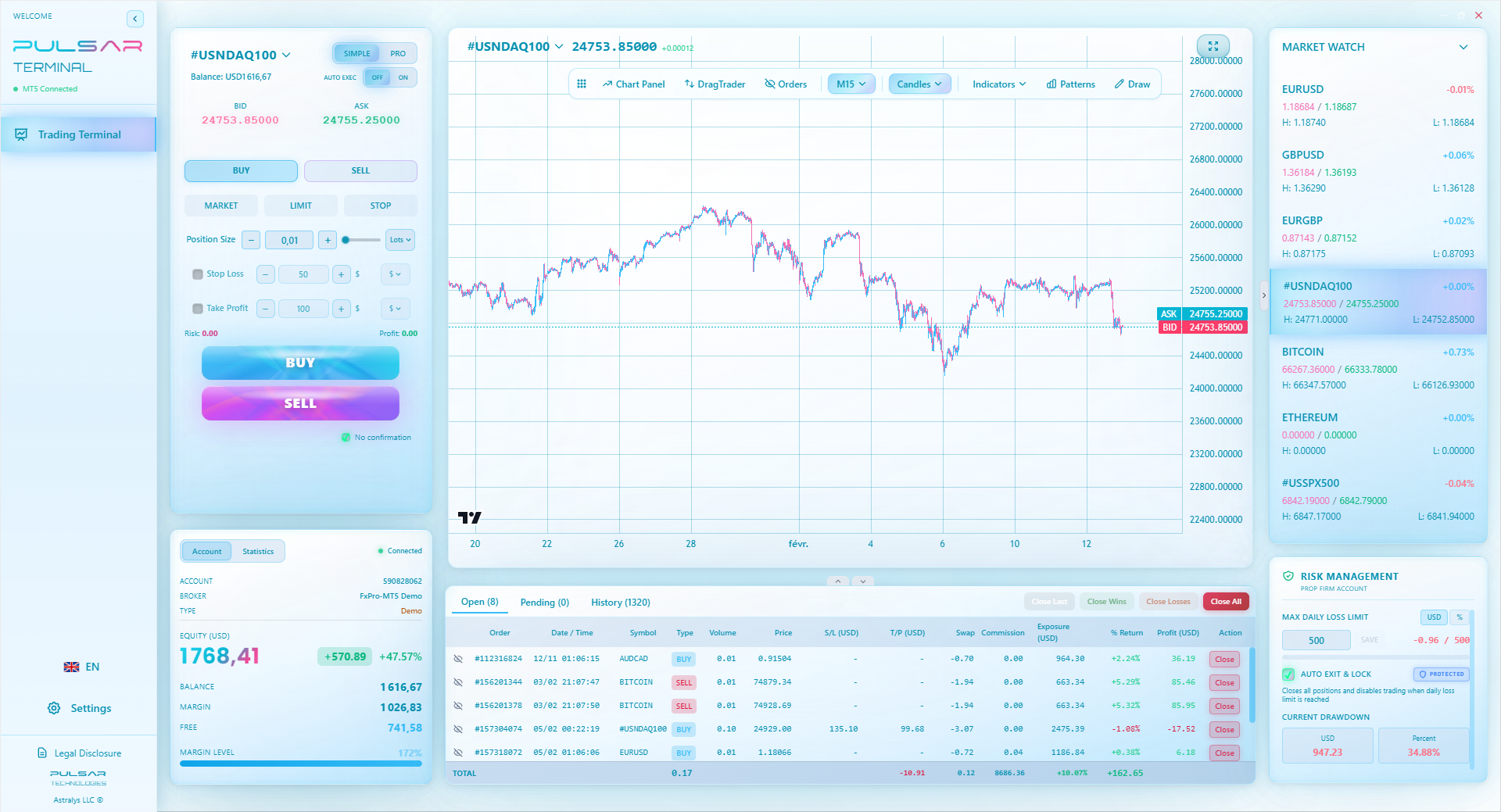
Manually drawing volume profiles and analyzing zones is time-consuming, but Pulsar Terminal's built-in Volume Profile tool does it instantly on your MT5 chart, showing you exactly where the high-volume nodes are.
Pulsar Terminal
Das All-in-One MT5-Tool: Drag-and-Drop-Orders, Multi-TP/SL, Trailing Stop, Grid Trading, Volume Profile und Prop-Firm-Schutz. Täglich von 1.000+ Tradern genutzt.
“High volatility on low volume is where Nigerian traders using high use get destroyed.”
Keep it clean. Here’s my exact chart setup, which works for both MT4 and the more advanced MT5.
- Main Chart Window: Candlestick chart. I use Heikin Ashi candles sometimes to smooth out noise, but regular candles are fine.
- First Sub-window (Below Price): The standard Volume Histogram. Color settings: Up volume = Green, Down volume = Red. Add a 20-period Simple Moving Average applied to the volume indicator itself. This blue line shows the average volume. Your job is to compare current bars to this average line.
- Second Sub-window: On-Balance Volume (OBV). That's it. No moving averages on it. Just the pure OBV line.
- On the Main Chart: Add the VWAP indicator. Set it to start from the daily session open (usually 10 PM Nigerian time for the Forex day).
That’s three indicators total. It gives you a complete volume picture: immediate activity (histogram), cumulative flow (OBV), and institutional reference (VWAP).

Example: Let's say you're watching EUR/USD guide. Price approaches a key resistance at 1.0950. The volume histogram bars are weak and below the 20-period average. OBV is flat. This tells you the buying pressure isn't there to break it. You wait. Suddenly, a fundamental news hit causes a spike. Price jumps to 1.0970 on a massive volume bar that doubles the average. OBV ticks up sharply. This is a confirmed, high-conviction breakout. Your entry trigger might be a retest of 1.0960 with supporting volume.
💡 Winstons Tipp
Your first loss is your smallest loss. If you enter on high volume and the market immediately reverses on even higher volume, you are wrong. Get out. Volume just told you the story changed.
“Volume is your quality control department. No confirmation, no trade.”
Volume isn't a standalone strategy. It's the quality control department for your existing plan. Here’s how to bake it into your process.
For Entry: Make volume confirmation a non-negotiable entry filter. Your checklist should read: "1. Price signal present (e.g., breakout). 2. Volume is above average and confirms the move. 3. Enter." If condition #2 is missing, you do not trade. This one filter will improve your win rate dramatically.
For Exit: Volume can help you stay in winning trades longer. In a strong trend, pullbacks should occur on low volume. If you're long and the market pulls back quietly (low red volume bars), it's likely just profit-taking, not a reversal. Hold. Conversely, if your profitable trade starts seeing strong volume moves against you, it might be time to tighten stops or take partial profits.
For Risk Management: This is critical for Nigerian traders using high use. High volatility on low volume is extremely dangerous. If you're in a trade and volume suddenly dries up, be aware that the spread definition might widen, and any sudden move could be exaggerated. Consider reducing your position size in such environments as a rule. Your risk per trade shouldn't just be based on price stops; market liquidity (shown by volume) should influence it too.
Finally, remember the 10% capital gains tax. When you're calculating your profits from a volume-confirmed win, factor that in from the start. It's part of your real-world risk/reward.
FAQ
Q1Is the Volume indicator accurate in Forex?
It's not accurate in the sense of reporting exact dollars traded, but the tick volume it shows is extremely reliable for measuring relative activity and trader interest. The key is to compare current volume to its recent average, not to take the absolute number as fact.
Q2Which volume indicator is best for beginners in Nigeria?
Start with the basic Volume Histogram and its 20-period moving average. It's visual and simple. Once you can consistently spot high-volume vs. low-volume periods, then add On-Balance Volume (OBV) to understand cumulative buying/selling pressure.
Q3How does volume work with use from brokers like Exness or HFM?
Volume itself isn't affected by your use. However, high use amplifies both gains and losses. Trading low-volume, volatile periods with high use is exceptionally risky. Use volume to identify high-conviction, liquid market conditions before deploying high use.
Q4Can I use volume for trading USD/NGN pairs?
Yes, but with caution. Naira pairs can have lower liquidity and be more sensitive to local news. Volume spikes around CBN announcements are significant. Focus on whether high volume sustains a new price direction rather than the initial spike.
Q5What's the difference between OBV and the MACD indicator?
MACD indicator is a momentum oscillator based on moving averages of price. OBV is a cumulative volume flow indicator. MACD tells you the speed of a price move; OBV tells you the strength of conviction behind it. They are excellent complementary tools.
Q6Do I need to adjust volume settings for different timeframes?
The indicator settings (like the period for the volume MA) stay the same. However, the interpretation changes. A volume spike on a 5-minute chart might be noise. The same spike on a 4-hour chart is a major signal. Base your significant decisions on higher timeframe volume confirmation.
Prof. Winstons Lektion
Wichtige Erkenntnisse:
- ✓Tick volume measures activity, not absolute cash.
- ✓Use OBV divergences to spot smart money moves.
- ✓Never trust a breakout without a volume surge.
- ✓Low volume + high use = account suicide.
Wie nützlich war dieser Artikel?
Klicken Sie auf einen Stern
Wöchentliche Trading-Einblicke
Kostenlose wöchentliche Analysen & Strategien. Kein Spam.
Über den Autor
Olumide Adeyemi
Pionier des Tradings in Westafrika
Einer der aktivsten Forex-Trading-Ausbilder Nigerias. 8 Jahre Trading-Erfahrung aus Lagos. Spezialisiert auf Strategien mit geringem Kapital und Prop-Firm-Challenges für afrikanische Trader.
Kommentare
Risikohinweis
Der Handel mit Finanzinstrumenten birgt erhebliche Risiken und ist möglicherweise nicht für alle Anleger geeignet. Vergangene Ergebnisse garantieren keine zukünftigen Renditen. Dieser Inhalt dient ausschließlich Bildungszwecken und stellt keine Anlageberatung dar. Führen Sie immer Ihre eigene Recherche durch, bevor Sie handeln.
Das könnte Sie auch interessieren

Cara Trading Forex Sukses: 7 Prinsip dari Trader Profesional
Cara trading forex sukses dengan 7 prinsip trader pro: manajemen modal, disiplin, journal trading, backtest. Data nyata, bukan janji profit palsu.
Jam Trading Forex Terbaik untuk Trader Indonesia: Panduan Lengkap dengan Tabel Waktu
Panduan jam trading forex untuk trader Indonesia. Tabel 4 sesi dunia, jam emas 20:00-00:00, sesi mana yang harus dihindari. Data akurat + tips dari trader berpengalaman.
Top 5 Sàn Forex Uy Tín Nhất 2026: Review Jujur dari Trader Indonesia
Top 5 sàn forex uy tín 2026 untuk trader Indonesia. Review jujur: spread, deposit, withdraw, dukungan lokal. Exness, XM, IC Markets & lebih.
Pulsar Terminal herunterladen
Alle diese Rechner sind in Pulsar Terminal mit Echtzeit-Daten Ihres MT5-Kontos integriert.
Pulsar Terminal herunterladen