


I lost ₹47,000 on a single Nifty Bank trade in 2019 because I ignored the Ichimoku cloud.

Rajesh Sharma
Senior Forex-Analyst ·  India
India
☕ 12 Min. Lesezeit
Was Sie lernen werden:
I lost ₹47,000 on a single Nifty Bank trade in 2019 because I ignored the Ichimoku cloud. The price was above the Kumo, the Tenkan-sen had crossed the Kijun-sen - it looked perfect. I went long. What I missed was that the Chikou Span was buried under price action from 26 periods ago, screaming hidden weakness. The setup collapsed. That loss, painful as it was, taught me more about this Japanese system than any book ever could. The Ichimoku trading strategy isn't just another indicator; it's a complete equilibrium snapshot. And for Indian traders navigating our unique, regulated markets, it can be a game-saver, if you know how to use it legally.
Let's cut through the mystique. Ichimoku Kinko Hyo translates to 'one-glance equilibrium chart.' A Japanese journalist, Goichi Hosoda, spent decades backtesting it before releasing it in the late 1960s. He wasn't messing around. The genius is in its completeness: it shows trend, momentum, support/resistance, and potential future zones, all at once.
It's built from five lines and a shaded area (the Kumo or cloud). Forget thinking of them as separate indicators. They're a system. Here's what each part does in plain English:
The Five Lines & The Cloud:
- Tenkan-sen (Conversion Line): The 9-period high-low midpoint. It's the short-term momentum gauge. Think of it as the 'speed' of the market.
- Kijun-sen (Base Line): The 26-period high-low midpoint. This is the medium-term trend confirmation. It's the 'direction.'
- Senkou Span A (Leading Span A): The midpoint of Tenkan and Kijun, plotted 26 periods ahead. One edge of the cloud.
- Senkou Span B (Leading Span B): The 52-period high-low midpoint, plotted 26 periods ahead. The other edge of the cloud.
- Chikou Span (Lagging Span): Today's closing price, plotted 26 periods back. It's the 'reality check' against past price action.
- Kumo (The Cloud): The area between Senkou Span A and B. This is your future support/resistance zone. It's the heart of the system.

Warning: Most Indian charting platforms (Zerodha Kite, Groww, Angel One) have Ichimoku built-in, but they often use the default settings (9, 26, 52). These were designed for Japanese trading sessions (including Saturdays). For our markets, some traders adjust them (e.g., 10, 30, 60), but I've found the classics work just fine on daily and 4-hour charts. Don't overcomplicate it before you understand it.
The cloud's thickness shows volatility. A thin cloud? Weak support/resistance. A thick, expanding cloud? Strong trend momentum. Price above the cloud = bull territory. Below = bear territory. Inside = consolidation or trend change. It really is a one-glance deal.
I use it as my primary filter. Before I even think about a scalping strategy on a 5-minute chart, I check the daily Ichimoku. If price is deep inside a thick cloud on the higher timeframe, I know any intraday move is likely noise. It's saved me from countless bad trades.

💡 Winstons Tipp
The cloud isn't a wall, it's a zone. Price will test it, poke it, and sometimes linger inside it. Don't panic. Wait for a decisive close outside the cloud on your chosen timeframe before committing.
“The Ichimoku cloud shows you where future battles will be fought. It gives you a roadmap, not a crystal ball.”
Theory is nice, but you need actionable signals. Here’s how I read the setup for Indian instruments like Nifty 50, Bank Nifty, or USD/INR futures.
The Golden Rules of Trend
First, establish the trend. This is non-negotiable.
- Bullish Trend: Price is ABOVE the Kumo (cloud). The cloud itself is green (Senkou A > Senkou B). The Tenkan-sen (blue) is above the Kijun-sen (red). This is your green light for looking at long opportunities.
- Bearish Trend: Price is BELOW the Kumo. The cloud is red (Senkou A < Senkou B). The Tenkan-sen is below the Kijun-sen. This is your signal to focus on shorts.
Trying to buy in a red cloud below price is like trying to swim upstream in the Ganga during monsoon. Don't do it.
The Power of the Kijun-sen
This 26-period baseline is a brutal trend filter. In a strong uptrend, price will use it as dynamic support. In a downtrend, it acts as resistance. A break of the Kijun-sen often signals a potential trend pause or reversal. I once caught a 1800-point move in Bank Nifty by waiting for a pullback to the Kijun-sen within a strong bullish cloud setup. Entry was near 42,100, exit at 43,900. The Kijun-sen held firm.
The Chikou Span Secret
This is the most overlooked part. The Chikou Span (lagging line) must confirm the trend.
- For a valid buy signal: The Chikou Span should be above the price action from 26 periods ago.
- For a sell signal: It should be below that old price action. If the Chikou Span is cutting through old price bars, the trend is weak. This was the exact reason my ₹47,000 loss happened. Everything else looked good, but the Chikou was tangled in past resistance. It's your hidden divergence indicator.
The TK Cross
This is the classic momentum signal: the Tenkan-sen (Conversion Line) crossing the Kijun-sen (Base Line).
- TK Cross Up: Tenkan crosses above Kijun. Potential buy signal.
- TK Cross Down: Tenkan crosses below Kijun. Potential sell signal.

Pro Tip: The TK Cross is a trap if used alone. It only has value if it aligns with the cloud trend. A TK Cross Up that occurs deep inside a red bearish cloud is usually a fakeout, a 'dead cat bounce.' Wait for price to clear the cloud before trusting the cross. I use this with the MACD indicator for confluence on higher timeframes for swing trading setups.
“A TK Cross is not a 'buy' signal. It's a momentum shift that only has value within the context of the cloud trend.”
The Kumo is your strategic map. Trading its edges is where the Ichimoku strategy shines.
Kumo Breakout (The Major Signal): This is a high-probability trend initiation signal. When price has been consolidating inside the cloud and then closes decisively above (for a buy) or below (for a sell) the cloud, pay attention. The thicker the cloud it breaks out of, the stronger the signal.
Example: In early 2025, USD/INR futures had been chopping inside a thick daily cloud. A weekly close above the cloud, with a simultaneous TK Cross Up and Chikou Span confirmation, signaled the start of a sustained move. This wasn't a guess; the system showed equilibrium shifting.
Kumo Twist: A powerful trend reversal signal. This happens when Senkou Span A (the faster cloud edge) crosses Senkou Span B (the slower cloud edge), causing the cloud to change color ahead of price. If price is above a newly green-twisting cloud, the bullish reversal potential is high. The opposite is true for a bearish twist.
Kumo Bounce/Rejection: In a strong trend, the cloud acts as dynamic support/resistance. In an uptrend, a pullback to the top edge of a green cloud is a potential buying opportunity. The cloud 'supports' the trend. I use these bounces to add to positions, always with a stop-loss just below the cloud.
| Signal Type | What to Look For | Ideal Market Context |
|---|---|---|
| Kumo Breakout | Price closes outside cloud after consolidation. | Range-bound market on higher timeframe. |
| Kumo Twist | Senkou Span A crosses Senkou Span B, cloud changes color. | End of a prolonged trend, potential reversal. |
| Kumo Bounce | Price pulls back to cloud edge in a trend. | Strong established trend, looking for re-entry. |
Remember, the cloud projected 26 periods ahead shows you where future battles will be fought. It gives you a roadmap, not a crystal ball.
“A TK Cross is not a 'buy' signal. It's a momentum shift that only has value within the context of the cloud trend.”
Here’s the crucial part for Indian traders: applying this legally. You cannot use Ichimoku on EUR/USD with an offshore broker - that's illegal. But you have powerful, legal markets.
For Nifty, Bank Nifty & Stocks: Use Ichimoku on daily and weekly charts to identify the primary trend. A stock like Reliance in a strong bullish cloud on the weekly chart is one you want to buy on dips, not short. For entry timing on swing trading setups, I drop to the 4-hour or 1-hour chart and look for TK Crosses aligned with the higher timeframe cloud trend.
For Legal Forex (Currency Derivatives): This is where Ichimoku is incredibly useful. On USD/INR, EUR/INR, GBP/INR, and JPY/INR futures (the only pairs we can legally trade), the system helps filter the often news-driven noise.
A Real Trade Example (USD/INR Futures):
- Date: November 2025
- Timeframe: Daily Chart
- Setup: Price was consolidating in the top half of a thick red cloud. Senkou Span A started rising towards Span B (cloud preparing to twist). A bullish TK Cross occurred, and price closed above the Kijun-sen. The Chikou Span was clear of past price.
- Action: I entered a long on the next session's open at 83.42.
- Stop Loss: Placed below the Kijun-sen and the cloud at 83.25.
- Exit: Price rallied to the previous swing high. I took partial profits at 83.65 and let the rest run until the Chikou Span showed weakness. Final exit around 83.78.
- Result: ~36 pips gain on the core position. Not a home run, but a high-probability, system-based trade.
The key is patience. Wait for the cloud, the price, the TK Cross, and the Chikou Span to tell the same story. One signal alone is a rumor. Four signals in agreement is news.
💡 Winstons Tipp
If the Tenkan-sen and Kijun-sen are parallel and wide apart, the trend is strong. If they're flat and纠缠在一起, the market is indecisive. Trade the former, avoid the latter.
“Trying to buy in a red cloud below price is like trying to swim upstream in the Ganga during monsoon. Don't do it.”
No strategy works without iron-clad risk management. And in India, you also have regulatory risks to manage.
Position Sizing with Ichimoku: Your stop-loss is often defined by the system. For a long trade in a bullish cloud, a logical stop is below the Kijun-sen or the nearest cloud edge. Use a position size calculator to determine your lot size so that loss from that stop is never more than 1-2% of your capital. That ₹47,000 loss I took? That was over 5% of my account on one trade. Stupid. Never again.
The Algo Trading Trap: You might think, "This is logical, I'll automate it." Be careful. SEBI's algo trading framework is fully live. If you use any automated system to generate orders (even a simple Excel sheet with an API), you and your broker must comply. You need a unique exchange strategy ID, API access requires 2FA and static IP whitelisting, and third-party providers must be empanelled. A complex 'black box' Ichimoku-based algo will face more scrutiny. Know the rules before you automate.
The Illegal Forex Trap: This is critical. Using Ichimoku on platforms like Exness, IC Markets, or XM to trade EUR/USD or XAU/USD as an Indian resident is illegal. The RBI has tightened rules further from April 1, 2026. Penalties include heavy fines and frozen bank accounts. Stick to SEBI-registered brokers and exchange-traded currency derivatives. If you want exposure to gold, use local MCX futures, not XAU/USD on an offshore platform.
Costs Matter: Remember, every trade costs money. Brokerage, STT, GST, exchange charges. A scalping strategy using tiny Ichimoku signals on a 1-minute chart will get eaten alive by costs in India. Use Ichimoku on higher timeframes where the signals have more weight and costs are a smaller percentage of your expected profit.
Warning: A margin call doesn't care about your beautiful Ichimoku cloud. If you over-use a cloud breakout trade and it reverses, you're out. The cloud shows probability, not certainty. Always trade with a stop.
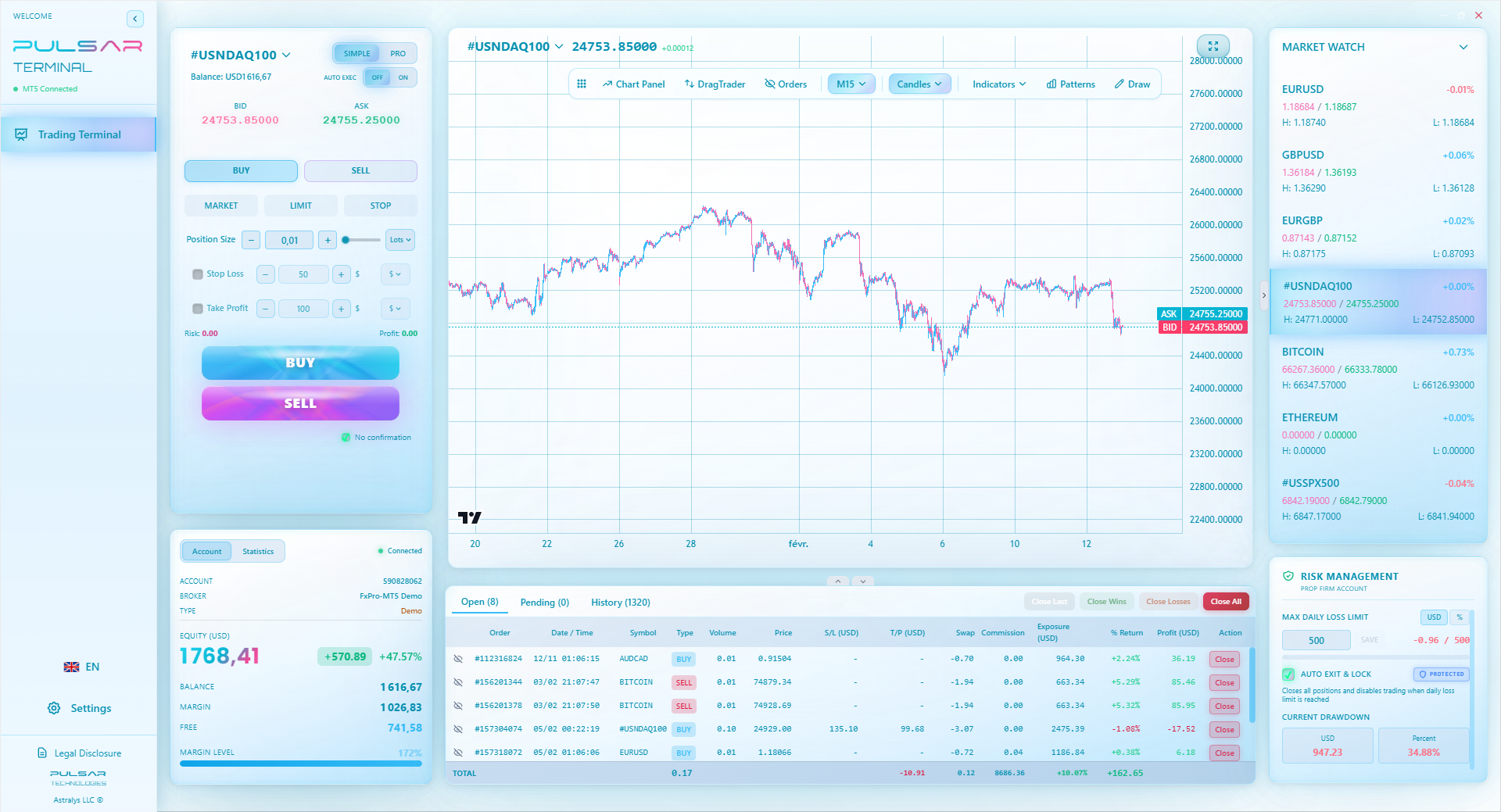
Managing multiple Ichimoku-based trades with manual stops is chaotic; Pulsar Terminal lets you set multi-level take-profits and trailing stops automatically on MT5, so you can focus on the analysis.
Pulsar Terminal
Das All-in-One MT5-Tool: Drag-and-Drop-Orders, Multi-TP/SL, Trailing Stop, Grid Trading, Volume Profile und Prop-Firm-Schutz. Täglich von 1.000+ Tradern genutzt.
“Trying to buy in a red cloud below price is like trying to swim upstream in the Ganga during monsoon. Don't do it.”
Ichimoku is a complete system, but I'm not a purist. I use it as my foundation and bring in one or two other tools for confirmation, especially on entries.
Volume is the Truth-Teller: An Ichimoku Kumo breakout with surging volume is far more trustworthy than one with thin volume. On Indian platforms, always have volume bars on your chart. A bullish TK Cross on high volume? That's institutional money playing along.
RSI for Momentum Confluence: The RSI indicator is a good partner. Look for scenarios where Ichimoku gives a trend-aligned signal (e.g., Kumo bounce in uptrend) and the RSI is bouncing from the 40-50 zone (not oversold). It confirms the momentum shift. I avoid buying when RSI is above 70, even if Ichimoku looks good - it's often too late.
Price Action & Key Levels: Ichimoku's cloud shows future zones, but past swing highs/lows and round numbers still matter. If a bullish cloud projects resistance right at a known historical high (say, Nifty at 24,000), expect a fight. Use that knowledge to manage profits.
The goal is to build a filter stack. Ichimoku defines the battlefield (trend & future S/R). Price action or volume gives you the entry trigger. This keeps you from overtrading and forces you to wait for high-quality setups where multiple factors align.
💡 Winstons Tipp
Always check the Chikou Span's position relative to price from 26 bars ago. If it's stuck in a cluster of old price bars, the trend lacks conviction, no matter how good the other signals look.
“That ₹47,000 loss taught me more about Ichimoku than any book ever could. The Chikou Span was screaming, and I wasn't listening.”
After 12 years and mentoring dozens of traders, these are the mistakes that keep costing people money.
- Trading the TK Cross in Isolation: This is the #1 mistake. A TK Cross is not a 'buy' or 'sell' signal. It's a momentum shift signal that only has value within the context of the cloud trend. Ignoring the cloud is a recipe for getting whipsawed.
- Ignoring the Chikou Span: Out of sight, out of mind. Because it's lagged behind, new traders ignore it. But it's your canary in the coal mine for hidden weakness or strength. Always check it.
- Using it on Low Timeframes for Scalping: Ichimoku was designed for capturing larger swings. On a 1 or 5-minute chart, the cloud is too slow, and the signals are noisy. You'll get chopped up. Use it on 1-hour charts and above for clearer signals.
- Forgetting About Costs: As discussed, each trade in India has a cost. Chasing tiny Ichimoku signals on small timeframes guarantees your broker wins, not you.
- No Patience with the Cloud: The cloud projects 26 periods ahead. Sometimes, price needs time to approach it or build energy for a breakout. New traders see a bullish cloud ahead and jump in immediately, only to sit through consolidation for days. Wait for price to engage with the cloud.
My advice? Paper trade it first. Apply the rules strictly on historical data for Nifty or a stock you know. See how the signals played out. Then, move to a small live account. This isn't a get-rich-quick scheme. It's a framework for understanding market equilibrium. When you learn to read it, the chart starts talking to you.
FAQ
Q1Is the Ichimoku trading strategy legal in India?
Yes, absolutely. Using Ichimoku Kinko Hyo as a technical analysis method is perfectly legal. There are no SEBI rules against any charting technique. However, you must apply it to legally tradable instruments within India (like NSE/BSE stocks, indices, or currency derivatives) through a SEBI-registered broker. Using it to trade illegal instruments like EUR/USD on offshore platforms is not permitted.
Q2What are the best Ichimoku settings for Indian market timings?
The classic settings (9, 26, 52) work well on daily and weekly charts, which are independent of session hours. For intraday charts, some traders adjust them to align with the 6.5-hour Indian trading day (e.g., 10, 30, 60). However, I recommend starting with the default settings on timeframes of 1-hour and above. The system's logic matters more than perfect numerical alignment. Consistency is key.
Q3Can I use Ichimoku Cloud for scalping Bank Nifty?
You can, but I wouldn't recommend it as your primary tool. Ichimoku components, especially the cloud, are slower-moving. On very low timeframes (like 1-5 minutes), signals will be late and whipsaws are common. It's better used on higher timeframes (like 15-min or 1-hour) to define the intraday trend, and then use faster price action or order flow for precise scalping entries.
Q4How do I avoid false signals with the Ichimoku TK Cross?
Filter it with the cloud. Only take a bullish TK Cross signal if price is above the Kumo (cloud), or if the cross occurs as price is breaking out above the cloud. Ignore all TK Crosses that happen deep inside or below a bearish (red) cloud. Similarly, only take bearish TK Crosses when price is below or breaking down from the cloud. The cloud context eliminates most false signals.
Q5What's the most important line in the Ichimoku system?
For trend identification, it's the Kumo (cloud). It defines bullish vs. bearish territory. For trade timing, it's the Kijun-sen (Base Line). It acts as dynamic support/resistance and its breach is a key event. However, the true power comes from the confluence of all elements - price relative to cloud, TK Cross, and Chikou Span position. No single line tells the whole story.
Q6Can I automate an Ichimoku strategy in India?
Yes, but it falls under SEBI's algorithmic trading regulations. You or your broker must tag all orders with a unique Algo ID, and API access requires strict security (2FA, static IP). If you use a third-party software or code to automate it, the provider may need to be empanelled with the broker. It's not a simple plug-and-play; you must ensure full regulatory compliance to avoid penalties.
Q7Does Ichimoku work on USD/INR futures?
It works exceptionally well. Currency pairs often exhibit strong trends, and the Ichimoku cloud is brilliant at identifying and projecting support/resistance in these trends. Use it on the daily chart of USD/INR futures to gauge the primary direction, and then use lower timeframes (4H, 1H) aligned with that trend for specific entry signals.
Prof. Winstons Lektion
Wichtige Erkenntnisse:
- ✓Never trade a TK Cross without cloud confirmation.
- ✓The Chikou Span is your hidden divergence detector.
- ✓Use Ichimoku on 1-hour+ timeframes, not for scalping.
- ✓A Kumo breakout with volume is high-probability.
- ✓Always align trades with the higher timeframe cloud.
Wie nützlich war dieser Artikel?
Klicken Sie auf einen Stern
Wöchentliche Trading-Einblicke
Kostenlose wöchentliche Analysen & Strategien. Kein Spam.
Über den Autor
Rajesh Sharma
Senior Forex-Analyst
Über 10 Jahre Erfahrung an indischen und südasiatischen Märkten. Begann mit NSE-Währungsderivaten, bevor er zum internationalen Forex wechselte. Spezialisiert auf USD/INR und Schwellenländer-Paare.
Kommentare
Risikohinweis
Der Handel mit Finanzinstrumenten birgt erhebliche Risiken und ist möglicherweise nicht für alle Anleger geeignet. Vergangene Ergebnisse garantieren keine zukünftigen Renditen. Dieser Inhalt dient ausschließlich Bildungszwecken und stellt keine Anlageberatung dar. Führen Sie immer Ihre eigene Recherche durch, bevor Sie handeln.
Das könnte Sie auch interessieren

Cara Trading Forex Sukses: 7 Prinsip dari Trader Profesional
Cara trading forex sukses dengan 7 prinsip trader pro: manajemen modal, disiplin, journal trading, backtest. Data nyata, bukan janji profit palsu.
Jam Trading Forex Terbaik untuk Trader Indonesia: Panduan Lengkap dengan Tabel Waktu
Panduan jam trading forex untuk trader Indonesia. Tabel 4 sesi dunia, jam emas 20:00-00:00, sesi mana yang harus dihindari. Data akurat + tips dari trader berpengalaman.
Top 5 Sàn Forex Uy Tín Nhất 2026: Review Jujur dari Trader Indonesia
Top 5 sàn forex uy tín 2026 untuk trader Indonesia. Review jujur: spread, deposit, withdraw, dukungan lokal. Exness, XM, IC Markets & lebih.
Pulsar Terminal herunterladen
Alle diese Rechner sind in Pulsar Terminal mit Echtzeit-Daten Ihres MT5-Kontos integriert.
Pulsar Terminal herunterladen