


Let's be honest.

Olumide Adeyemi
Pionier des Tradings in Westafrika ·  Nigeria
☕ 10 Min. Lesezeit
Was Sie lernen werden:
- 1What Is Forex, and Why Is Nigeria Obsessed?
- 2The Nigerian Regulatory Reality Check
- 3Real Costs and How to Pick a Broker
- 4Core Concepts You Actually Need (Not the Fluff)
- 5Building Your First Trading Plan (The Nigerian Edition)
- 6Pitfalls Every Nigerian Trader Must Avoid
- 7Your First Steps to Getting Started
Let's be honest. Most introductions to forex trading are useless. They tell you about pips and lots but skip the part where you lose your first N500,000 because you didn't understand the Naira's volatility or the CBN's rules. This isn't that guide. This is a 12-year trader's journal entry from Lagos, covering what actually matters: navigating Nigeria's unique market, avoiding regulatory pitfalls, and building a strategy that works when the power cuts out. I'll prove that success here depends less on fancy indicators and more on understanding local context.
Forex is simply buying one currency while selling another. You're betting on the exchange rate between them, like Naira to US Dollar (NGN/USD) or Euro to Dollar (EUR/USD). It's the world's largest financial market, trading over $7 trillion daily. But in Nigeria, it's more than that. It's a lifeline.
With persistent Naira depreciation - we saw a 40.9% drop against the dollar in the official market in 2024 - and limited traditional investment options, forex trading became a logical, if risky, hedge. People aren't just trading for luxury; many are trying to protect their savings from inflation. The average daily FX turnover here has skyrocketed from about $150 million in 2021 to over $430 million by 2025. That's a lot of people looking for an edge.
My own obsession started in 2013. I watched the Naira slowly lose ground and thought, "There has to be a way to position myself on the right side of this." My first trade was a disaster (more on that later), but it highlighted the core appeal: in a volatile economy, currency markets move. And where there's movement, there's opportunity, if you know how to handle it.

Warning: Don't confuse trading with a get-rich-quick scheme. It's a skill. Treating it as the former is the fastest way to lose your capital. The high use brokers offer (like 1:400) can amplify gains but will destroy an account just as quickly if you're careless.
This is where most generic guides fail. You can't talk about an introduction to forex trading here without understanding the legal fog.
Officially, individual forex trading is legal. The Central Bank of Nigeria (CBN) and the Securities and Exchange Commission (SEC) are the main watchdogs. But the rules for you and me, the retail traders, are murky. The CBN's primary goal is to manage foreign exchange outflows and protect the Naira. They've explicitly said using official FX windows (where dollars are cheaper) to fund trading accounts is a no-go - they call it economic sabotage.
The Brokerage Dilemma
You'll hear conflicting advice. Some sources say you must use a CBN-licensed broker. In practice, how many pure retail forex brokers are fully licensed by the CBN? Very few. So what do Nigerian traders do? We overwhelmingly use international brokers regulated abroad.
We're talking about brokers under the Seychelles FSA, the British Virgin Islands FSC, South Africa's FSCA, or Cyprus's CySEC. These brokers accept Nigerian clients. Is it technically allowed? The regulatory framework is so underdeveloped that it exists in a grey area. The common understanding is that while the CBN prefers you use local channels, there's no active law stopping you from trading with an international firm. However, any profit you make is absolutely subject to Nigeria's 10% Capital Gains Tax, payable to the FIRS. Keep your records straight.
My advice? Prioritize brokers with strong international reputations. I've had good experiences with brokers like Exness and IC Markets for their reliability during our frequent network issues. Their non-CBN regulation is, for now, the pragmatic choice for most serious traders.

💡 Winstons Tipp
Your first N100,000 in the market is tuition, not investment. Expect to learn from losing it. The goal is to make the lessons cheap.
“High use is the number one reason new traders blow up accounts.”
Forget the advertised "zero spread" hype. Your real cost of trading is a combination of the spread, commissions, and swap fees. Let's break it down with numbers relevant to us.
The spread is the difference between the buy and sell price. It's how many brokers make money. For the EUR/USD, the world's most traded pair:
- Capital.com averages around 0.64 pips.
- Exness Standard account is about 1 pip.
- Tickmill's Classic account starts from 1.6 pips.
A "pip" is the smallest price move. If you don't know how to calculate its value, our pip definition guide is essential.
Then there are commissions. Some brokers offer "raw" spreads from 0.0 pips but charge a commission per lot. For example, FP Markets charges $6.00 per standard round lot. Is that cheaper than a 1-pip spread? It depends on your trade size, which is why using a position size calculator is non-negotiable.
Minimum Deposits and use
Brokers know the Nigerian market. Minimum deposits are often low to attract traders. XTB offers $0 minimum, Capital.com is $20, AvaTrade is $100. This low barrier is a double-edged sword. It lets you start small, but it pairs dangerously with the high use offered here - up to 1:400 in some cases.

Pro Tip: Never use the maximum use. Ever. I treat 1:50 as my absolute ceiling, and even that's for very short-term trades. High use is the number one reason new traders blow up accounts. It directly leads to a margin call.
When selecting a broker, look for:
- Reliable Execution: Test their platform during Lagos peak hours.
- Deposit/Withdrawal Methods: Do they support local bank transfers or cards? How long do withdrawals take?
- Customer Support: 24/5 support is a must. You don't want to be stuck when a trade goes south at 10 PM.
I learned this the hard way. In 2017, I funded an account with a flashy broker offering 1:500 use. The spread would widen massively during news events, stopping me out of trades that would have been winners. I lost N300,000 in two weeks. The platform was cheap for a reason.
Let's strip it back to the essentials you'll use every day.
Currency Pairs: You'll mostly trade major pairs (like EUR/USD, GBP/USD) and exotics that involve the Naira (like USD/NGN on CFDs, though this is complex). Start with majors. They have the tightest spreads and most predictable liquidity. Our EUR/USD guide is a great deep dive on the most popular pair.
Going Long vs. Short: If you buy (go long) EUR/USD, you expect the Euro to rise against the Dollar. If you sell (go short), you expect it to fall. This is the basic speculation.
Lots and Position Sizing: A standard lot is 100,000 units of currency. A mini lot is 10,000, a micro lot is 1,000. Trading a standard lot on EUR/USD means each pip movement is worth about $10. That's huge for a small account. This is why position sizing is your most important risk tool. Trading 0.01 (micro) lots is where most Nigerians should start.
Analysis: The Two Schools
- Technical Analysis: Using charts, patterns, and indicators to predict future movement. Tools like the RSI indicator (to spot overbought/oversold conditions) and the MACD indicator (for trend momentum) are staples in my toolkit.
- Fundamental Analysis: Trading based on economic news, interest rates, and geopolitical events. In Nigeria, this means watching CBN MPC meeting announcements, oil prices, and monthly inflation data like a hawk.
Most successful traders blend both. I might use a technical setup on GBP/USD, but I'll avoid opening a trade just before a major UK inflation report is released.
💡 Winstons Tipp
In Nigeria, your generator is as important as your charting software. Factor infrastructure risk into every trade plan.
“In a volatile economy, currency markets move. And where there's movement, there's opportunity, if you know how to handle it.”
A trading plan without local context is a recipe for failure. Yours must account for our unique challenges.
Your Strategy
Choose a style that fits your life. Are you a student with a laptop? Scalping strategy (entering and exiting trades in minutes) might seem appealing, but it requires intense screen time and a rock-solid internet connection - a tall order in many parts of Nigeria. A swing trading approach, holding trades for days or weeks, is often more practical. It doesn't require you to stare at charts all day.
Risk Management Rules
This is your survival manual. Mine looks like this:
- Risk Per Trade: Never risk more than 1% of my total account balance on a single trade. If my account is N500,000, my maximum loss on any trade is N5,000.
- Stop-Loss Orders: Every single trade has a stop-loss order set before I enter. This is an automatic order that closes my trade at a predetermined loss level. It removes emotion.
- Profit Targets: I decide my take-profit level in advance. A common rule is to aim for at least 1.5 times what you're risking (a 1:1.5 risk-reward ratio).
The Practicalities
- Power & Internet: Have a backup plan. A good inverter or generator is a trading tool. Use a mobile data hotspot as a backup to your fibre line.
- Trading Hours: The most liquid sessions are the London (2 PM - 5 PM our time) and overlapping London/New York sessions. Plan your analysis around these times.

Example: Let's say I have a N200,000 account. My 1% rule means I can risk N2,000 per trade. I see a setup on Gold (XAU/USD) where my stop-loss is 50 points away. Using a position size calculator, I find that to risk only N2,000, I should trade a position size of 0.04 lots. This precise math keeps me in the game. For more on trading gold, see our XAU/USD guide.
I've fallen into most of these. Learn from my losses.
1. Chasing the Naira Narrative: It's 2024. The Naira is in freefall. "I'll just short USD/NGN forever!" This is emotional trading, not analytical. When the CBN intervenes or oil prices jump, the Naira can have sharp, painful rallies that wipe out months of profits. I lost N150,000 in a single day in June 2024 thinking the downtrend was infinite.
2. Overleveraging with Small Capital: You deposit N50,000, use 1:200 use, and suddenly you're controlling N10,000,000 in the market. A 0.5% move against you wipes out your entire account. It feels like you're close to big money, but you're actually closest to zero.
3. Ignoring Total Costs: You take 10 trades a day, each with a 1.5 pip spread. On a micro lot (0.01), that's about $0.15 per trade in cost. Ten trades is $1.50. Do that for 20 days a month, and you've paid $30 in spreads alone. Your strategy needs to overcome this friction.
4. No Written Plan: You wing it. Today you're a scalper, tomorrow a fundamentalist. This inconsistency is a guaranteed path to losses. Write your rules down and follow them, even when it's boring.
5. Prop Firm Hype: Prop trading firms are huge here. They promise you access to large capital if you pass a challenge. The catch? Their rules are brutally strict, often with daily loss limits. You need robotic discipline to pass. Using tools that automate protection, like setting a hard daily loss limit, isn't cheating - it's essential for surviving their evaluations.
💡 Winstons Tipp
If you can't explain your trade setup in one simple sentence, you don't understand it. Complexity is the enemy of execution.
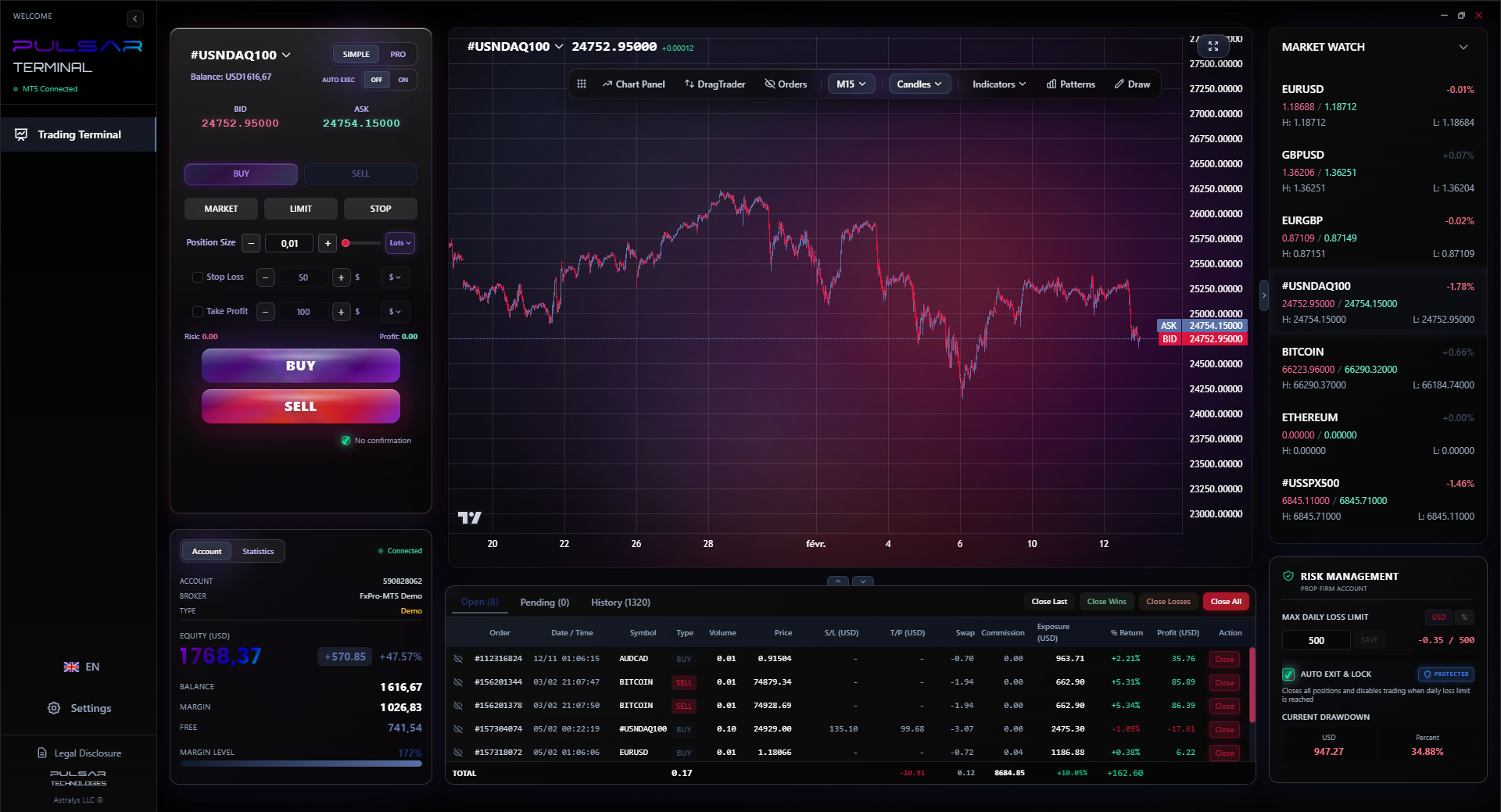
Managing risk and sticking to a prop firm's strict daily loss limits is nearly impossible manually, which is why tools like Pulsar Terminal automate this protection directly on your MT5 platform.
Pulsar Terminal
Das All-in-One MT5-Tool: Drag-and-Drop-Orders, Multi-TP/SL, Trailing Stop, Grid Trading, Volume Profile und Prop-Firm-Schutz. Täglich von 1.000+ Tradern genutzt.
“Your trading plan without local context is a recipe for failure.”
Let's translate all this into action.
- Educate Relentlessly: Finish this guide. Read our other instrument and strategy guides. Watch reputable trading mentors, but be skeptical of "signal sellers" promising guaranteed returns.
- Open a Demo Account: This is practice money. Don't skip this. Pick a broker like XM or Pepperstone that offers a unlimited demo. Trade on it for at least three months. Your goal isn't to make fake profit, but to execute your trading plan 100 times without deviating.
- Start a Trading Journal: Document every trade. Entry price, exit price, why you took it, your emotional state. Review it weekly. This is how you find your personal edge.
- Fund a Live Account Small: Start with an amount you can afford to lose completely - maybe N50,000. Trade micro lots (0.01) only. Your goal for the first six months is not profit, but survival and consistency.
- Continuously Adapt: The market changes. The Naira's dynamics in 2026 will be different from 2024. Your plan must evolve. Stay informed about local and global economics.
This introduction to forex trading isn't about giving you a magic formula. It's about giving you the map and warning you where the quicksand is. The rest is up to your discipline. Good luck, and trade safely.
FAQ
Q1Is forex trading legal in Nigeria?
Yes, forex trading by individuals is legal. However, the specific regulations for retail traders are not fully developed. The CBN prohibits using official foreign exchange windows to fund trading accounts. Most Nigerian traders use internationally regulated brokers, which operates in a practical grey area. You must pay 10% capital gains tax on any profits.
Q2How much money do I need to start forex trading in Nigeria?
You can start with a very small amount due to low minimum deposits. Brokers like XTB require $0, Capital.com $20. However, I strongly recommend starting with at least N50,000 - N100,000 in a live account. This allows for proper position sizing and risk management without being forced to use dangerously high use just to see meaningful moves.
Q3What is the best forex trading strategy for beginners in Nigeria?
Swing trading is often more practical than scalping for beginners here. It involves holding trades for several days, which doesn't require constant screen time or a perfect internet connection. It allows you to analyze the market around stable power/internet hours and manage your trades without stress. Focus on mastering one or two major currency pairs first.
Q4Which forex broker is best for Nigerian traders?
There's no single "best" broker. Look for international brokers with strong regulation (like FSCA, CySEC), reliable deposit/withdrawal methods for Nigeria, and stable platforms. Brokers like Exness, IC Markets, and XM are popular choices among Nigerian traders for their accessibility and service. Always test a broker with a demo account first.
Q5How do I avoid losing money in forex trading?
You can't avoid losses entirely; they are part of trading. The goal is to manage them. Use a stop-loss on every trade, never risk more than 1-2% of your account on a single trade, avoid overleveraging, and have a written trading plan you follow consistently. Emotional decisions are the biggest cause of large losses.
Q6Do I pay tax on forex trading profits in Nigeria?
Yes. Profits from forex trading are subject to Capital Gains Tax (CGT) at a rate of 10%. You are responsible for declaring this income and paying the tax to the Federal Inland Revenue Service (FIRS). Keep detailed records of all your trades for tax purposes.
Prof. Winstons Lektion
Wichtige Erkenntnisse:
- ✓Risk a maximum of 1% per trade, no exceptions.
- ✓Start with swing trading, not scalping, for practicality.
- ✓Demo trade for 3 months before using real money.
- ✓Factor in a 10% capital gains tax on all profits.
- ✓Prioritize brokers with FSCA or CySEC regulation.
Wie nützlich war dieser Artikel?
Klicken Sie auf einen Stern
Wöchentliche Trading-Einblicke
Kostenlose wöchentliche Analysen & Strategien. Kein Spam.
Über den Autor
Olumide Adeyemi
Pionier des Tradings in Westafrika
Einer der aktivsten Forex-Trading-Ausbilder Nigerias. 8 Jahre Trading-Erfahrung aus Lagos. Spezialisiert auf Strategien mit geringem Kapital und Prop-Firm-Challenges für afrikanische Trader.
Kommentare
Risikohinweis
Der Handel mit Finanzinstrumenten birgt erhebliche Risiken und ist möglicherweise nicht für alle Anleger geeignet. Vergangene Ergebnisse garantieren keine zukünftigen Renditen. Dieser Inhalt dient ausschließlich Bildungszwecken und stellt keine Anlageberatung dar. Führen Sie immer Ihre eigene Recherche durch, bevor Sie handeln.
Das könnte Sie auch interessieren

Cara Trading Forex Sukses: 7 Prinsip dari Trader Profesional
Cara trading forex sukses dengan 7 prinsip trader pro: manajemen modal, disiplin, journal trading, backtest. Data nyata, bukan janji profit palsu.
Jam Trading Forex Terbaik untuk Trader Indonesia: Panduan Lengkap dengan Tabel Waktu
Panduan jam trading forex untuk trader Indonesia. Tabel 4 sesi dunia, jam emas 20:00-00:00, sesi mana yang harus dihindari. Data akurat + tips dari trader berpengalaman.
Top 5 Sàn Forex Uy Tín Nhất 2026: Review Jujur dari Trader Indonesia
Top 5 sàn forex uy tín 2026 untuk trader Indonesia. Review jujur: spread, deposit, withdraw, dukungan lokal. Exness, XM, IC Markets & lebih.
Pulsar Terminal herunterladen
Alle diese Rechner sind in Pulsar Terminal mit Echtzeit-Daten Ihres MT5-Kontos integriert.
Pulsar Terminal herunterladen