


I lost ₹1.8 lakh in 2018 not from a bad trade, but from ignorance.

Rajesh Sharma
Senior Forex-Analyst ·  India
India
☕ 11 Min. Lesezeit
Was Sie lernen werden:

I lost ₹1.8 lakh in 2018 not from a bad trade, but from ignorance. I'd been happily scalping EUR/USD through an offshore broker for months. Then a notice arrived from my bank, freezing my account and demanding details of all 'unauthorized foreign exchange transactions.' The profit was gone, plus a fine. That's when I learned the hard way that in India, you don't just trade the markets, you trade within a legal minefield. The question 'is forex trading illegal in India' doesn't have a simple yes or no. It has a 'yes, but' and a 'no, unless.' Let's cut through the broker marketing nonsense and get real about what you can and cannot do.
Forget everything you see on YouTube ads. In India, forex isn't a free market. It's a heavily guarded fortress. The rulebook is written by two giants: the Reserve Bank of India (RBI) and the Securities and Exchange Board of India (SEBI), under the Foreign Exchange Management Act (FEMA) of 1999.
FEMA isn't a suggestion. It's the law. Its main job is to control the flow of money in and out of India to protect the rupee. Any transaction that skirts these rules is illegal. Full stop.
SEBI regulates the 'how.' They decide which instruments you can trade and on which platforms. For retail traders like you and me, the door is open only a tiny crack. You can trade currency derivatives - futures and options - on recognized Indian exchanges like the NSE, BSE, or MSE. That's it. Direct spot forex trading, where you buy and sell currencies for immediate delivery, is completely off-limits for residents.

Warning: The Liberalised Remittance Scheme (LRS), which lets you send $250,000 abroad per year, explicitly cannot be used for speculative forex trading. Using it to fund an offshore trading account is a direct FEMA violation. They will catch it.
The permitted list is brutally short. You can only trade pairs where one leg is the Indian Rupee (INR). Think USD/INR, EUR/INR, GBP/INR, JPY/INR. Dreaming of trading the volatile moves on EUR/USD or the commodity swings on AUD/USD? Through legal Indian channels, you can't. That's the first, and biggest, shock for most new traders.
This framework exists for a reason. The RBI is fighting a constant battle to manage the rupee's value against global shocks. Letting retail money flood into offshore EUR/USD trades directly undermines that control. Your trading freedom is sacrificed for (what they see as) broader economic stability. Understanding this isn't academic, it's the difference between building a career and facing a margin call from the Enforcement Directorate.

💡 Winstons Tipp
The only spread that matters in India is the one between legal and illegal. Get that wrong, and no trading skill will save you.

This is where you need to pay attention. The line between legal and illegal is razor sharp, and the consequences are financial ruin.
Illegal Activities:
- Trading Forex Pairs without INR: Opening a position on EUR/USD, GBP/USD, Gold (XAU/USD), or any other major/minor pair through any platform is illegal. It doesn't matter if the broker is 'regulated' in Cyprus, Australia, or the Bahamas. If you're an Indian resident and the pair doesn't include INR, you're breaking the law.
- Using Unauthorized Platforms: This includes almost every popular international broker you've heard of. The RBI maintains an 'Alert List' of unauthorized entities. As of late 2025, this list had 95 names, including big ones like OctaFX, XM, Pepperstone, FP Markets, and even the MetaTrader 4 and MetaTrader 5 platforms themselves when used for illegal forex. Check out our Exness review or IC Markets review to see how they operate in regulated jurisdictions, but know they are not options for you in India.
- Spot Forex Trading: Any attempt to directly buy/sell currency pairs for immediate settlement is prohibited for retail.
The Penalties (This Will Wake You Up): The fines aren't a slap on the wrist. Under FEMA, penalties can be:
- Three times the amount involved in the illegal transaction.
- Or up to ₹5 lakh if the sum isn't quantifiable.
- Plus a recurring penalty of ₹10,000 for every single day the violation continues.
- Imprisonment for up to five years.
- Confiscation of the assets involved in the transaction.
Let's make that real. If you illegally trade a $10,000 position on GBP/USD, the fine could theoretically be $30,000 (approx. ₹25 lakh) plus daily penalties. They seized ₹172 crore from OctaFX's Indian operations in 2025. They're not messing around.

Example: In 2024, India saw over 3.6 million cyber fraud cases, with losses topping ₹22,800 crore. A huge chunk of this is from fake or illegal trading platforms. If you send money to an illegal offshore broker and they vanish, you have zero legal recourse. The RBI won't help you recover funds from an entity they've already warned you not to use.
Your bank is your first line of enforcement. They monitor transactions for suspicious forex activity. The moment you try to withdraw large profits from an offshore broker to your Indian account, red flags go up. That's how I got caught.

“The potential 5-year prison sentence isn't for show. For what? A slightly better charting package?”
So, is all hope lost? No. You just have to play a different game. The legal path is narrower, more institutional, but it's stable and safe from regulatory nightmares.
The Instruments: Futures & Options Only
You won't be trading a 'forex pair' in the traditional sense. You'll be trading standardized contracts on the National Stock Exchange (NSE) or BSE. The most liquid is the USD/INR futures contract. Each contract is for $1000. The price quotes how many rupees it takes to buy one US dollar.
If you believe the rupee will weaken (USD will strengthen), you buy a USD/INR futures contract. If you think the rupee will strengthen, you sell it. The pip concept still applies, but it's in paise (0.01 INR). A move from 83.50 to 83.55 is a 5 paise (or 5 pip) move.
The Brokers: SEBI-Registered Only
You must use a SEBI-registered broker. These are primarily equity brokers who also offer currency derivatives. Popular names include Zerodha, Upstox, Angel One, ICICI Direct, HDFC Securities, and Kotak Securities. Their platforms are built for the Indian markets. Don't expect the same charting sophistication as MetaTrader, but they get the job done. You'll need to complete your KYC just like for a stock trading account.
The Strategy Shift
Forget about the 24/5 market. Currency derivatives on NSE have specific trading hours (9 AM to 5 PM, typically). This kills most scalping strategies that rely on the London or New York opens. You're trading the Indian banking hours, which are driven by domestic dollar demand, RBI intervention rumors, and global risk sentiment filtered through the local lens.
Volatility can be high around key economic data releases. I once caught a 45-pip move on USD/INR futures within 15 minutes after an RBI policy announcement that was more hawkish than expected. Entry at 83.20, exit at 83.65. The profit was clean, legal, and hit my bank account without a single question asked. That's the peace of mind you're buying.
You'll need to adjust your technical analysis too. Support/Resistance, MACD indicator, and RSI indicator still work, but the volume profile is different. Use a position size calculator religiously, as contract sizes are fixed. This is more suited to swing trading or day trading based on domestic flows.
💡 Winstons Tipp
Your first analysis before any trade should be: 'Can I explain this to a bank manager without him calling the ED?' If not, walk away.

If you manage to make money legally, the Income Tax Department wants its share. How they tax it depends on how you trade.
1. As Business Income: If the authorities deem your trading to be a business (based on frequency, volume, and organization), your net profits are added to your total income and taxed at your applicable slab rate. This can be as high as 30% plus cess. You can claim deductions for expenses like internet, brokerages, and platform fees.
2. As Capital Gains: This is the more common route for most active traders in derivatives. Profits from futures and options are considered 'Speculative Business Income' but are taxed similarly to short-term capital gains.
- Short-Term: Since derivatives are settled in less than 12 months, all gains are short-term.
- Tax Rate: A flat 15% (plus cess and surcharge) applies to these short-term gains from equity/currency derivatives.
3. Goods and Services Tax (GST): You also pay GST on the brokerage fees you incur. This is typically 18% of the brokerage charged by your broker. It's not on your profit, but it's an additional cost of doing business.
Keep careful records. Every trade, every contract note from your broker. I use a simple spreadsheet logging date, instrument, entry/exit, profit/loss, and brokerage paid. When tax season comes, it's a 30-minute job instead of a panic-filled weekend.

Pro Tip: Consult a CA who understands trading. The classification of your income (business vs. capital gains) can significantly impact your tax liability. A few thousand rupees in fees can save you lakhs in taxes if you're a high-volume trader.

“Your trading freedom is sacrificed for what the RBI sees as broader economic stability.”
I know what you're thinking. 'My friend uses XM and withdraws profits all the time.' Or, 'Pepperstone has tighter spreads, I'll just use a VPN.'
Let me tell you why this is a terrible, life-altering idea.
First, the technicalities. When you sign up with an offshore broker, you lie about your residency. You commit fraud from the first click. They ask for utility bills for proof of address? You fake them. That's not just a FEMA violation, that's outright fraud.
Second, the money trail. To fund the account, you might use a credit card, a crypto transfer, or an international bank wire. When you win and want to withdraw, that money needs to come back to your Indian bank account. Large, repeated international credits from a financial entity your bank doesn't recognize trigger automatic reports. The bank's compliance officer will ask for the source. Your story about 'trading profits from an offshore platform' is an admission of guilt. They can, and will, refuse the credit and report it.
Third, you have zero protection. If XM or Pepperstone (both on RBI's Alert List) decides, for any reason, to freeze your account, withhold your profits, or claim you violated their terms, who do you call? SEBI? They'll laugh at you. The financial regulator in Cyprus or Vanuatu? Good luck with that from India. You are at their absolute mercy.
The RBI's Alert List is updated constantly. In October 2024, they added 13 entities. By late 2025, it hit 95. The enforcement is ramping up, not slowing down. The ED's action against OctaFX (₹800 crore alleged fraud) is a signal to everyone. The crackdown is real.
You're not just risking your trading capital. You're risking your entire banking relationship, your credit score, and your freedom. The potential 5-year prison sentence isn't for show. For what? A slightly better charting package or the ability to trade Gold? It's the worst risk-reward trade you'll ever make.
💡 Winstons Tipp
Master the 4-hour and daily charts on USD/INR. The noise of the 24/5 global market is gone. What's left is pure price action driven by real money flows. It's a cleaner game.

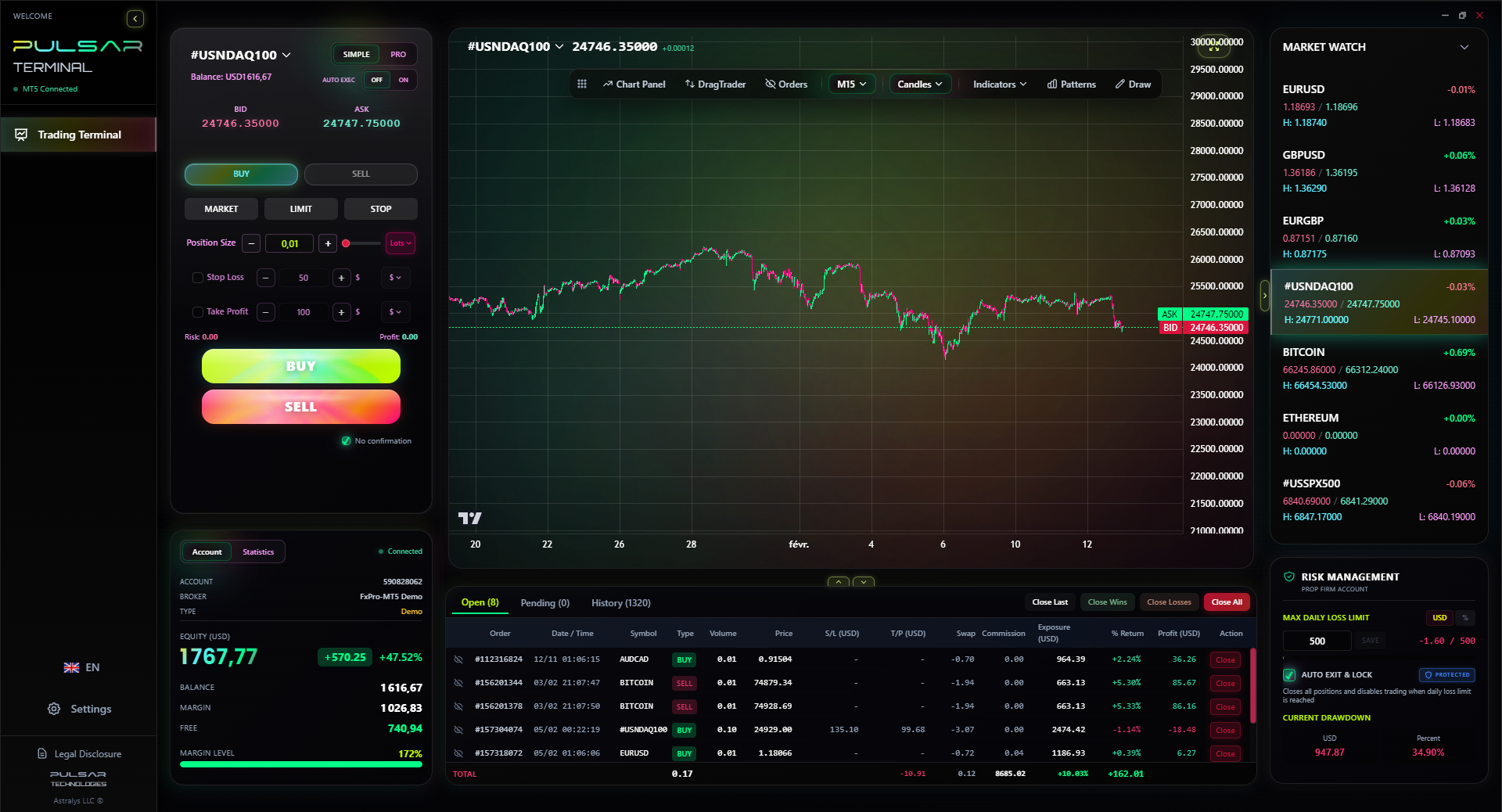
Managing risk on legal Indian platforms is paramount, and tools like Pulsar Terminal can automate complex order strategies directly on compatible platforms, helping you stick to your plan without emotional interference.
Pulsar Terminal
Das All-in-One MT5-Tool: Drag-and-Drop-Orders, Multi-TP/SL, Trailing Stop, Grid Trading, Volume Profile und Prop-Firm-Schutz. Täglich von 1.000+ Tradern genutzt.
Looking at the trend, don't hold your breath. If anything, regulations are getting tighter.
In April 2026, the RBI introduced new rules further tightening forex derivatives. They banned banks from offering certain non-deliverable INR derivative contracts to users, stopped the rebooking of cancelled contracts, and barred transactions with related parties. The goal? Curb speculation and reduce rupee volatility. The message is clear: less speculation, more control.
The RBI has also made the Legal Entity Identifier (LEI) mandatory for all market participants. This increases transparency but also makes it easier for them to track every single transaction back to a legal entity. The system is becoming more monitored, not less.
The driving force is India's foreign exchange reserves. They're a point of national pride and a key economic defense. They swung from a high of over $725 billion in early 2026 down to around $709 billion in a matter of weeks. This kind of volatility makes the RBI incredibly nervous about uncontrolled capital flows.
Could a digital rupee or further financial digitization change things in a decade? Maybe. But for the foreseeable future, the fortress walls are being reinforced, not lowered. Your strategy should be built on this reality. Master the USD/INR futures market. Understand the unique drivers of the rupee. Become an expert in the one legal arena you have, rather than pining for the illegal ones you don't.
Pro Tip: The legal USD/INR market has its own advantages. It's less picked over by algorithmic funds that dominate EUR/USD. A solid understanding of RBI policy, domestic dollar demand, and seasonal flows (e.g., IT company dollar conversions) can give you an edge you'd never have on the crowded majors. Focus your energy there.
FAQ
Q1Can I use MetaTrader 4 or 5 for legal trading in India?
No. The RBI's Alert List explicitly names 'MetaTrader 4' and 'MetaTrader 5' as unauthorized Electronic Trading Platforms (ETPs) for forex transactions in India. Using them to connect to any broker for forex trading violates FEMA rules. For legal trading, you must use the trading platforms provided by your SEBI-registered Indian broker (like Zerodha's Kite or Upstox).
Q2Is trading Gold (XAU/USD) or Crypto legal in India?
Trading XAU/USD (Gold vs US Dollar) through an international forex/CFD broker is illegal for Indian residents, as it is a non-INR pair. Trading in cryptocurrencies is a separate, gray area. While buying/holding crypto on Indian exchanges might have some tolerance, trading crypto derivatives (like BTC/USD) through offshore platforms almost certainly falls foul of FEMA for similar forex violation reasons. It's a high-risk zone.
Q3What happens if I have an old account with an offshore broker but don't trade anymore?
The safest course is to formally close the account and withdraw any remaining balance. An inactive account is still a liability. If the broker is ever investigated (like OctaFX was), your data could be part of that investigation. Having an account is evidence of attempting an unauthorized transaction. Clean it up.
Q4Are the profits from legal currency futures trading taxable?
Yes. Profits from trading currency futures and options on Indian exchanges are typically taxed as short-term capital gains at a flat rate of 15% (plus cess and surcharge), regardless of your income tax slab. You must declare these in your ITR.
Q5Can NRI (Non-Resident Indian) trade freely on international platforms?
It depends on their residency status. If they are legally resident outside India (and can prove it with address proofs), they are generally subject to the laws of their country of residence. They can use international brokers. However, if they try to use an NRI account in India to fund or withdraw from such trading, it will likely raise red flags with the bank.
Q6What is the minimum capital needed to start legal forex trading in India?
It's relatively low. Since you're trading futures contracts, you need enough for the initial margin. For one USD/INR futures contract ($1000 notional), the margin can be as low as ₹8,000-12,000 depending on broker and volatility. So, you could technically start with ₹15,000-20,000. However, always trade with risk capital you can afford to lose.
Prof. Winstons Lektion
Wichtige Erkenntnisse:
- ✓Only trade INR pairs (USD/INR, EUR/INR) on SEBI brokers.
- ✓Fines can be 3x your illegal trade amount plus ₹10k/day.
- ✓Offshore broker profits can be frozen & confiscated.
- ✓Tax legal profits at 15% as short-term capital gains.
Wie nützlich war dieser Artikel?
Klicken Sie auf einen Stern
Wöchentliche Trading-Einblicke
Kostenlose wöchentliche Analysen & Strategien. Kein Spam.
Über den Autor
Rajesh Sharma
Senior Forex-Analyst
Über 10 Jahre Erfahrung an indischen und südasiatischen Märkten. Begann mit NSE-Währungsderivaten, bevor er zum internationalen Forex wechselte. Spezialisiert auf USD/INR und Schwellenländer-Paare.
Kommentare
Risikohinweis
Der Handel mit Finanzinstrumenten birgt erhebliche Risiken und ist möglicherweise nicht für alle Anleger geeignet. Vergangene Ergebnisse garantieren keine zukünftigen Renditen. Dieser Inhalt dient ausschließlich Bildungszwecken und stellt keine Anlageberatung dar. Führen Sie immer Ihre eigene Recherche durch, bevor Sie handeln.
Das könnte Sie auch interessieren

Cara Trading Forex Sukses: 7 Prinsip dari Trader Profesional
Cara trading forex sukses dengan 7 prinsip trader pro: manajemen modal, disiplin, journal trading, backtest. Data nyata, bukan janji profit palsu.
Jam Trading Forex Terbaik untuk Trader Indonesia: Panduan Lengkap dengan Tabel Waktu
Panduan jam trading forex untuk trader Indonesia. Tabel 4 sesi dunia, jam emas 20:00-00:00, sesi mana yang harus dihindari. Data akurat + tips dari trader berpengalaman.
Top 5 Sàn Forex Uy Tín Nhất 2026: Review Jujur dari Trader Indonesia
Top 5 sàn forex uy tín 2026 untuk trader Indonesia. Review jujur: spread, deposit, withdraw, dukungan lokal. Exness, XM, IC Markets & lebih.
Pulsar Terminal herunterladen
Alle diese Rechner sind in Pulsar Terminal mit Echtzeit-Daten Ihres MT5-Kontos integriert.
Pulsar Terminal herunterladen