


It was 10:15 PM on a Sunday, SAST.

David van der Merwe
Schwellenland-Trader ·  South Africa
☕ 10 Min. Lesezeit
Was Sie lernen werden:
- 1The 24/5 Illusion: Your SAST Trading Clock
- 2Why This Schedule is a Risk Manager's Bible
- 3The FSCA & SARB: Your Local Rulebook
- 4The Real Cost of Trading in SA: It's More Than Spreads
- 5Building Your Personal Trading Schedule
- 6Holidays & Early Closes: The Calendar Landmines
- 7How to Actually Check if the Market is Open
It was 10:15 PM on a Sunday, SAST. I’d spent the weekend analyzing charts, convinced the USD/ZAR was primed for a drop. I placed a sizable sell order, confident. The trade barely moved for an hour, then spiked wildly against me at 11 PM. I’d forgotten the Tokyo session hadn’t opened yet - liquidity was a ghost town. That rookie mistake cost me R2,300 in minutes. The simple question, ‘is the forex market open today?’ isn’t about a yes/no answer. It’s about understanding the living, breathing schedule of global money, and missing its rhythm is how accounts get slaughtered.
The forex market is open 24 hours a day, five days a week. That's the textbook line. For a South African trader, that's dangerously incomplete. The market isn't a single entity; it's a relay race between financial centers, and the baton passes create periods of chaos and calm.
In South African Standard Time (SAST), the weekly cycle looks like this:
| Session | Major Financial Center | SAST Open | SAST Close | Key Characteristic |
|---|---|---|---|---|
| Sydney | Australia | 10:00 PM (Sun) | 7:00 AM (Mon) | Quiet start, sets the tone. |
| Tokyo | Japan | 1:00 AM | 10:00 AM | Asian liquidity, focus on JPY pairs. |
| London | UK / Europe | 10:00 AM | 7:00 PM | Highest volume. Most volatility. |
| New York | USA | 4:00 PM | 1:00 AM (next day) | Overlaps with London = ‘Power Hours’. |
The market officially opens for the week when Sydney kicks off at 10 PM SAST on Sunday. It closes for the week when New York wraps up at 10 PM SAST on Friday. So, as of right now (Wednesday, April 8, 2026), yes, the market is open. But the real question is: what part of the market is open?

Warning: Trading the USD/ZAR or EUR/ZAR during the Sydney or early Tokyo session is like trading in a library. Spreads widen because liquidity is thin. Your stop-loss can get picked off by a single large bank order. I learned this the hard way. Save your major trades for when London or New York is awake.
The most dangerous and profitable times are the overlaps. The London/New York overlap (4 PM - 7 PM SAST) is where 70% of the day's volume often happens. News releases compound the volatility. If you're asking is the forex market open today, you must be asking which session is active to gauge the expected market personality.

💡 Winstons Tipp
If you wouldn't walk into a Sandton mall at 3 AM expecting a proper retail experience, don't trade the EUR/USD during the Sydney session. You're not getting the real market.
“The market isn't a single entity; it's a relay race between financial centers, and the baton passes create periods of chaos and calm.”
Most traders think of hours as a convenience. I think of them as a primary risk parameter. Getting this wrong doesn't just mean missing moves; it means getting gutted by them.
The Liquidity Trap
Outside major sessions, the ‘market’ is just a few market-makers and algos. The bid/ask spread on your broker's platform might look tight, but the actual market depth is paper-thin. I once tried to scalping strategy the GBP/USD during Tokyo lunch. My 5-pip stop was hit by a 3-pip spike that vanished seconds later. The trade would have been profitable 30 minutes later. That wasn't a market move; it was a liquidity void swallowing my capital.
Economic Data Releases
Major economic data (US Non-Farm Payrolls, SARB interest rate decisions, CPI prints) are scheduled during active session hours for that region. Trading right before a major release during a quiet session is like sitting on a railway track. You know the train (volatility) is coming, but you have no idea which direction it will send prices. Your stop-loss becomes a suggestion, not a guarantee.
Weekend Gaps
This is the big one. The market closes Friday at 10 PM SAST and reopens Sunday at 10 PM SAST. In those 48 hours, the world doesn't stop. Geopolitical events, bank failures, or surprise election results can cause prices to ‘gap’ - open at a dramatically different level from Friday's close. If you're holding a position over the weekend, you are naked to this risk. I stopped holding weekend positions in 2019 after a Sunday night gap on EUR/USD wiped out a week's profits. The market was ‘closed’ to me, but not to the world.
Using a position size calculator is useless if you don't adjust for the session's typical volatility. A 20-pip stop in the London session might be reasonable. That same stop in the thin Sydney session is a coin flip.
“Getting the market hours wrong doesn't just mean missing moves; it means getting gutted by them.”
Knowing when the global market is open is one thing. Knowing the local rules that govern your access to it is another. In South Africa, two bodies call the shots: the FSCA and the SARB.
The Financial Sector Conduct Authority (FSCA) is your first checkpoint. Any broker seriously offering services here should be licensed by them. This isn't just bureaucracy. An FSCA license means:
- Segregated Client Funds: Your trading capital is held separately from the broker's company money. If the broker goes under (it happens), your funds should be safe.
- A Local Presence: They need a Key Individual in SA who has passed regulatory exams. This gives you a physical recourse.
- Transparency Rules: They can't just make up prices or hide massive fees.
Always verify the FSP number on the FSCA website. Don't just trust the broker's homepage. I've seen ‘regulated’ brokers whose license was for ‘financial advice,’ not for holding client money for forex trading.
Then there's the South African Reserve Bank (SARB). Their exchange controls directly impact you. You have a Single Discretionary Allowance of R1 million per calendar year to move offshore for legal purposes, including funding a forex account with an international broker. If you want to move more, you need tax clearance. This is why many traders use international brokers with a local FSCA presence - it simplifies the funding process.

Pro Tip: When comparing brokers like Exness review, IC Markets review, or XM review, check which entity you're signing up with. Their global brand might be regulated elsewhere, but for peace of mind, ensure you're onboarded through their FSCA-licensed South African entity.
“Getting the market hours wrong doesn't just mean missing moves; it means getting gutted by them.”
Let's talk numbers. Because if you don't know your costs, you're not trading, you're donating.
Spreads: This is the difference between the buy and sell price. It's how many ‘zero-commission’ brokers make money.
- Majors (EUR/USD, GBP/USD): On a good ECN account, you can get 0.1 - 0.6 pips. On a standard account, expect 1.0 - 1.5 pips.
- ZAR Pairs (USD/ZAR, EUR/ZAR): Here's where it stings. Due to lower liquidity, spreads are wider. USD/ZAR can be 5-10 pips, EUR/ZAR 14-20 pips easily. That means the pair needs to move 10 pips just for you to break even on a round trip. This murders scalping strategies.
Commissions: Often charged on tight ‘raw spread’ accounts. A typical structure is $3.50 per side per 100k lot. So, a full trade (in and out) costs $7. You must factor this into your profit target.
Overnight Financing (Swap): This is the interest for holding a position past 10 PM SAST (the broker's daily rollover). It can be a cost or a small credit. Long USD/ZAR might pay a small positive swap because of SA's higher interest rates. But it's not a trading strategy - the spot move will dwarf the swap.
The Hidden Killer: Payment Fees. Depositing and withdrawing in ZAR to an international broker often involves a forex conversion and bank fees. That R500 deposit might only see R480 hit your trading account. Do that often, and it's a silent tax.
Here’s a real example from my log: A trade on XAU/USD guide (gold). Entry $2180, target $2190, stop $2175. Spread was 0.35, commission $5. My risk was $5 per pip ($500 total). To break even, gold needed to move: (Spread 0.35 + (Commission $5 / $5 per pip) ) = 1.35 pips. My 10-pip target was actually an 8.65-pip net gain. Not accounting for this is how you end up ‘right’ on direction but lose on balance.
💡 Winstons Tipp
Your trading platform should show the current session as prominently as your P&L. If it doesn't, make it so. Ignorance of the clock is not a defense when your account is liquidated.
“Just because you *can* trade at 3 AM SAST doesn't mean you *should*. The market will be there tomorrow. Your capital might not be.”
So, how do you use this? You build a schedule that matches your life and strategy.
The Part-Time Trader (9-5 Job): Your sweet spot is the early evening. The New York session is still active until 1 AM SAST. The London/New York overlap (4-7 PM) is prime time. Focus on majors like EUR/USD guide where liquidity is high and spreads are tight. Avoid trading before major US news at 3:30 PM SAST if you can't monitor it.
The Early Riser: The Tokyo/London overlap (10 AM - 12 PM SAST) offers solid movement, especially in EUR/JPY or GBP/JPY pairs.
The Weekender: Do your analysis and planning on Saturday. The market is closed. This is when you review charts, set watchlists, and plan your week without the pressure of live prices. Never, ever place a new trade on Sunday evening before 11 PM SAST. Let the market wake up first.
My Rule: I have a literal ‘market hours’ widget on my desktop. It shows me which session is active in SAST. If it's not London or New York, I'm either not trading or my position size is halved. This single habit saved me more money than any indicator ever has.

Example: Let's say you trade the MACD indicator crossover strategy. During the London session, a crossover might lead to a reliable 15-pip follow-through. During the Sydney session, that same crossover might fizzle out at 5 pips and reverse. The strategy didn't change; the market's energy did.
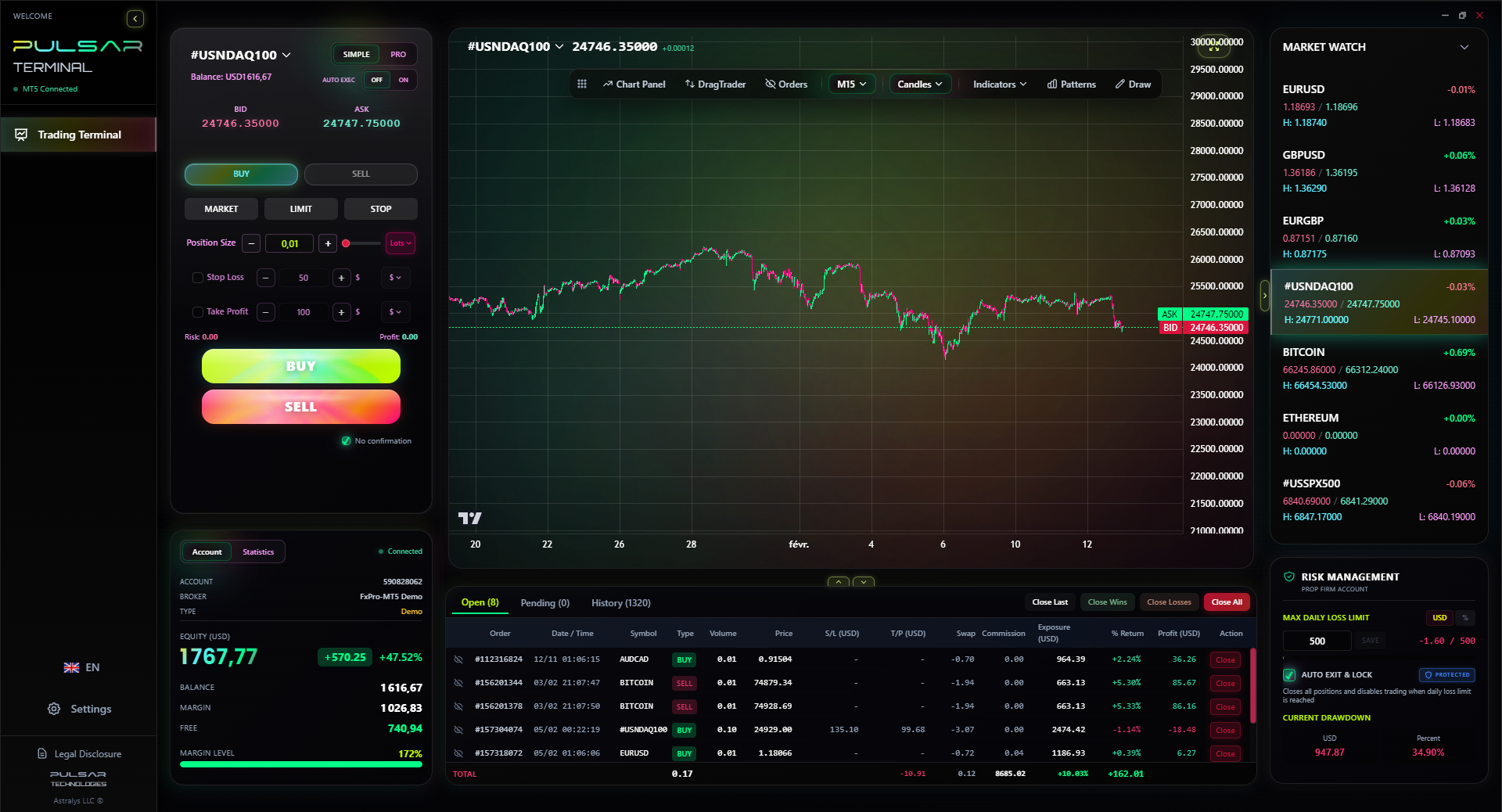
Sticking to a disciplined trading schedule is one thing; executing orders precisely during volatile session overlaps is another. Pulsar Terminal's drag-and-drop order management on MT5 lets you enter, adjust, and exit trades instantly when the market moves.
Pulsar Terminal
Das All-in-One MT5-Tool: Drag-and-Drop-Orders, Multi-TP/SL, Trailing Stop, Grid Trading, Volume Profile und Prop-Firm-Schutz. Täglich von 1.000+ Tradern genutzt.
“Just because you *can* trade at 3 AM SAST doesn't mean you *should*. The market will be there tomorrow. Your capital might not be.”
The market is open 24/5… except when it's not. Bank holidays in major financial centers (UK, US, Japan, Australia) mean those specific sessions are dead or closed. Christmas Day, New Year's Day, Good Friday - liquidity evaporates.
More insidious are early closes. The day before Christmas, New York might close at 2 PM SAST instead of 1 AM. Liquidity drains away hours before the official close, leading to erratic price action. I got caught in this on December 24th, 2023. I was in a USD/CAD trade, New York closed early, and a tiny bit of news caused a 40-pip slide with no buyers to step in. My stop was filled 15 pips below where I set it - a phenomenon called ‘slippage.’
You need a global economic calendar that marks these holidays and early closes. It's not enough to know if the forex market is open today; you need to know if the players are at their desks.
💡 Winstons Tipp
The SARB's R1 million allowance isn't a trading target. It's a regulatory limit. Blowing through that on losses isn't a badge of honor; it's a financial disaster.
“That rookie mistake cost me R2,300 in minutes. The simple question, 'is the forex market open today?' isn't about a yes/no answer.”
Don't guess. Have a system.
- Session Widgets: Most trading platforms (MT4/MT5) have free ‘Session’ indicators that shade the chart with different colors for each major session. Install one.
- Economic Calendars: Sites like ForexFactory or Investing.com have a ‘Holidays’ filter. Check it at the start of each week.
- Broker Notices: Reputable brokers like Pepperstone review or XM review will post notices about holiday schedule changes on their website or platform.
- The Simple Test: Look at the spread on EUR/USD. If it's consistently below 1 pip, you're in a liquid session. If it's bouncing between 0.5 and 3.0 pips erratically, you're in a twilight zone - step away.
The ultimate tool is discipline. Just because you can trade at 3 AM SAST doesn't mean you should. The market will be there tomorrow. Your capital might not be if you treat it like a 24/7 casino.
FAQ
Q1What time does the forex market open and close in South Africa?
In South African Standard Time (SAST), the global forex market opens at 10:00 PM on Sunday evening and closes at 10:00 PM on Friday evening. However, liquidity and volatility vary dramatically depending on which international session (Sydney, Tokyo, London, New York) is active at the time.
Q2Can I trade forex on Saturday and Sunday in South Africa?
No. The global interbank forex market is closed from Friday at 10:00 PM SAST until Sunday at 10:00 PM SAST. Some brokers may offer limited cryptocurrency or weekend CFD trading, but for major currency pairs, the market is shut. Holding trades over this period exposes you to gap risk when it reopens.
Q3Is USD/ZAR more volatile during South African business hours?
Not necessarily. The ZAR is most active and liquid when both London and South African markets are open (10:00 AM to 5:00 PM SAST). However, its biggest moves often happen during the London session or when US economic data is released (after 3:30 PM SAST), driven by global dollar flows, not local news alone.
Q4What is the best time of day to trade forex in SA?
The most reliable time for high liquidity and lower spreads is the London/New York session overlap, from 4:00 PM to 7:00 PM SAST. This is when the highest volume of trades occurs, leading to smoother price action and better order execution for pairs like EUR/USD and GBP/USD.
Q5Do South African public holidays affect forex trading?
Local South African holidays (like Heritage Day) do not directly close the global forex market. However, they can affect liquidity and spreads on the ZAR pairs if local banks and institutions are offline. The bigger impact comes from holidays in the UK, US, and Japan, which can shut down entire sessions.
Q6Why did my stop-loss get a bad fill when the market was 'open'?
This usually happens during low-liquidity periods (like the Sydney session or around major holidays). With fewer buyers and sellers, your broker may not be able to execute your order at your exact price and 'slips' to the next available price. This is a key reason to avoid trading during thin market hours.
Q7How do I check if my broker is legitimately FSCA regulated?
Go directly to the FSCA's official website and use their 'Search for an FSP' tool. Enter the broker's company name or the FSP number they provide. Verify that the license category includes 'Discretionary FSP' for forex trading. Don't rely on logos on a broker's site.
Prof. Winstons Lektion
Wichtige Erkenntnisse:
- ✓Trade London/NY overlap (4-7 PM SAST) for real liquidity.
- ✓Halve your position size in thin sessions (Sydney, Tokyo lunch).
- ✓Never hold a trade over the weekend unless you can afford a gap.
- ✓Check FSCA registration directly, not via broker marketing.
- ✓A 10-pip spread on USD/ZAR requires a 10-pip move just to break even.
Wie nützlich war dieser Artikel?
Klicken Sie auf einen Stern
Wöchentliche Trading-Einblicke
Kostenlose wöchentliche Analysen & Strategien. Kein Spam.
Über den Autor
David van der Merwe
Schwellenland-Trader
In Johannesburg ansässiger Trader mit 11 Jahren Erfahrung in Schwellenländerwährungen. Spezialisiert auf ZAR-Paare, FSCA-regulierten Handel und Analyse des südafrikanischen Marktes.
Kommentare
Risikohinweis
Der Handel mit Finanzinstrumenten birgt erhebliche Risiken und ist möglicherweise nicht für alle Anleger geeignet. Vergangene Ergebnisse garantieren keine zukünftigen Renditen. Dieser Inhalt dient ausschließlich Bildungszwecken und stellt keine Anlageberatung dar. Führen Sie immer Ihre eigene Recherche durch, bevor Sie handeln.
Das könnte Sie auch interessieren

Cara Trading Forex Sukses: 7 Prinsip dari Trader Profesional
Cara trading forex sukses dengan 7 prinsip trader pro: manajemen modal, disiplin, journal trading, backtest. Data nyata, bukan janji profit palsu.
Jam Trading Forex Terbaik untuk Trader Indonesia: Panduan Lengkap dengan Tabel Waktu
Panduan jam trading forex untuk trader Indonesia. Tabel 4 sesi dunia, jam emas 20:00-00:00, sesi mana yang harus dihindari. Data akurat + tips dari trader berpengalaman.
Top 5 Sàn Forex Uy Tín Nhất 2026: Review Jujur dari Trader Indonesia
Top 5 sàn forex uy tín 2026 untuk trader Indonesia. Review jujur: spread, deposit, withdraw, dukungan lokal. Exness, XM, IC Markets & lebih.
Pulsar Terminal herunterladen
Alle diese Rechner sind in Pulsar Terminal mit Echtzeit-Daten Ihres MT5-Kontos integriert.
Pulsar Terminal herunterladen