


It was October 7th, 2022.

Sarah Collins
Trading-Stratege ·  United Kingdom
☕ 10 Min. Lesezeit
Was Sie lernen werden:
It was October 7th, 2022. GBP/USD had just cratered to 1.0350, a level no one thought they'd see in their lifetime. My phone was buzzing non-stop. One of my students, let's call him Mark, was in a panic. 'My account's down 60% in an hour,' he messaged. He'd used the maximum 30:1 use on a 'sure thing' long position, convinced the pound couldn't fall further. It did. That's use forex trading in the UK. It's not a magic money multiplier; it's a risk amplifier, and the FCA's strict rules are there for a bloody good reason. Let's talk about what it really is, how the caps work, and why most people get it completely wrong.
Right, let's clear this up first. use isn't a tool to make you rich quick. It's a loan from your broker that lets you control a larger position with less of your own cash. Think of it like a mortgage. You put down a 10% deposit to control a £300,000 house. In forex, with 10:1 use, you put down £1,000 to control a £10,000 position.
The critical bit everyone misses? Your profit and loss are calculated on the full position size, not your deposit. A 1% move against you on that £10,000 position is a £100 loss. On your £1,000 deposit, that's a 10% hit. That's the magnification effect.

Warning: use doesn't change the market's volatility. It only changes your exposure to it. A 50-pip move hurts the same whether you're leveraged or not; the difference is how much of your own capital gets wiped out.
I learned this the hard way early on. I traded a 0.5 lot EUR/USD position with 100:1 use (pre-FCA caps). A 30-pip stop-loss seemed safe. When it hit, I lost £150. On a £500 account, that was a 30% loss in one trade. My analysis wasn't wrong, but my position size calculator settings were reckless. The trade size, amplified by use, was simply too big for my account.
“use doesn't change the market's volatility. It only changes your exposure to it.”
The UK's Financial Conduct Authority (FCA) slapped use caps on retail traders back in 2018. They did it because the loss statistics were horrific. These aren't suggestions; they're hard limits. If you're trading with an FCA-regulated broker as a retail client, this is your world.
The use Caps Table
Here’s what you’re allowed:
| Asset Class | Maximum use | Example Instruments |
|---|---|---|
| Major Forex Pairs | 30:1 | EUR/USD, GBP/USD, USD/JPY |
| Minor Forex Pairs, Gold, Major Indices | 20:1 | EUR/GBP, GBP/AUD, XAU/USD, FTSE 100 |
| Other Commodities, Non-Major Indices | 10:1 | Brent Crude, DAX 40 |
| Individual Shares & Other Assets | 5:1 | Tesla, Apple CFDs |
What This Means for You
First, crypto CFDs are off the table for retail. Good. They were a casino. Second, your maximum use on the EUR/USD guide is 30:1. Not 50:1, not 100:1. Thirty-to-one.
This forces you to put up more of your own money as margin. For a standard lot (100,000 units) of EUR/USD at 30:1, you need about £2,666 of margin. At 100:1, you'd only need £800. The FCA rule makes the position more expensive to hold, which naturally makes you think twice.
The Professional Client Loophole (And Its Cost)
You can apply for 'professional client' status. Some brokers like Pepperstone review or IC Markets review might then offer you 200:1 or more. But it's a trade-off. You lose the FCA's crucial protections: Negative Balance Protection and coverage under the Financial Services Compensation Scheme (FSCS). If your account goes negative, you owe the broker. If the broker goes bust, you're not guaranteed the £85,000 protection. I've never recommended a retail trader do this. The risks far outweigh the benefit of higher use.

💡 Winstons Tipp
The most dangerous phrase in trading is 'This time it's different.' It never is. Maximum use always feels great until it doesn't.
“Treat the FCA's 30:1 limit as an emergency buffer, not a target.”
use doesn't just amplify market risk. It amplifies your costs, too. This is where beginners get a nasty surprise on their statement.
Spreads & Commissions: These are charged on the full position size. With a spread definition of 1.0 pip on EUR/USD, a 1-lot trade costs you $10 to enter and exit. On a £1,000 account using use, that's 1% gone before the market even moves. On a raw spread account like Pepperstone's Razor, you might pay 0.1 pips but a £4.50 round-turn commission per lot. The cost is similar, just structured differently.
Overnight Financing (Swap): This is the interest paid or received for holding a leveraged position overnight. It's calculated on the full position size. On a 1-lot short GBP/USD position, the swap could be -$5 per night. Over a week, that's $25 coming out of your pocket. It adds up, turning a potentially profitable swing trade into a loser if you hold too long.

Example: Let's say you buy 1 lot of GBP/USD at 1.2500 with 30:1 use. Your margin is roughly £3,333. The spread is 1.5 pips ($15 cost). You hold for 5 days with an average daily swap cost of -$4. That's another $20. You need the market to move over 3.5 pips in your favour just to break even on costs. use didn't cause those costs, but it enabled the larger position size that made them significant.
This is why scalpers care intensely about spreads, and swing trading strategies must factor in swap rates. Always check the cost of doing business on your broker's platform before you click buy.
“Treat the FCA's 30:1 limit as an emergency buffer, not a target.”
Okay, so the FCA caps your use at 30:1. That doesn't mean you should use 30:1. Using maximum use is like driving your car constantly at 155 mph because the speedometer goes that high. It's technically possible, but you're one small mistake from disaster.
Your Real use is Your Position Size. This is the golden rule. The FCA limit is a ceiling. Your actual, working use should be much, much lower. I rarely exceed 5:1 or 10:1 on my total account equity, even on my best-conviction trades.
Here’s a practical method:
- Decide how much of your account you're willing to risk on the trade. Say 1%. For a £5,000 account, that's £50.
- Determine your stop-loss distance in pips. Let's say 25 pips on GBP/USD.
- Calculate your position size. £50 risk / (25 pips * £1 per pip on a micro lot) = 2 micro lots (0.02 standard lots).
- The required margin for 0.02 lots at 30:1 is tiny. Your effective use on this trade is low, even though your available use is high.
This method, using a position size calculator, completely decouples your risk management from the broker's use offering. You control the outcome.

Pro Tip: Treat the FCA's 30:1 limit as an emergency buffer, not a target. If you're constantly using 25:1 or 30:1, your position sizes are too large and your stops are too tight. You're trading on a knife's edge.
One of my most successful students runs a mean reversion strategy on XAU/USD guide. His trades often use an effective use of around 3:1. He's patient, his stops are wide, and he's been consistently profitable for three years. He's proof that less is more.
💡 Winstons Tipp
If you can't explain your position size in relation to your stop-loss and account risk, you don't have a trade. You have a gamble.
“Your real use is your position size. The FCA limit is just the ceiling you should never touch.”
This is the nightmare scenario. A margin call happens when your losses eat into the required margin for your open positions. Your broker will then ask you to deposit more funds immediately to keep the trades open. If you don't, they start closing your positions, often at the worst possible price.
With the FCA's Negative Balance Protection, you can't owe more than your deposit. But you can still be wiped out. Here’s how it happens:
You deposit £1,000. You open a 0.3 lot position on EUR/USD (using about £900 margin at 30:1). Your free margin is £100. The market moves 33 pips against you. Your loss is £99 (0.3 lots * 33 pips * £1 per pip). Your equity is now £901, but your used margin is still £900. Your free margin is now just £1. You are one tiny pip away from a margin call.
The Fix: Maintain a high Margin Level percentage. Margin Level = (Equity / Used Margin) * 100. Most brokers will call you at 100%. I set a personal rule: if my Margin Level drops below 200%, I'm either over-leveraged or my trades are going wrong. I start reducing positions, not adding to them.
Automation is your friend here. Using a platform tool that can set a trailing stop or breakeven order can protect profits and free up margin. For instance, if you're manually moving stops to breakeven, you might forget or be too slow. A tool that automates this once a trade is X pips in profit locks in safety and manages that margin requirement for you.
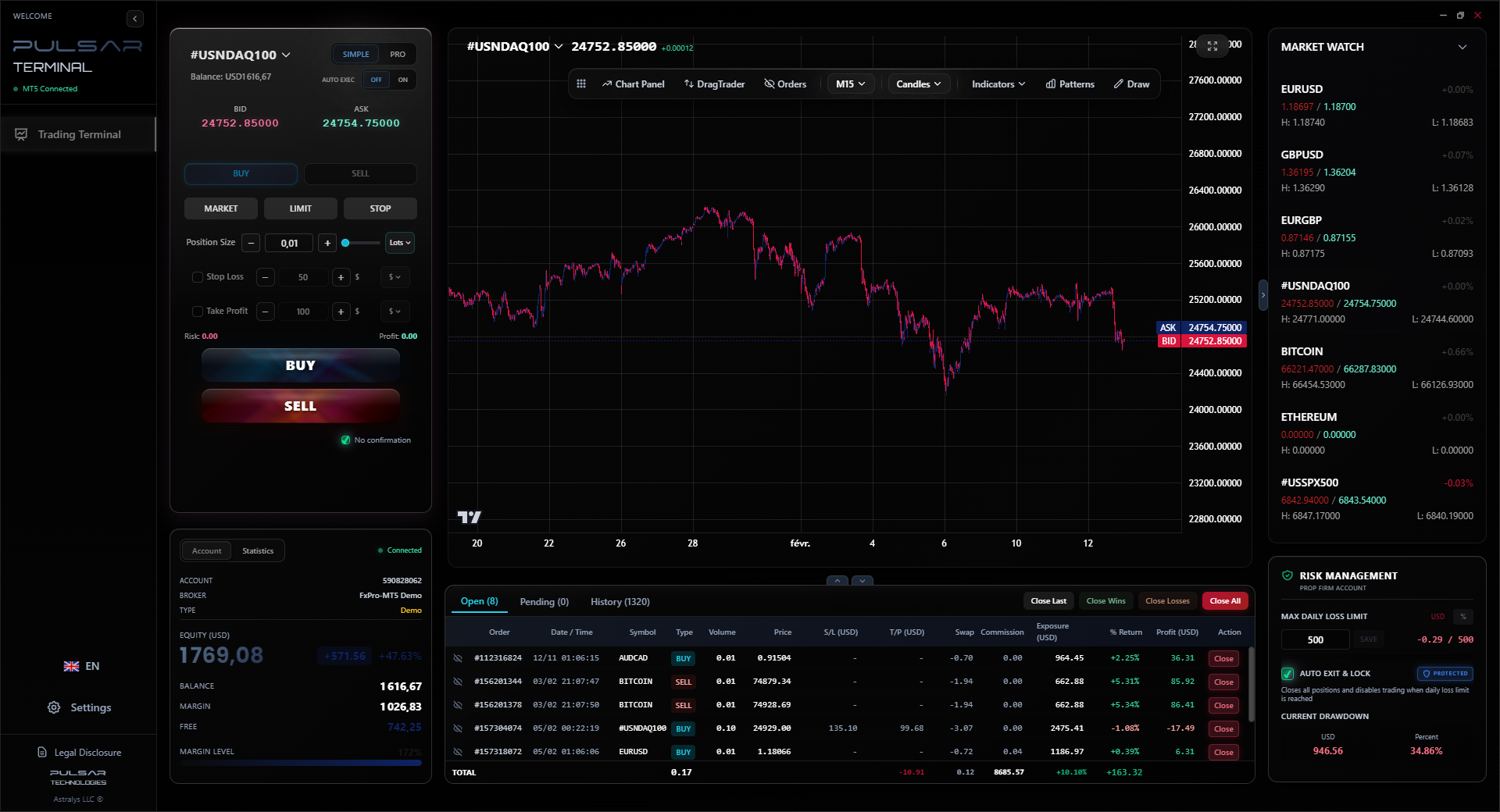
Managing multiple trades and their margin requirements under pressure is tough; Pulsar Terminal's drag-and-drop order management and auto-breakeven features handle this precision work for you on MT5.
Pulsar Terminal
Das All-in-One MT5-Tool: Drag-and-Drop-Orders, Multi-TP/SL, Trailing Stop, Grid Trading, Volume Profile und Prop-Firm-Schutz. Täglich von 1.000+ Tradern genutzt.
“Your real use is your position size. The FCA limit is just the ceiling you should never touch.”
Your first filter is non-negotiable: FCA Regulation. Check the register. No FCA license, no trade. The protections are worth far more than slightly higher use or lower spreads.
Beyond that, you're looking for execution quality and fair pricing. Here’s the lowdown on a few major players:
- Pepperstone (FCA): Excellent for active traders. Their Razor account offers raw spreads (0.1 pips on EUR/USD) with a commission. Their Pepperstone review shows they're built for speed and low latency. Great if you're scalping strategy.
- IG: The old guard. Huge product range, solid platform. Spreads are a bit wider on standard accounts, but they're a fortress of a company. Good for beginners who want an all-in-one platform.
- XM (FCA): They offer the standard FCA use limits. Known for educational resources and customer service. Their XM review often highlights them as a good starting point for new traders building their first strategy.
- OANDA: Trusted name, particularly strong on forex. Their spreads are competitive, and they have a great reputation for fair execution.
Don't get hung up on 'zero spread' claims. Look at the all-in cost: spread + commission. Test their demo platform during volatile news events (like Non-Farm Payrolls) to see if spreads widen ridiculously or orders get requoted. That's where a cheap broker becomes an expensive one.
💡 Winstons Tipp
Brokers sell use like car dealers sell horsepower. It's exciting, but most buyers have no idea how to control it. Your job is to be the driver, not the passenger.
“use forex trading is a marathon of survival, not a sprint to riches.”
Before you hit the buy button on a leveraged trade, run through this list. I have it taped to my monitor.
- Broker Check: Am I with an FCA-regulated broker? (Yes/No)
- Risk Percent: Is my risk on this trade 1% or less of my account equity? (Use a calculator).
- Effective use: What is my actual use (Total Position Value / Account Equity)? Is it below 10:1?
- Cost Check: Have I accounted for the spread and potential swap costs? Do I still have a positive expected value?
- Margin Level: What is my current Margin Level? Is it comfortably above 200% after this trade?
- Stop-Loss: Is my stop-loss in place, based on market structure, not on how much I'm willing to lose?
- Emotion Check: Am I increasing size or using more use because I'm chasing losses or feeling greedy?
If you answer 'No' to any of the first three, or your Margin Level is too low, do not take the trade. Walk away. The market will be there tomorrow. use forex trading is a marathon of survival, not a sprint to riches. The FCA rules are your guardrails. Your discipline is the steering wheel. Use both, and you might just make it.
FAQ
Q1Can I get more than 30:1 use in the UK?
Yes, but not as a retail client. You can apply for 'professional' status with your broker, which involves meeting high activity or wealth thresholds. It lets you access higher use but strips away vital FCA protections like Negative Balance Protection and FSCS coverage. For 99% of traders, it's a terrible idea.
Q2What's the difference between 1:10 and 10:1 use?
Nothing. They mean the same thing: for every £1 of your money, you control £10 in the market. It's just different notation. In the UK, we usually say '30 to 1' or write it as 30:1.
Q3Why did the FCA limit use for retail traders?
Because the loss rates were appalling. Consistently, around 70-80% of retail CFD traders lost money. The FCA found that excessive use was a primary driver, encouraging oversized, risky bets. The caps force traders to commit more of their own capital, which theoretically encourages more careful trading.
Q4Do use limits apply to demo accounts?
Often, no. Brokers frequently offer higher use on demo accounts to attract clients. This is a trap. It trains you to trade with unrealistic risk parameters. Always set your demo account use to the FCA retail limit (30:1) to practice under real-world conditions.
Q5How does use affect my tax?
use itself doesn't directly affect tax. In the UK, forex trading profits from spread betting are generally tax-free. Profits from CFD trading are subject to Capital Gains Tax. Your profit or loss is calculated on the final monetary outcome of your closed trades, regardless of the use used. Always consult an accountant for your specific situation.
Q6Is 5:1 use on stocks safer than 30:1 on forex?
Not necessarily. 'Safer' depends on the volatility of the asset. A 5:1 position on a volatile individual stock can be riskier than a 30:1 position on a stable major forex pair like EUR/USD. The key is the potential price move (in percent) against you, multiplied by your use. Always assess risk based on the instrument's behaviour, not just the use number.
Prof. Winstons Lektion
Wichtige Erkenntnisse:
- ✓FCA retail use caps are 30:1 on majors, 20:1 on minors/gold.
- ✓Effective use (your position size) matters more than available use.
- ✓Always risk 1% or less of your account per trade.
- ✓Negative Balance Protection is a critical FCA safeguard.
- ✓Costs (spread, swap) are magnified alongside your position.
Wie nützlich war dieser Artikel?
Klicken Sie auf einen Stern
Wöchentliche Trading-Einblicke
Kostenlose wöchentliche Analysen & Strategien. Kein Spam.
Über den Autor
Sarah Collins
Trading-Stratege
In London ansässige Trading-Strategin mit 12 Jahren Erfahrung an den Finanzmärkten. Ehemalige Analystin bei einem City-of-London-Broker. Deckt GBP-Paare, europäische Märkte und FCA-regulierten Handel ab.
Kommentare
Risikohinweis
Der Handel mit Finanzinstrumenten birgt erhebliche Risiken und ist möglicherweise nicht für alle Anleger geeignet. Vergangene Ergebnisse garantieren keine zukünftigen Renditen. Dieser Inhalt dient ausschließlich Bildungszwecken und stellt keine Anlageberatung dar. Führen Sie immer Ihre eigene Recherche durch, bevor Sie handeln.
Das könnte Sie auch interessieren

Cara Trading Forex Sukses: 7 Prinsip dari Trader Profesional
Cara trading forex sukses dengan 7 prinsip trader pro: manajemen modal, disiplin, journal trading, backtest. Data nyata, bukan janji profit palsu.
Jam Trading Forex Terbaik untuk Trader Indonesia: Panduan Lengkap dengan Tabel Waktu
Panduan jam trading forex untuk trader Indonesia. Tabel 4 sesi dunia, jam emas 20:00-00:00, sesi mana yang harus dihindari. Data akurat + tips dari trader berpengalaman.
Top 5 Sàn Forex Uy Tín Nhất 2026: Review Jujur dari Trader Indonesia
Top 5 sàn forex uy tín 2026 untuk trader Indonesia. Review jujur: spread, deposit, withdraw, dukungan lokal. Exness, XM, IC Markets & lebih.
Pulsar Terminal herunterladen
Alle diese Rechner sind in Pulsar Terminal mit Echtzeit-Daten Ihres MT5-Kontos integriert.
Pulsar Terminal herunterladen