


Chasing the lowest spread forex broker is the Nigerian trader's favorite distraction.

Olumide Adeyemi
Pionier des Tradings in Westafrika ·  Nigeria
☕ 11 Min. Lesezeit
Was Sie lernen werden:
Chasing the lowest spread forex broker is the Nigerian trader's favorite distraction. I've seen it a hundred times. You'll spend weeks comparing 0.0 pip offers from Exness and IC Markets, convinced that shaving off half a pip is your ticket to riches. Then you'll blow your account in three trades. The brutal truth? Your broker's spread is about 10% of your problem. The other 90% is you. Let me show you why, with the real numbers from trading here for over a decade, and what you should actually be looking for.
We need to get this out of the way first. Yes, spreads matter. No, they are not the holy grail. A spread is just the cost of doing business, like the fuel in your car. Focusing only on finding the cheapest fuel won't make you a better driver, and it definitely won't save you if you're heading for a cliff.
Here’s the math that changed my perspective. Early on, I was scalping EUR/USD with a broker charging a 1.5 pip spread. I switched to a 'raw spread' account offering 0.0 pips + a $7 commission per lot. I felt like a genius. Then I reviewed my trades. My average winning trade was 15 pips. My average loser was 25 pips. The 1.5 pip saving was a rounding error compared to my terrible risk management. I was optimizing the cost of the bullet while ignoring the fact I was shooting myself in the foot.

Example: Let's say you trade 10 standard lots of EUR/USD per month.
- Broker A: 1.0 pip spread. Cost = 10 lots * 1.0 pip * $10 per pip = $100.
- Broker B: 0.2 pip spread + $5 commission per lot round-turn. Cost = (10 lots * 0.2 pip * $10) + (10 lots * $5) = $20 + $50 = $70. You save $30. Great. Now, if one bad trade because of poor execution or platform freeze loses you $300, that 'savings' is meaningless. The real cost isn't the spread; it's the quality of the trade environment.
The Nigerian market is flooded with ads screaming 'lowest spreads!' because brokers know it's an easy sell. Don't fall for the marketing. Your first filter shouldn't be the lowest number; it should be whether the broker is stable, reliable, and fits your style. A slightly higher spread with rock-solid execution is always better than a 0.0 pip spread that vanishes the moment news hits or your internet flickers. For a deeper look at how to trade a major pair effectively, check out our EUR/USD guide.

💡 Winstons Tipp
A broker's reliability during news events is worth 100 times the savings from a fractional pip. Test execution in a volatile demo first.
“Your broker's spread is about 10% of your problem. The other 90% is you.”
If you're looking for the lowest spread forex broker, you're asking the wrong question. You should be looking for the broker that provides the best overall trading environment for your situation. Here’s your real checklist.
Regulation & Safety of Funds
This is non-negotiable, especially now. With Nigeria's new Investments and Securities Act (ISA) 2025, the SEC is cracking down on unregistered platforms. Your broker doesn't need to be registered with the SEC Nigeria (most international ones aren't yet), but it must be regulated somewhere reputable. This is your safety net. I learned this the hard way in 2017 when an unregulated 'bucket shop' offering insane use and tight spreads simply disappeared with client funds. Poof. Gone.
Look for brokers regulated by the ASIC (Australia), FCA (UK), CySEC (Cyprus), or the FSA (Seychelles). For Nigerian clients, brokers like Exness and IC Markets often onboard under their Seychelles entities, which is a common and acceptable practice. This regulation means segregated client accounts, dispute resolution channels, and financial reporting. It's boring, but it's the foundation.
Execution Quality & Slippage
This is where the rubber meets the road. How does your broker handle your order when the market gets volatile? A 'low spread' broker with poor liquidity will give you massive slippage - your order fills at a much worse price than you clicked. I've had trades on gold (XAU/USD) slip 5-10 pips during news events with certain brokers, completely wiping out my planned profit. A broker with deeper liquidity might show a slightly wider spread at that moment but will execute your order with minimal slippage. This is far more valuable. Read our XAU/USD guide to understand gold's unique volatility.
Deposits & Withdrawals in Naira
You need easy, cheap access to your money. The best spread in the world is useless if you can't fund your account or it takes two weeks and a 10% fee to withdraw your profits. Nigerian traders need local payment options.
| Payment Method | What to Look For |
|---|---|
| Bank Transfer | Direct Naira deposits to a local Nigerian bank account. Low fees, but can be slow (1-3 days). |
| Debit/Credit Cards | Instant deposits. Verify they accept Verve cards, not just Visa/Mastercard. Some banks block international forex transactions. |
| E-Wallets | Skrill, Neteller, Flutterwave, OPay. Usually fast and have lower fees than cards for withdrawals. |
Brokers like HFM and others offer Naira-denominated accounts, which remove currency conversion risk. This is a huge, underrated benefit.
Platform & Tools
You'll live on their platform. MT4/MT5 is standard, but their proprietary platforms matter too. Are the charts fast? Can you set multiple take-profits on a single trade easily? Does it have a reliable mobile app for when NEPA takes light? These quality-of-life features impact your trading more than a 0.1 pip difference. For serious chart analysis, a tool like Pulsar Terminal that integrates with MT5 can be a game-changer for drawing tools and order management, but your broker's native stability is key first.

Warning: A broker offering 'unlimited use' alongside the lowest spreads is waving a huge red flag. It's a lure for inexperienced traders who will blow up fast. use is a tool, not a scorecard. Start low.
“Optimizing the cost of the bullet while ignoring the fact you're shooting yourself in the foot.”
Let's look at some actual options. Remember, 'lowest' is a contest you don't need to win. You need 'good enough' on spreads and excellent on everything else.
Based on current data and my own experience, here’s a breakdown. (Note: Minimum deposits can vary by account type).
| Broker | Typical EUR/USD Spread (Live Account) | Key Regulation for NG Clients | Naira Payment Support | Good For |
|---|---|---|---|---|
| Exness | 0.0 - 0.3 pips (Raw Spread Acc) | FSA (Seychelles) | Yes (Local transfer, cards, e-wallets) | Scalpers, high-volume traders. Their local support is strong. |
| IC Markets | 0.0 - 0.1 pips (Raw Spread Acc) | ASIC (Australia) / FSA (Seychelles) | Yes (Cards, Skrill, Neteller) | Traders wanting institutional-grade execution. |
| Pepperstone | 0.0 - 0.2 pips (Razor Acc) | ASIC, FCA | Yes (Cards, Skrill, Neteller) | All-around reliability and tech. Great for scalping strategies. |
| HFM | 0.0 - 0.2 pips (Zero Acc) | FSA (St. Vincent & Grenadines) | YES (NGN Accounts, local bank transfer) | Traders who want everything in Naira to avoid CBN forex hassles. |
| XM | From 0.6 pips (Zero Acc) | ASIC, CySEC | Yes (Cards, Skrill, Neteller) | Beginners, lower minimum deposits. Good education. |
My personal experience? I've kept accounts with both IC Markets and Pepperstone for years. IC Markets' spreads are microscopically tighter, but I've had equally profitable months on both because my strategy doesn't rely on that fractional difference. Pepperstone's platform has occasionally felt more stable during high volatility for me. It's a personal preference. The point is, you can't go wrong with any in the top tier if they meet your deposit needs.

Pro Tip: Open a demo account with your top 2 or 3 choices. Trade on them for a week during London and New York sessions. Test the execution, feel the platform, and try a dummy deposit/withdrawal process. This tells you more than any spread table ever will.
💡 Winstons Tipp
If you can't easily calculate your maximum loss before entering a trade, your position size is wrong. The spread is irrelevant at that point.
“The Naira volatility tax can be a bigger 'spread' than anything your broker charges.”
While you're fixated on the spread, these other costs are quietly eating your account. I call them the 'silent killers'.
1. The Naira Volatility Tax: If you fund a USD account with Naira, you're already trading. The CBN's official and parallel market rates can have a 10-20% difference. If you deposit when the Naira is 1300/$ and withdraw at 1500/$, you've lost over 15% of your capital in pure currency conversion, regardless of your trading skill. This is the biggest 'spread' Nigerian traders face. A Naira-denominated account eliminates this.
2. Inactivity Fees: Many low-spread brokers charge a monthly fee if you don't trade. Life happens - you get busy, travel, take a break. I got hit with a $50 fee once after a two-month break. That's 5 pips on a standard lot you lose for doing nothing.
3. Withdrawal Fees: That 'free withdrawal' might only be once a month. Subsequent withdrawals can cost $20-$30. If you're making small, frequent withdrawals (a good practice), this adds up fast. Always read the fee schedule.
4. The Overnight Swap Rate: If you hold trades overnight (carry trade or swing trading), you pay or receive a swap fee. On some pairs like AUD/JPY or for commodities, these fees can be huge. I once held a gold trade for a week; the negative swap was larger than the spread I paid on entry. You must factor this into your profit target.
5. The Psychological Cost of a Bad Platform: This is intangible but real. A clunky platform that misses orders or freezes causes frustration, which leads to revenge trading and overtrading. That emotional toll results in far greater financial losses than any spread. Use our position size calculator to manage your risk, but you also need a platform that lets you execute your plan calmly.
“The Naira volatility tax can be a bigger 'spread' than anything your broker charges.”
Forget chasing the lowest spread forex broker. Here’s where you should focus your energy to keep more money in your pocket:
1. Master Position Sizing: This is the number one skill. Risking 1% per trade versus 5% per trade is the difference between surviving a losing streak and getting a margin call. A proper position size makes the spread irrelevant. If you're risking 50 pips to make 100, whether the spread is 0.2 or 1.0 pips is noise.
2. Improve Your Entry Timing: Use simple price action or indicators like the RSI indicator or MACD indicator to avoid entering in the middle of noisy, wide-spread periods. Entering on a clean breakout or retest often gives you a better effective entry price than any raw spread account.
3. Reduce Your Trading Frequency: Are you a scalper making 20 trades a day? Then yes, a low spread is critical. But most Nigerian traders I meet are not true scalpers; they're just overtrading. If you switch to a higher-timeframe strategy making 5-10 trades a week, the total spread cost plummets, and your stress level drops too.
4. Choose the Right Account Type: Brokers offer different accounts. A 'Standard' account with no commission but higher spreads is often better for beginners or smaller accounts. A 'Raw/Zero' account with a commission is better for larger accounts. I made the mistake of using a Zero account with a $500 balance; the commissions were a massive percentage of my small profits. It was inefficient.
5. Tax Planning: Remember, your profits are subject to a 10% Capital Gains Tax in Nigeria. Factor this into your net profit calculations from the start. It's a much larger cost than spreads. Keep clean records.
💡 Winstons Tipp
The most expensive 'spread' in Nigeria is the difference between the official and parallel market Naira rates. A Naira account solves this.
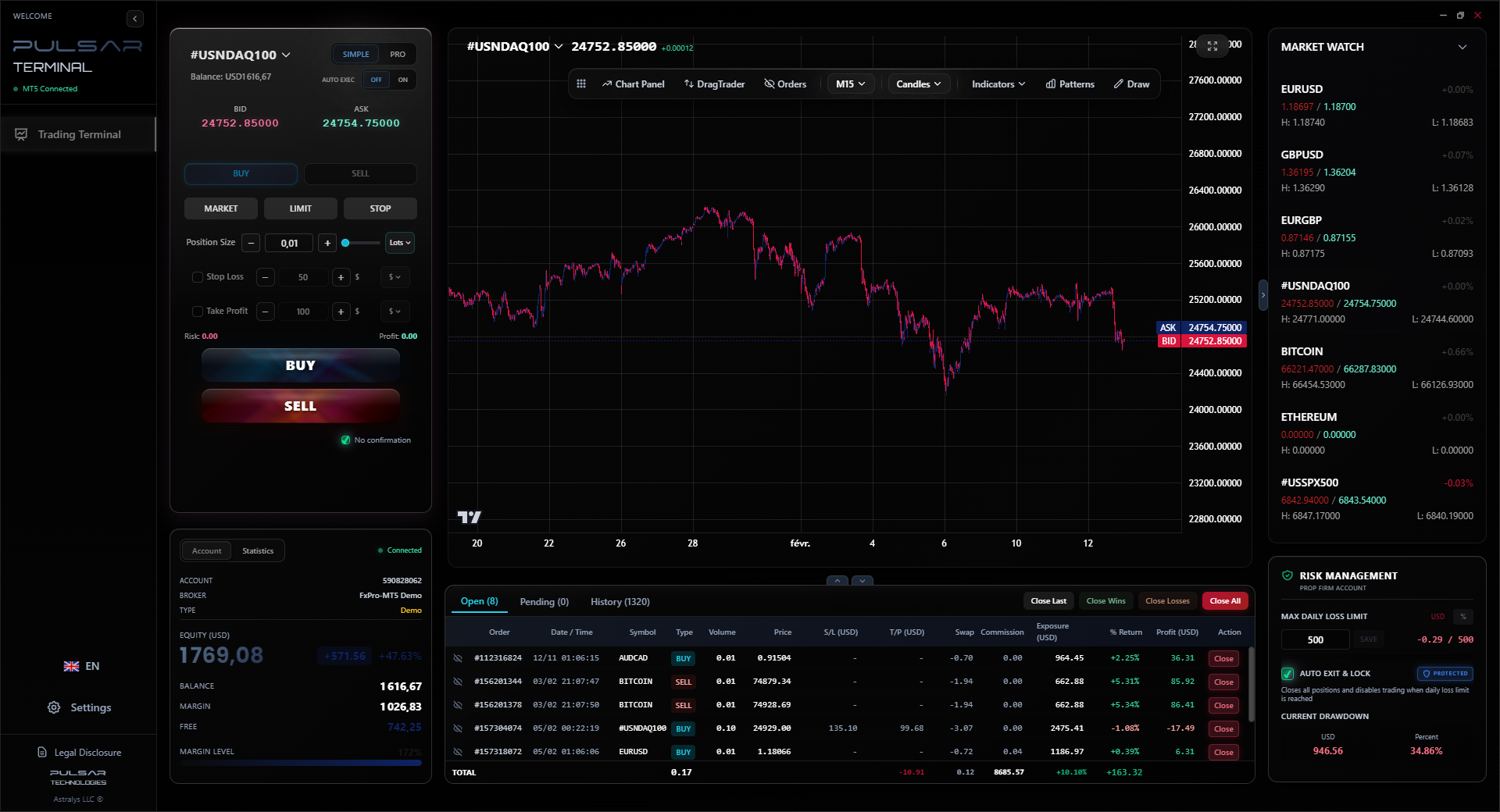
Managing multiple take-profits and stop-losses efficiently is key to risk management, and Pulsar Terminal lets you set them all with a single drag-and-drop directly on your MT5 chart.
Pulsar Terminal
Das All-in-One MT5-Tool: Drag-and-Drop-Orders, Multi-TP/SL, Trailing Stop, Grid Trading, Volume Profile und Prop-Firm-Schutz. Täglich von 1.000+ Tradern genutzt.
“Choose a reputable broker, then focus 100% of your energy on your strategy and psychology.”
So, who is the lowest spread forex broker in Nigeria? Based on raw numbers, it's often a tie between Exness, IC Markets, and Fusion Markets for their raw ECN accounts.
But the right question is: Which broker is the most suitable for a Nigerian trader in 2026?
For beginners and those who want simplicity: Look at HFM for its Naira accounts and local support, or XM for its educational focus. The slightly higher spread is a fair price for stability and ease of use. You can read our detailed XM review for more.
For active day traders and scalpers: IC Markets or Pepperstone are superb choices. Their execution is top-tier, and their raw spreads are as good as it gets. You'll need to manage the commission cost, but for your volume, it makes sense.
For traders who value local presence and raw spreads: Exness is a powerhouse here. They've invested in the Nigerian market, offer competitive conditions, and their platform is strong.
My personal setup? I use IC Markets for my primary ECN trading. But I also maintain a smaller Naira account with a local-friendly broker for quick experiments and to avoid currency risk on that portion of my capital.
Stop letting the spread be your primary decision-maker. Choose a reputable, well-regulated broker that offers smooth Naira transactions and a stable platform. Then, focus 100% of your energy on your trading strategy, risk management, and psychology. That's where the real money is made - and saved.
The spread is just the cover charge. Don't blow your entire night's budget at the door before you even get to the table.
FAQ
Q1Is forex trading legal in Nigeria?
Yes, forex trading is legal for individuals in Nigeria. The Central Bank of Nigeria (CBN) oversees the broader FX market. Importantly, the new Investments and Securities Act (ISA) 2025 now requires online forex platforms operating in Nigeria to register with the SEC. Most Nigerian traders use internationally regulated brokers, which is a common and accepted practice.
Q2What is a good spread for forex trading in Nigeria?
For major pairs like EUR/USD, a 'good' spread is under 1.0 pip on a standard account, and between 0.0 and 0.3 pips on a raw/ECN account (plus commission). However, 'good' is relative. For a scalper, 0.5 pips might be too high. For a swing trader holding for days, 1.5 pips is negligible. Judge the spread in the context of your average trade target.
Q3Can I trade with a Naira account?
Yes. Brokers like HFM offer Naira (NGN)-denominated trading accounts. This is a major advantage as it removes the currency risk between the USD and the volatile Naira. Your deposits, trades, profits, and losses are all calculated in Naira, simplifying everything and protecting you from CBN forex policy changes.
Q4Do I pay tax on forex trading profits in Nigeria?
Yes. Profits from forex trading are considered capital gains and are subject to a 10% tax. You are responsible for declaring this income to the Federal Inland Revenue Service (FIRS). Keep detailed records of all your trades, deposits, and withdrawals.
Q5What's more important, low spreads or high use?
Trick question. Neither is 'important' in the way beginners think. Low spreads reduce a small cost. High use amplifies both profits and losses, and is the #1 reason new traders blow up. Focus on low use (like 1:10 or 1:30) and consistent execution. use is a dangerous tool, not a benefit. Chasing high use alongside low spreads is a classic trap.
Q6How do I fund my forex account from Nigeria?
Most international brokers accept local bank transfers (in Naira to their Nigerian partner bank), debit/credit cards (Verve, Visa, Mastercard), and e-wallets like Skrill, Neteller, Flutterwave, or OPay. Bank transfers are usually cheapest, while cards and e-wallets are fastest. Always check your broker's specific deposit page for Nigeria.
Q7What is a pip in forex trading?
A pip (percentage in point) is the standard unit for measuring movement in a currency pair. For most pairs, it's the 4th decimal place (e.g., a move from 1.1050 to 1.1051 is 1 pip). It's how you calculate profit and loss. Understanding pips is fundamental, and you can learn more in our detailed pip definition guide.
Prof. Winstons Lektion
Wichtige Erkenntnisse:
- ✓Spreads matter, but execution quality matters more.
- ✓Naira accounts eliminate currency risk, a huge hidden cost.
- ✓Never choose a broker based on use offers.
- ✓Regulation is your non-negotiable safety net.
- ✓The total cost of trading includes swaps, fees, and slippage.
Wie nützlich war dieser Artikel?
Klicken Sie auf einen Stern
Wöchentliche Trading-Einblicke
Kostenlose wöchentliche Analysen & Strategien. Kein Spam.
Über den Autor
Olumide Adeyemi
Pionier des Tradings in Westafrika
Einer der aktivsten Forex-Trading-Ausbilder Nigerias. 8 Jahre Trading-Erfahrung aus Lagos. Spezialisiert auf Strategien mit geringem Kapital und Prop-Firm-Challenges für afrikanische Trader.
Kommentare
Risikohinweis
Der Handel mit Finanzinstrumenten birgt erhebliche Risiken und ist möglicherweise nicht für alle Anleger geeignet. Vergangene Ergebnisse garantieren keine zukünftigen Renditen. Dieser Inhalt dient ausschließlich Bildungszwecken und stellt keine Anlageberatung dar. Führen Sie immer Ihre eigene Recherche durch, bevor Sie handeln.
Das könnte Sie auch interessieren

Cara Trading Forex Sukses: 7 Prinsip dari Trader Profesional
Cara trading forex sukses dengan 7 prinsip trader pro: manajemen modal, disiplin, journal trading, backtest. Data nyata, bukan janji profit palsu.
Jam Trading Forex Terbaik untuk Trader Indonesia: Panduan Lengkap dengan Tabel Waktu
Panduan jam trading forex untuk trader Indonesia. Tabel 4 sesi dunia, jam emas 20:00-00:00, sesi mana yang harus dihindari. Data akurat + tips dari trader berpengalaman.
Top 5 Sàn Forex Uy Tín Nhất 2026: Review Jujur dari Trader Indonesia
Top 5 sàn forex uy tín 2026 untuk trader Indonesia. Review jujur: spread, deposit, withdraw, dukungan lokal. Exness, XM, IC Markets & lebih.
Pulsar Terminal herunterladen
Alle diese Rechner sind in Pulsar Terminal mit Echtzeit-Daten Ihres MT5-Kontos integriert.
Pulsar Terminal herunterladen