


Over 70% of retail forex traders in South Africa will experience a margin call within their first year.

David van der Merwe
Schwellenland-Trader ·  South Africa
☕ 12 Min. Lesezeit
Was Sie lernen werden:
- 1What a Margin Call Really Is (It's Not What You Think)
- 2South Africa's Rules: The 30:1 use Game-Changer
- 3How to Calculate Your Margin & Avoid the Call
- 4Broker Policies Differ Wildly: What to Look For
- 5A Story From My Trading Journal: The R50,000 Lesson
- 6Your 5-Point Checklist to Avoid a Margin Call
- 7The SARS Surprise: Margin Calls and Your Tax Return
Over 70% of retail forex traders in South Africa will experience a margin call within their first year. I was one of them. Back in 2015, I watched a single ZAR/USD trade wipe out 80% of my account in under an hour because I didn't understand how margin really worked. The FSCA's 30:1 use cap for retail traders, introduced in 2021, was a direct response to stories like mine. This isn't just theory, it's about keeping your money in your pocket. Let's talk about what a margin call actually means for you, how the local rules change the game, and the exact steps to make sure your broker's warning email never hits your inbox.
Most traders think a margin call is a friendly warning. It's not. It's a final, desperate shout from your broker that you're about to lose everything in that trade. Technically, it's the point where your account equity (your balance plus any floating profit or loss) falls below the required margin to keep your positions open.
Here's the brutal truth: by the time you get the 'call' - which is usually just an email or pop-up in your platform - your broker is already preparing to close your positions. They do this to protect themselves, not you. They lent you money (that's the use), and if your account can't cover the potential loss, they start selling your assets to get their money back.
In South Africa, with FSCA-regulated brokers, the process is standardized but still ruthless. Let's say you have a R10,000 account. You open a position that requires R3,333 in margin (that's the 3.33% needed for 1:30 use on a major pair). If your floating loss eats into your remaining equity (the R6,667 not used as margin) and gets dangerously close to zero, the system triggers a margin call. Different brokers have different thresholds, often called 'Stop Out Levels', usually between 50% and 20% of your required margin. Once you hit that, they start closing, biggest loss first.

Warning: Don't rely on the margin call as a stop-loss. By the time it happens, automatic liquidation has already begun. Your own stop-loss order is the only real control you have.
I learned this the hard way trading GBP/ZAR during a Brexit headline spike. My R15,000 account was holding a position with R5,000 margin. I thought I had R10,000 as a 'buffer'. The market moved 200 pips against me overnight. The margin call email arrived at 3 AM. By the time I woke up at 6 AM, the position was closed and my account was sitting at R2,100. The buffer evaporated in a volatility flash. The lesson? Your 'usable margin' isn't a safety net, it's the fuse on a bomb.
“By the time you get the 'margin call' email, your broker is already preparing to close your positions.”
The FSCA's 2021 use cap fundamentally altered risk for the local retail trader. Before that, seeing offers of 1:500 or even 1:1000 from international brokers was common. Now, for most of us, 1:30 on majors is the legal maximum.
Why This Actually Helps You
I hated this rule when it first came out. It felt like the government was treating me like a child. But after a year of trading with it, I realized it probably saved me from myself. At 1:30 use, to control a standard lot ($100,000) of EUR/USD, you need about $3,333 in margin. At 1:500, you'd only need $200. That tiny margin means the smallest market move can obliterate your account. The 30:1 rule forces you to put more skin in the game, which naturally makes you more cautious.
The Professional Client Loophole (And Its Trap)
You'll see brokers like IC Markets or Exness still advertise high use. That's for 'Professional Clients'. To qualify, you typically need a portfolio over R8.5 million (or equivalent), significant trading experience, and a high-income threshold. They'll ask you to self-declare. This is a massive trap for the overconfident. If you claim to be a pro to get 1:400 use, you lose all the retail client protections. When - not if - you blow up your account, you have zero recourse. I've seen two traders in my Johannesburg circle do this. Both lost six-figure sums and had no comeback.
The Real Cost of Higher use
Let's do the math with a tool like our position size calculator.

Example: You have a R20,000 account. On USD/ZAR at 1:30 use, a 1% risk trade means you can comfortably take a position size of about 0.5 standard lots. The same 1% risk at 1:400 use would let you take nearly 7 standard lots. A 100 pip move against you at 1:30 might hurt, but at 1:400, it would be a total account wipeout. The higher use doesn't increase your skill, it just amplifies your mistakes.

💡 Winstons Tipp
Professor Winston always said, 'The market doesn't bankrupt you. Your own unchecked use does.' Calculate your maximum position size for a 1% risk first, then check if you have the margin. Never reverse that order.
“The 30:1 use rule forces you to put more skin in the game, which naturally makes you more cautious.”
This is the most practical skill you can learn. If you don't know your numbers, you're driving blind.
The basic formula is: Margin = (Trade Size / use) * Exchange Rate (if needed)
For a ZAR-denominated account:
- Trade in USD pairs: You're trading in USD, your account is in ZAR. You need to convert. Let's say you want to buy 1 standard lot (100,000 units) of EUR/USD at 1:30 use. The EUR/USD rate is 1.0850, and the USD/ZAR rate is 18.50.
- Margin in USD = 100,000 / 30 = $3,333.33
- Margin in ZAR = $3,333.33 * 18.50 = R61,666.60 That's a huge chunk of capital! This is why trading majors directly with a small ZAR account is tough.
- Trade in ZAR pairs (like USD/ZAR): This is simpler. Buy 1 standard lot of USD/ZAR (100,000 USD) at a rate of 18.50 with 1:30 use.
- Margin in USD = 100,000 / 30 = $3,333.33
- Margin in ZAR = $3,333.33 * 18.50 = R61,666.60 (It's the same calculation, as the quote currency is ZAR).
The key takeaway? Trade smaller. Use mini (10,000) or micro (1,000) lots. That R61,666 margin becomes R6,166 for a mini lot, which is far more manageable.
The Used Margin vs. Free Margin Mindset
Your trading platform shows 'Used Margin' and 'Free Margin'. Free Margin is your equity minus your used margin. This is your breathing room. I have a personal rule: if my free margin ever drops below 50% of my used margin, I start closing my worst-performing trade, no questions asked. This proactive move has saved me from a margin call at least three times.

Pro Tip: Before you enter any trade, use your broker's calculator or a simple spreadsheet to ask: "If this trade goes against me by 200 pips, what will my free margin be?" If the answer makes you uncomfortable, your position is too big. This is more important than any indicator.
“The 30:1 use rule forces you to put more skin in the game, which naturally makes you more cautious.”
Not all margin calls are created equal. The FSCA sets the use floor, but brokers set their own margin call and stop-out levels. This is a critical part of your broker choice.
| Broker Example | Typical Margin Call Level | Typical Stop Out Level | What It Means For You |
|---|---|---|---|
| XM | 50% | 20% | You get a warning when your equity hits 50% of required margin. They start closing at 20%. Gives you a little time to react. |
| Pepperstone | Varies by account | Varies by account | Often around 80% for call, 50% for stop-out. Can be stricter, forcing earlier action. |
| IC Markets | 100% | 50% | The 'call' happens when you have no free margin left (100%). Liquidation starts at 50%. Less warning, more sudden. |
When I reviewed XM, their 50% call level stood out as more trader-friendly. It's like a low-fuel light. IC Markets' 100% level is like the engine sputtering - you're already in trouble.
You must find this information in the broker's legal documents. Don't rely on the sales page. Email their support and ask: "What is your exact margin call percentage and stop-out percentage for a retail ZAR account?" Their answer tells you how they treat clients in distress.
Also, watch for 'margin closeout' policies on volatile pairs. Some brokers will hike margin requirements on exotic pairs like USD/ZAR during local market turmoil or SARB announcements. Your position that was okay at 3% margin might suddenly require 5%, instantly triggering a call. Always trade volatile pairs with a much larger buffer.
💡 Winstons Tipp
Your free margin is your life support. If it ever falls below the value of your largest open position's potential loss, you are one bad trade from a crisis. Consolidate or close something.
“Funding a margin call is rarely a rescue; it's usually just delaying the inevitable.”
Let me be vulnerable. My worst margin call wasn't in my early days. It was in 2020, after I thought I knew it all.
I had a R100,000 account with an offshore broker (pre-FSCA cap). I was swing trading XAU/USD (gold). The strategy had been working. I got overconfident. The market was trending up, and I saw a pullback to a support level on the MACD indicator. I went all in.
- Account: R100,000
- Trade: Long XAU/USD at $1,800
- Position Size: 3 standard lots (using 1:200 use)
- Margin Used: Roughly R13,500
- My Stupidity: No stop-loss. I was 'sure' it would bounce.
It didn't bounce. Gold dropped $30 that day. My floating loss was over R50,000. The margin call notification popped up. I froze. Instead of closing, I added more funds - another R25,000 - to meet the margin. This is called 'throwing good money after bad.'
Gold dropped another $25. The stop-out happened. Total loss: R75,000 of my original capital plus the R25,000 I deposited. A R100,000 disaster.
The lessons were expensive but clear:
- use is a drug. 1:200 let me take a position 3x larger than my sense should have allowed.
- No stop-loss is a death wish. My ego wrote a cheque the market cashed.
- Funding a margin call is usually a mistake. It's rarely a rescue, it's just delaying the inevitable. The only valid reason to add funds is if you have a clear, logical plan and the market move was an irrational spike. This wasn't that.
That loss hurt, but it forged my current rule: I never use more than 5% of my account as total margin for all open trades. Ever. It forces discipline that no regulator ever could.
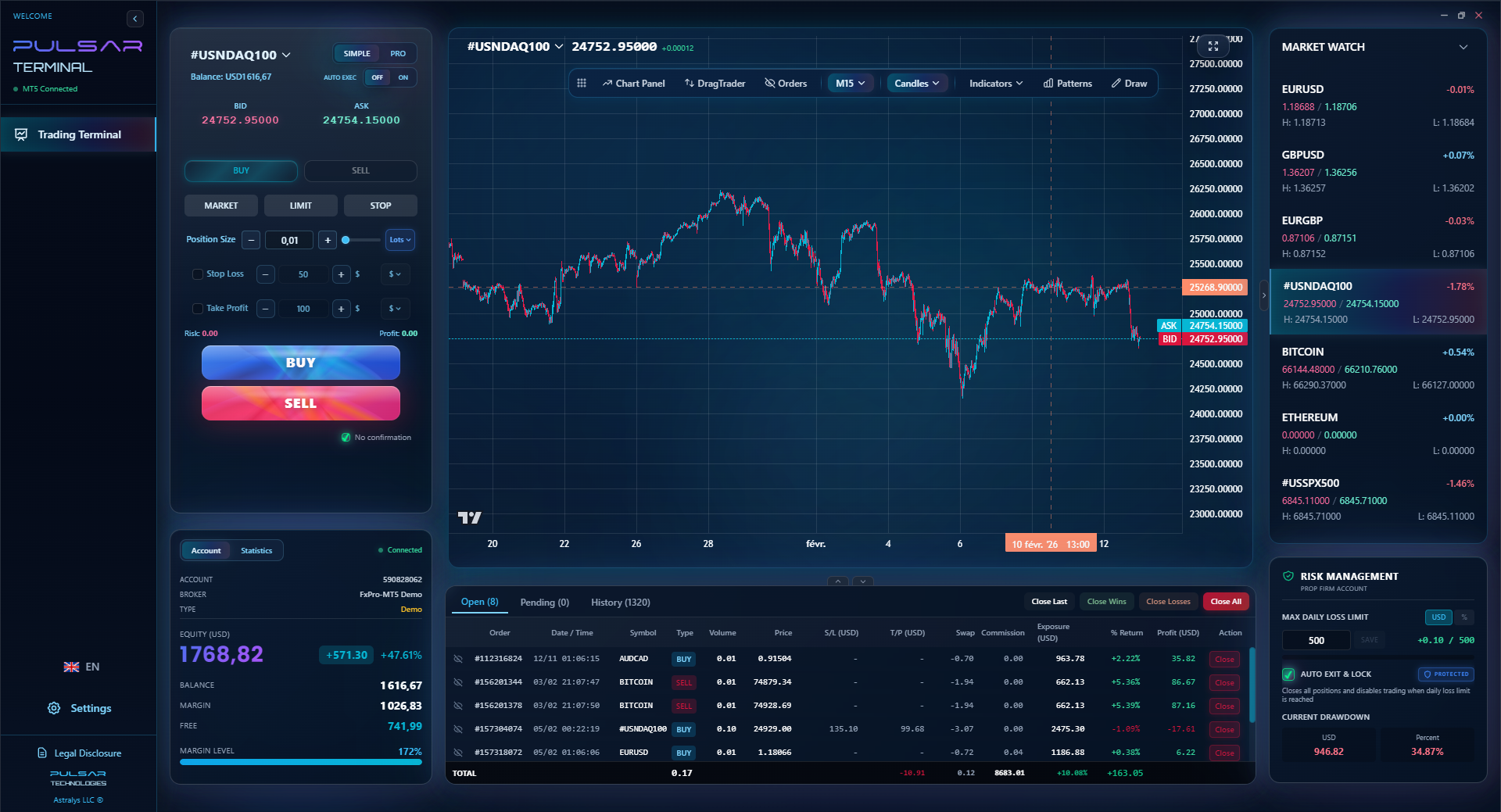
Managing multiple trades and their collective margin requirement is complex, but tools like Pulsar Terminal allow you to set a global equity stop-loss that can close all positions if your total account risk hits a predefined level, automating your 'margin drought' protocol.
Pulsar Terminal
Das All-in-One MT5-Tool: Drag-and-Drop-Orders, Multi-TP/SL, Trailing Stop, Grid Trading, Volume Profile und Prop-Firm-Schutz. Täglich von 1.000+ Tradern genutzt.
“Funding a margin call is rarely a rescue; it's usually just delaying the inevitable.”
- Know Your Stop-Out Level Before You Trade. This is your broker's line in the sand. If it's 50%, it means you need to maintain equity above 50% of your used margin. Plan your trades so that even if your stop-loss is hit, you're nowhere near this level. Use a position size calculator religiously.
- Trade with a Stop-Loss. Always. This is non-negotiable. A stop-loss is a pre-planned exit for when you're wrong. It takes the emotion out. Place it at a level that invalidates your trade idea. If you're trading a support break, your stop goes below the support. Not where you 'can afford' to lose.
- Mind the Correlation. Opening multiple buys on USD/ZAR, EUR/USD, and GBP/USD? You're basically taking the same trade three times. If the US dollar strengthens, all three will likely go against you simultaneously, multiplying your margin drawdown. Diversify your risks.
- Factor in Spreads & Swaps. When you enter a trade, you start at a slight loss due to the spread definition. On exotic pairs like ZAR crosses, spreads can be 50-100 pips. That's an immediate hole in your equity. Also, holding positions overnight incurs swap fees. A negative swap on a large position held for weeks can silently eat your free margin.
- Have a 'Margin Drought' Protocol. What will you do if your free margin drops by 70%? My protocol is: 1) Close the worst-performing trade immediately. 2) Do NOT open any new trades. 3) Re-assess the market condition. Am I trading against a trend? Is there news? This protocol stops a bad day from becoming an account-ending disaster.
Implementing these steps turns margin management from a reactive panic into a calm, systematic process. It's the difference between being a gambler and being a trader.
💡 Winstons Tipp
A margin call is a failure of planning, not analysis. You can be wrong on market direction and still survive with proper position sizing. The goal is to live to trade the next setup.
“A margin call has tax implications. SARS needs to see your loss, or they'll tax your gross profits.”
Here's a twist many South African traders forget: a margin call has tax implications. SARS views frequent trading as generating income, not capital gains. This means your net profit for the year is taxable at your income tax rate (up to 45%).
How does a margin call fit in? Let's say you made R50,000 in profits over the year, but then in March you had a margin call that wiped out R20,000. Your taxable income from trading is R30,000 (R50,000 - R20,000). You must declare that R30,000.
The critical part is record-keeping. SARS requires clear records. When they ask about that R20,000 loss, you need to show:
- The broker statement showing the trade entries and exits.
- The margin call notification.
- The account statement showing the liquidation.
If you can't prove it, SARS may disallow the loss, and you'll be taxed on the full R50,000. I keep a simple spreadsheet: Date, Pair, Entry, Exit, P/L, and a note for any margin-related closure. It's boring, but it's saved me thousands in potential tax disputes.
Also, remember the exchange controls. Funding an offshore broker from your SA bank account uses your annual allowances. A frantic deposit to avoid a margin call counts towards your R1 million Single Discretionary Allowance or your R10 million Foreign Capital Allowance. Keep records of these transfers too - your bank might ask, and SARS definitely will.
FAQ
Q1Can my broker change my margin requirements without warning?
Yes, they can, and they often do during periods of extreme volatility or around major economic events (like a SARB interest rate decision). They usually reserve the right to do this in their terms of service. This is why you should always use far less margin than the maximum available. A sudden increase from 3.33% to 5% could instantly trigger a margin call if you're using 90% of your available margin.
Q2Is a margin call the same as a stop-loss?
Absolutely not. A stop-loss is an order you control. You set the price where you accept a defined loss and exit the trade. A margin call is a broker-controlled process that happens when your account can no longer support your open losses. It results in forced liquidation, often at the worst possible price (during a spike), and you have no control over the exit price. Always use your own stop-loss.
Q3What happens if I ignore a margin call?
You can't ignore it. It's not a request, it's a notification of an automated process. If you don't close positions or add funds, the broker's system will automatically start closing your positions, usually starting with the one with the largest loss, until your equity is back above the required margin level. Ignoring it guarantees you will lose money.
Q4Do all FSCA brokers have the same margin call rules?
No. The FSCA sets the maximum use (30:1 for retail), but each broker sets its own specific margin call percentage and stop-out level. These can vary significantly, as shown in the broker comparison table. This is a key factor to check when choosing a broker.
Q5How does trading ZAR pairs affect my margin risk?
It increases it in two ways. First, ZAR pairs (like USD/ZAR, EUR/ZAR) are more volatile than majors like EUR/USD, meaning they can move against you faster. Second, the spreads are much wider (often 50-100 pips vs. 1 pip). This means the moment you enter the trade, you're already down that spread amount, which immediately reduces your equity and free margin, putting you closer to a margin call from the very start.
Q6If I qualify as a professional client for higher use, should I take it?
Unless you are managing very large capital (millions of Rands) with institutional-grade risk systems, almost certainly not. The higher use is a tool for experts who need efficiency with huge positions. For a retail trader, it's a weapon of self-destruction. You also give up vital consumer protections. The potential downside massively outweighs the upside.
Prof. Winstons Lektion
Wichtige Erkenntnisse:
- ✓Never let used margin exceed 5% of total account equity.
- ✓Your broker's Stop Out Level is more important than their spreads.
- ✓A stop-loss is a pre-planned exit. A margin call is a forced funeral.
- ✓Calculate position size for risk first, margin second. Always.
Wie nützlich war dieser Artikel?
Klicken Sie auf einen Stern
Wöchentliche Trading-Einblicke
Kostenlose wöchentliche Analysen & Strategien. Kein Spam.
Über den Autor
David van der Merwe
Schwellenland-Trader
In Johannesburg ansässiger Trader mit 11 Jahren Erfahrung in Schwellenländerwährungen. Spezialisiert auf ZAR-Paare, FSCA-regulierten Handel und Analyse des südafrikanischen Marktes.
Kommentare
Risikohinweis
Der Handel mit Finanzinstrumenten birgt erhebliche Risiken und ist möglicherweise nicht für alle Anleger geeignet. Vergangene Ergebnisse garantieren keine zukünftigen Renditen. Dieser Inhalt dient ausschließlich Bildungszwecken und stellt keine Anlageberatung dar. Führen Sie immer Ihre eigene Recherche durch, bevor Sie handeln.
Das könnte Sie auch interessieren

Cara Trading Forex Sukses: 7 Prinsip dari Trader Profesional
Cara trading forex sukses dengan 7 prinsip trader pro: manajemen modal, disiplin, journal trading, backtest. Data nyata, bukan janji profit palsu.
Jam Trading Forex Terbaik untuk Trader Indonesia: Panduan Lengkap dengan Tabel Waktu
Panduan jam trading forex untuk trader Indonesia. Tabel 4 sesi dunia, jam emas 20:00-00:00, sesi mana yang harus dihindari. Data akurat + tips dari trader berpengalaman.
Top 5 Sàn Forex Uy Tín Nhất 2026: Review Jujur dari Trader Indonesia
Top 5 sàn forex uy tín 2026 untuk trader Indonesia. Review jujur: spread, deposit, withdraw, dukungan lokal. Exness, XM, IC Markets & lebih.
Pulsar Terminal herunterladen
Alle diese Rechner sind in Pulsar Terminal mit Echtzeit-Daten Ihres MT5-Kontos integriert.
Pulsar Terminal herunterladen