


I remember thinking I'd found a goldmine.

James Mitchell
Senior Trading-Analyst
☕ 10 Min. Lesezeit
Was Sie lernen werden:
- 1What Is Maven Trading? The Ultra-Low-Cost Prop Firm
- 2The Numbers: Costs, Rules, and That Payout Cap
- 3Trading Conditions: The Good, The Bad, The Slippage
- 4The US Regulatory Gray Area (And Why It Matters)
- 5Who Is Maven Trading Actually For? (And Who Should Avoid It)
- 6Alternatives and How to Think About Scaling
- 7Final Verdict: A Cheap Test, Not a Real Funding Solution
I remember thinking I'd found a goldmine. Maven Trading's $13 challenge for a $2,000 account? That's cheaper than a decent lunch. I breezed through the rules, funded my challenge, and started scalping. By day three, I was up $450. Then, on a EUR/USD news spike, my stop-loss got hit at a price 8 pips worse than where I'd set it. The slippage wiped out my entire daily profit target and then some. That $13 'bargain' cost me the whole challenge in one bad fill. It taught me a hard lesson: the cheapest prop firm challenge isn't always the best deal.
Maven Trading is a proprietary trading firm that's made a name for itself by offering some of the lowest-priced evaluation challenges in the industry. We're talking about challenges that start at $13 for a $2,000 simulated account. Their whole pitch is accessibility. They want to be the entry point for traders who are put off by the $100-$500 fees charged by more established firms.
They operate on a two-phase evaluation model, which is pretty standard. You pay your fee, get a demo account with specific profit targets and loss limits, and if you pass, you're offered a funded account where you keep a share of the profits. Maven partners with brokers like Purple Trading and Match-Prime for trade execution and supports platforms like cTrader and MT5.
But here's the thing you need to understand right away: Maven is a retail-facing prop firm. They're not the old-school, Wall Street type of prop shop that hires traders onto a physical desk. They're part of the new wave of online evaluation firms, and that comes with a specific set of pros, cons, and regulatory questions we'll get into.

Warning: The low fee is a marketing tool. It's designed to get you in the door with minimal friction. Your real cost isn't the $13; it's the time, effort, and potential frustration if the trading conditions or rules don't suit your style.
“The $10,000 payout cap makes Maven a non-starter for serious, high-volume traders looking to scale.”
Let's get specific. The pricing is Maven's biggest draw, but the rules and limits define the real opportunity.
Challenge Costs and Account Sizes
Maven's structure is tiered. As of my last check, it looks something like this:
- $2,000 Account Challenge: Fee = ~$13-$15
- $5,000 Account Challenge: Fee = ~$19
- $10,000 Account Challenge: Fee = ~$38
Compared to an average challenge fee of $100-$500 elsewhere, it's undeniably cheap. The profit split is also attractive on paper: at least 80% goes to you.
The Evaluation Rules
You'll face standard prop firm challenge rules: a profit target (usually 8-10%), a maximum daily loss (often around 5%), and a maximum overall loss limit. You have to pass two phases. The rules aren't the most relaxed, but they're in line with many competitors. The real test is consistency under their specific conditions.
The $10,000 Payout Cap
This is the kicker, and it's a major limitation. Maven has a reported payout cap of $10,000 per payout cycle. Let's say you're on a $100,000 funded account and you crush it, making $50,000 in profits in a month. Your 80% share would be $40,000. But with Maven, you'd only get $10,000 of that. The rest? It stays with the firm, or you wait for the next cycle.

Example: Trader A uses a firm with no cap. They make $30k profit, keep $24k (80%). Trader B uses Maven, makes the same $30k, but only gets a $10k payout. That's a $14,000 difference for the same performance.
This cap makes Maven a non-starter for serious, high-volume traders looking to scale. It's fine for a beginner wanting to practice with "house money," but it severely limits your upside. For strategies that aim for large, infrequent wins, like certain types of swing trading, this cap can be a deal-breaker.

💡 Winstons Tipp
A cheap entry fee is often a distraction from poor terms. Always read the profit withdrawal rules first, not the price tag.
“Think of Maven as a training wheels prop firm. It's a low-cost way to feel out the evaluation process.”
This is where my personal experience, and many online reports, get critical. Maven doesn't control the markets; their partner brokers do. And the feedback on execution is mixed, with a notable number of complaints.
When I traded that $13 challenge, the spreads on major forex pairs like EUR/USD were generally okay during London/N.Y. overlap. But outside core hours, they widened significantly. The real issue was slippage on stop-loss orders during volatile periods. That 8-pip slippage event I mentioned wasn't a once-in-a-blue-moon thing. I've heard similar stories from others, especially around news events.
Now, slippage happens everywhere. But when you're trading a prop firm challenge with tight daily loss limits, a single bad fill can blow your entire day's allowable loss. It turns a calculated risk into a challenge-ending event. You're not just battling the market; you're battling execution quality.
If you're a scalper relying on tight spreads and precise entries/exits, these conditions can be a nightmare. A strategy that might be profitable on a raw IC Markets or Pepperstone account might fail in Maven's environment purely due to execution costs.

Pro Tip: Before buying a challenge, see if you can find a demo account from their partnered broker (Purple Trading, Match-Prime). Trade it during your usual hours for a week. Watch the spreads and try to simulate stop-loss scenarios. It's the best $0 research you can do.

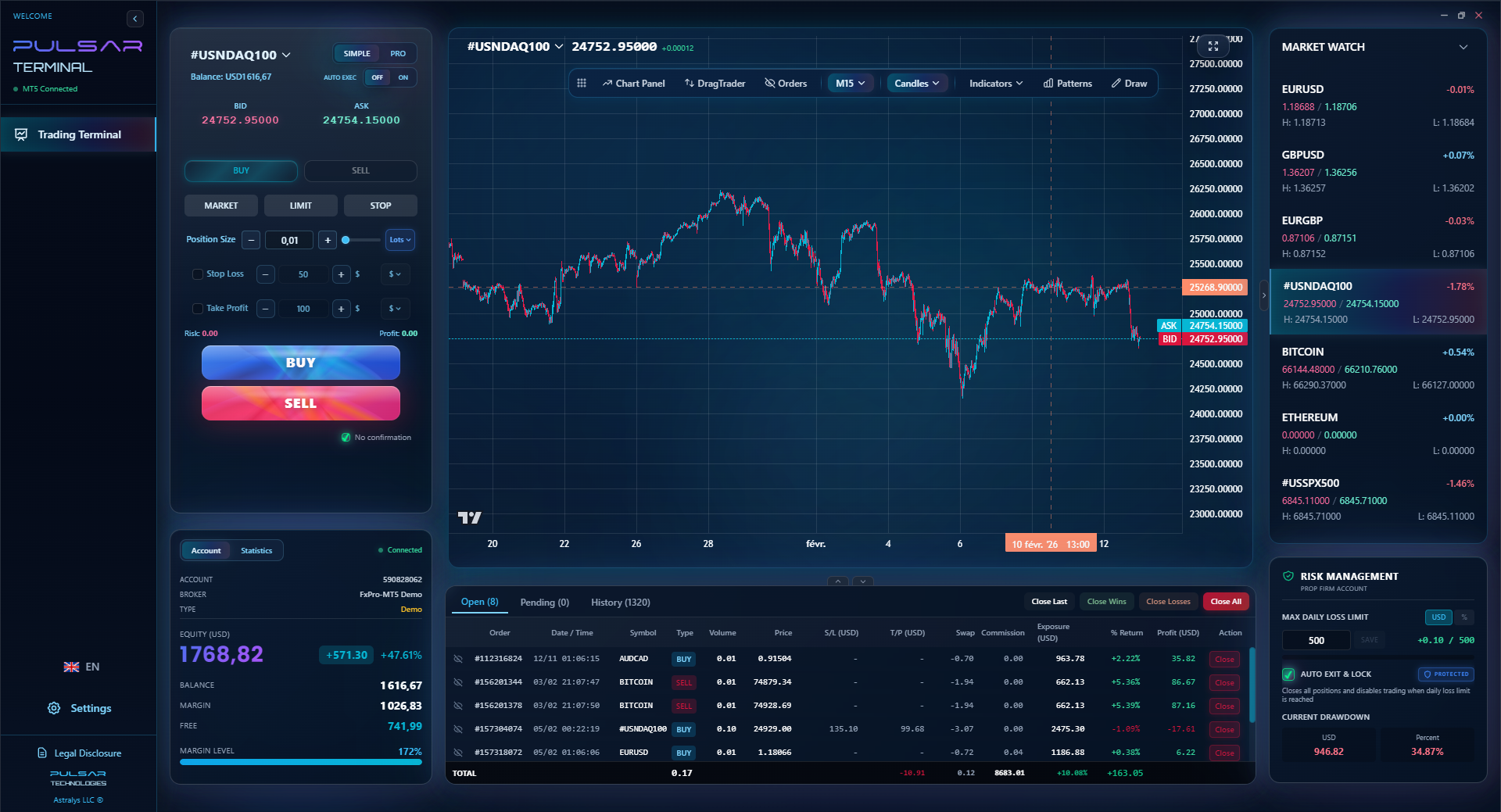
Managing tight daily loss limits on a prop challenge is stressful; Pulsar Terminal's drag-and-drop order and risk management tools on MT5 help you set and adjust stops faster, so you can focus on the trade, not the platform.
Pulsar Terminal
Das All-in-One MT5-Tool: Drag-and-Drop-Orders, Multi-TP/SL, Trailing Stop, Grid Trading, Volume Profile und Prop-Firm-Schutz. Täglich von 1.000+ Tradern genutzt.
“Think of Maven as a training wheels prop firm. It's a low-cost way to feel out the evaluation process.”
Here's the million-dollar question for US traders: Is this even legal? The short answer is it's complicated, and the ground is shifting.
Proprietary trading firms like Maven typically operate as evaluation service providers. You pay a fee for a test. If you pass, they let you trade a pool of their own capital. This model has historically kept them outside the direct registration requirements of the SEC or CFTC. They're not your broker; they're a funding company.
But the regulators are waking up. The CFTC, which oversees futures and forex, has been making noises about classifying these evaluation-based firms as Commodity Trading Advisors (CTAs). If that happens by 2026 as some expect, firms like Maven would face registration, capital requirements, and strict risk disclosure rules. That could change their business model or put some out of business.
The SEC also took a swing in 2024 with new "dealer" rules, though those got tied up in court. The point is, the regulatory scrutiny is intensifying. For you, the trader, this means two things:
- KYC/AML is getting stricter. Expect to provide ID, proof of address, and maybe even source of funds info. It's a hassle, but it's a sign of a semi-legitimate operation.
- There's counterparty risk. If the firm isn't well-capitalized or structured properly, a regulatory shift could freeze payouts or shut them down. Your earned profits aren't in a segregated client account like they are with a real broker. They're an IOU from the prop firm.
Trading with a maven prop firm isn't illegal for you, the retail trader. But you're participating in a market segment that's in the regulatory crosshairs. You need to be comfortable with that uncertainty.
💡 Winstons Tipp
If a firm's main selling point is its low cost, ask yourself what they're cutting to make that possible. It's usually your upside.
“Your real cost isn't the $13 challenge fee; it's the time, effort, and potential frustration.”
Given the low fees, high payout cap, and execution concerns, Maven serves a very specific niche.
Maven Might Be a Fit For:
- Absolute Beginners: Someone who has never taken a prop firm challenge. Losing $13 is a psychologically easier lesson than losing $200.
- Strategy Testers: Traders who want to see if their discipline holds up under formal profit/loss rules without a big upfront investment.
- Traders with Small, Frequent Wins: If your strategy consistently nets $500-$1000 a month on a $50k account, the $10k cap isn't an immediate barrier.
You Should Probably Look Elsewhere If:
- You're a Serious, Profitable Trader: The $10k payout cap will brutally limit your earnings potential. Firms like Apex or TakeProfit offer better scaling and higher or no caps.
- You Trade High-Volatility or News Strategies: If your edge depends on precise stops, the reported slippage issues are a major red flag.
- You Want Long-Term Stability: The regulatory uncertainty makes Maven a questionable choice for building a multi-year funded trading career.
- You Need Advanced Tools: If your edge comes from complex order types or specific platform features, you need to check if Maven's platform offerings (cTrader, MT5) support them fully.
Think of Maven as a training wheels prop firm. It's a low-cost way to feel out the evaluation process. But most traders will outgrow it very quickly due to the cap alone.
“Your real cost isn't the $13 challenge fee; it's the time, effort, and potential frustration.”
If the payout cap turns you off (and it should), here's how to think about the prop firm landscape.
The Scaling Model: Most reputable firms have a clear scaling plan. You start with a $50k or $100k account. You hit consistent profit targets, and they automatically increase your account size - $150k, $200k, and so on. Your profit split stays high (80-90%), and there's no artificial cap on how much you can withdraw. Your earnings grow with your proven skill. Maven's model, with its static account sizes and hard cap, doesn't encourage this growth.
A Better Path for Most:
- Prove Yourself Cheaply (Optional): If you're totally new, maybe use one Maven challenge as a $13 practice test. Don't plan to stay.
- Graduate to a Standard Firm: Once you're confident, invest in a challenge from a firm known for better execution and clear scaling. Yes, the $200-$300 fee stings more, but it's a business investment.
- Manage Your Risk Relentlessly: This is universal. Use a position size calculator for every trade. Your goal in a challenge isn't to get rich; it's to pass without hitting the daily loss limit. I once blew a challenge because I got cocky after three good trades and quadrupled my position size. One margin call later, I was out.
Firms like FTMO, The5%ers, or Apex Trader Funding, while more expensive upfront, offer a more realistic path to turning trading into a real income. Their rules are tougher, but the ceiling is much, much higher.
💡 Winstons Tipp
Never trust a prop firm's demo execution. It must be tested. Slippage in simulation is a warning bell for real funded accounts.

“View that $13 as tuition, not an investment.”
So, is the maven prop firm a scam? No, not really. They deliver what they advertise: a very cheap chance to try a prop firm challenge.
But is it a good foundation for a funded trading career? In my opinion, also no.
The $10,000 payout cap is a fundamental flaw for anyone with serious ambition. Coupled with the mixed reports on execution quality, it creates a ceiling that's just too low. The regulatory overhang adds another layer of risk that you don't get with a traditional broker.
My advice? If you're curious about prop firms and $13 is meaningless to you, go ahead and try a Maven challenge. Treat it as a paid simulation. Learn the psychological pressure of trading under their specific rules. But don't expect it to be your long-term funding partner.
View that $13 as tuition, not an investment. Once you pass, take your proven discipline and apply it to a firm that will actually let you scale your profits. Because at the end of the day, a prop firm should remove limits, not create new ones. And for US traders navigating an uncertain regulatory [landscape], picking a firm with a sustainable model is more important than ever.
Pro Tip: Whatever firm you choose, document everything. Screenshot your challenge rules, profit targets, and all trade confirmations. If there's ever a dispute about slippage or a rule violation, you'll need your own evidence. I learned this the hard way with a different firm years ago.
FAQ
Q1Is Maven Trading legit and safe for US traders?
Maven Trading operates as a legitimate evaluation service provider, which is a common and currently legal model in the US. However, 'safe' is relative. There's counterparty risk (they hold your profits), and the entire retail prop firm industry faces increasing regulatory scrutiny from the CFTC and SEC. It's safer than an outright scam, but riskier than trading your own capital with a regulated broker.
Q2What is the $10,000 payout cap at Maven?
This is a maximum limit on how much profit you can withdraw per payout period (e.g., monthly). If you earn $25,000 in profits in a month, your 80% share would be $20,000. With Maven, you'd only receive $10,000. The remaining $10,000 does not necessarily roll over; it's often simply forfeited or subject to the firm's discretion, severely capping your earning potential.
Q3Are the Maven Trading challenges really only $13?
Yes, for their smallest account size ($2,000), the challenge fee can be as low as $13-$15. Larger account challenges ($5k, $10k) cost slightly more ($19, $38). These are some of the lowest fees in the industry, but remember the low fee is offset by the strict payout cap and potential execution issues.
Q4What brokers and platforms does Maven use?
Maven partners with brokers like Purple Trading and Match-Prime for trade execution. They support several platforms, including the popular cTrader and MetaTrader 5 (MT5). It's crucial to test a demo on these platforms through the broker to check spreads and execution speed before buying a challenge.
Q5Can I pass the Maven challenge using a scalping strategy?
It's possible, but caution is advised. Scalping relies on tight spreads and precise execution. Reports of slippage and wider spreads on Maven's partnered brokers could erode a scalper's edge. If you scalp, you must be extra diligent about monitoring execution quality and might need to adjust your strategy for larger stop-loss buffers.
Q6How does Maven compare to other prop firms like FTMO or Apex?
Maven is the budget option. Firms like FTMO or Apex have much higher challenge fees ($200-$500) but offer significantly higher account sizes, realistic scaling plans, and no hard payout caps. They are generally considered more professional and stable for serious traders, while Maven is seen as an introductory or practice platform.
Q7Will new CFTC rules in 2026 shut down Maven?
It's impossible to say for sure. Expected CFTC rules may classify firms like Maven as Commodity Trading Advisors (CTAs), requiring registration and capitalization. This could force them to change their business model, increase fees, or cease US operations. It's a real risk factor to consider before investing time in passing their challenges.
Prof. Winstons Lektion
Wichtige Erkenntnisse:
- ✓The $10k payout cap severely limits earnings.
- ✓Low fees often mean high hidden costs (slippage, caps).
- ✓Test execution on a broker demo before buying.
- ✓Regulatory changes in 2026 could disrupt the model.
Wie nützlich war dieser Artikel?
Klicken Sie auf einen Stern
Wöchentliche Trading-Einblicke
Kostenlose wöchentliche Analysen & Strategien. Kein Spam.
Über den Autor
James Mitchell
Senior Trading-Analyst
In New York ansässig mit über 9 Jahren Trading-Erfahrung. Fokus auf Haupt-USD-Paare, Prop-Firm-Challenges und die US-Regulierungslandschaft.
Kommentare
Risikohinweis
Der Handel mit Finanzinstrumenten birgt erhebliche Risiken und ist möglicherweise nicht für alle Anleger geeignet. Vergangene Ergebnisse garantieren keine zukünftigen Renditen. Dieser Inhalt dient ausschließlich Bildungszwecken und stellt keine Anlageberatung dar. Führen Sie immer Ihre eigene Recherche durch, bevor Sie handeln.
Das könnte Sie auch interessieren

Cara Trading Forex Sukses: 7 Prinsip dari Trader Profesional
Cara trading forex sukses dengan 7 prinsip trader pro: manajemen modal, disiplin, journal trading, backtest. Data nyata, bukan janji profit palsu.
Jam Trading Forex Terbaik untuk Trader Indonesia: Panduan Lengkap dengan Tabel Waktu
Panduan jam trading forex untuk trader Indonesia. Tabel 4 sesi dunia, jam emas 20:00-00:00, sesi mana yang harus dihindari. Data akurat + tips dari trader berpengalaman.
Top 5 Sàn Forex Uy Tín Nhất 2026: Review Jujur dari Trader Indonesia
Top 5 sàn forex uy tín 2026 untuk trader Indonesia. Review jujur: spread, deposit, withdraw, dukungan lokal. Exness, XM, IC Markets & lebih.
Pulsar Terminal herunterladen
Alle diese Rechner sind in Pulsar Terminal mit Echtzeit-Daten Ihres MT5-Kontos integriert.
Pulsar Terminal herunterladen