


You're probably wondering if the latest MetaTrader 5 update news for September 2025 is a game-changer or just another software patch.

James Mitchell
Senior Trading-Analyst
☕ 11 Min. Lesezeit
Was Sie lernen werden:
- 1The US Regulatory Cage: Your First Reality Check
- 2The September 2025 Update: What Actually Changed
- 3The US Broker Landscape: Your Short List
- 4The Numbers They Don't Highlight: Costs & Loss Rates
- 5Bigger Than an Update: The 2025-2026 Strategic Shifts
- 6A Practical Guide to Upgrading & Staying Compliant
- 7What's Next for MT5 in the USA?
You're probably wondering if the latest MetaTrader 5 update news for September 2025 is a game-changer or just another software patch. The truth is, for a US trader, the platform updates are only half the story. The real impact comes from understanding how these changes fit within the strict US regulatory cage you operate in. I've seen too many traders get excited about new features, only to blow up their accounts because they ignored the rules of the game. Let's cut through the hype and look at what these updates mean for your real-world trading, your broker options, and your bottom line.
Before we touch a single new feature, you have to understand the box you're trading in. The US has the strictest retail trading rules in the world, enforced by the CFTC and NFA. This isn't a suggestion, it's the law, and it fundamentally shapes how you can use MT5.
The big three rules that will mess you up if you forget them: the FIFO rule (First-In, First-Out), the hedging ban, and the 50:1 use cap on majors. I learned this the hard way years ago trying to run a simple hedging strategy I'd used overseas. The platform let me place the trades, but my broker's compliance desk shut it down and sent a warning. It doesn't matter what fancy algorithm you code; if it violates these rules, it's dead on arrival.

Warning: Your MT5 platform might technically allow a function, but your US-regulated broker's systems will block it if it breaks NFA rules. Always check with your broker's compliance docs first.
This regulatory environment is why your choice of broker is so limited. You can't just sign up with any offshore firm offering MT5. You need a broker registered as a Retail Foreign Exchange Dealer (RFED) with the CFTC. This is also why CFDs are off the table for you - they're basically prohibited for US retail traders. Your world is forex, futures, and a handful of other instruments, not the vast CFD universe available elsewhere.
The capital requirement for these brokers - a minimum of $20 million - is supposed to protect you. It means the brokers left standing are heavily capitalized, but it also means fewer choices and sometimes higher costs. It's a trade-off: safety for flexibility.
Alright, let's get into the metatrader 5 update news september 2025. The updates were incremental, not revolutionary. The headline releases were Build 5260 (September 5) and Build 5320 (September 25).
Build 5260 had tweaks to Algo Forge (MetaQuotes' development environment) and extended support for a math library called OpenBLAS. This is backend stuff that makes life easier for MQL5 programmers building complex indicators or EAs. If you're not coding your own systems, you won't feel this directly.
Build 5320 was more notable. It introduced a separate 'CodeBase' category for services (specialized programs that run on the server) and improved how inputs are handled in MQL5. The real kicker, buried in the notes, was that this was the last build to support Windows 7, 8, 8.1, and Server 2008. If you're running an old machine with an outdated OS, your time is up. You need to upgrade your hardware or OS to keep connecting to broker servers.
The Bigger Picture: The Platform Shift
The more significant trend, confirmed by data from Q3 2025, is that MT5 finally overtook MT4 in retail CFD trading volume on MetaQuotes platforms, holding 62% to MT4's 38%. This shift has been coming for years, driven by MT5's superior backtesting engine, more timeframes, and built-in economic calendar. For you, a US trader, it means the industry's focus and new development are squarely on MT5. If you're still on MT4 out of habit, you're on a legacy platform.
Another key piece of metatrader 5 update news from that period was the rollout of 'Integrated Payments' by some brokers (like JP Markets), allowing deposits directly through the terminal. Don't get too excited - this feature's availability for US brokers is limited and subject to a maze of financial regulations.

💡 Winstons Tipp
A new platform feature feels like a new weapon. But remember, a novice with a laser sword still loses to a master with a stick. Master your basics first.
“Your understanding of the FIFO rule is more important than your understanding of any indicator.”
Here’s the cold, hard truth: as a US resident, you have exactly three major regulated brokers offering MT5. That’s it. Your choices are defined by who can legally operate here.
Let's look at the numbers on the ground, based on the latest broker reviews and my own experience checking accounts:
| Broker | Min. Deposit | EUR/USD Avg. Spread | Key MT5 Account Note |
|---|---|---|---|
| Oanda | $0 | ~1.4 pips | Straightforward, spread-only pricing. No commission. |
| Forex.com | $100 | Variable, 'RAW' as low as 0.0 pips | Offers a 'RAW' account: tight spread + $7 per $100k traded commission. |
| Trading.com | $50 | From 0.9 pips | Standard variable spread account structure. |
I have personal experience with two of these. On Oanda, the execution is solid and the platform integration is seamless, but you pay for that reliability in the spread. I once placed a $50,000 trade on EUR/USD during a quiet London session and the effective cost (via the spread) was about $7. On Forex.com's RAW account, I've seen the spread hit true zero, but then you get hit with that $7 commission. For that same $50k trade, the cost is a fixed $3.50. It's cheaper for larger sizes, but you need to be an active trader to justify it.

Pro Tip: Your trading style dictates your broker choice. If you're a high-volume scalping strategy trader making dozens of trades a day, the RAW/commission model at Forex.com will likely save you money. If you're a casual swing trading investor placing a few trades a week, Oanda's spread-only model is simpler.
Remember, all these brokers enforce the US rules (FIFO, no hedging, 50:1 max). They also publish terrifyingly consistent statistics: about 75% of retail accounts lose money. That number isn't a guess, it's a reported fact from these same brokers. Your first job is to not be part of that statistic.
Let's talk about the most important numbers, the ones that determine if you make or lose money. We've touched on spreads, but the real cost is often your own behavior, magnified by use.
First, the use: 50:1 max. That means with $2,000 in your account, you can control a $100,000 position. This is a double-edged sword. It makes profits feel amazing, but it absolutely accelerates losses. A mere 2% move against you wipes out your entire margin. I've done it. In 2018, I got overconfident on a USD/JPY scalping strategy and used near-max use. A sudden flash spike from a news event I ignored took out my stop and erased 40% of my account in under a minute. The platform worked perfectly, my risk management did not.
Now, look at these published loss rates from the brokers themselves for Q3 2025:
- Oanda: 75% of retail CFD accounts lost money.
- Forex.com: 74%-77% lost money.
- Trading.com: 73.7% lost money.
This isn't a coincidence. It's the inevitable outcome of use, emotion, and poor position sizing. The platform updates won't save you from this. Only a rigorous, mechanical approach to risk will. You must use a position size calculator for every single trade. Not sometimes, always. Your survival depends on it.
The other cost is opportunity. Because you can't trade CFDs, you miss out on thousands of instruments available to non-US traders. Your world is primarily forex majors, some minors, a few indices, and commodities. This actually simplifies your focus, but it's a limitation you must accept.
💡 Winstons Tipp
The 75% loss rate isn't a warning sign; it's the scoreboard. Your only goal is to be in the 25%. That requires a system, not just signals.
“The platform updates won't save you from a 75% loss rate. Only rigorous, mechanical risk management will.”
The September updates were just blips on the radar. The real, tectonic shifts for MT5 are happening in the institutional and technological arena, and they trickle down to affect you.
1. The Ultency Engine Push: Throughout 2025 and into 2026, MetaQuotes has been aggressively pushing 'Ultency,' its new liquidity aggregation and order matching engine. Big names like LMAX Group integrated it. For you, the end-user trader, the promise is better execution speeds and potentially tighter pricing from your broker. If your broker adopts it, you might see slightly less slippage on market orders. It's a backend improvement that should be invisible but positive.
2. The Prop Firm Purge: Here's a critical piece of context. In 2024, MetaQuotes pulled platform support from several prop firms serving US clients due to regulatory pressure. This caused chaos. By late 2025, some prop firms were scrambling for alternatives like cTrader for their US traders. If you're involved in the prop firm world, this is a huge deal. It means your chosen firm's platform availability is not guaranteed and is subject to MetaQuotes' compliance whims.
3. The Technical Leap (Build 5572+): While after September, the late 2025/early 2026 builds introduced something massive: GPU-accelerated ONNX models. This lets MQL5 programs run complex machine learning models directly on your graphics card. We're talking about a quantum leap in algorithmic trading power for those who code. The charting engine also got a major upgrade with 'Blend2D' for smoother, faster rendering. These are the updates that actually expand what's possible on the platform.
So, what should you actually do with this information? Here's a step-by-step plan.
Step 1: Check Your Windows Version. If you're on Windows 7, 8, or 8.1, your MT5 will stop connecting to brokers soon (if it hasn't already). You must upgrade your operating system to Windows 10 or 11. This is non-negotiable. I had a client who ignored this, and one Tuesday morning he was locked out of his trades. It was a preventable disaster.
Step 2: Update Your MT5 Platform. Always run the latest stable version. Go to Help > About in your MT5. Your build number should be higher than 5320. If it's not, close MT5 and run the installer from your broker's website. Do not skip updates; they often contain critical security patches.
Step 3: Audit Your EAs and Scripts. After any major update, test your Expert Advisors and scripts on a demo account first. The September builds changed how some input operations work in MQL5. An EA that worked last month might have a bug now. I once lost $1,200 because an old grid EA I'd forgotten about malfunctioned after an update and placed unintended trades.
Step 4: Re-Read Your Broker's Rulebook. Go to your broker's website and find the 'Terms of Service' and 'Risk Disclosure' for US clients. Know the rules on margin call procedures, order execution, and specifically, the FIFO and hedging policies. Your understanding of these rules is more important than your understanding of the MACD indicator.

Example: You buy 1 lot of EUR/USD at 1.0800. Later, you buy another 1 lot at 1.0850. The price falls to 1.0820 and you want to cut risk by selling 1 lot. Under FIFO, you must close the first position (1.0800) for a $200 loss. You cannot choose to close the 1.0850 position. This changes your entire trade management logic.
💡 Winstons Tipp
Treat every software update like a mechanic treats a new model year. Open the hood (demo account) and test everything before you drive it in the race.
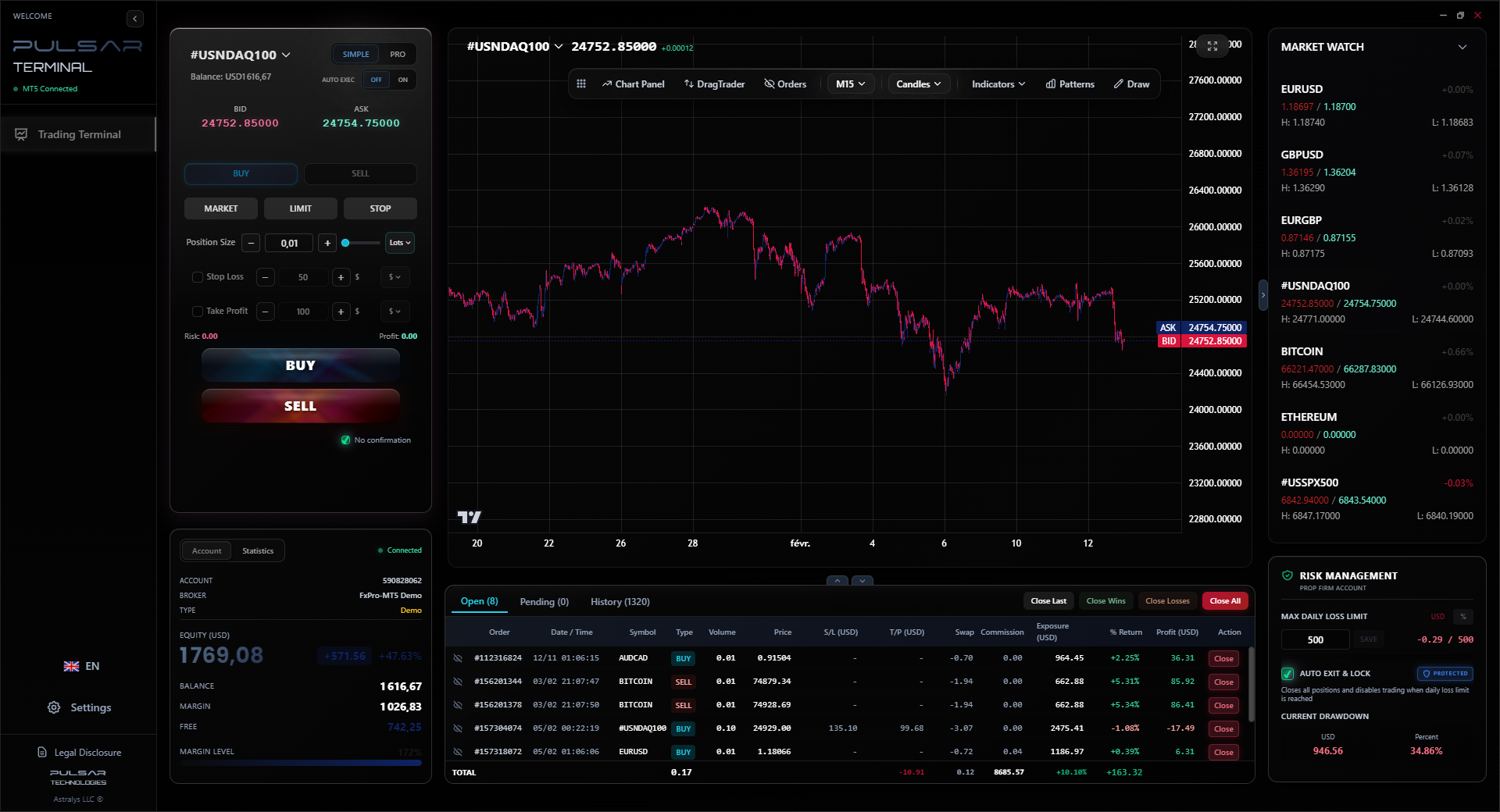
Manually managing trades under strict FIFO rules is a headache, but tools like Pulsar Terminal automate complex trade management and partial closures directly on your MT5 platform.
Pulsar Terminal
Das All-in-One MT5-Tool: Drag-and-Drop-Orders, Multi-TP/SL, Trailing Stop, Grid Trading, Volume Profile und Prop-Firm-Schutz. Täglich von 1.000+ Tradern genutzt.
“For the US trader, MT5 is a professional tool inside a heavily guarded sandbox.”
Looking ahead, the path for MT5 in the US is one of consolidation within a strict framework.
Expect the broker list to stay very short. The $20 million capital barrier is too high for new entrants. Your existing brokers (Oanda, Forex.com, Trading.com) will continue to be your primary options. They will slowly integrate backend improvements like Ultency, but the front-end experience for you, the trader, will remain largely familiar due to regulatory constraints.
The innovation will happen in two areas: 1) Advanced algorithmic trading (fueled by the GPU/ONNX capabilities), and 2) Companion tools and integrations. Since the core MT5 platform is somewhat rigid, third-party tools that connect to it via API are becoming essential for serious traders. Think advanced trade management, better charting tools, and automated journaling.
The mobile and web platforms will keep getting polish. The Android app got a full redesign, and the web platform now has a night theme. These are quality-of-life improvements for managing trades on the go.
, for the US trader, MT5 is becoming a stable, regulated, and powerful workstation. It's not the wild west of innovation you might see promoted for international traders. It's a professional tool inside a heavily guarded sandbox. Your edge won't come from waiting for the next update; it will come from mastering the tools you have within the rules that bind you. Focus on your strategy, your psychology, and your relentless risk management. The platform is just the vehicle.
FAQ
Q1Is MetaTrader 5 legal to use in the United States?
Yes, but only when provided by a broker registered with the CFTC and NFA, like Oanda, Forex.com, or Trading.com. You cannot legally use MT5 with an unregulated offshore broker as a US resident.
Q2What was the most important change in the September 2025 MT5 update?
For most traders, the key takeaway was that Build 5320 (Sept 25) was the last to support old Windows OSes (7, 8, 8.1). If you don't upgrade your operating system, your MT5 will eventually stop connecting to broker servers.
Q3Can I hedge or use a grid trading strategy on MT5 in the US?
No. The NFA's hedging ban prohibits holding simultaneous long and short positions in the same currency pair. Most automated grid strategies rely on this, so they are not compliant for US retail accounts. You need to find alternative, FIFO-compliant strategies.
Q4Why are there so few US brokers offering MT5?
The regulatory burden is immense. Brokers must be registered as Retail Foreign Exchange Dealers (RFEDs) with the CFTC, maintain at least $20 million in capital, and adhere to strict rules like FIFO and use caps. This high barrier to entry limits the number of firms that can operate.
Q5Did the September 2025 update improve execution speed or spreads?
Not directly. Those are primarily functions of your broker's liquidity and technology. The updates focused on developer tools (Algo Forge, MQL5) and system support. Improvements in execution would come from your broker adopting MetaQuotes' newer 'Ultency' matching engine on their backend.
Q6I'm with a prop firm. Will these updates affect my challenge?
Possibly. MetaQuotes has withdrawn support from some prop firms serving US clients. You must confirm with your specific prop firm that they officially support MT5 for US residents and that their platform is updated to a compliant, recent build. Many have moved US traders to other platforms like cTrader.
Q7As a US trader, should I switch from MT4 to MT5?
Yes, absolutely. As of Q3 2025, MT5 handles the majority of trading volume on MetaQuotes platforms. It has a better backtester, more timeframes, and is where all future development is focused. MT4 is a legacy platform, and your broker may phase it out over time.
Prof. Winstons Lektion
Wichtige Erkenntnisse:
- ✓US rules (FIFO, 50:1 use) dictate your strategy.
- ✓Only 3 major brokers offer legal MT5 access.
- ✓Update your OS: Windows 7/8 support is gone.
- ✓75% of retail accounts lose - focus on risk first.
Wie nützlich war dieser Artikel?
Klicken Sie auf einen Stern
Wöchentliche Trading-Einblicke
Kostenlose wöchentliche Analysen & Strategien. Kein Spam.
Über den Autor
James Mitchell
Senior Trading-Analyst
In New York ansässig mit über 9 Jahren Trading-Erfahrung. Fokus auf Haupt-USD-Paare, Prop-Firm-Challenges und die US-Regulierungslandschaft.
Kommentare
Risikohinweis
Der Handel mit Finanzinstrumenten birgt erhebliche Risiken und ist möglicherweise nicht für alle Anleger geeignet. Vergangene Ergebnisse garantieren keine zukünftigen Renditen. Dieser Inhalt dient ausschließlich Bildungszwecken und stellt keine Anlageberatung dar. Führen Sie immer Ihre eigene Recherche durch, bevor Sie handeln.
Das könnte Sie auch interessieren

Cara Trading Forex Sukses: 7 Prinsip dari Trader Profesional
Cara trading forex sukses dengan 7 prinsip trader pro: manajemen modal, disiplin, journal trading, backtest. Data nyata, bukan janji profit palsu.
Jam Trading Forex Terbaik untuk Trader Indonesia: Panduan Lengkap dengan Tabel Waktu
Panduan jam trading forex untuk trader Indonesia. Tabel 4 sesi dunia, jam emas 20:00-00:00, sesi mana yang harus dihindari. Data akurat + tips dari trader berpengalaman.
Top 5 Sàn Forex Uy Tín Nhất 2026: Review Jujur dari Trader Indonesia
Top 5 sàn forex uy tín 2026 untuk trader Indonesia. Review jujur: spread, deposit, withdraw, dukungan lokal. Exness, XM, IC Markets & lebih.
Pulsar Terminal herunterladen
Alle diese Rechner sind in Pulsar Terminal mit Echtzeit-Daten Ihres MT5-Kontos integriert.
Pulsar Terminal herunterladen