


Here's a fact that should make you pause: over 70% of retail forex traders lose money.

Olumide Adeyemi
Pionier des Tradings in Westafrika ·  Nigeria
☕ 12 Min. Lesezeit
Was Sie lernen werden:
- 1The Legal Reality: Is Forex Trading Even Legal in Nigeria?
- 2The Hidden Costs & The 10% Tax Man
- 3Picking Your Prime Forex Broker: The Nigerian Checklist
- 4Trading Naira Pairs: Volatility is a Double-Edged Sword
- 5The Nigerian Trader's Survival Guide: Risk Management
- 6Pitfalls to Avoid: Lessons from My Mistakes
- 7Building a Sustainable Prime Forex Strategy
Here's a fact that should make you pause: over 70% of retail forex traders lose money. In Nigeria, with our unique market dynamics and regulatory grey areas, that number might be even higher. Everyone's chasing 'prime forex' opportunities - the best setups, the tightest spreads, the perfect broker. But the real secret to prime forex isn't a magic indicator; it's understanding the local landscape so you don't get wrecked by something you never saw coming, like a surprise tax bill or a broker that vanishes with your money. I've traded through Naira volatility for over a decade, and I'll show you what actually works.
Let's clear this up first, because I've seen too many guys operate in the shadows, scared of some bogeyman. Forex trading is 100% legal for individuals in Nigeria. The Central Bank of Nigeria (CBN) and the Securities and Exchange Commission (SEC) are the main bodies involved.
But here's the critical nuance, and it's where most of the confusion (and risk) comes from. The CBN cares about monetary policy and managing the country's foreign reserves. They regulate banks and Bureau de Change (BDC) operations. The SEC? They're focused on stocks and bonds. The crucial gap is that there's no specific, strong licensing framework for online retail forex brokers operating within Nigeria.
What does this mean for you? It creates a two-tier system:
- Local Broker Risk: A 'Nigerian' broker might just be an office in Lagos with no real oversight. If they blow up, your money is likely gone. The CBN authorizes some for OTC products, but the protection is thin.
- International Broker Safety Net: There's no law stopping you from using brokers regulated abroad. This is your safest bet. You're placing your funds under the protection of authorities like the UK's FCA or Cyprus's CySEC, which have strict client money rules.

Warning: Just because a broker has a .ng domain and accepts Naira deposits doesn't mean it's regulated by the CBN in a way that protects you. Always verify their actual license with the issuing authority.
The legal foundation exists - the Foreign Exchange Act of 1995, the Investment and Securities Act - but the on-the-ground enforcement for retail traders is minimal. You are responsible for your own due diligence. This makes choosing the right broker, which we'll get to, your single most important legal and financial decision.

💡 Winstons Tipp
Your broker's regulation sheet is more important than their advertised spreads. A cheap trade with an unregulated firm is the most expensive trade you'll ever make.
“High use offered to Nigerian clients isn't a privilege; it's a weapon of mass account destruction.”
You might nail a 50-pip trade on EUR/USD, but your real profit is what hits your bank account after all costs. In Nigeria, we have one big, non-negotiable cost that many traders conveniently 'forget' until it's too late.
The Capital Gains Tax: 10%
The Federal Inland Revenue Service (FIRS) wants its share. You are liable for a 10% capital gains tax on your gross forex trading profits. It doesn't matter if your broker is in Malta or the Marshall Islands. If you're a Nigerian resident earning income, the tax obligation is here. I know traders who've made life-changing money only to get a nasty shock from a tax audit years later. Keep a detailed trade journal. It's not just for strategy review; it's your audit shield.
Broker Costs: Spreads, Commissions, and Fees
This is where your choice of broker directly eats into your edge. Let's look at real numbers for a standard account trading EUR/USD, the world's most traded pair:
| Broker | Typical EUR/USD Spread | Minimum Deposit | Key Note |
|---|---|---|---|
| IC Markets | 0.0 pips + commission | $200 | True ECN, raw spreads. Our IC Markets review breaks down the commission structure. |
| XM | From 0.8 pips | $5 | Very low barrier to entry. |
| AvaTrade | 0.93 pips | $100 | Fixed spreads, good for beginners. |
| Capital.com | 0.64 pips | $20 | Competitive all-rounder. |
| HFM | From 0.2 pips | ₦4,000 / $100 | Offers Naira accounts, high use available. |
A 2-pip spread vs. a 0.5-pip spread might not seem like much on one trade. But over 100 trades, that's 150 pips of your potential profit gone before you even start. For active strategies like scalping, tight spreads are non-negotiable.

Example: You make 100 trades a month, averaging 1 standard lot (100,000 units) each. A 1.5 pip difference in spread costs you 100 trades * 1.5 pips * $10 per pip = $1,500 per month. That's life-changing money for most people, just vanished in fees.
The Naira Conversion Trap
Funding your account? If you deposit in Naira and your broker converts it to USD, you're at the mercy of their exchange rate, which is often worse than the official or parallel market rate. Some brokers, like HFM and Exness, offer Naira-denominated accounts, which can simplify this. Always check the actual conversion rate applied.
“The real secret to prime forex isn't a magic indicator; it's understanding the local landscape so you don't get wrecked by something you never saw coming.”
Forget flashy ads with guys posing next to Lamborghinis. Your broker is your business partner. Choose a bad one, and your business fails. Here’s my practical checklist, born from painful experience.
1. International Regulation is King. This is your first and most important filter. Look for Tier-1 licenses: UK (FCA), Australia (ASIC), Cyprus (CySEC). A broker like Pepperstone, regulated by ASIC and the FCA, is held to a far higher standard of conduct and client fund segregation than an unregulated entity. I learned this the hard way early in my career with a local outfit that 'had issues' with withdrawals during a volatile period. My money was stuck for weeks.
2. Naira-Friendly Operations. Can you deposit and withdraw in Naira without crazy fees? Do they support local payment methods (bank transfer, USSD, maybe even mobile money)? Check their stated processing times for withdrawals. A broker that takes 7 business days to get your profit to you is creating unnecessary stress. Exness and HFM are known for good local support.
3. Realistic use. I see brokers advertising 1:2000 or even 1:3000 use to Nigerian clients. This is a weapon of mass account destruction. With 1:1000 use, a 10-pip move against you on a standard lot can wipe out a significant chunk of your margin. High use amplifies both gains and losses, and psychologically, it encourages terrible over-trading. Start low - 1:50 or 1:100 max - until you have a proven, profitable system. Use a position size calculator for every single trade.
4. Platform & Tools. Most brokers offer MetaTrader 4 or 5. That's fine. But check the execution quality. Are there frequent requotes or slippage during news events? For advanced tools, some brokers integrate with platforms like Pulsar Terminal, which can add serious firepower to your MT5 setup for things like advanced order management and volume analysis.
5. Customer Support. Test them. Send an email or hop on live chat with a technical question. See how long they take to respond and how helpful they are. If they're slow or unhelpful when you're not in a crisis, imagine what they'll be like when you have a real problem with a live trade.
“The real secret to prime forex isn't a magic indicator; it's understanding the local landscape so you don't get wrecked by something you never saw coming.”
Trading USD/NGN or other Naira crosses can feel like playing a different sport. The volatility is immense, and the fundamentals are hyper-local. In 2025, the Naira gained 7.5% against the dollar - its first annual gain in 13 years. By early 2026, it was around ₦1,419/$1. But in November 2025, it dipped 1.7% in a month.
What moves the Naira? CBN policy announcements, oil price fluctuations (our main export), foreign reserve levels, and parallel market sentiment. This isn't like trading EUR/USD, which reacts to global macro trends. This is local, often political, and news-driven.
I once tried to swing trade USD/NGN based on a technical breakout. The chart looked perfect. I entered, and the next day, a surprise CBN governor announcement about new FX measures caused a 5% gap against me at the open. My stop-loss was useless. I learned that with these pairs, your risk management has to be brutal. Wider stops are mandatory, and position sizes must be tiny relative to your account.

Pro Tip: If you trade Naira pairs, treat them as a speculative side-show, not your main strategy. Allocate no more than 5-10% of your capital to them. The spreads are often wider, and the emotional rollercoaster can ruin your discipline for your core trades on more stable majors.
💡 Winstons Tipp
If you can't instantly state your maximum risk in Naira before clicking 'buy,' you have no business being in that trade. Discipline is calculated, not felt.
“A 2-pip spread vs. a 0.5-pip spread might not seem like much. But over 100 trades, that's $1,500 of your potential profit gone before you even start.”
This is the section that separates the survivors from the statistics. All the broker research and legal knowledge means nothing if you blow up your account. Here’s the unsexy, non-negotiable foundation.
The 1% Rule is Your Holy Grail. Never, ever risk more than 1% of your trading capital on a single trade. If you have a ₦500,000 account, that's ₦5,000 max risk per trade. This isn't a suggestion; it's the law if you want to stay in the game. Calculate your position size based on the distance to your stop-loss. A proper position size calculator does this math for you instantly.
use is Not a Reward, It's a Risk Parameter. The broker offers you 1:500. You don't have to use it. Using high use to trade a large position with a tiny stop-loss is a recipe for being stopped out by normal market noise. It's the number one reason new traders get frustrated. They're not 'wrong' on direction; they're just using too much use for their strategy.
Have a Written Trading Plan. What pairs do you trade? What's your entry criteria? (Is it a MACD crossover? A specific RSI level?) Where is your stop-loss? Where is your take-profit? What's your daily loss limit? Write it down. I didn't for my first two years, and my results were random. Once I wrote my plan, my consistency improved dramatically.
Prepare for a Margin Call. Know what it is before it happens. A margin call is when your broker warns you that your losses are eating into the required margin for your open positions. If you don't add funds or close positions, they will start closing them for you, often at the worst possible price. The way to avoid it is simple: use sensible use and the 1% rule.
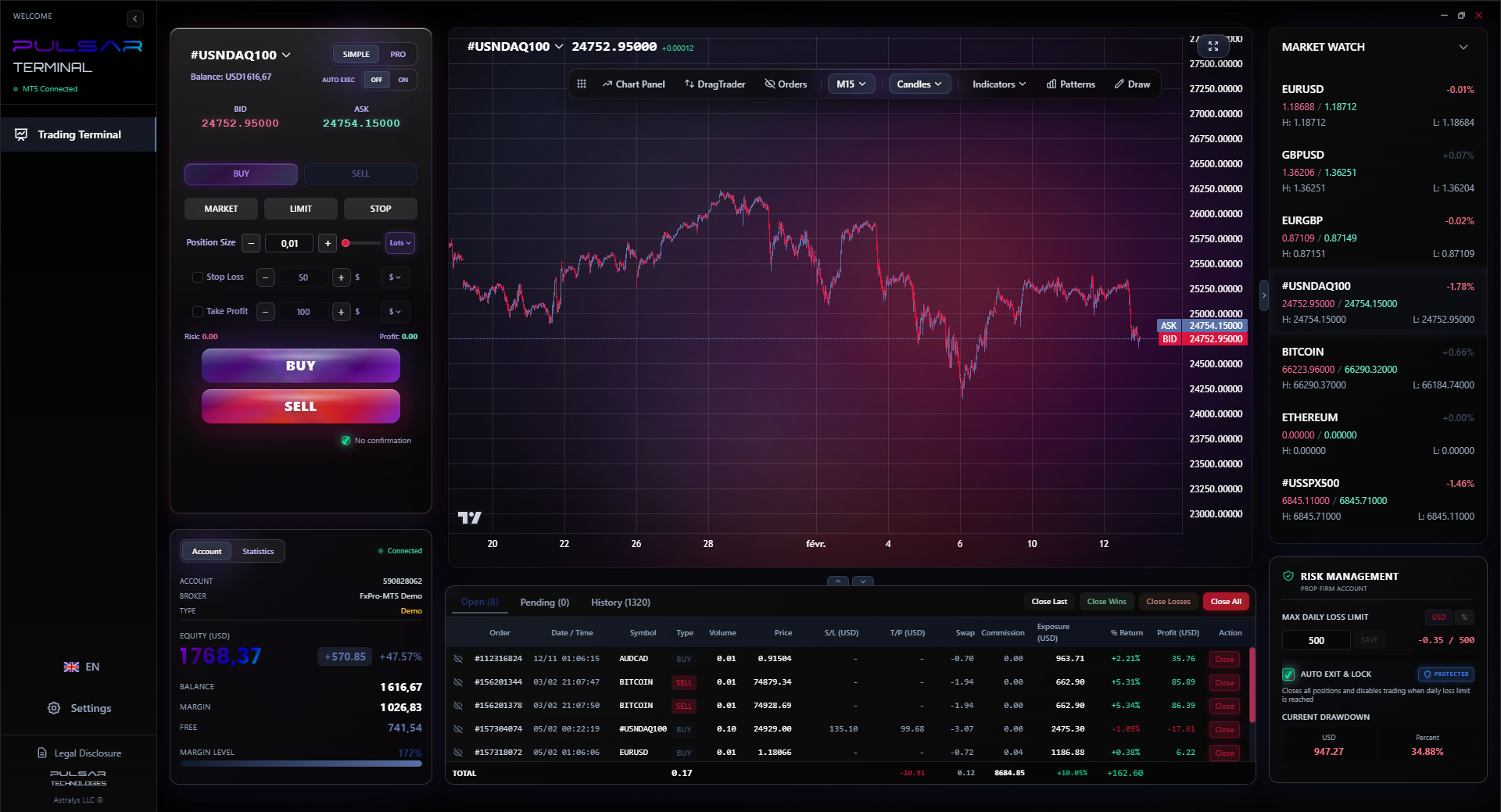
Sticking to a strict risk management plan with manual stops is hard; a tool like Pulsar Terminal automates trailing stops and breakeven orders directly on your MT5 chart, removing emotion from the equation.
Pulsar Terminal
Das All-in-One MT5-Tool: Drag-and-Drop-Orders, Multi-TP/SL, Trailing Stop, Grid Trading, Volume Profile und Prop-Firm-Schutz. Täglich von 1.000+ Tradern genutzt.
“A 2-pip spread vs. a 0.5-pip spread might not seem like much. But over 100 trades, that's $1,500 of your potential profit gone before you even start.”
Let me save you some money and heartache by sharing where I and countless others have gone wrong.
Chasing 'Surefire' Signals from Social Media. The 'guru' on Telegram with a screenshot of a 100-pip win. I fell for this early on. Paid for a signal service. The first few trades won small. Then came the 'big one' that required a wider stop. It hit the stop, and the loss wiped out all previous gains plus 30% of my account. These services have no accountability. You are their customer, not their priority.
Trying to Recover Losses Immediately. You lose ₦20,000 on a bad trade. The instinct is to jump back in with a bigger position to win it back fast. This is emotional trading, and it's how you turn a bad day into a catastrophic week. My rule now: after two consecutive losses, I'm done for the day. I shut down the platform and walk away.
Ignoring the Total Cost of Trading. We talked about spreads and tax. But also factor in potential bank charges for international transfers, currency conversion fees, and any inactivity fees from your broker. These nibble away at your bottom line.
Neglecting Your Psychology. Trading in Nigeria comes with extra pressure. Family expectations, a volatile economy, the desire for quick success. This pressure leads to overtrading - taking setups that aren't in your plan just because you 'need' to make money. You have to manage your mindset as actively as you manage your trades. Meditation, exercise, having a non-trading hobby - these aren't luxuries; they're essential tools for a clear head.
💡 Winstons Tipp
The market doesn't care about your rent, your bills, or your dreams. Trade the chart in front of you, not the story in your head. Emotional capital is your most finite resource.
“Consistent small gains, compounded over time, are the real path to wealth in forex. It's boring, but it works.”
So what does a realistic, sustainable approach look like for a Nigerian trader?
Start with a Demo Account, But Not Forever. Use a demo to learn the platform and test your basic strategy. But after 2-3 months, move to a live account with the smallest possible amount. XM's $5 minimum or FXTM's ₦100 minimum is perfect for this. Why? Because real money triggers real emotions that a demo account can never replicate. You need to feel the sting of a loss and the thrill of a win with real capital to learn true discipline.
Specialize. Don't try to trade 28 currency pairs, gold, oil, and indices all at once. Pick one or two major pairs. Master them. Understand their average daily range, what time they are most active (London session for EUR/USD, for example), and what economic news moves them. Depth beats breadth every time.
Keep a Trading Journal. This is your single most valuable improvement tool. For every trade, record:
- Date/Time, Pair
- Entry Price, Stop-Loss, Take-Profit
- Position Size (in lots)
- Reason for entry (e.g., '1H chart bullish divergence on RSI')
- Screenshot of the chart
- Outcome (P/L in pips and money)
- Notes on emotions ('Felt rushed,' 'Was confident')
Review this journal weekly. Look for patterns. Are you losing more on trades entered after 10 PM? Are your winning trades all based on one specific setup? This data is gold.
Think in Percentages, Not Naira. Train your brain to think about risk and reward as a percentage of your account. A 2% gain on a ₦200,000 account is ₦4,000. That's a fantastic day. Chasing ₦50,000 in a day is how you blow up. Consistent small gains, compounded over time, are the real path to wealth in forex. It's boring, but it works.
FAQ
Q1Do I need to pay tax on my forex trading profits in Nigeria?
Yes. The Federal Inland Revenue Service (FIRS) requires you to pay a 10% Capital Gains Tax on your gross forex trading profits. It's your responsibility to declare this income and pay the tax, regardless of whether your broker is based in Nigeria or overseas.
Q2What is the best forex broker for beginners in Nigeria?
For a complete beginner, look for a broker with a very low minimum deposit (like XM at $5 or FXTM at ₦100), good educational resources, and a user-friendly platform like MetaTrader. XM and Capital.com are strong contenders. The 'best' broker also depends on your goals - tight spreads are crucial for scalping, while fixed spreads might suit a slower swing trader.
Q3Is 1:1000 use safe for trading?
For the vast majority of traders, no, it's extremely dangerous. use of 1:1000 means a very small price move against you can wipe out your entire margin. It encourages position sizes that are far too large for most accounts. I recommend starting with 1:50 or 1:100 maximum until you have a proven, profitable strategy and iron-clad discipline. Always use a position size calculator.
Q4Can I use international brokers like IC Markets or Pepperstone in Nigeria?
Absolutely. There is no law preventing Nigerian residents from opening accounts with internationally regulated brokers. In fact, it's often safer, as your funds are protected under stricter foreign regulations like ASIC (Australia) or FCA (UK). Both IC Markets and Pepperstone accept Nigerian clients.
Q5What is a pip in forex trading?
A pip (percentage in point) is the standard unit for measuring movement in a currency pair. For most pairs, it's the fourth decimal place (0.0001). A move from 1.1850 to 1.1851 is one pip. For pairs involving the Japanese Yen, it's the second decimal place (0.01). Understanding the pip definition and its monetary value is fundamental to calculating your profit, loss, and position size.
Q6How much money do I need to start forex trading in Nigeria?
You can start with very little. Brokers like XM allow $5, and FBS allows $1. However, starting with such a small amount is primarily for learning the mechanics and psychology with real money. To trade seriously while properly implementing risk management (the 1% rule), a more realistic starting capital for a beginner is between ₦100,000 and ₦500,000. This allows for meaningful position sizing without being wiped out by a few losing trades.
Q7What's the difference between a spread and a commission?
The spread definition is the difference between the buy (ask) and sell (bid) price. It's a cost built into the price. A commission is a separate, fixed fee charged per lot traded. Some brokers (like IC Markets on their Raw account) offer very low or 0.0 pip spreads but charge a commission. Others (like many standard accounts) have wider spreads but no commission. You need to calculate the total cost per trade to compare brokers fairly.
Prof. Winstons Lektion
Wichtige Erkenntnisse:
- ✓Legal ≠ Well-Regulated. Use internationally licensed brokers.
- ✓The 10% FIRS tax on profits is non-negotiable. Keep records.
- ✓Never risk more than 1% of your capital on a single trade.
- ✓use above 1:100 is a trap for inexperienced traders.
- ✓Trade the chart, not your financial desperation.
Wie nützlich war dieser Artikel?
Klicken Sie auf einen Stern
Wöchentliche Trading-Einblicke
Kostenlose wöchentliche Analysen & Strategien. Kein Spam.
Über den Autor
Olumide Adeyemi
Pionier des Tradings in Westafrika
Einer der aktivsten Forex-Trading-Ausbilder Nigerias. 8 Jahre Trading-Erfahrung aus Lagos. Spezialisiert auf Strategien mit geringem Kapital und Prop-Firm-Challenges für afrikanische Trader.
Kommentare
Risikohinweis
Der Handel mit Finanzinstrumenten birgt erhebliche Risiken und ist möglicherweise nicht für alle Anleger geeignet. Vergangene Ergebnisse garantieren keine zukünftigen Renditen. Dieser Inhalt dient ausschließlich Bildungszwecken und stellt keine Anlageberatung dar. Führen Sie immer Ihre eigene Recherche durch, bevor Sie handeln.
Das könnte Sie auch interessieren

Cara Trading Forex Sukses: 7 Prinsip dari Trader Profesional
Cara trading forex sukses dengan 7 prinsip trader pro: manajemen modal, disiplin, journal trading, backtest. Data nyata, bukan janji profit palsu.
Jam Trading Forex Terbaik untuk Trader Indonesia: Panduan Lengkap dengan Tabel Waktu
Panduan jam trading forex untuk trader Indonesia. Tabel 4 sesi dunia, jam emas 20:00-00:00, sesi mana yang harus dihindari. Data akurat + tips dari trader berpengalaman.
Top 5 Sàn Forex Uy Tín Nhất 2026: Review Jujur dari Trader Indonesia
Top 5 sàn forex uy tín 2026 untuk trader Indonesia. Review jujur: spread, deposit, withdraw, dukungan lokal. Exness, XM, IC Markets & lebih.
Pulsar Terminal herunterladen
Alle diese Rechner sind in Pulsar Terminal mit Echtzeit-Daten Ihres MT5-Kontos integriert.
Pulsar Terminal herunterladen