


Prop firm options trading is a trap for 93% of people who try it.

James Mitchell
Senior Trading-Analyst
☕ 13 Min. Lesezeit
Was Sie lernen werden:
- 1What Prop Firm Options Trading Actually Is (And Isn't)
- 2The Real Cost: Fees, Rules, and How They Stack Against You
- 3The Regulatory Gray Area: Is This Even Legal?
- 4Options Strategies That Work (And The Ones That Get You Kicked)
- 5How to Vet a Prop Firm in 2026 (Red Flags & Green Lights)
- 6The Psychology: Trading Their Money Feels Different
- 7The Final Verdict: Is Prop Firm Options Trading Worth It?
Prop firm options trading is a trap for 93% of people who try it. That's not an opinion, it's the data. The industry is built on selling you a dream of trading millions with 'no risk,' but the structure is designed for you to fail the evaluation and pay reset fees. I've traded for prop firms, passed challenges, and blown up accounts. This guide will show you the real numbers, the hidden rules, and the only way to approach this game if you're serious about getting funded and keeping the money.
Let's clear the marketing fog. Prop firm options trading isn't you getting a job. It's you renting a firm's capital for a fee, under their insanely strict rules, to try and make them money. If you succeed, you get a cut. If you fail - which is the expected outcome - they keep your evaluation fee.
It works like this: You pay a fee (say, $250) to take a 'challenge.' You get a simulated account with, for example, $100,000 in buying power. You have to hit a profit target (like 8%) without breaking daily or total loss limits. Pass, and you get a 'funded' account where you trade the firm's real money. You keep 70-90% of the profits.
Here's what it isn't: It's not a license to print money. It's not a way to learn to trade. And crucially, for most firms, it's not you directly trading CBOE-listed options in your own name. The firm holds the master account; you're operating a sub-account under their risk umbrella. This structure is why they can skirt some regulations - a fact that's changing fast, as you'll see in the regulations section.

Warning: The 'no risk to your capital' line is a half-truth. You're not risking your capital on market losses, but you are 100% risking your evaluation fee, which you will statistically lose. The average ROI for all traders who buy a challenge is negative.
The appeal is obvious: scale. Turning a $10,000 personal account into a living is brutally hard. Managing a $100,000 prop account? The numbers work better. But that scale comes with handcuffs. Your every move is monitored by algorithms that will shut you down the millisecond you breach a rule. It's high-stakes swing trading with a robot babysitter.
“Prop firm options trading is a trap for 93% of people who try it.”
This is where the dream meets the spreadsheet. You need to understand the economics before you spend a dime.
The Fee Structure (Where Your Money Goes):
| Fee Type | Typical Cost | What It Is | The Catch |
|---|---|---|---|
| Evaluation Fee | $35 - $500+ | Upfront cost to take the challenge. | Non-refundable. This is the firm's primary revenue. |
| Reset Fee | $60 - $80 | Cost to restart a failed challenge. | Encourages you to 'try again' rather than quit. A huge profit center. |
| Monthly Subscription | $50 - $200 | Access to platform/data after funding. | Even when you're making them money, you pay rent. |
| Live Account Activation | $50 - $100 | One-time fee to start your funded account. | A newer fee as competition squeezes margins. |
| Market Data (Futures) | ~$130/month | Professional data fees from exchanges like CME. | Often passed directly to you, the funded trader. |
| Commissions | $3-$4 per side | Per-contract fees to execute trades. | Cuts directly into your profitability. A $6-8 round trip on one contract adds up. |
The Profit Split Illusion: They advertise 'up to 90% profit split!' Sounds great. But you only get that split on net profits after all fees and commissions. If your strategy has a 55% win rate and you're paying $8 per contract in commissions, that split is on a much smaller number than your gross P&L.
The Rules That Make You Blow Up: This is the killer. The rules aren't designed to help you succeed; they're designed to protect the firm's capital and trigger resets.
- Daily Loss Limit: Often 4-5% of your account's starting balance. Hit it, account frozen. No 'sleeping on it' to recover.
- Trailing Drawdown: The most common account killer. Your maximum loss (drawdown) level trails your account's highest equity point. Example: You start at $100k, profit to $104k. Your max loss might now be $99k (trailing from the high). A pullback to $100k - still up on the challenge! - can trigger a violation if it crosses that trailing threshold. It forces you to be consistently profitable with no meaningful drawdowns.
- Time Limits: Many challenges have a 30-day minimum trading period. You can't just hit your 8% target in one good week and stop. You have to survive the full period without breaking a rule.
I learned this the hard way. In 2021, I passed a challenge with a firm (since shut down) trading SPX options. I was up 12% in three weeks. Got cocky. Took a position that was too large relative to my position size calculator plan. A 1% overnight move against me triggered my daily loss limit because of the size. Account failed. I was profitable overall but broke a single rule. Gone. That $350 fee and three weeks of work? Poof.

Example: Let's say you buy a $300 challenge for a $100k account. Industry stats say you have a 7% chance of a payout. The average payout is 4% of account size ($4,000). Your expected value is (0.07 * $4,000) - $300 = -$20. You're expected to lose money before you even trade.

💡 Winstons Tipp
Never calculate your potential profits based on the funded account size. Calculate them based on your expected net profit after commissions, fees, and the profit split. That number is usually 60-70% smaller than the headline figure that got you excited.
“The rules aren't designed to help you succeed; they're designed to protect the firm's capital and trigger resets.”
This is the elephant in the room. The regulatory landscape for prop firms offering options and futures access is shifting from gray to a glaring red flag for regulators.
Most retail prop firms are not registered broker-dealers with the SEC or Commodity Trading Advisors (CTAs) with the CFTC. They've operated by calling themselves 'educational evaluators.' You pay for a 'course' or 'evaluation,' and trading their capital is a 'reward.' This loophole is closing.
The CFTC is now openly questioning if these firms are de facto CTAs and should be regulated as such. That means capital requirements, audits, and serious oversight. The SEC is also narrowing exemptions to drag more proprietary trading operations under FINRA oversight.
The big earthquake was MetaQuotes' February 2024 crackdown. MetaQuotes, maker of MetaTrader, forced firms using MT4/5 to prove they were regulated brokers. Overnight, dozens of firms lost their platform. An estimated 80-100 firms folded in 2024 alone. This pushed the industry towards other platforms like cTrader, DXtrade, and MatchTrader, but the message was clear: the free ride is over.
What does this mean for you, the trader?
- Firm Solvency Risk: You could pass a challenge, get funded, and then the firm vanishes because it can't meet new regulatory capital requirements or loses its platform. Your earned profits? Possibly gone.
- Rule Changes Overnight: As regulators circle, firms may suddenly change their payout structures, rules, or even ban certain products (like 0DTE options) to reduce risk and regulatory scrutiny.
- The Good Firms Are Adapting: The survivors are partnering with actual regulated brokers (Exness, IC Markets) for execution or becoming properly licensed themselves. When choosing a firm, their regulatory posture is now a top-tier consideration.

Pro Tip: Before paying any firm, search the NFA's BASIC database and the SEC's EDGAR. If they or their executing broker aren't listed, that's a major red flag. You're trusting them with your profit share.
“The rules aren't designed to help you succeed; they're designed to protect the firm's capital and trigger resets.”
You can't just transplant your personal account strategy into a prop firm model. The rules force a specific style of trading.
Strategies That Get You Blown Up:
- Naked Shorting (Especially 0DTE): Selling uncovered calls or puts is a fast track to a margin call in your personal account. In a prop firm, it's a ticket to an instant daily loss limit violation. The gamma risk is too high.
- High-Frequency Scalping: Most firms have rules against 'scalping' or holding trades for seconds. They also often ban use of certain automated tools. Even if your scalping strategy is profitable, it may violate their terms of service.
- Lottery-Ticket Buying: Funding an account to buy cheap, out-of-the-money calls hoping for a moonshot. The consistency rules and time horizon make this a statistical loser in this framework.
Strategies That Can Survive the Rules:
- Defined-Risk Spreads: This is the bread and butter for funded options traders. Iron condors, credit spreads, butterflies. Your max loss is known and capped at entry, which makes managing the firm's daily loss limit possible. You're trading volatility and time decay, not just direction.
- Delta-Neutral or Delta-Hedged Approaches: Strategies that aim to profit from changes in volatility (vega) or the volatility smile, while minimizing directional (delta) risk. This aligns with managing drawdowns.
- Swing Trading Directional Plays with Hedges: Buying a call spread on SPX if you're bullish, but pairing it with a smaller put position as a hedge. It's about managing the portfolio Greeks (Delta, Gamma, Vega) to stay within the firm's often-strict per-symbol risk limits.
My Personal Blueprint: When I finally passed and stayed funded, my strategy was boring. I traded 30-45 DTE iron condors on SPX, 15-20 points wide. I'd manage at 50% of max profit or 21 days to expiration, whichever came first. I used a MACD indicator on the daily chart not for entries, but to avoid opening new positions if momentum was screaming in one direction. The goal wasn't home runs. It was grinding out 1-2% per month on the allocated capital, net of fees. It worked because the risk was always defined and small relative to my daily loss limit.
Risk management isn't a part of the strategy here; it is the strategy. Every trade must be sized so that 2-3 consecutive max-loss trades won't hit your daily limit. That often means trading smaller than your gut tells you to.
💡 Winstons Tipp
Your first goal in a challenge isn't to hit the profit target. It's to survive 30 days without hitting a single risk rule. Survival first, profits second. This mindset shift alone will improve your odds.
“You have to internalize that the $100,000 is not yours. It's a tool with a brittle handle.”
With consolidation and regulation, choosing a firm is more critical than ever. Here’s your checklist.
Green Lights (Good Signs):
- Transparent, Simple Rules: The rules are clear on their website, not hidden in a 50-page PDF. Their profit split is straightforward.
- No Consistency Rules: Some firms have abolished the 'must trade X days' rule. This is a huge positive.
- Responsive Support: You can get a live person on chat or phone to clarify rules before you buy.
- Partnership with a Real Broker: They openly state they execute through a known, regulated broker like a Pepperstone or XM. This adds a layer of security.
- Realistic Payout Stories: They have verified payout proofs from traders, not just anonymous testimonials.
Red Flags (Walk Away):
- 'Guaranteed' Funding or 'Easy' Money: This is gambling marketing, not trading.
- Hidden or Overly Complex Fees: If you need a spreadsheet to figure out your costs, run.
- No Demo or Free Trial: A reputable firm will let you test their platform/rules with paper money.
- Pressure to Trade: Any firm encouraging you to trade more or reset immediately after a failure is treating you as a fee cow.
- Platform is 'Proprietary' and Clunky: A bad platform will cost you money in slippage and missed opportunities.
The Payout Test: This is the ultimate test. Search the firm's name + "payout problem" or "withdrawal issue." Go to forums like ForexPeaceArmy. If there's a pattern of delayed or denied payouts, believe it. A firm that doesn't pay is a scam, full stop.
Consider starting small. Don't go for the $500, $200k account challenge first. Buy the smallest evaluation they offer. The goal isn't the capital size; it's to test their systems, payout process, and rule enforcement with the least amount of your money at risk. If you pass and get paid smoothly, then scale up.
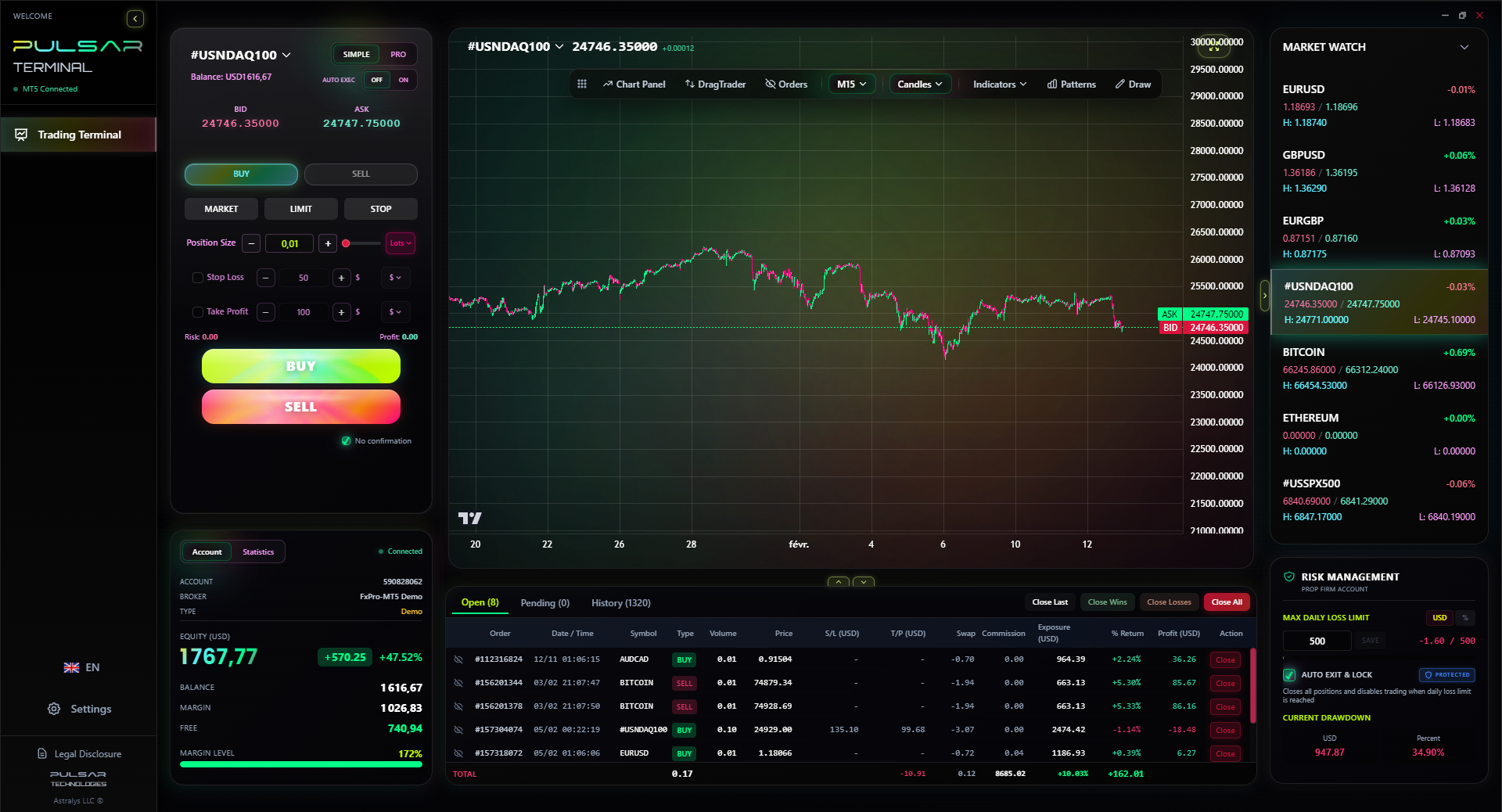
Managing a prop firm's daily loss limit is a constant manual headache, but tools like Pulsar Terminal can automate hard stop-losses and trailing draws directly on your MT5 chart, turning a complex rule into a set-and-forget safety net.
Pulsar Terminal
Das All-in-One MT5-Tool: Drag-and-Drop-Orders, Multi-TP/SL, Trailing Stop, Grid Trading, Volume Profile und Prop-Firm-Schutz. Täglich von 1.000+ Tradern genutzt.
“You have to internalize that the $100,000 is not yours. It's a tool with a brittle handle.”
This is the silent killer nobody talks about enough. Trading a $10,000 personal account and a $100,000 prop account trigger different psychological demons.
With your own money, a loss hurts, but it's yours. You can decide to ride out a drawdown. With prop capital, a loss brings the cold, algorithmic gaze of the risk manager. That trailing drawdown is always creeping behind you. It creates what I call 'shadow pressure' - anxiety that isn't about the market, but about the rules.
You'll make mistakes you'd never make in your personal account:
- Over-trading to 'Get Active': You might take sub-par trades just to log activity, especially if there's a minimum trading day rule.
- Cutting Winners Short: The fear of a reversal erasing your gains and triggering the trailing stop will cause you to exit profitable trades too early.
- Paralysis After a Loss: One bad trade that eats half your daily limit can freeze you for days, hurting your consistency.
The only antidote is to systemize everything. Your trading plan must be robotic:
- Pre-defined Entries/Exits: Use your indicators like RSI as strict gatekeepers, not suggestions.
- Maximum Position Size: This is non-negotiable. It should be a fraction of your daily loss limit. If your daily limit is $2,000, your max loss on any single trade should be $400 or less.
- Daily Loss Cut-off: If you hit 50% of your daily limit, you stop trading for the day. No exceptions. This protects you from revenge trading.
You have to internalize that the $100,000 is not yours. It's a tool with a brittle handle. Your job is to use the tool gently to carve out your small piece, not to swing it like a sledgehammer.
💡 Winstons Tipp
If you wouldn't take the trade in your personal account with 1/10th the size, don't take it in the prop account. The money feels different, but the market doesn't care.
“For the 7% who do have an edge, it's a path to scaling their business.”
So, should you do it? The answer is a conditional 'maybe' for a very specific person.
It's NOT for you if:
- You're a beginner learning to trade.
- You need income quickly.
- You have a low-risk tolerance or can't follow a plan under pressure.
- You see it as a replacement for building your own capital.
It MIGHT be for you if:
- You have a proven, consistent, and written track record of profitability in your personal account over 6+ months.
- Your strategy is based on defined-risk options spreads or other rule-friendly approaches.
- You have the discipline of a monk and can treat the capital as a dangerous tool, not a lottery ticket.
- You view the evaluation fees as a business expense for acquiring capital, not a trading cost.
Think of it as a performance-based capital lease. You're renting buying power to amplify a proven edge. The fees and rules are the cost of that lease.
The math only works if you pass the challenge. To pass, you need an edge and the discipline to execute it under surveillance. For the 93% who don't have that, it's an expensive lesson. For the 7% who do, it's a path to scaling their business.
My final, frank advice: Build your own account first. Get to a point where you're consistently profitable and bored by your own success. Then, and only then, consider using a prop firm as a lever to scale that proven operation. Don't use it as the arena to find out if you can fight.
FAQ
Q1What is the success rate for prop firm challenges?
The published industry data is brutal. Only about 5-10% of traders pass on their first attempt. More tellingly, only 7% of all traders who purchase a challenge ever receive a payout. The vast majority fail and either quit or pay reset fees.
Q2Can I trade 0DTE options with a prop firm?
Many firms are now explicitly banning 0DTE (zero days to expiration) options or placing extreme restrictions on them due to their high gamma risk. This risk can blow through daily loss limits in minutes. Even if allowed, it's a terrible fit for the prop firm model which demands consistency and controlled drawdowns.
Q3How are prop firms able to offer such high use?
They bypass FINRA's Pattern Day Trader rules because you, the trader, are not the owner of the brokerage account. The prop firm owns the master account. You are trading a sub-account with their capital, so retail use restrictions don't apply. They set their own internal risk limits, which are often stricter on loss amounts but allow higher notional exposure.
Q4What's the difference between a prop firm and a regular broker like Robinhood?
A broker (Robinhood, TD Ameritrade) executes your trades with your money. A prop firm gives you their money to trade, but you must pass their test and follow their rules to get it. With a broker, you keep 100% of your profits (and losses). With a prop firm, you split profits (e.g., 80/20) and have no personal loss liability beyond your initial challenge fee.
Q5How often do prop firms pay out?
Payout frequency varies. Common schedules are bi-weekly (every two weeks) or monthly. Some firms offer weekly or even 'on-demand' payouts once you reach a certain threshold. Always check the firm's specific payout policy and look for trader reviews confirming they honor it.
Q6Do I need a special platform for prop firm options trading?
Often, yes. After the MetaQuotes crackdown, many firms moved to dedicated platforms like DXtrade, cTrader, or MatchTrader. For equity/options-specific firms, you might use platforms like Sterling Trader Pro or the firm's own proprietary software. You typically cannot use your personal Thinkorswim or Tastyworks account.
Q7What happens if the prop firm goes out of business?
If the firm shuts down, your funded account and any unrealized profits in it are likely gone. Earned profits that haven't been paid out may also be lost. This is a real risk in the current climate, which is why vetting the firm's financial stability and regulatory setup is crucial.
Prof. Winstons Lektion
Wichtige Erkenntnisse:
- ✓93% of challenge buyers never get a payout.
- ✓Average payout is just 4% of the funded account size.
- ✓Trailing drawdowns are the #1 account killer.
- ✓Vet the firm's payout history before paying a fee.
- ✓Trade defined-risk spreads to manage firm limits.
Wie nützlich war dieser Artikel?
Klicken Sie auf einen Stern
Wöchentliche Trading-Einblicke
Kostenlose wöchentliche Analysen & Strategien. Kein Spam.
Über den Autor
James Mitchell
Senior Trading-Analyst
In New York ansässig mit über 9 Jahren Trading-Erfahrung. Fokus auf Haupt-USD-Paare, Prop-Firm-Challenges und die US-Regulierungslandschaft.
Kommentare
Risikohinweis
Der Handel mit Finanzinstrumenten birgt erhebliche Risiken und ist möglicherweise nicht für alle Anleger geeignet. Vergangene Ergebnisse garantieren keine zukünftigen Renditen. Dieser Inhalt dient ausschließlich Bildungszwecken und stellt keine Anlageberatung dar. Führen Sie immer Ihre eigene Recherche durch, bevor Sie handeln.
Das könnte Sie auch interessieren

Cara Trading Forex Sukses: 7 Prinsip dari Trader Profesional
Cara trading forex sukses dengan 7 prinsip trader pro: manajemen modal, disiplin, journal trading, backtest. Data nyata, bukan janji profit palsu.
Jam Trading Forex Terbaik untuk Trader Indonesia: Panduan Lengkap dengan Tabel Waktu
Panduan jam trading forex untuk trader Indonesia. Tabel 4 sesi dunia, jam emas 20:00-00:00, sesi mana yang harus dihindari. Data akurat + tips dari trader berpengalaman.
Top 5 Sàn Forex Uy Tín Nhất 2026: Review Jujur dari Trader Indonesia
Top 5 sàn forex uy tín 2026 untuk trader Indonesia. Review jujur: spread, deposit, withdraw, dukungan lokal. Exness, XM, IC Markets & lebih.
Pulsar Terminal herunterladen
Alle diese Rechner sind in Pulsar Terminal mit Echtzeit-Daten Ihres MT5-Kontos integriert.
Pulsar Terminal herunterladen