


Here's a stat that gets traders excited: some proprietary trading firms let you pass their evaluation by hitting a single, massive profit target, with no rule limiting how much you make per day.

James Mitchell
Senior Trading-Analyst
☕ 11 Min. Lesezeit
Was Sie lernen werden:
- 1What Even Is a Consistency Rule? (And Why Firms Use It)
- 2The Allure: Why Prop Firms Without a Consistency Rule Are Tempting
- 3The Reality Check: The Hidden Risks Nobody Talks About
- 4How to Find and Vet Prop Firms Without Consistency Rules
- 5Adapting Your Strategy: Trading Without a Safety Net
- 6The Long Game: Are These Firms Sustainable for You?
- 7Final Verdict: Should You Use Prop Firms Without a Consistency Rule?
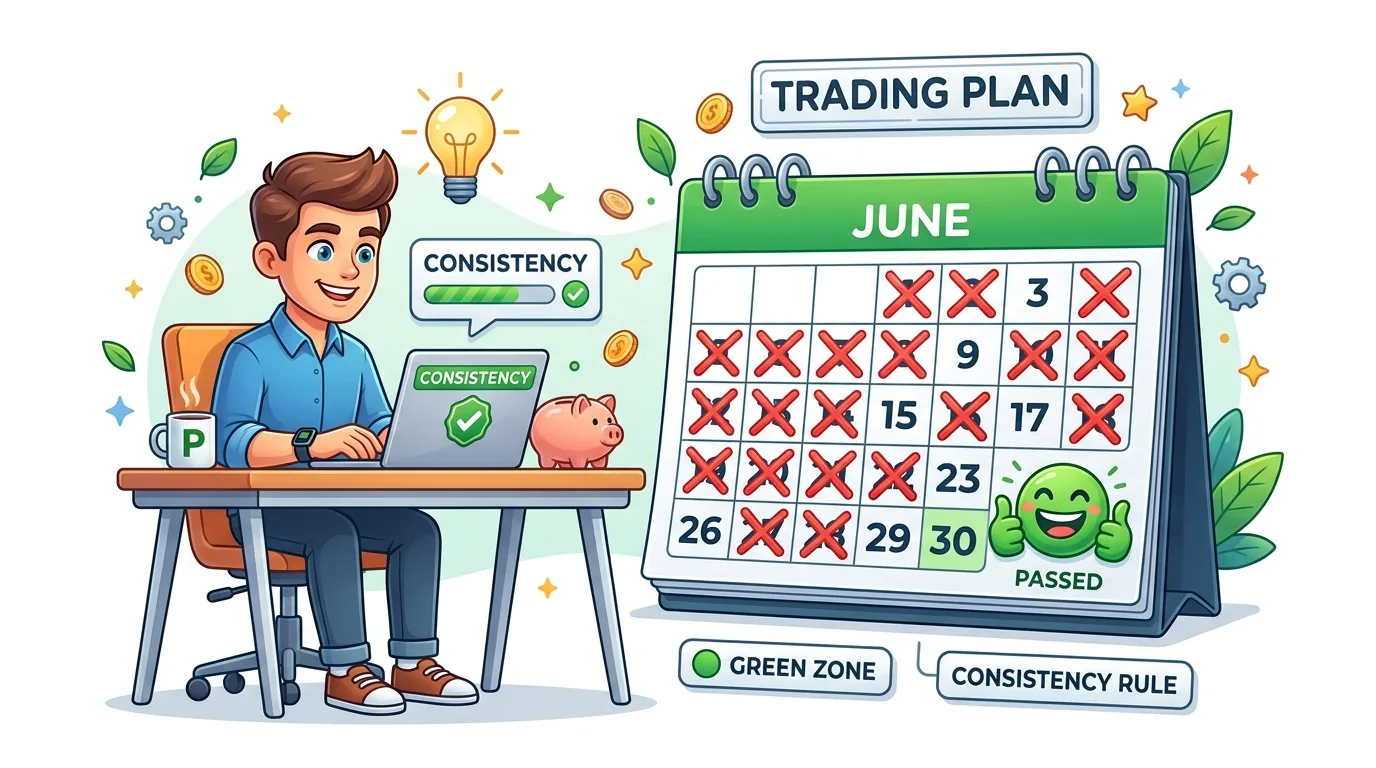
Here's a stat that gets traders excited: some proprietary trading firms let you pass their evaluation by hitting a single, massive profit target, with no rule limiting how much you make per day. No 'consistency rule' to slow you down. Sounds like a dream, right? I thought so too, back in 2018. I put $500 into an eval with one of these firms, caught a perfect EUR/USD breakout, and bagged a $4,200 profit in two days - smashing the profit target. I passed. Then I lost the entire funded account in one week. Let's talk about why that happened, and whether these prop firms without a consistency rule are actually a good deal.
Before we get into the firms that skip it, let's be clear on what we're skipping. A consistency rule is a restriction prop firms put on their evaluation challenges. It's designed to stop you from passing by getting lucky once.
Typically, it looks something like this: "Your largest single day's profit cannot exceed 30% of your total profit target." So, if you need to make $10,000 to pass, you can't make more than $3,000 in one day. If you do, that day's profit might not count, or you could fail the challenge outright.
Firms use this rule for one main reason: risk management. They're not looking for gamblers who go 'all in' on one trade. They're looking for traders who can grind out profits steadily, day after day, without taking insane risks. It's about proving you have a repeatable process, not a lucky ticket.
From the firm's perspective, it makes total sense. They're on the hook for your losses once you're funded. They want someone who won't vaporize their capital on a wild bet. The consistency rule is their first filter for disciplined behavior.

Warning: Don't confuse a consistency rule with a daily loss limit. The daily loss limit (like 5% of your account) is about capping your downside. The consistency rule is about capping your upside to prove steady skill. Most firms have a daily loss limit. Only some have a consistency rule.
“The lack of a consistency rule doesn't remove risk. It just shifts it from the firm's rulebook onto your own discipline.”
Okay, so why would you want to avoid that rule? The appeal is obvious and powerful.
Speed. This is the big one. You can pass the evaluation much, much faster. Imagine a challenge where you need to make $10,000 profit starting with a $100,000 account. With a 30% consistency rule, the fastest you could theoretically pass is in four perfect trading days ($3k, $3k, $3k, $1k). Without the rule? You could pass in one day if you catch a major news event or a strong trend.
Freedom for Your Strategy. Some strategies aren't built for daily dribbles of profit. Maybe you're a swing trader who holds positions for days, aiming for one or two big wins per month. A consistency rule punishes you for that. A firm without one lets your strategy breathe.
Psychological Relief. Knowing you don't have to watch the clock and cut a winning trade short because you're nearing some arbitrary daily profit cap is a huge mental weight off. You can let your winners run, which is Trading 101.
I'll be honest, the speed is seductive. After my initial blow-up, I got smart about it. I used a firm with no consistency rule to pass a $50k challenge in 2021. I waited for a clear setup on Gold (XAU/USD), entered at $1785, and rode it up to $1820. One trade, one day, profit target met. It felt efficient. But that efficiency is a double-edged sword, and it cuts deep if you're not prepared.

Pro Tip: If you're using a high-impact strategy like news trading or scalping volatile openings, a no-consistency-rule firm can be a perfect fit. Just have your risk parameters locked down tighter than a drum.

💡 Winstons Tipp
The market doesn't care about your profit target. Trade the chart in front of you, not the rulebook beside you. A good setup is a good setup, whether you need 2% or 10% today.

“Passing a challenge quickly doesn't mean you're a consistently profitable trader. It means you passed one test.”
This is where my experience, and the experience of many traders I've coached, becomes your lesson. Removing the consistency rule doesn't remove risk. It just shifts it.
Risk #1: It Incentivizes Bad Habits. This is the silent killer. The fastest way to pass is to take oversized risk. Go for a home run. When that works (and sometimes it does), you pass. But you've just been rewarded for reckless behavior. You carry that habit into your funded account, where real money is on the line. That's exactly what I did. My big win to pass felt like validation. It wasn't. It was luck.
Risk #2: You Might Not Be Ready. Passing a challenge quickly doesn't mean you're a consistently profitable trader. It means you passed one test. The real test is keeping the funded account for months, making consistent withdrawals. The lack of a consistency rule gives you zero practice at the daily grind of professional trading.
Risk #3: The Drawdown Rules Are Still There. People get excited about no profit cap and forget the loss cap. Firms like FTMO, The5%ers, and others still have strict daily and overall drawdown limits. You can make $10k in a day, but if you lose 5% ($5k) the next day, you're out. The volatility you used to pass can just as easily take you out.
Risk #4: The "Funded Account Trap." Some firms have easier evaluations but much stricter rules on the funded account. They might have tighter drawdowns or introduce trailing thresholds on profit. You sprint through the open door only to find a narrower hallway on the other side.
Let me give you a real example from my mistake. In my funded account, I had a $100k balance. I thought, "I made $4k quickly before, I can do it again." I put on a trade with a 4% risk (way too high). It went against me. I lost $4,000 in hours, hit my daily loss limit, and was shut down. I never even made a withdrawal. The lack of a consistency rule in the eval taught me nothing about using a sane position size calculator.

“Passing a challenge quickly doesn't mean you're a consistently profitable trader. It means you passed one test.”
So you've weighed the risks and still want to go for it. How do you find these firms? You have to read the fine print. Don't trust promotional headlines.
Where to Look:
- Direct on Websites: Go to the firm's FAQ or "Rules" page. Search for "largest daily profit," "consistency," or "profit split per day."
- Comparison Reviews: Sites like ours break down rule sets. Look for phrases like "No limit on daily profit during challenge."
- Trader Forums: Real user experiences are gold. But be skeptical - people brag about wins more than they confess to losses.
What to Vet (Beyond the Missing Rule):
- Daily & Overall Drawdown: Is it static or trailing? A static drawdown (e.g., 5% max loss from starting balance) is more forgiving than a trailing one that locks in profits but also raises your loss threshold.
- Profit Split & Withdrawal Terms: How often can you withdraw? 80/90 split? Is there a first-payout delay?
- Trading Instruments: Can you trade what you know? Some restrict exotic pairs or certain news trades.
- Scaling Plan: If you succeed, will they increase your capital? What are those rules?
- Platform & Fees: Are you stuck with a terrible platform? Are there data fees or high spreads on your preferred instrument like EUR/USD?
A quick table on what matters most:
| Feature | Why It Matters for a No-Consistency-Rule Firm |
|---|---|
| Daily Loss Limit | Your primary safeguard against blowing up in one session. Non-negotiable. |
| Overall Drawdown Type | Static is better for volatile strategies. Trailing is tougher. |
| Minimum Trading Days | Some firms require X days of trading, even if you hit the target. Can slow you down. |
| Profit Target | Is it realistic? 10% in a month is different from 10% in a week. |
Warning: If a firm has no consistency rule and a very high profit target (like 20% in 30 days), they are mathematically encouraging extreme risk. That's a red flag, not an opportunity.
💡 Winstons Tipp
Impose a 'personal consistency rule' if the firm doesn't. Mine was simple: no trade could target more than 3x its risk. It kept me from chasing unicorns.

“Use a no-consistency-rule firm as a specific tool, not as a general shortcut.”
Trading for a firm with no consistency rule is a different mindset. You can't just take your normal strategy and go bigger. You need a tailored approach.
The Mindset Shift
Your goal is no longer "pass the challenge." Your goal must be "demonstrate sustainable risk management while passing the challenge." If you can't do the second, you'll fail with the funded account. Every trade you place in the eval should be a trade you'd be comfortable placing in the funded account.
Strategy Adjustments
- Defense First: Your risk per trade must be lower than you think. I now use a maximum of 1% risk per trade in any eval, regardless of the rules. That 1% rule saved me from myself more times than I can count. It forces you to be picky with entries.
- Use a Two-Phase Approach:
- Phase 1 (Capital Preservation): Trade super small (0.5% risk) to build a small buffer. Get a feel for the account, the platform's execution, the spreads. This builds a psychological cushion.
- Phase 2 (Controlled Aggression): Once you're up 2-3%, you can slightly increase risk on a high-conviction setup. Not to 4%, but maybe to 1.5%. The goal is to compound your buffer, not YOLO it.
- Instrument Selection: Stick to your best one or two instruments. For me, that's often XAU/USD or EUR/USD. Don't jump into volatile small-cap stocks just because you can.
- Let Profits Run, But Not Into Madness: Yes, you can let a winner go. But have a logical exit based on the chart, not greed. Use a trailing stop. If you're up 8% on the day, consider banking some profit. Remember, the daily loss limit is still active and waiting.
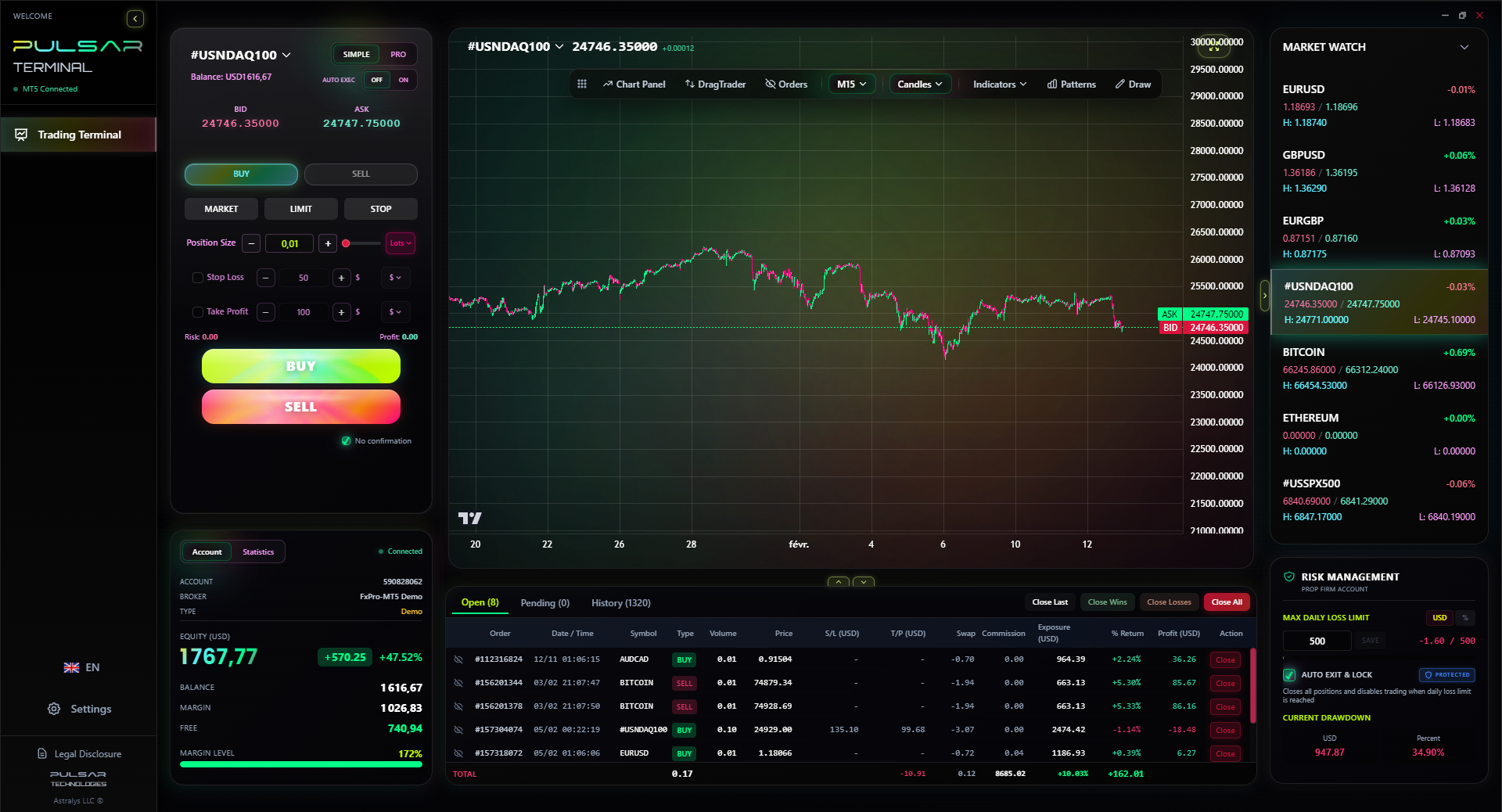
A tool that became essential for me in managing this is one that lets me set multi-level exits and trailing stops automatically. Manually moving stops as a trade runs in your favor is stressful and error-prone.

Example: On a $100k account, 1% risk is $1,000. If your stop loss is 50 pips on EUR/USD, your position size is $20 per pip ($1,000 / 50). That's 2 standard lots. Write this down before every trade. A position size calculator is mandatory.

Managing multi-level exits and trailing stops manually under pressure is a common failure point; Pulsar Terminal automates this directly on your MT5 chart, so your strategy executes flawlessly while you focus on the next setup.
Pulsar Terminal
Das All-in-One MT5-Tool: Drag-and-Drop-Orders, Multi-TP/SL, Trailing Stop, Grid Trading, Volume Profile und Prop-Firm-Schutz. Täglich von 1.000+ Tradern genutzt.
“Use a no-consistency-rule firm as a specific tool, not as a general shortcut.”
Let's talk long-term. Is passing a challenge with no consistency rule a path to a sustainable prop trading career? It can be, but only if you're brutally honest with yourself.
For the Right Trader: If you have a proven, edge-based strategy that naturally produces occasional large wins (like a swing trading trend-following system), and you have the discipline to trade small between those wins, these firms are fantastic. They get out of your way.
For the Wrong Trader (Most of Us Early On): If you're still developing consistency, if you're prone to revenge trading after a loss, or if you view the missing rule as an invitation to gamble, you will fail. The firm's capital will just be a slightly longer runway to your inevitable margin call.
The true test comes after you get funded. The psychology changes. It's real money now (even if it's the firm's). The pressure to not lose the "opportunity" can make you tighten up, miss trades, or overtrade.
My advice? Use a no-consistency-rule firm as a specific tool for a specific purpose, not as a general shortcut. Maybe you use it to get one funded account quickly while you grind a more traditional, rule-heavy eval with another firm. Diversify your "prop firm portfolio."
, the firm's rules are just a framework. Your own rules - your trading plan, your risk management, your emotional control - are what determine long-term success. A lack of a consistency rule exposes weak personal rules faster than anything else.
💡 Winstons Tipp
Your first withdrawal is the only profit that matters. Everything before that is just theater. Structure your eval trading to make that first payout inevitable, not accidental.

“The most important rules aren't written by the prop firm. They're written by you.”
Here's my straight take, twelve years in.
Prop firms without a consistency rule are a powerful option, but they are an advanced tool. They are not for beginners looking for a shortcut. They are for traders who already have discipline but feel constrained by artificial profit caps.
The Bottom Line:
- Yes, use them if: You have a verified track record of steady profits, you possess ironclad risk management (max 1-2% per trade), and your strategy benefits from uncapped winning days.
- No, avoid them if: You're new to prop firms, you're still mastering your emotions, or you think this is a way to 'get rich quick.' It's a way to 'blow up quick' if you're not careful.
My biggest career mistakes have come from confusing luck for skill. The absence of a consistency rule makes that confusion dangerously easy. If you choose this path, impose your own consistency rule. Maybe your rule is "no single trade can risk more than 1.5% of the account" or "I will withdraw 50% of any daily profit over 5%."
Be the professional the firm's rulebook assumes you are. Because at the end of the trading day, the most important rules aren't written by them. They're written by you.
FAQ
Q1Which well-known prop firms do NOT have a consistency rule?
Rule sets change, so always check their latest terms. Historically, firms like FTMO have had strict consistency rules, while others like The5%ers (in some programs) and several smaller, newer firms often omit them. The key is to read the specific challenge rules for phrases limiting 'largest daily profit.' Never assume.
Q2Is it easier to pass a challenge without a consistency rule?
It can be faster, but 'easier' is misleading. It removes one restriction, but the core difficulty - managing risk to hit a profit target without hitting a loss limit - remains. In fact, it can be harder because the temptation to take reckless, oversized trades is much higher, which often leads to failure.
Q3What's the biggest mistake traders make with these firms?
They treat the evaluation like a lottery ticket instead of a job interview. They risk 5-10% of their account on one trade to hit the target fast. Even if they pass, this habit guarantees they'll lose the funded account. The mistake is focusing on passing instead of proving they can trade sustainably.
Q4Can I use a scalping strategy with these firms?
Absolutely, but with caution. Scalping can generate many small wins. Without a consistency rule, a great scalping day can rocket you toward your target. However, you must be aware of the firm's rules on minimum trade holding time (if any) and ensure your broker (like IC Markets or Pepperstone) offers the tight spreads and fast execution scalping requires.
Q5Do these firms have stricter rules after you're funded?
Sometimes, yes. This is a critical research point. Some introduce trailing drawdowns on the funded account, which is a much tougher risk constraint. Always compare the evaluation rules side-by-side with the funded account rules before you pay for a challenge.
Q6How should I adjust my position sizing?
Be more conservative, not more aggressive. The freedom calls for more discipline. Use a position size calculator and cap your risk at 1% of your account balance per trade, maximum. This single rule will do more to ensure your long-term success than any firm's rule ever could.
Prof. Winstons Lektion
Wichtige Erkenntnisse:
- ✓Risk per trade must be LOWER, not higher, without a consistency rule (max 1%).
- ✓The eval is a job interview for your funded account self. Trade like it.
- ✓Speed is seductive, but sustainability pays the bills.
- ✓Always vet the funded account rules twice as hard as the challenge rules.
Wie nützlich war dieser Artikel?
Klicken Sie auf einen Stern
Wöchentliche Trading-Einblicke
Kostenlose wöchentliche Analysen & Strategien. Kein Spam.
Über den Autor
James Mitchell
Senior Trading-Analyst
In New York ansässig mit über 9 Jahren Trading-Erfahrung. Fokus auf Haupt-USD-Paare, Prop-Firm-Challenges und die US-Regulierungslandschaft.
Kommentare
Risikohinweis
Der Handel mit Finanzinstrumenten birgt erhebliche Risiken und ist möglicherweise nicht für alle Anleger geeignet. Vergangene Ergebnisse garantieren keine zukünftigen Renditen. Dieser Inhalt dient ausschließlich Bildungszwecken und stellt keine Anlageberatung dar. Führen Sie immer Ihre eigene Recherche durch, bevor Sie handeln.
Das könnte Sie auch interessieren

Cara Trading Forex Sukses: 7 Prinsip dari Trader Profesional
Cara trading forex sukses dengan 7 prinsip trader pro: manajemen modal, disiplin, journal trading, backtest. Data nyata, bukan janji profit palsu.
Jam Trading Forex Terbaik untuk Trader Indonesia: Panduan Lengkap dengan Tabel Waktu
Panduan jam trading forex untuk trader Indonesia. Tabel 4 sesi dunia, jam emas 20:00-00:00, sesi mana yang harus dihindari. Data akurat + tips dari trader berpengalaman.
Top 5 Sàn Forex Uy Tín Nhất 2026: Review Jujur dari Trader Indonesia
Top 5 sàn forex uy tín 2026 untuk trader Indonesia. Review jujur: spread, deposit, withdraw, dukungan lokal. Exness, XM, IC Markets & lebih.
Pulsar Terminal herunterladen
Alle diese Rechner sind in Pulsar Terminal mit Echtzeit-Daten Ihres MT5-Kontos integriert.
Pulsar Terminal herunterladen