


I remember staring at my screen in late 2024, watching the USD/NGN rate hit 1717.

Olumide Adeyemi
Pionier des Tradings in Westafrika ·  Nigeria
☕ 10 Min. Lesezeit
Was Sie lernen werden:
- 1The Profitability Myth: Why There's No Single 'Best' Strategy
- 2Nigerian Market Realities: Trading in Our Sandbox
- 3Core Strategies, Adapted for Naija
- 4The Real Secret Sauce: Risk Management
- 5Building Your Own 'Most Profitable' System
- 6The Naija Mindset: Psychology and Discipline
- 7The Boring Stuff: Taxes and Record-Keeping
- 8Final Verdict: So, What Is It?
I remember staring at my screen in late 2024, watching the USD/NGN rate hit 1717. My friend had just messaged me, convinced he'd found the 'holy grail' strategy to get rich. He blew his account two weeks later. The truth is, asking for the single most profitable forex strategy is like asking for the best car. It depends entirely on who's driving, the road conditions, and how much fuel you have. For us trading in Nigeria, with our unique market access and the Naira's wild swings, profitability isn't about a secret indicator. It's about a framework. Let's break down what actually works here.
If a guy on Instagram is selling you a 'guaranteed' strategy for ₦50,000, run. Seriously. The global forex market turns over $9.6 trillion daily. No single approach captures all that. Profitability is personal. It's a function of your personality, your schedule, your capital, and frankly, your emotional grit.
Think about it. A full-time bank employee in Lagos can't sit and watch charts all day. A strategy requiring constant screen time, like aggressive scalping strategy, is a terrible fit. They'd be stressed, make rushed decisions, and likely fail. For them, a swing trading approach, checking charts once in the evening, makes far more sense.
I learned this the hard way early on. I tried to copy a prop firm trader's high-frequency method. My internet in Abuja wasn't as fast, my psychology was different, and I lost $800 in three days chasing 5-pip moves. His strategy was profitable for him. For me, it was a disaster. The most profitable forex strategy for you is the one you can execute consistently without losing sleep. It's the one that fits your life.

Warning: Any strategy promising specific monthly returns (e.g., 'Make 20% monthly!') is a scam. Consistent, sustainable returns in forex are measured in single-digit percentages per month for the very best retail traders. Anyone claiming otherwise is lying.

💡 Winstons Tipp
A strategy is just a hypothesis. Your trade journal is the lab report that proves or disproves it. If you're not journaling, you're not trading, you're guessing.
We're trading in a unique environment. The SEC says our online retail space is largely unregulated. That means we have to be extra smart about who we trust with our money. We also have specific advantages and challenges that shape what a 'profitable' strategy looks here.
Our Tools and Access
We mainly use MT4 and MT5. Brokers like Exness, XM, and IC Markets are popular because they accept us and offer platforms we know. Payment is key: using local processors or crypto to fund accounts is normal for us. The use offered can be eye-watering - up to 1:2000 or even 'unlimited' in some cases. This is a double-edged sword we'll talk about later.
The Naira Factor
You live the volatility. The USD/NGN move from 2023 to 2024 was brutal. This reality does two things. First, it creates a genuine need to hedge or seek returns in harder currencies. Second, it can warp our perception of risk. Losing 50 pips on EUR/USD might feel trivial compared to the Naira's moves, but in forex terms, it's a significant event. A profitable strategy here must have iron-clad risk rules to prevent a 'Naira mindset' from encouraging over-use.
Optimal Trading Hours
The sweet spot for liquidity is 1 PM to 6 PM WAT. That's when London is active and New York comes online. A strategy that generates signals primarily during this overlap, like certain breakout plays on EUR/USD, has a better chance here than one relying on thin Asian session moves.
“The difference between a profitable trader and a loser isn't the entry strategy. It's the exit strategy.”
Let's look at common strategies through a Nigerian lens. Forget which is 'best.' Let's see which might be most suitable.
Swing Trading (The 9-to-5er's Friend)
This is my personal go-to and what I recommend to most people starting out. You hold trades for days or weeks, aiming to catch a 'swing' in the market. You don't need to watch screens all day. You analyze in the evening, set your orders, and manage them.
- How it works here: Use the 4-hour or daily charts. Look for clear trends or ranges. A simple method: wait for price to pull back to a key moving average (like the 50 or 200 EMA) in a strong trend, then enter. Place your stop-loss on the other side of the swing.
- Nigerian Advantage: Fits around work. Less stress. Lower transaction costs (fewer trades mean less spread paid).
- My Trade: In Jan 2025, I bought GBP/USD on a pullback to the 50-day EMA on the daily chart at 1.2650. I held for two weeks, took half profit at 1.2820, and let the rest run with a trailing stop. Final gain: about 220 pips. I checked it maybe twice a day.
Trend Following (The Patient Person's Game)
This is the classic 'the trend is your friend.' You identify a sustained move and jump on board. It requires patience, as you might sit through boring consolidation periods.
- How it works here: Tools like the MACD indicator or ADX can help confirm trend strength. Don't try to pick tops and bottoms. Just ride the wave. This works well on majors like USD/JPY or XAU/USD (Gold).
- Nigerian Reality: High use is the enemy of trend following. A small retracement can wipe you out if you're over-leveraged. Use a sane position size.
Breakout Trading (The Volatility Hunter)
When price smashes through a key level it's been respecting, that's a breakout. This strategy aims to catch the explosive move that often follows.

Pro Tip: For breakouts, I wait for the candle to close beyond the level (support/resistance, triangle, etc.) before entering. This filters out false breaks, which are super common. A pending order just beyond the level gets you in cleanly.
Scalping (The High-Stress Hustle)
Scalping is making 10-20 trades a day for 5-10 pips each. It's intense. You need a rock-solid internet connection, a broker with razor-thin spreads (look at Pepperstone or IC Markets Raw spreads), and the ability to handle stress.
- Nigerian Challenge: Our internet can be unreliable. A dropout during a scalp can be catastrophic. Also, the mental toll is high. I've done it, and the constant adrenaline is exhausting. It's not sustainable for most.
What About Carry Trades?
Borrowing a low-yield currency to buy a high-yield one. With our interest rates, theoretically, the Naira could be the 'high-yield' side. But trading USD/NGN as a retail trader is extremely difficult due to access and liquidity. For most of us, this isn't a practical primary strategy.
Here's the truth bomb. The difference between a profitable trader and a loser isn't the entry strategy. It's the exit strategy. It's risk management. This is the non-negotiable core of the most profitable forex strategy.
The 1% Rule (Your Lifeline)
Never, ever risk more than 1% of your trading capital on a single trade. For a $1,000 account, that's $10. Use a position size calculator every single time. This one rule alone will keep you in the game long enough to learn.
Stop-Losses: Your Best Friend
You must use a stop-loss. Always. No debate. It's not a suggestion; it's an insurance policy. Before you even think about your profit target, know where you'll get out if you're wrong. Placing it at a logical technical level (beyond a swing high/low) is better than an arbitrary number.
Profit Targets & Risk-Reward
Aim for a risk-reward ratio of at least 1:1.5. If you risk $10 (10 pips), aim to make $15 (15 pips). Better is 1:2 or 1:3. This means you can be wrong more than you're right and still be profitable. If your strategy only offers 1:0.5 setups, it's mathematically doomed in the long run.
use: The Silent Account Killer
Just because your broker offers 1:1000 doesn't mean you should use it. Using high use while ignoring the 1% rule is a guaranteed path to a margin call. I treat use like a powerful car engine - it's there if I need it for a specific maneuver, but I don't drive at top speed all the time. For swing trading, I rarely use more than 1:10 or 1:20.

Example: Account: $1,000. Risk per trade: 1% = $10. Trade: Buy EUR/USD at 1.0850. Stop-Loss at 1.0830 (20 pips risk). Each pip on a micro lot (0.01) = $0.10. To risk $10, $10 / (20 pips * $0.10) = 5 micro lots (0.05). Your position size is 0.05. That's it. No guessing.
💡 Winstons Tipp
The market doesn't know you exist. It doesn't care about your rent, your ego, or your last loss. Trade the price on the screen, not the story in your head.
“High use while ignoring the 1% rule is a guaranteed path to a margin call.”
So how do you build this? It's a checklist.
- Find Your Timeframe: Can't watch screens? Go daily/4H. Love action? Check 15M/5M.
- Pick a Core Approach: Start with one. Try swing trading or trend following. Master it on a demo.
- Add Simple Tools: Don't overload your chart. Maybe a moving average and the RSI indicator for overbought/oversold zones. That's enough.
- Define Your Rules (WRITE THEM DOWN):
- Entry: "I will buy when price pulls back to the 50 EMA on the 4H chart in an uptrend and the RSI is above 30."
- Stop-Loss: "My stop-loss will be placed 15 pips below the recent swing low."
- Take-Profit: "My first take-profit will be at a 1:2 risk-reward ratio. I will move my stop to breakeven when price reaches 1:1."
- Backtest & Demo Trade: Test your written rules on past data. Then trade it on a demo account for at least 2-3 months. Track every trade in a journal.
- Review and Tweak: Are you consistently losing? Maybe your entry rule is flawed. Adjust one thing at a time and test again.
This process is boring. It's not sexy. But it's how you build something that works for you.
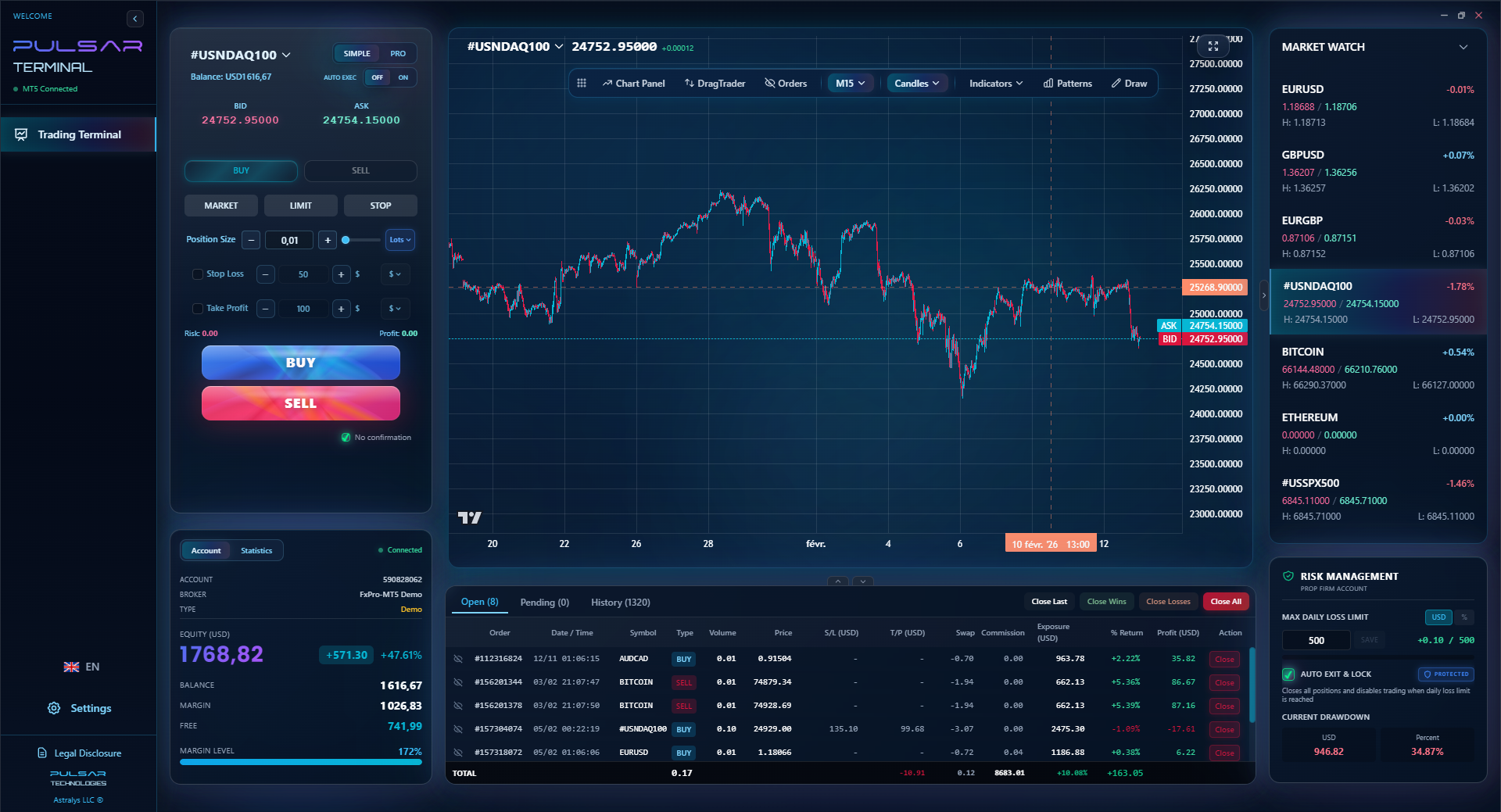
Building a rule-based system is one thing, but executing it flawlessly on MT5 is another. Pulsar Terminal lets you drag-and-drop orders, set multi-level take-profits, and automate trailing stops directly on your chart, so your plan happens exactly as you designed it.
Pulsar Terminal
Das All-in-One MT5-Tool: Drag-and-Drop-Orders, Multi-TP/SL, Trailing Stop, Grid Trading, Volume Profile und Prop-Firm-Schutz. Täglich von 1.000+ Tradern genutzt.
Our environment trains us to seek quick wins. The 'fast money' allure is everywhere. Forex trading fights directly against that instinct. The most profitable forex strategy in the world will fail if your psychology is weak.
Common Pitfalls:
- Revenge Trading: After a loss, you jump right back in with a bigger size to 'make it back.' This is how accounts blow up.
- Moving Stop-Losses: You're in a losing trade, and instead of accepting the loss, you slide your stop further away, hoping the market turns. It usually doesn't. This turns a small loss into a catastrophic one.
- Overtrading: No clear signals, but you're bored, so you take a trade anyway. This is just gambling.
Discipline means following your written plan, especially when you're scared or greedy. It means taking the loss when your stop is hit and not re-entering out of emotion. This is the hardest part of trading, full stop.
“The goal for your first year shouldn't be to buy a Range Rover. It should be to not lose money.”
Yes, you have to pay taxes. Forex trading profits are subject to a 10% Capital Gains Tax in Nigeria. Even if your broker is overseas, the income is taxable here.
Keep impeccable records: statements from your broker, records of all deposits and withdrawals (especially via crypto or domiciliary accounts), and a detailed trade journal. When you start making consistent profits, consult a local accountant who understands forex. It's a cost of doing business and keeps you on the right side of the law. Trying to hide trading profits isn't a viable long-term strategy.
💡 Winstons Tipp
Your first profit target should be to preserve capital. Your second should be consistent small gains. The Lamborghini is a fantasy until you've mastered the first two.
The most profitable forex strategy for a Nigerian trader is a simple, rule-based, swing or trend-following approach, executed on the higher timeframes (4H/Daily), with ruthless 1% risk management, and the psychological discipline to follow the plan.
It's not a secret code. It's a boring system that you personalize and stick to through wins and losses. It accounts for our market access, our need for flexibility, and the volatile financial environment we live in.
Start small. Use a demo. Build your plan. When you can be profitable for three months on demo, fund a small live account - maybe $200-$500. Treat it as the cost of your final education. The goal for your first year shouldn't be to buy a Range Rover. It should be to not lose money. If you can achieve that, you're already ahead of 90% of traders. Then, and only then, can you start thinking about scaling up. Good luck, and trade safe.
FAQ
Q1What is the easiest forex strategy for a beginner in Nigeria?
Swing trading on the 4-hour or daily chart. It doesn't require constant screen time, fits around a job, and is less stressful. Start by learning to identify trends and support/resistance levels. Pair it with the 1% risk rule on a demo account for at least two months.
Q2Is forex trading legal and taxable in Nigeria?
Yes, and yes. Trading forex is legal for individuals. However, the online retail space is largely unregulated by local authorities like the SEC, so you must be careful choosing an internationally regulated broker. Your profits are subject to a 10% Capital Gains Tax, and you are required to declare this income.
Q3How much money do I need to start forex trading in Nigeria?
You can start with very little. Brokers like FBS have a $1 minimum, and XM has a $5 minimum. However, I strongly recommend starting with at least $200-$500 on a live account after you've proven yourself on a demo. This allows for proper position sizing while risking only 1% per trade. Starting with $10 is possible but makes risk management very difficult.
Q4What is the best time to trade forex in Nigeria?
The most liquid and active time is between 1:00 PM and 6:00 PM West Africa Time (WAT). This overlaps with the London and New York sessions, meaning more volume, tighter spreads, and clearer price movements. This is the ideal window for most strategies.
Q5Should I use the high use offered by brokers?
Generally, no. High use (like 1:500 or 1:1000) is a tool that amplifies both gains and losses. If you are not strictly adhering to the 1% risk rule, high use will destroy your account quickly. For swing trading, use of 1:10 to 1:30 is more than sufficient. Use high use with extreme caution, if at all.
Q6Which broker is best for Nigerian traders?
There's no single 'best,' as it depends on your needs. Popular and reputable choices include Exness (for very low minimums and Naira payments), XM (great for beginners with low deposits), IC Markets (excellent for raw spreads and active traders), and Pepperstone (strong regulation and platforms). Always check their specific offers for Nigerian residents, including deposit/withdrawal methods.
Q7How do I handle the Naira's volatility when trading forex?
Separate the two. Your trading capital should be in USD (or another major currency) in your broker account. Your trading decisions (stop-losses, take-profits) are based on the currency pair you're trading (e.g., EUR/USD), not Naira movements. Don't let the Naira's instability tempt you into taking oversized risks in forex to 'compensate.' Manage your forex trades based on their own technicals and your risk parameters.
Prof. Winstons Lektion
Wichtige Erkenntnisse:
- ✓Profitability is personal, not universal.
- ✓Risk management (1% rule) is non-negotiable.
- ✓Swing trading fits the Nigerian lifestyle best.
- ✓Discipline beats a 'secret' strategy every time.
Wie nützlich war dieser Artikel?
Klicken Sie auf einen Stern
Wöchentliche Trading-Einblicke
Kostenlose wöchentliche Analysen & Strategien. Kein Spam.
Über den Autor
Olumide Adeyemi
Pionier des Tradings in Westafrika
Einer der aktivsten Forex-Trading-Ausbilder Nigerias. 8 Jahre Trading-Erfahrung aus Lagos. Spezialisiert auf Strategien mit geringem Kapital und Prop-Firm-Challenges für afrikanische Trader.
Kommentare
Risikohinweis
Der Handel mit Finanzinstrumenten birgt erhebliche Risiken und ist möglicherweise nicht für alle Anleger geeignet. Vergangene Ergebnisse garantieren keine zukünftigen Renditen. Dieser Inhalt dient ausschließlich Bildungszwecken und stellt keine Anlageberatung dar. Führen Sie immer Ihre eigene Recherche durch, bevor Sie handeln.
Das könnte Sie auch interessieren

Cara Trading Forex Sukses: 7 Prinsip dari Trader Profesional
Cara trading forex sukses dengan 7 prinsip trader pro: manajemen modal, disiplin, journal trading, backtest. Data nyata, bukan janji profit palsu.
Jam Trading Forex Terbaik untuk Trader Indonesia: Panduan Lengkap dengan Tabel Waktu
Panduan jam trading forex untuk trader Indonesia. Tabel 4 sesi dunia, jam emas 20:00-00:00, sesi mana yang harus dihindari. Data akurat + tips dari trader berpengalaman.
Top 5 Sàn Forex Uy Tín Nhất 2026: Review Jujur dari Trader Indonesia
Top 5 sàn forex uy tín 2026 untuk trader Indonesia. Review jujur: spread, deposit, withdraw, dukungan lokal. Exness, XM, IC Markets & lebih.
Pulsar Terminal herunterladen
Alle diese Rechner sind in Pulsar Terminal mit Echtzeit-Daten Ihres MT5-Kontos integriert.
Pulsar Terminal herunterladen