


Thinking about trading CFD forex from the UK? You're probably wondering if it's even possible to make money when the FCA's own warnings say most retail traders lose.

Sarah Collins
Trading-Stratege ·  United Kingdom
☕ 14 Min. Lesezeit
Was Sie lernen werden:
- 1CFD Forex: It's Not What You Think (Anymore)
- 2The Real Costs: It's More Than Just the Spread
- 3Picking Your UK Broker: FCA Regulation is Non-Negotiable
- 4A Practical Trading Approach for UK Limits
- 5The Mind Game: Psychology in a Regulated Environment
- 6The Tax Man: Spread Betting vs. CFD Forex
- 7Pitfalls to Avoid: Learning from My Mistakes
Thinking about trading CFD forex from the UK? You're probably wondering if it's even possible to make money when the FCA's own warnings say most retail traders lose. I get it. I've been there, staring at the charts with a cup of tea, trying to figure out how to beat the odds. The truth is, trading CFD forex here is a different beast entirely, thanks to our strict regulations. It's not about getting rich quick with 500:1 use anymore. It's about smart, disciplined trading within a framework designed to stop you from blowing up your account. Let's break down exactly how it works now, what it really costs, and how you can approach it with your eyes wide open.
Right, let's clear this up first. A Contract for Difference (CFD) on forex is basically a bet on the price movement of a currency pair, like GBP/USD or EUR/USD. You never own the actual currencies. You're speculating on the difference between the entry and exit price.
Here's the crucial bit for UK traders: the game changed completely in 2019. Before that, you could get use of 100:1, 200:1, even 500:1 from some offshore brokers. It was like trading with a rocket strapped to your back - thrilling, but you'd explode on the smallest mistake. The FCA stepped in and put a hard cap on use for us retail folks.
Now, for major pairs like EUR/USD, you're limited to 30:1. That means for every £1,000 in your account, you can control a position worth £30,000. It sounds like a lot, and it is, but it's a far cry from the wild west days. This rule alone has saved countless accounts from instant vaporisation. The FCA also gave us two other lifesavers: negative balance protection (you can't lose more than you deposit) and a margin close-out rule (your broker must close your trade if your losses hit 50% of your required margin).

Warning: That 50% margin close-out isn't a suggestion. It's automatic. If your equity drops to half the margin needed for your open trades, the platform will start closing positions, usually starting with the biggest loser. You don't get a warning call. It just happens.
The bottom line? Trading CFD forex in the UK is a more controlled, slower-burn activity. It forces you to be a better trader because you can't rely on insane use to make small moves profitable. You have to be right about direction and timing. I learned this the hard way in 2018. I had a short GBP/USD position with 100:1 use. A sudden, sharp rally triggered my stop-loss and wiped out 40% of my account in minutes. Under today's rules, that same move would have cost me about 12%. Still painful, but survivable.
This environment actually suits strategies like swing trading much better than the ultra-fast scalping strategy some people try to use.

💡 Winstons Tipp
The FCA's 30:1 use limit isn't a restriction, it's a governor on your engine. It stops you from blowing the engine on the first straight. Use it to learn how to drive the car properly.
Brokers love to advertise 'tight spreads' and 'commission-free' trading. Don't be fooled. Your profit gets nibbled away from several angles, and you need to account for every single one.
The Spread
This is the difference between the buy (ask) and sell (bid) price. It's your primary, instant cost. On a standard account for EUR/USD, you might see 0.9 pips. On a 'raw' or professional account, it could be 0.1 pips, but you'll pay a commission per lot. You need to calculate the all-in cost.
- Example: Pepperstone's Razor account has a 0.09 pip spread on EUR/USD + a $7 commission per round lot ($3.50 per side). That commission works out to about 0.7 pips. So your total cost to enter and exit is roughly 0.09 + 0.7 = 0.79 pips. Compare that to a standard account with a 0.9 pip spread and no commission. The 'raw' account is actually cheaper.
Overnight Financing (Swap)
This is the killer for holding positions long-term. If you keep a trade open past 10pm UK time (the typical rollover), you pay or receive a fee. For buying a currency with a lower interest rate (like JPY) and selling one with a higher rate (like USD), you'll usually pay a daily fee. It's calculated on your full position size, not just your margin.
I once held a long AUD/JPY trade for three weeks during a quiet market. I was right on direction and made 45 pips. But after the swap fees were deducted, my net profit was just 22 pips. I'd effectively given half my profit back to the broker for the privilege of waiting. Always check the swap rates in your platform's specification window.
Other Sneaky Fees
- Currency Conversion: Deposit GBP but trade USD pairs? Most brokers slap on a 0.5%-1% fee to convert your money. The fix? Use a multi-currency account or a specialist service like Revolut to convert at better rates before depositing.
- Inactivity Fees: No trades for 12 months? Some brokers will charge you £10 a month. Just close the account if you're taking a long break.
- Guaranteed Stop-Loss Orders (GSLOs): These protect you from gapping risk, but you pay a premium in the form of a wider spread. Only use them around major news events like the Bank of England rate decisions.

Example: Let's say you trade 1 standard lot (100,000 units) of GBP/USD. Spread is 0.9 pips (£9). You hold for 5 days and pay a swap of -£4.80 per night (£24 total). Your total cost, just to break even, is £33. Your trade needs to move over 3 pips in your favour just to cover costs. This is why a position size calculator is non-negotiable.
“Trading CFD forex in the UK is a more controlled, slower-burn activity. It forces you to be a better trader.”
This is the most important decision you'll make. Your broker is the foundation of your entire operation. In the UK, the rule is simple: only use an FCA-regulated broker.
Why? First, your money is protected. Client funds are held in segregated accounts at top-tier banks. If the broker goes bust (it happens), your trading capital is separate and should be returned. Second, you get all the protections we talked about: use caps, negative balance protection, and the 50% margin close-out. An offshore broker might offer 500:1 use, but if your account goes to -£10,000, you legally owe them that money.
So, what should you look for beyond the FCA license?
1. Pricing Structure: Are they a 'market maker' (often wider spreads, no commission) or an 'ECN/STP' broker (tighter raw spreads + commission)? ECN models like IC Markets or Pepperstone usually offer better overall pricing for active traders.
2. Platform & Tools: MT4 is still the king, but MT5 is gaining ground for its better multi-asset features. Check if they support your preferred platform. Also, see what charting tools, indicators, and economic calendars they offer for free.
3. Minimum Deposit & Funding: The good news? Many top FCA brokers like XTB and CMC have no minimum deposit. You can start with £100. Funding is easy with UK bank transfers (Faster Payments), which are usually free and instant. Debit cards and e-wallets like PayPal are also common.
4. The Ugly Truth in the Risk Warning: By law, every FCA broker must display the percentage of their retail clients that lose money on CFDs. You'll see numbers between 70% and 89%. Don't ignore this. Look at it every time you log in. Let it remind you that this is difficult. A good broker isn't one that hides this stat; it's one that provides the tools and education to help you try to be in the minority.
My personal experience? I've used several. I started with a big, well-known UK brand but found their spreads on the XAU/USD guide (gold) were too high for my strategy. I switched to a tighter-spread ECN broker and my cost basis improved immediately. Do your homework. Read detailed reviews like our Exness review or XM review to compare specifics.
Okay, you've got a regulated broker and understand the costs. How do you actually trade with these 30:1 use limits?
Forget Get-Rich-Quick. With lower use, you need realistic profit targets. Aiming for 5-10% per month is ambitious but possible. Aiming for 100% is a surefire path to the 70% loser club.
Position Sizing is Your New Best Friend. This is the #1 skill. With 30:1 use on EUR/USD, your margin requirement is about 3.33%. So, with a £10,000 account, you could technically control £300,000. That's a 3-lot position. Should you do it? Absolutely not. One bad 50-pip move would trigger a margin call.
A safer rule is to risk only 1-2% of your account per trade. On that £10k account, that's £100-200 risk per trade. If your stop-loss is 20 pips away on GBP/USD (where 1 pip = ~£8 on a standard lot), your position size should be micro lots to keep the risk in check. A position size calculator does this math instantly.
Strategy Adjustments:
- Trend Following: Works well. Lower use means you can hold through retracements without getting stopped out as easily. Use a trailing stop to lock in profits as the trend moves.
- News Trading: Be extremely careful. Spreads can widen massively, and slippage can occur. The guaranteed stop-loss is useful here, but expensive.
- Range Trading: Also viable. Look for pairs stuck in a clear channel. Buy near support, sell near resistance. Your profit targets will be smaller, so keep position sizes sensible to make it worthwhile after costs.
Use the Tools: Combine price action with one or two reliable indicators. I always have the RSI indicator on my chart to spot overbought/oversold conditions within a trend. The MACD indicator is great for confirming trend momentum. Don't overcomplicate it.
Here's a real trade I took last quarter: I went long on EUR/USD at 1.0720. My analysis showed a strong support zone there. With a £15k account, I risked 1.5% (£225). My stop was at 1.0680 (40 pips risk). Using a position size calculator, that meant a 0.56 lot position. I held for eight days, took half profit at 1.0820 (+100 pips) and let the rest run with a trailing stop, which got me out at 1.0785. The swap costs ate about £18, but the net profit was still solid. The key was the initial position size - it let me breathe during the trade.
💡 Winstons Tipp
Your trading journal is your most valuable indicator. It doesn't predict the market, it predicts you. The patterns in your behaviour are more reliable than any chart pattern.
“The moment you try to 'get back' at the market after a loss is the moment you stop trading and start gambling.”
The FCA's rules are a physical constraint, but your biggest battle is mental. Knowing you're statistically likely to lose changes how you think.
Embrace the Slowdown. The use limits are a gift to your psychology. They prevent the emotional rollercoaster of watching 50% of your account vanish in a heartbeat. The losses come slower, giving you time to think and react rationally.
Have a Written Plan. Before you enter any trade, write down:
- Entry reason (e.g., "Daily chart bounce from 200-day MA")
- Entry price, stop-loss price, and take-profit price
- Position size and exact £ risk
- What would invalidate your idea (e.g., "A close below the 1.0700 weekly low")
Stick to the plan. I can't tell you how many times I've moved my stop-loss 'just a little further' hoping a trade would come back, only to turn a £100 loss into a £400 loss. Every. Single. Time.
The Weekend Rule. The UK forex market closes Friday night and opens Sunday night. Anything can happen over the weekend - elections, wars, bank collapses. If you can't afford a 2% gap against you on Monday, don't hold the position. Either close it or use a guaranteed stop (and accept the cost).
Dealing with Losses. You will have losing trades. Lots of them. A 40% win rate can be highly profitable if your winning trades are much bigger than your losers. The moment you try to 'get back' at the market after a loss is the moment you stop trading and start gambling. Walk away. Have a cuppa. Come back tomorrow.

Pro Tip: Keep a trading journal. Not just "bought EUR/USD, made money." Log your emotional state ("Felt rushed before BoE news"), the exact setup, and what you learned. Review it weekly. Your biggest improvements will come from spotting your own repetitive mistakes.
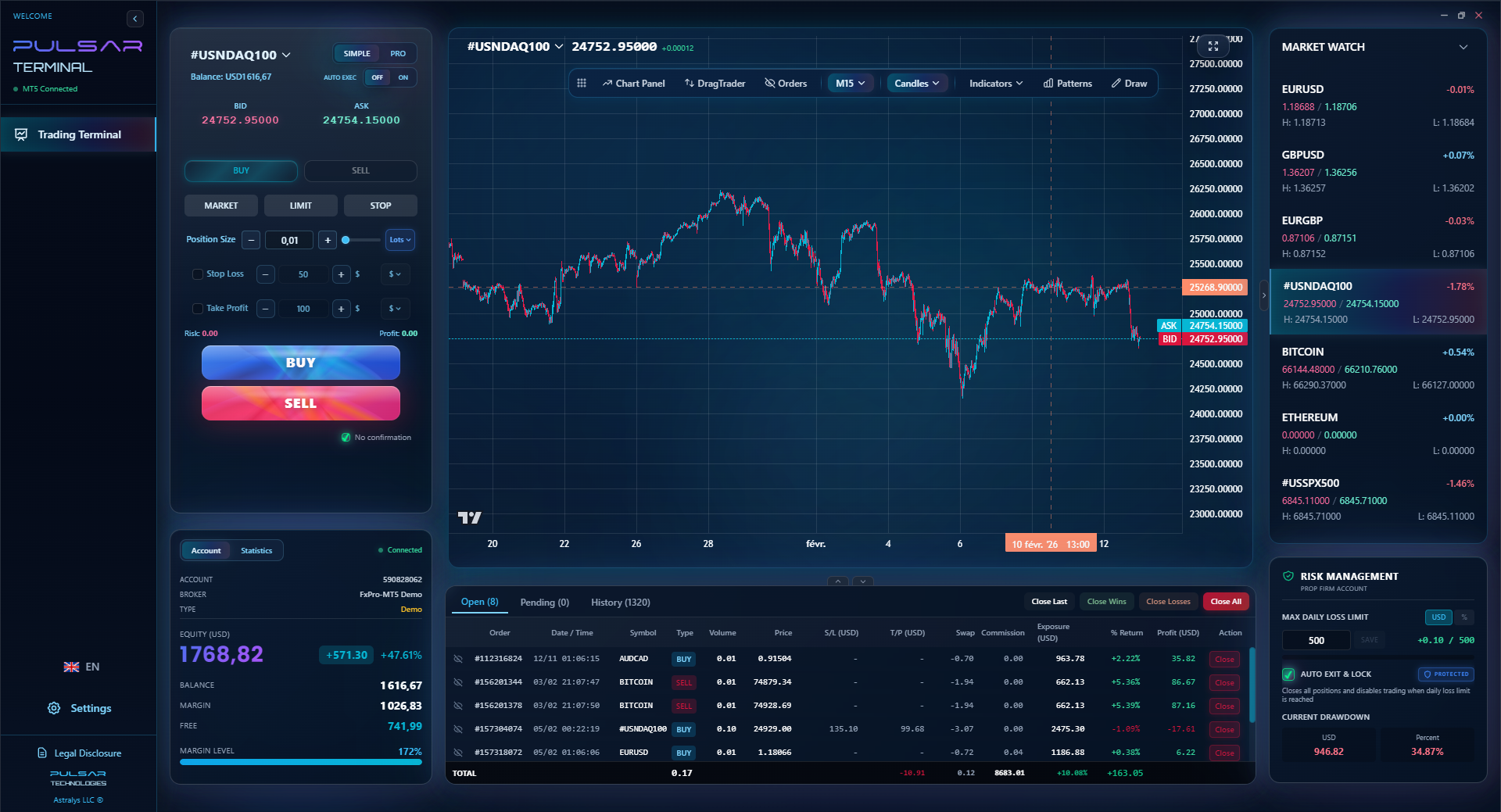
Managing multiple trades and their individual stop-losses under FCA rules is complex, but tools like Pulsar Terminal automate partial closures and trailing stops directly on your MT5 platform.
Pulsar Terminal
Das All-in-One MT5-Tool: Drag-and-Drop-Orders, Multi-TP/SL, Trailing Stop, Grid Trading, Volume Profile und Prop-Firm-Schutz. Täglich von 1.000+ Tradern genutzt.
This is a uniquely UK consideration, and it's a big one.
Spread Betting: This is a derivative product similar to a CFD, but it's classified as gambling under UK law. The huge benefit? All profits are completely free from Capital Gains Tax (CGT) and Income Tax. This is a massive advantage for successful traders. However, spread betting isn't covered by the same FCA product intervention rules as CFDs. While many providers voluntarily apply similar use limits, they don't have to. You also don't get the same level of negative balance protection (though many reputable firms offer it).
CFD Trading: Profits from CFDs are subject to Capital Gains Tax. You have an annual CGT allowance (for the 2025/26 tax year, it's £3,000). Any profits above that are taxed at 10% (basic rate) or 20% (higher/additional rate). Losses can be offset against other capital gains.
Which should you choose?
| Feature | CFD Trading | Spread Betting |
|---|---|---|
| Tax on Profits | Subject to CGT | Tax-Free |
| FCA use Caps | Yes (Mandatory) | No (Often Voluntary) |
| Negative Balance Protection | Yes (Mandatory) | No (Often Voluntary) |
| Underlying Market | FX, Indices, Shares, etc. | FX, Indices, Shares, etc. |
For most new traders, I'd suggest starting with CFDs. The mandatory FCA protections (use cap, negative balance) are a crucial safety net while you're learning. The tax bill is a problem for profitable traders. If you become consistently profitable over a few years, you can then consider switching some capital to spread betting for the tax efficiency, assuming you're confident in your risk management without the regulatory crutch.
Keep Records. Whether you trade CFDs or spread bets, use your broker's statement or a dedicated software to track every trade, deposit, and withdrawal. Your future accountant (or future self doing a self-assessment) will thank you.
💡 Winstons Tipp
If you don't know your exact cost per trade in pounds and pence before you click 'buy', you're not trading. You're donating. The spread, commission, and swap are your silent partners in every deal.
“The FCA warning shows 70-89% lose money. Let that statistic humble you before every single trade you place.”
Let's finish with a quick list of how UK traders typically blow up. I've done most of these.
1. Over-leveraging Within the Limit. Just because you can use 30:1 doesn't mean you should. Using full use on every trade is a recipe for disaster. It leaves no room for error or adding to a good position.
2. Chasing Losses. You lose £200 on a bad EUR/USD trade. The instinct is to immediately jump into another trade with a £400 risk to 'make it back fast.' This is the single fastest way to turn a small loss into an account-ending loss.
3. Ignoring the Swap. Planning a long-term carry trade? If you're buying a low-yield currency and selling a high-yield one, the daily swap cost will bleed your account dry even if the price doesn't move. Always, always check the swap rates.
4. Trading Around Major UK News. The GBP pairs (GBP/USD, EUR/GBP) can go absolutely wild during BoE announcements, UK inflation data, or general elections. Spreads widen to 10+ pips, orders get rejected, and stop-losses can suffer massive slippage. Either avoid trading these events altogether or use very wide stops and tiny position sizes.
5. Not Understanding the 50% Margin Rule. People think, "My stop-loss is at 20% down, I'm safe." But if you have multiple positions open, a sharp move in one can drain your overall equity, triggering the broker to close all your positions at the worst possible time. Monitor your total account equity versus your total used margin.
6. Picking a Broker for the Wrong Reason. A fancy welcome bonus or a sleek app is meaningless if their execution is slow or their spreads are huge during the London open. Focus on regulation, pricing, and reliability. Read independent reviews like our Pepperstone review to get the full picture.
Trading CFD forex in the UK is a marathon, not a sprint. The rules are there for a reason. Use them to build discipline, manage your risk obsessively, and focus on the process rather than the payout. It's the only way to try and end up in that minority of traders who make it work.
FAQ
Q1What is the maximum use I can get for forex trading in the UK?
For retail clients with an FCA-regulated broker, the maximum use on major forex pairs like EUR/USD or GBP/USD is 30:1. This is a hard cap set by the Financial Conduct Authority. For minor pairs or gold, it's 20:1, and for individual shares, it's just 5:1.
Q2Is CFD forex trading tax-free in the UK?
No, profits from CFD trading are subject to Capital Gains Tax (CGT). You have an annual tax-free allowance (currently £3,000), and anything above that is taxed. However, a similar product called spread betting is tax-free, but it doesn't come with the same mandatory FCA use and negative balance protections.
Q3What does 'negative balance protection' mean?
It's an FCA rule that means you can never lose more money than you have deposited in your trading account. If a trade goes catastrophically wrong and would put your balance below zero, your broker absorbs the loss. This is a critical protection that you only get with proper FCA regulation.
Q4Why do so many retail traders lose money on CFDs?
The FCA warning shows 70-89% lose money. The main reasons are over-leveraging (even within the limits), poor risk management, lack of a trading plan, emotional decision-making, and not accounting for all the costs (spreads, swaps). The statistics are a stark reminder that this is a skilled profession, not a hobby.
Q5Can I start trading CFD forex with £100?
Yes, technically. Many FCA brokers have no minimum deposit. However, with £100 and 30:1 use, your maximum position size is very small. More importantly, you have almost no room for error. A single 10-pip loss could be 10-20% of your account. It's better to see a small account as a learning tool for practicing discipline, not a way to make significant money.
Q6What's the difference between a standard and a raw spread account?
A standard account has no commission, but the spread (the buy/sell difference) is wider, incorporating the broker's fee. A raw or ECN account has a much tighter spread (sometimes almost 0) but charges a separate commission per trade. For active traders, the raw account usually offers a lower total cost. You need to calculate the 'all-in' cost (spread + commission) to compare.
Q7What is the best trading platform for beginners in the UK?
MetaTrader 4 (MT4) is still the most popular and beginner-friendly. It's stable, has thousands of free indicators and expert advisors (EAs), and every broker supports it. It's a great place to start. As you advance, you might explore MT5 or broker-specific platforms with more integrated tools.
Prof. Winstons Lektion
Wichtige Erkenntnisse:
- ✓FCA use caps are your protective gear, not handcuffs.
- ✓Calculate ALL costs: spread, commission, and swap.
- ✓Risk a maximum of 1-2% of your capital per trade.
- ✓FCA regulation and segregated funds are non-negotiable.
- ✓Tax-free spread betting is for veterans, not beginners.
Wie nützlich war dieser Artikel?
Klicken Sie auf einen Stern
Wöchentliche Trading-Einblicke
Kostenlose wöchentliche Analysen & Strategien. Kein Spam.
Über den Autor
Sarah Collins
Trading-Stratege
In London ansässige Trading-Strategin mit 12 Jahren Erfahrung an den Finanzmärkten. Ehemalige Analystin bei einem City-of-London-Broker. Deckt GBP-Paare, europäische Märkte und FCA-regulierten Handel ab.
Kommentare
Risikohinweis
Der Handel mit Finanzinstrumenten birgt erhebliche Risiken und ist möglicherweise nicht für alle Anleger geeignet. Vergangene Ergebnisse garantieren keine zukünftigen Renditen. Dieser Inhalt dient ausschließlich Bildungszwecken und stellt keine Anlageberatung dar. Führen Sie immer Ihre eigene Recherche durch, bevor Sie handeln.
Das könnte Sie auch interessieren

Cara Trading Forex Sukses: 7 Prinsip dari Trader Profesional
Cara trading forex sukses dengan 7 prinsip trader pro: manajemen modal, disiplin, journal trading, backtest. Data nyata, bukan janji profit palsu.
Jam Trading Forex Terbaik untuk Trader Indonesia: Panduan Lengkap dengan Tabel Waktu
Panduan jam trading forex untuk trader Indonesia. Tabel 4 sesi dunia, jam emas 20:00-00:00, sesi mana yang harus dihindari. Data akurat + tips dari trader berpengalaman.
Top 5 Sàn Forex Uy Tín Nhất 2026: Review Jujur dari Trader Indonesia
Top 5 sàn forex uy tín 2026 untuk trader Indonesia. Review jujur: spread, deposit, withdraw, dukungan lokal. Exness, XM, IC Markets & lebih.
Pulsar Terminal herunterladen
Alle diese Rechner sind in Pulsar Terminal mit Echtzeit-Daten Ihres MT5-Kontos integriert.
Pulsar Terminal herunterladen