


It was October 2022, and the USD/ZAR was screaming towards R18.50.

David van der Merwe
Schwellenland-Trader ·  South Africa
☕ 10 Min. Lesezeit
Was Sie lernen werden:
- 1Why Your Broker's Business Model is Your Business
- 2Type 1: The Market Maker (Dealing Desk)
- 3Type 2: The STP (No Dealing Desk) Broker
- 4Type 3: The ECN Broker
- 5The Murky Middle: Hybrid Brokers & The South African Reality
- 6How to Choose: Match the Broker Type to Your Trading
- 7Red Flags to Run From (Regardless of Type)
It was October 2022, and the USD/ZAR was screaming towards R18.50. My trade was in the money, my stop loss was set, and I was ready to take profit. I clicked to close. The platform froze for a second, then filled me at a price 15 pips worse than the quoted rate. That wasn't market volatility. That was my broker's 'last look' policy - a hidden cost I hadn't understood because I didn't know what type of broker I was really dealing with. Let's make sure you don't make the same expensive mistake. Choosing the right type of broker isn't about fancy platforms; it's about understanding who's on the other side of your trade.
Most traders in SA pick a broker based on who has the slickest ads or the biggest deposit bonus. That's a fantastic way to lose money. The fundamental type of broker you use dictates your trading costs, your potential for conflict, and even the speed of your executions. It's the foundation everything else is built on.
Think of it this way: you wouldn't buy a car without knowing if it's petrol, diesel, or electric. The fuel type changes everything - cost per kilometre, performance, maintenance. Your broker's model is your trading fuel. An ECN broker connects you directly to other market participants. An STP broker routes your order to its liquidity providers. A Market Maker often takes the other side of your trade internally. Your job is to figure out which engine works for your strategy and, more importantly, which one won't leave you stranded on the side of the N1 with an empty tank and a hefty tow bill.
I learned this the hard way with my first major account. I was scalping the EUR/USD guide, in and out for 5-10 pips at a time. I was winning on paper, but my account balance was stagnant. Why? My broker, a classic market maker, had wide, variable spreads that would balloon right as I entered. My 5-pip profit would be eaten by a 3-pip spread on entry and another 2 on exit. I was running in quicksand. Once I switched to a true ECN model with a small commission but razor-thin spreads, my scalping strategy actually started to work. The type of broker didn't just change my costs; it changed what was possible.
This is the old-school model, and you'll still find plenty of them operating here. A Market Maker, or Dealing Desk (DD) broker, creates its own internal market for you. When you buy, they often sell to you directly from their own book. They're not just a middleman; they're frequently the counterparty to your trade.
How They Make Money
Their profit is primarily the spread - the difference between the bid and ask price they quote you. They can control this spread, often widening it during volatile news events (like SARB interest rate announcements) or when liquidity is thin. They may also engage in 'last look,' where they have a milliseconds-long window to reject your order if it's immediately profitable against them. That's what happened to me on that USD/ZAR trade.

Warning: The main conflict of interest is obvious: if you win, they lose (on that trade). This doesn't mean every market maker is out to get you, but the incentive structure is fundamentally misaligned. Their risk management team's job is to limit the broker's losses, which can sometimes manifest in re-quotes or sudden platform 'issues' when you try to enter a fast-moving trade.
Who It Might Suit
Surprisingly, this model can work for certain traders. If you're a complete beginner with a tiny account (say, under R2000), the lack of commission can make it feel cheaper. They often offer guaranteed stop losses (for a fee) and fixed spreads, which make cost calculation simple. If you're a long-term swing trader holding positions for weeks, the spread impact is less critical than for a scalper. Just know what you're signing up for.

💡 Winstons Tipp
A broker's 'type' is their business model. Never forget they are a business first, your partner second. Your job is to find one whose profit aligns with your success.

“Your broker's model is your trading fuel. Choose the wrong type, and you're running in quicksand.”
STP stands for Straight Through Processing. This is the middle ground. An STP broker doesn't take the other side of your trade. Instead, they automatically route your order directly to one or more of their liquidity providers (big banks or financial institutions). They act as a pure conduit.
How They Make Money
STP brokers typically add a small markup to the raw spread they get from their liquidity providers. This is their commission. For example, if their liquidity provider offers a 0.8 pip spread on EUR/USD, the STP broker might quote you 1.2 pips. That 0.4 pip markup is their revenue. It's more transparent than a market maker's variable spread, but you still need to scrutinise the total cost.
The Liquidity Provider Game
This is the critical part. The quality of an STP broker depends entirely on the quality and number of its liquidity providers. A broker with one dodgy provider will have worse prices and more slippage than a broker connected to ten top-tier banks. Some brokers use a 'hybrid' model: they route most orders STP but may internalise small, losing client trades (acting as a market maker for those). Always check a broker's disclosure.

Example: Let's say you're trading 1 standard lot (100,000 units) of GBP/ZAR. A raw spread from a provider might be 150 pips (R150 per pip definition on that pair). An STP broker marking it up by 20 pips charges you 170 pips. On that one trade, their markup costs you R200. Over 100 trades, that's R20,000 in hidden fees. This is why you must use a position size calculator that includes the spread as a cost of doing business.
Many reputable international brokers serving the SA market, like IC Markets review and Pepperstone review, operate on an STP/ECN model. It's generally considered a fairer setup for active traders.
ECN stands for Electronic Communication Network. This is as close to the 'real' market as most retail traders can get. An ECN broker doesn't route your order to a single provider; it places your order into a digital pool where it can be matched with orders from other participants - other traders, banks, hedge funds. You're trading in a genuine marketplace.
The Cost Structure: Commission + Spread
ECN brokers make money by charging a flat commission per trade, per lot. In return, they give you access to the raw, interbank spread, which can often be 0.0 pips on major pairs like EUR/USD during high liquidity. Your total cost is Commission + Raw Spread.
For high-volume traders, this is almost always cheaper. Let's get specific: In 2023, I was trading 20-30 lots per month on an ECN account. The commission was $3.50 per 100k lot (round turn). The EUR/USD spread was often 0.1 pips. My total cost per trade was about $4.50. On my old market maker account, the 'commission-free' spread was 1.2 pips, which equates to $12 per 100k lot. The ECN saved me over $7.50 on every single trade. That adds up to real money.
The Raw Reality
ECN trading isn't all sunshine. You need a larger account. Minimum deposits are higher (often $500-$1000). The raw spreads can be fantastic, but during low liquidity (like Asian session for EUR pairs), they can also gap wildly. There are no guaranteed stops. It's the pure, unfiltered market - which is what we want, but it can be brutal. You need solid discipline to avoid a margin call when volatility spikes.

Pro Tip: Don't just look at the advertised 'from' spreads. Check the broker's average spread statistics over a 24-hour period. A true ECN should have near-zero spreads on majors during London/NY overlap. If their 'ECN' account shows a fixed 1-pip minimum, it's not a real ECN.
💡 Winstons Tipp
The spread isn't a fee you see leaving your account, so beginners ignore it. It's the most consistent cost you have. On a market maker, it's their entire profit margin. Scrutinise it.
“The main conflict of interest is obvious: if you win, they lose. Their incentive structure is fundamentally misaligned.”
Here's where it gets tricky, especially for us trading from South Africa. The lines are blurred. Most brokers you'll encounter, including the big global names, are hybrids. They might offer an STP model for 95% of trades but internalise the small, obviously losing trades from novice clients. Or they might offer both a 'Standard' (market maker) account and a 'Raw' (ECN/STP) account.
Your first question to any broker should be: 'Can you clearly explain your execution model for the account I'm opening?' If they waffle, walk away.
The FSCA and Local vs. International
You have a choice: a broker registered with the South African Financial Sector Conduct Authority (FSCA) or an international broker. FSCA-regulated brokers (like some local offerings) are often market makers or hybrids. The regulation is good for safety - you have recourse - but the trading conditions might be less competitive. International brokers like Exness review or XM review often provide better spreads and true ECN access, but your funds are held offshore. It's a trade-off between superior trading conditions and perceived local safety. I use both: a smaller account with an FSCA broker for testing strategies, and my main capital with a top-tier international ECN/STP broker. Never put all your eggs in one basket.
This hybrid landscape is why a tool that gives you transparency is non-negotiable. You need to see your true execution price versus the market price at the exact millisecond you clicked.
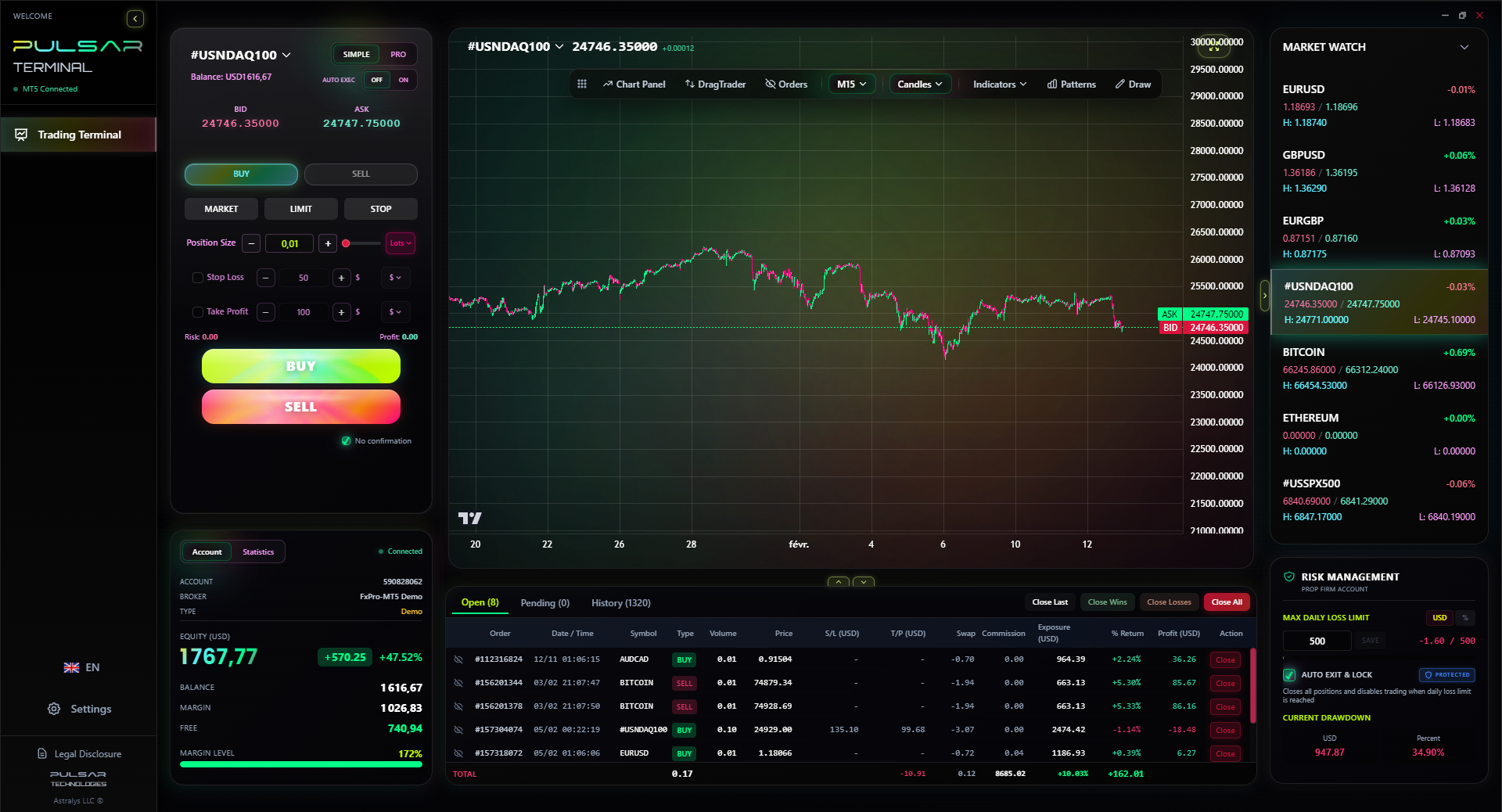
When you're trading with a true ECN or STP broker, seeing the raw market depth and managing orders with precision is critical, which is where tools like Pulsar Terminal for MT5 give you that institutional edge.
Pulsar Terminal
Das All-in-One MT5-Tool: Drag-and-Drop-Orders, Multi-TP/SL, Trailing Stop, Grid Trading, Volume Profile und Prop-Firm-Schutz. Täglich von 1.000+ Tradern genutzt.
Stop looking at bonuses. Start diagnosing your own trading. Here’s a blunt breakdown:
| Your Trading Profile | Likely Best Broker Type | What to Prioritise |
|---|---|---|
| Beginner, Small Account (<R10k), Swing Trading | Market Maker / Standard Account | Simplicity, fixed spreads, educational tools. Accept the higher cost as a 'tuition fee.' |
| Active Trader, Scalper, News Trader | True ECN or Premium STP | Lowest total cost (commission + spread), execution speed, depth of market data. |
| High-Volume Day Trader (5+ lots daily) | True ECN with tiered commissions | Direct market access, volume-based commission discounts, institutional-grade platform. |
| Cautious Trader Prioritising Local Regulation | FSCA-Regulated Hybrid | Regulatory safety, local support. Scrutinise spreads and execution policy closely. |
Ask yourself these questions: How many trades do I take per day? What's my average hold time? What's my typical position size? Your answers will point you to the right model. A scalper using a market maker is like a F1 driver putting cooking oil in his engine. It will seize up.
Finally, test them. Open a demo account that uses the real execution model of their live account (not a simulated one). Place trades during the SARB announcement or the US NFP release. Watch for re-quotes, slippage, and spread widening. That demo test is more valuable than any review you'll read.
💡 Winstons Tipp
Your first R10,000 in the market is tuition. Pay it to a regulated entity, even if their spreads are fat. Losing it to an unregulated 'ECN' scam teaches you nothing.

“Test them during the SARB announcement. That demo test is more valuable than any review you'll read.”
Some warning signs transcend the broker type. If you see these, cancel your deposit and find another broker.
- 'Guaranteed Profits' or 'No Risk' Marketing: This is illegal. Trading is risk. Full stop.
- Difficulty Withdrawing Your Money: If it's easier to deposit than withdraw, it's a scam. Your first test withdrawal should be small and fast.
- No Clear Regulatory Disclosure: They should openly display their license number (FSCA, ASIC, FCA, etc.) on their website. Verify it on the regulator's official site.
- Hidden Fees in the Terms: Look for fees on inactive accounts, high withdrawal fees, or currency conversion markups beyond the interbank rate.
- They Call You Unsolicited to Push a Trade: A legitimate broker will never, ever call you with a 'hot tip.' That's a bucket shop tactic.
- Their 'ECN' Account Has No Commission: This is mathematically impossible. If they claim raw spreads with no commission, they're making money by massively widening the spread. It's a lie.
I got caught by the last one early on. The account said 'ECN,' had tight spreads on the marketing page, and charged no commission. Live trading revealed spreads that were 5-8 pips on majors when the real market was at 0.5. They were just a market maker in ECN clothing. The lesson? The label is less important than the actual, live trading conditions.
FAQ
Q1Which type of forex broker is safest for beginners in South Africa?
From a regulatory safety perspective, an FSCA-regulated broker is safest for your capital. However, their trading model (often market making) might have higher costs. For a true beginner, a regulated broker with a simple, fixed-spread account is a decent start. View the wider spreads as part of the learning cost, but plan to graduate to a more transparent model as your skills and account grow.
Q2Are ECN brokers really better than Market Makers?
They're better for specific traders. If you're an active day trader or scalper, a true ECN's lower total cost and direct market access are objectively better. For a casual swing trader placing a few trades a month, the difference might be negligible, and a market maker's fixed spreads could offer simpler planning. 'Better' depends entirely on your strategy and volume.
Q3What is the main disadvantage of an ECN broker?
The two main disadvantages are cost structure and volatility. You need a larger account to absorb the per-trade commission and handle the minimum deposit. Secondly, you get raw spreads, which can gap significantly during news or thin liquidity, leading to slippage. There's no 'cushion' or re-quote - you get the real market, for better or worse.
Q4How can I tell if my broker is a true ECN?
First, they must charge a clear, per-lot commission. Second, check their live spreads on a major pair like EUR/USD during the London session - they should frequently show 0.0 or 0.1 pips. Third, they should provide some form of market depth tool showing pending orders from other participants. If they offer 'commission-free ECN,' it's a marketing trick.
Q5Do I need a different strategy for different broker types?
Absolutely, especially for short-term strategies. A scalping strategy that aims for 5-pip profits will fail on a broker with a 3-pip spread. Your risk management, particularly stop-loss placement, must account for potential slippage, which is more common with STP/ECN models during news. Always backtest and demo-trade your strategy on the specific execution model you'll use live.
Q6Is it legal for South Africans to use international brokers?
Yes, it is legal for you to open an account with an international broker. The responsibility falls on the broker to decide if they accept clients from South Africa. Many top global brokers do. The key consideration isn't legality, but practicality: your funds are held offshore, and your recourse is with a foreign regulator, which can be more complex than dealing with the FSCA.
Prof. Winstons Lektion
Wichtige Erkenntnisse:
- ✓Market Makers profit from your spread, creating a direct conflict.
- ✓True ECNs charge commission but offer raw, interbank spreads.
- ✓STP brokers add a markup to liquidity provider prices.
- ✓Most brokers are hybrids; demand transparency on execution.
- ✓Match the broker type to your strategy volume and style.
Wie nützlich war dieser Artikel?
Klicken Sie auf einen Stern
Wöchentliche Trading-Einblicke
Kostenlose wöchentliche Analysen & Strategien. Kein Spam.
Über den Autor
David van der Merwe
Schwellenland-Trader
In Johannesburg ansässiger Trader mit 11 Jahren Erfahrung in Schwellenländerwährungen. Spezialisiert auf ZAR-Paare, FSCA-regulierten Handel und Analyse des südafrikanischen Marktes.
Kommentare
Risikohinweis
Der Handel mit Finanzinstrumenten birgt erhebliche Risiken und ist möglicherweise nicht für alle Anleger geeignet. Vergangene Ergebnisse garantieren keine zukünftigen Renditen. Dieser Inhalt dient ausschließlich Bildungszwecken und stellt keine Anlageberatung dar. Führen Sie immer Ihre eigene Recherche durch, bevor Sie handeln.
Das könnte Sie auch interessieren

Cara Trading Forex Sukses: 7 Prinsip dari Trader Profesional
Cara trading forex sukses dengan 7 prinsip trader pro: manajemen modal, disiplin, journal trading, backtest. Data nyata, bukan janji profit palsu.
Jam Trading Forex Terbaik untuk Trader Indonesia: Panduan Lengkap dengan Tabel Waktu
Panduan jam trading forex untuk trader Indonesia. Tabel 4 sesi dunia, jam emas 20:00-00:00, sesi mana yang harus dihindari. Data akurat + tips dari trader berpengalaman.
Top 5 Sàn Forex Uy Tín Nhất 2026: Review Jujur dari Trader Indonesia
Top 5 sàn forex uy tín 2026 untuk trader Indonesia. Review jujur: spread, deposit, withdraw, dukungan lokal. Exness, XM, IC Markets & lebih.
Pulsar Terminal herunterladen
Alle diese Rechner sind in Pulsar Terminal mit Echtzeit-Daten Ihres MT5-Kontos integriert.
Pulsar Terminal herunterladen