


Ever heard another trader in Joburg or Cape Town mention 'wallpaper forex trading' and wondered what they're on about? It's not some fancy new strategy.

David van der Merwe
Schwellenland-Trader ·  South Africa
☕ 10 Min. Lesezeit
Was Sie lernen werden:
- 1What 'Wallpaper Forex Trading' Actually Means
- 2Why South African Traders Get Stuck in This Trap
- 3FSCA Rules & The Real-World Risk Picture
- 4Practical Strategies to Never Make 'Wallpaper' Again
- 5Choosing the Right Broker & Tools in SA
- 6A Real ZAR Trade: From Almost Wallpaper to Salvaged
- 7Building a Disciplined SA Trader Mindset
Ever heard another trader in Joburg or Cape Town mention 'wallpaper forex trading' and wondered what they're on about? It's not some fancy new strategy. Honestly, it's a local slang term for the worst thing that can happen to your account. When we say a trade has become 'wallpaper,' we mean it's so deep in the red it might as well be decorative - you're just staring at a huge, unmoving loss on your screen, hoping for a miracle that never comes. Let's break down why this happens to so many South African traders, how our unique market plays a part, and most importantly, how you can avoid turning your hard-earned Rands into expensive wall art.
Right, let's clear this up first. 'Wallpaper forex trading' isn't a strategy you'll find in any textbook. It's a grim bit of trader humor that's popped up in local forums and WhatsApp groups. It describes that soul-crushing moment when a trade goes so badly against you that you can't bring yourself to close it. The loss is just sitting there on your chart, frozen. You stop checking it for movement and start accepting it as a permanent part of your trading platform's background - like ugly wallpaper.
I've been there. Early in my career, I got stubborn on a USD/ZAR trade. I bought at 18.50, convinced the Rand would strengthen. It didn't. It blew past 19.00. My R10,000 account was down over R3,000 on that single position. I refused to take the hit, telling myself 'it'll come back.' It became wallpaper. I'd open MT5 just to see that big red number, a constant reminder of my mistake. That trade eventually hit my stop-loss at 19.40 when my broker issued a margin call. The loss was far worse than if I'd just admitted I was wrong.
The psychology is key. It's not about analysis anymore; it's about pride, hope, and the sunk cost fallacy. You're emotionally married to a bad idea. In South Africa, with our market's wild swings, this can happen fast. The ZAR can move 200 pips in a day on political news. If you're not careful, a small scalp can turn into a long-term, very expensive decoration for your chart.

💡 Winstons Tipp
A loss is just a receipt proving you paid for an education. Frame it, learn from it, but never hang it as wallpaper on your live account.
“Wallpaper trading is what happens when hope replaces your trading plan.”
We face a perfect storm of conditions that make 'wallpaper trades' a real risk. It's not just about discipline; our market itself sets traps.
The ZAR Volatility Rollercoaster
Our beloved Rand is one of the most traded emerging market currencies for a reason: it moves. A lot. Pairs like USD/ZAR and EUR/ZAR can have daily ranges that make major pairs like EUR/USD look sleepy. This volatility is a double-edged sword. It creates opportunity, but it also means losses can accelerate before you've even finished your morning coffee. If you're using high use (capped at 30:1 by the FSCA for retail traders, but that's still plenty), a 2% move against you can wipe out 60% of your margin. That's a fast track to wallpaper territory.
Local Broker Structures and Costs
Let's talk numbers. Some brokers popular here have wider spreads on ZAR pairs. I've seen USD/ZAR spreads as high as 50 pips on standard accounts during off-hours. If you enter a trade already 50 pips in the hole, you're starting from a position of weakness. That messes with your risk calculation from the get-go. You might hold a losing trade longer, hoping just to get back to breakeven on the spread. It's a bad habit.

Warning: A wide spread isn't just a cost; it's a psychological anchor. If your trade is down 30 pips but the spread was 40, you're actually in profit on the mid-price. Don't let broker pricing distort your view of a trade's health.
The 'Braai Stand' Mentality
I'll say it: we have a cultural tendency to be stubborn. Maybe it's the vasbyt (perseverance) spirit, which is great in life, but dangerous in trading. At a braai, you'll hear guys talk about 'riding it out' or 'the market must come back.' This isn't property or shares you're holding for years. Forex, especially with the use we use, is a game of precision. A trade that's wrong is wrong. Holding it and hoping is a recipe for turning a small loss into an account-ending one. I learned this the hard way, and it cost me more than a few steaks.
“A 1% risk rule isn't restrictive; it's the freedom to be wrong and still trade tomorrow.”
The Financial Sector Conduct Authority (FSCA) isn't trying to spoil the party. Their 30:1 use limit for major pairs (and lower for others) is there for a very good reason: to stop you from blowing up your account in minutes. But here's the thing - even at 30:1, risk is extreme if you don't manage it.
Think of use as a power tool. 30:1 is a industrial-grade drill. In the hands of a pro, it builds things fast. In the hands of a novice, it causes serious damage. A 1% market move becomes a 30% P&L swing on your used margin. If you're over-leveraged (putting too much margin on one trade), a few bad moves can quickly push you to a margin call, where the broker automatically closes your positions. That's often the brutal end to a 'wallpaper trade.'
Your best defense is a solid position size calculator. Never risk more than 1-2% of your account on a single trade. On a R20,000 account, that's R200-R400. If your stop-loss is 50 pips away on USD/ZAR, you work backwards to find the lot size that keeps your potential loss within that range. This simple math is the difference between a controlled loss and a catastrophic one. It forces you to cut losers early, before they become part of your screen's decor.
Also, remember the tax man. SARS sees consistent trading as income, not capital gains. If you do manage to miraculously salvage a wallpaper trade after months, those gains are fully taxable. And those earlier losses? You can offset them, but only if you have careful records. A messy, emotional trade makes for a nightmare at tax time.
“A 1% risk rule isn't restrictive; it's the freedom to be wrong and still trade tomorrow.”
Okay, enough about the problem. How do we fix it? This is where you need to build systems that override emotion.
The Unbreakable Rule: Use a Stop-Loss. Always.
I don't care if you're trading USD/ZAR based on a SARB announcement or XAU/USD (gold) on a hunch. You define your stop-loss BEFORE you enter the trade. Not after. Not 'I'll see how it goes.' Your stop-loss is your fire escape. It's the price at which your thesis is proven wrong. When it hits, you're out. No debate, no hesitation.
Try a Multi-Take Profit Approach
One mental trick is to avoid the 'all or nothing' mindset. Instead of aiming for one huge profit target, scale out. Close half your position at a first target to bank some profit and cover costs. Move your stop-loss to breakeven on the remainder. This way, you're playing with 'house money' and the trade can never become a loss. The psychology is liberating. You're not a hostage waiting for one price.
Schedule Your Trade Reviews
Don't stare at the screen. Set specific times to check your open positions (e.g., London open, NY close). In between, walk away. Constant watching makes you micromanage and second-guess. A trade that needs you to babysit it every minute is probably a bad trade. This distance helps you see the chart objectively, not emotionally.

Pro Tip: If you find yourself constantly moving your stop-loss away from the price to give a trade 'more room,' stop. That's the wallpaper mentality talking. Close the trade, take a break, and re-assess the market fresh.
💡 Winstons Tipp
The ZAR doesn't care about your pride. It will move whether you're right or wrong. Your job is to be right on risk, not just direction.
“The ZAR's volatility isn't your enemy - your reaction to it is.”
Your broker and platform can either help you avoid disaster or subtly encourage bad habits. For South Africans, regulation is non-negotiable. Stick with FSCA-regulated brokers or reputable international ones with a strong local presence. Your funds should be in segregated accounts.
Look for tight spreads on the pairs you trade. If you're focusing on ZAR crosses, compare the USD/ZAR spreads across brokers like Exness, XM, and Pepperstone. Every pip saved on the spread is a pip you don't have to make up.
Your trading platform is your cockpit. Most of us use MT4 or MT5. The basics are fine, but advanced order types can be clunky. This is where tools that integrate with MT5 can change the game. Being able to set a trailing stop that automatically follows price, or to place a multi-part take-profit order with one click, removes friction from good risk management.
For example, setting a breakeven stop manually involves watching the trade and modifying an order. If you get distracted, you forget. An automated tool does it instantly when price hits your specified level, locking in safety without you needing to remember. That's one less way a trade can turn against you.
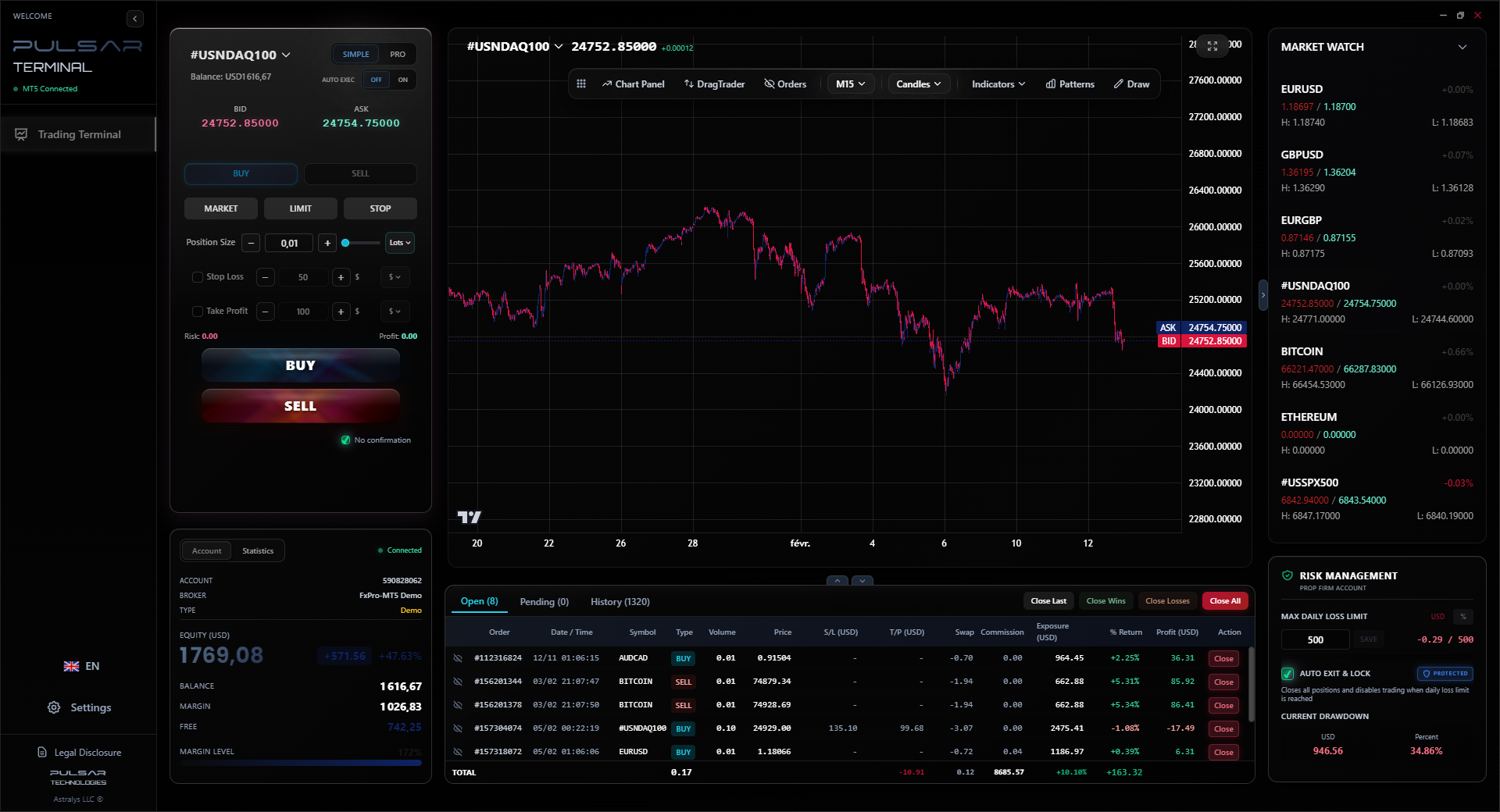
Managing multiple take-profit levels and moving stops to breakeven manually is error-prone, but tools like Pulsar Terminal automate these risk-management actions directly on your MT5 charts.
Pulsar Terminal
Das All-in-One MT5-Tool: Drag-and-Drop-Orders, Multi-TP/SL, Trailing Stop, Grid Trading, Volume Profile und Prop-Firm-Schutz. Täglich von 1.000+ Tradern genutzt.
“The ZAR's volatility isn't your enemy - your reaction to it is.”
Let me give you a real example from last year. In early 2025, USD/ZAR was soaring. It broke 19.00. The sentiment was overwhelmingly bearish on the Rand. I thought it was overextended and saw a potential reversal pattern on the 4-hour chart.
The Mistake: I sold USD/ZAR at 19.05, expecting a pullback. My stop was at 19.30, risking 25 Rands per pip on a mini lot. The trade immediately went against me. It climbed to 19.20, then 19.25. My paper loss was over R500. The old me would have deleted the stop and hoped. The wallpaper mindset was whispering.
The Correction: Instead, I stuck to my plan. The stop at 19.30 hit. I lost R625 (25 pips * R25). It hurt, but it was controlled. The market then... skyrocketed to 19.93. If I'd held, that would have been a loss of over R2,200 on that single mini lot - a classic wallpaper scenario that could have crippled my weekly progress.
The Lesson: That disciplined loss saved me from a catastrophe. A week later, I re-entered with a better-defined trend-following idea and made back the loss and more. The key was accepting the small wrong to avoid the big, account-breaking wrong. Your first loss is often your best loss. Tools that help you execute these rules mechanically are worth their weight in gold, or in our case, platinum.
“Your first loss is usually your cheapest loss. Don't order the deluxe version by removing your stop.”
Finally, this is a mental game. You need to reframe what a 'loss' is. A stopped-out trade isn't a failure; it's the cost of doing business. It's the fee you pay for the opportunity to be in the game for the next trade, where you might catch a 500-pip move on the Rand.
Track your trades religiously. Note why you entered, where your stop was, and why you exited. Review this weekly. You'll quickly see patterns - do your losing trades all become 'wallpaper candidates' because you ignore stops? Or do you cut winners short? The data doesn't lie.
Connect with other serious local traders, not the 'get-rich-quick' crowd. Talk about risk management, not just wins. The goal isn't to never have a losing trade; it's to never have a losing trade that threatens your ability to trade tomorrow. Keep your charts clean, your rules simpler, and your emotions in check. That's how you ensure the only wallpaper in your life is the one you choose for your lounge, not your trading terminal.
💡 Winstons Tipp
If you wouldn't enter the trade at the current price, why are you still in it? That's the wallpaper question. Answer it honestly.
FAQ
Q1Is 'wallpaper forex trading' illegal in South Africa?
No, it's not illegal. It's just a slang term for a very bad trading habit - holding onto massive losses indefinitely. The trading itself is legal through FSCA-regulated brokers, but the behavior will likely destroy your account.
Q2What's the biggest cause of wallpaper trades for ZAR pairs?
Over-leveraging combined with the Rand's natural volatility. A small move against you becomes a huge loss quickly, and pride stops traders from closing it. Using excessive use on volatile pairs like USD/ZAR is the fastest route to this problem.
Q3How does the FSCA's 30:1 use limit help?
It caps how much you can borrow from your broker, theoretically limiting the speed of a blow-up. However, 30:1 is still very high risk if you don't manage position size. It prevents 100:1 or 500:1 disasters, but you can still lose everything quickly with poor risk management.
Q4Can I recover a trade that's already 'wallpaper'?
Sometimes, but it's a dangerous gamble. The best action is usually to close it, accept the painful lesson, and re-focus on a new trade with proper risk parameters. Trying to 'trade your way out' often leads to even bigger losses and emotional burnout.
Q5Do South African brokers offer tools to prevent this?
All platforms offer basic stop-loss orders, which are the essential tool. Some brokers and advanced trading terminals offer more sophisticated automated risk tools like trailing stops, breakeven triggers, and guaranteed stop-losses (for a fee), which can help enforce discipline.
Q6How should I factor in spreads on ZAR pairs?
Always include the spread as part of your initial risk. If the USD/ZAR spread is 30 pips, and your stop-loss is 50 pips away, your total risk is 80 pips from your entry price. Use a position size calculator to adjust your lot size so that 80 pips equals 1-2% of your account.
Q7What's the first step to stop making wallpaper trades?
Write down a simple trading plan that includes your maximum risk per trade (e.g., 1% of account) and vow to never, ever move a stop-loss further away from price. Execute this for your next 20 trades without exception. It builds the muscle memory of discipline.
Prof. Winstons Lektion
Wichtige Erkenntnisse:
- ✓Define risk before reward, every single trade.
- ✓Maximum 1-2% risk per trade protects your capital.
- ✓A stop-loss is a non-negotiable exit plan, not a suggestion.
- ✓Volatile ZAR pairs demand smaller position sizes.
- ✓Automate risk tools to enforce your discipline.
Wie nützlich war dieser Artikel?
Klicken Sie auf einen Stern
Wöchentliche Trading-Einblicke
Kostenlose wöchentliche Analysen & Strategien. Kein Spam.
Über den Autor
David van der Merwe
Schwellenland-Trader
In Johannesburg ansässiger Trader mit 11 Jahren Erfahrung in Schwellenländerwährungen. Spezialisiert auf ZAR-Paare, FSCA-regulierten Handel und Analyse des südafrikanischen Marktes.
Kommentare
Risikohinweis
Der Handel mit Finanzinstrumenten birgt erhebliche Risiken und ist möglicherweise nicht für alle Anleger geeignet. Vergangene Ergebnisse garantieren keine zukünftigen Renditen. Dieser Inhalt dient ausschließlich Bildungszwecken und stellt keine Anlageberatung dar. Führen Sie immer Ihre eigene Recherche durch, bevor Sie handeln.
Das könnte Sie auch interessieren

Cara Trading Forex Sukses: 7 Prinsip dari Trader Profesional
Cara trading forex sukses dengan 7 prinsip trader pro: manajemen modal, disiplin, journal trading, backtest. Data nyata, bukan janji profit palsu.
Jam Trading Forex Terbaik untuk Trader Indonesia: Panduan Lengkap dengan Tabel Waktu
Panduan jam trading forex untuk trader Indonesia. Tabel 4 sesi dunia, jam emas 20:00-00:00, sesi mana yang harus dihindari. Data akurat + tips dari trader berpengalaman.
Top 5 Sàn Forex Uy Tín Nhất 2026: Review Jujur dari Trader Indonesia
Top 5 sàn forex uy tín 2026 untuk trader Indonesia. Review jujur: spread, deposit, withdraw, dukungan lokal. Exness, XM, IC Markets & lebih.
Pulsar Terminal herunterladen
Alle diese Rechner sind in Pulsar Terminal mit Echtzeit-Daten Ihres MT5-Kontos integriert.
Pulsar Terminal herunterladen