


I was short on GBP/USD, up about 120 pips.

Olumide Adeyemi
Pionier des Tradings in Westafrika ·  Nigeria
☕ 10 Min. Lesezeit
Was Sie lernen werden:
- 1Equity vs. Balance: The Difference That Can Wipe You Out
- 2How Equity Works with Margin and use (The Nigerian Reality)
- 3Why Equity is Your #1 Risk Management Tool
- 4Common Equity Mistakes I See Nigerian Traders Make
- 5A Practical Example: Calculating Equity in a Trade
- 6Using Your Platform to Monitor Equity
- 7Equity & Prop Firm Challenges: The Special Case
- 8Building Your Strategy Around Your Equity
I was short on GBP/USD, up about 120 pips. My balance showed a nice profit, so I got cocky and opened another position without checking. The market reversed hard. I kept looking at my balance, thinking I was still okay, but I wasn't watching the real number: my equity. By the time I realized my total account value had crashed through my broker's stop-out level, it was too late. A £2,000 account was gone in minutes. That painful lesson cost me real money and taught me that if you don't understand what equity means in forex trading, you're just gambling with fancy charts.
Most new traders look at their account balance and think, "That's my money." It's not. Not really. Your balance is just a history book. It shows your starting cash, plus any deposits or withdrawals, plus the profits or losses from trades you've already closed and forgotten about. It's static. It doesn't care what's happening right now.
Your equity is the live feed. It's the brutal, real-time truth.
Here's the formula you need to burn into your memory: Equity = Balance + Floating Profit/Loss.
Let's say you deposit ₦500,000 (roughly $360) into a broker like Exness. Your balance is ₦500,000. You buy one mini lot of EUR/USD. The trade immediately goes against you by 50 pips. That's a floating loss of about ₦25,000.
Your balance? Still smugly sitting at ₦500,000. Your equity? It's screaming at ₦475,000. That equity number is what your broker uses to decide if you can keep that losing trade open. Ignoring it is how you get a margin call.

Warning: Your trading platform's "Profit" column shows your floating P/L. That number added to your Balance is your Equity. If you only watch your Balance while you have open trades, you are driving with your eyes closed.

💡 Winstons Tipp
Your equity is your oxygen level. You wouldn't climb a mountain without checking it. Don't trade without knowing yours.
This is where things get intense for us in Nigeria. We often have access to very high use - think 1:500, 1:1000, or even 1:2000 with some international brokers. This doesn't make you rich; it makes your equity hypersensitive.
The Margin & Free Margin Link
Margin is the deposit you need to open a trade. With 1:1000 use on a $10,000 (standard lot) position, you only need $10 of your own money as margin. Sounds great, right? Here's the trap.
Your Free Margin is calculated as: Equity - Used Margin. This is your breathing room, your ammunition for new trades, and your buffer against losses.
Let's use real numbers from a trade I took last month. I had a ₦800,000 account with XM (use 1:1000). I went long on Gold (XAU/USD), using about ₦120,000 as margin for the position. My equity was ₦800,000 (no floating P/L yet). So, Free Margin = ₦800,000 - ₦120,000 = ₦680,000. Plenty of room.
Gold dropped $15. My floating loss hit ₦90,000. My equity dropped to ₦710,000. Instantly, my Free Margin shrunk to ₦590,000. My available buying power got slashed by the moving equity, even though my balance hadn't changed. This is the real-time risk management high-wire act.
The Stop-Out Level
Every broker has a stop-out level (usually 20-50%). When your Equity falls to a certain percentage of your Used Margin, they start closing your losing positions, biggest loser first. They don't wait for your balance to hit zero. They watch your equity. If your equity is crashing, you're out.
Using a position size calculator religiously is the only way to manage this relationship. It bases your lot size on your equity, not your balance, to keep your risk sane.
“If you don't understand what equity means in forex trading, you're just gambling with fancy charts.”
Forget fancy indicators for a second. Your equity curve is the most important chart you have. If it's a rollercoaster heading down, your strategy is broken, no matter how many winning trades you have.
I judge every trade by its potential impact on my equity. My rule is simple: never risk more than 1% of my current equity on a single trade. Not 1% of my balance. My equity.
Why? Let's walk through a bad week. Start: ₦1,000,000 equity.
- Trade 1: Lose 1% (₦10,000). New equity: ₦990,000.
- Trade 2: Risk is now 1% of ₦990,000 = ₦9,900. Lose again. New equity: ₦980,100.
- Trade 3: Risk is 1% of ₦980,100 = ₦9,801.
See how the risk amount shrinks as you lose? It protects you from a death spiral. If you risked 1% of the original balance (₦10,000) every time, your third loss would still cost ₦10,000, digging a deeper hole. This is called equity-based position sizing, and it's non-negotiable for survival, especially in volatile markets like USD/NGN.

Pro Tip: Set a daily loss limit based on your equity. If my equity drops 5% in a day, I'm done. I shut it down. This single rule has saved me from turning a bad morning into a catastrophic month more times than I can count.
I've mentored dozens of traders here, and the equity blunders are painfully consistent.
Mistake 1: Adding Money to Stop a Margin Call. Your equity is falling, you get a warning. The instinct is to fund the account to boost the number. This is throwing good money after bad. You're propping up a losing idea. The proper response is to close or hedge the position, not deposit more.
Mistake 2: Over-leveraging on Small Equity. With a ₦200,000 account, using 1:1000 use to open multiple standard lots is a ticket to ruin. Your equity will swing hundreds of percent on tiny market moves. The spread alone can eat you alive. High use is a tool, not a strategy.
Mistake 3: Ignoring Swap Rates on Equity. Holding positions overnight? Those swap fees (or credits) directly adjust your balance daily, which changes your starting equity for the next day. On a long-term swing trading position, this can add up to a significant chunk of your profit or loss.
Mistake 4: Confusing Floating Loss with a "Paper Loss." "It's not a real loss until I close it." This is the most dangerous phrase in trading. A floating loss reduces your equity right now. It limits your other trades. It creates psychological stress. That loss is as real as it gets.
💡 Winstons Tipp
If you can't state your current equity and your daily loss limit right now, you're not trading. You're speculating without a net.
“A floating loss reduces your equity right now. It limits your other trades. That loss is as real as it gets.”
Let's make this concrete with a scenario using a broker like IC Markets.
Trader Tunde's Account:
- Initial Deposit: $500
- Closed Trade Profit: +$30
- No withdrawals.
- Account Balance = $530
Tunde's Current Open Trades:
- EUR/USD: Long 0.1 lots. Current floating profit: +$15.
- XAU/USD (Gold): Short 0.05 lots. Current floating loss: -$40.
Calculation:
- Total Floating P/L = +$15 + (-$40) = -$25
- Equity = Balance + Floating P/L
- Equity = $530 + (-$25) = $505
What this means for Tunde: His balance says $530, so he feels okay. But his real, usable capital is only $505. If he wants to open a new trade, his free margin is based on the $505 equity. If gold moves further against him, his equity will drop toward his used margin, potentially triggering a stop-out. He's in a weaker position than his balance suggests. He should be focused on managing the losing gold trade, not celebrating a phantom $530 balance.

Example: If Tunde's used margin for these trades is $150, his Free Margin is $505 - $150 = $355. His Margin Level is (Equity / Used Margin) * 100 = ($505 / $150) * 100 = 336.67%. If his broker's stop-out level is 20%, his equity would need to fall to $30 before automatic liquidation. He has a buffer, but it's shrinking.
You don't need to calculate this manually. Your platform does it for you, but you have to know where to look.
In MT4 or MT5, the "Terminal" window (Ctrl+T) has a "Trade" tab. You'll see columns for Balance, Equity, and Margin. Watch the Equity column like a hawk. Many platforms also let you set alerts for when your equity hits a certain level.
Some brokers, like Pepperstone, have apps with clear equity displays. But here's my advice: don't just glance at it. Keep a simple journal. At the same time each day, record your closing equity. Plot it on a graph in Excel or Google Sheets. That equity curve tells the true story of your trading. Is it going up and to the right smoothly? Or is it a jagged mess? Your goal is a smooth, upward slope.
This daily check also forces you to confront your floating losses. Seeing that equity number lower than yesterday is a powerful incentive to review and adjust your open trades, perhaps using a trailing stop to lock in profits on winners before they turn against you.
“Your equity curve is the most important chart you have. If it's heading down, your strategy is broken.”
For many Nigerian traders aiming at prop firms, understanding equity takes on a life-or-death importance. These firms don't just have a stop-out level; they have daily drawdown limits based on your starting equity or balance.
Here's a typical, brutal rule: "Your daily loss cannot exceed 5% of your starting equity." Let's say you start a $100,000 challenge. Your starting equity is $100,000. You can lose $5,000 today. But listen carefully: if you make $2,000 first, your equity peaks at $102,000. Your daily loss limit is still calculated from the starting equity ($100,000). So, from your peak, you can only fall to $95,000 before you violate the daily rule and fail. You can be in profit overall and still get blown out!
This makes managing floating losses absolutely critical. A trade that goes $4,000 against you might still be within your overall account stop-out, but if it happens in one day, it could break the daily equity rule. You need to be more aggressive with stop-losses in a challenge than you might be in your personal account.
Passing these challenges requires robotic discipline tied to equity calculations, not feelings.
💡 Winstons Tipp
The only number that matters when a trade is open is equity. Balance is for accountants after the fact.
Managing prop firm daily drawdown limits requires watching equity like a hawk, and Pulsar Terminal's dashboard gives you a real-time, customizable view of your key account metrics directly on your MT5 chart.
Pulsar Terminal
Das All-in-One MT5-Tool: Drag-and-Drop-Orders, Multi-TP/SL, Trailing Stop, Grid Trading, Volume Profile und Prop-Firm-Schutz. Täglich von 1.000+ Tradern genutzt.
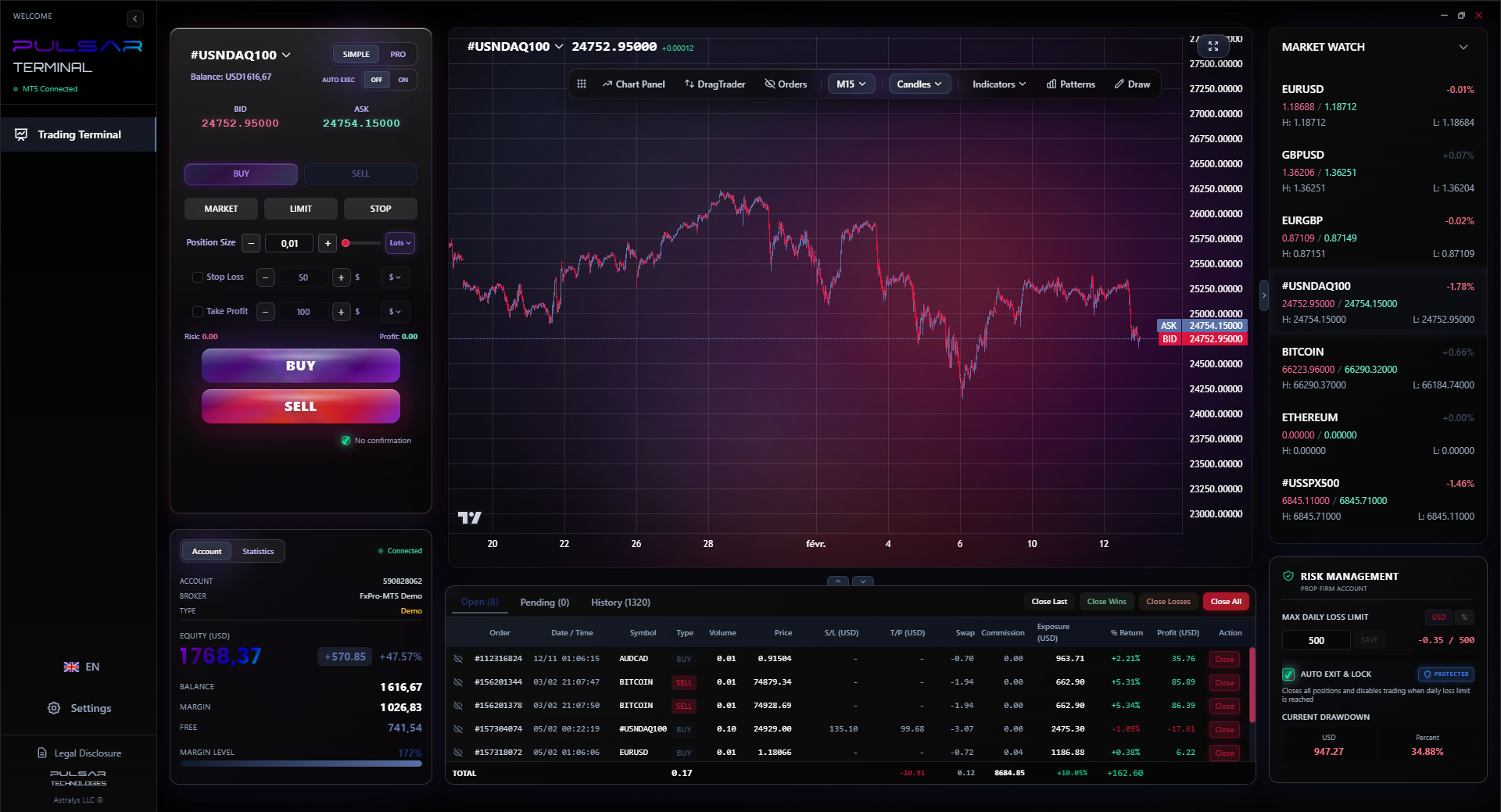
Your equity isn't just a number to watch; it should be the foundation of your trading plan.
1. The Equity Milestone System: Don't trade the same way with a ₦500,000 account as you did with ₦200,000. Set milestones. When my equity grew 25% from my starting point, I allowed myself to increase my base position size slightly. When it hit a 50% increase, I withdrew my initial capital. Now I'm only trading with profits. This psychologically liberates you.
2. The Equity Drawdown Rule: My main rule: if my equity drops 10% from its highest point (its peak), I go into safety mode. I reduce position sizes by half until I climb back. This prevents me from giving back a month's gains in a reckless week.
3. Scaling In/Out Based on Equity: Some advanced strategies involve adding to a winning position. A sensible way to do this is to only add when the trade is in profit enough that your equity has increased by the amount you plan to risk on the addition. You're using profits to fund further speculation, not core equity.
, answering "what does equity mean in forex trading?" is the first step toward trading like a business owner, not a gambler. It's your company's net worth, updated by the second. Manage that, and you manage your future in this market.
FAQ
Q1Is equity the same as my profit?
No. Your profit or loss is the change in your equity from one point to another. If you start with ₦1,000,000 equity and end the month with ₦1,150,000 equity, your profit is ₦150,000. Equity is the total value at any single moment.
Q2Why did my broker close my trade when I still had money in my balance?
Because your equity, not your balance, hit the broker's stop-out level. Your balance included old profits, but your current open losses dragged your equity down too far. They close trades to prevent your equity from going negative (you owing them money).
Q3Should I base my position size on my balance or my equity?
Always on your current equity. Your balance is outdated information if you have open trades. Using equity for your position size calculator ensures your risk adjusts to your present financial reality, protecting you during drawdowns.
Q4How often should I check my equity?
Constantly when you have open positions. It's your vital sign. At a minimum, you must know your equity before opening any new trade. A daily check of your closing equity to track your progress is also essential.
Q5Can my equity ever be higher than my balance?
Yes, absolutely. This happens when you have open trades that are in profit. For example, a ₦500,000 balance with ₦80,000 in floating profit gives you an equity of ₦580,000. Enjoy it, but remember it can change fast.
Q6Do swap fees and commissions affect equity?
Yes. Commissions are deducted from your balance immediately when a trade opens/closes, directly reducing equity. Swap fees are applied to your balance daily at rollover, which changes the equity for the next trading session.
Q7What's a good margin level percentage to maintain?
There's no perfect number, but I get nervous below 200%. A margin level of 100% means your equity equals your used margin - you have zero free margin. Most broker stop-outs happen between 20% and 50%. Staying above 200% gives you a healthy buffer against market moves.
Prof. Winstons Lektion
Wichtige Erkenntnisse:
- ✓Equity = Balance + Floating P/L. Memorize it.
- ✓Risk a maximum of 1% of current equity per trade.
- ✓Brokers liquidate based on equity, not balance.
- ✓Prop firm daily loss rules use starting equity.
- ✓Your free margin and buying power depend on equity.
Wie nützlich war dieser Artikel?
Klicken Sie auf einen Stern
Wöchentliche Trading-Einblicke
Kostenlose wöchentliche Analysen & Strategien. Kein Spam.
Über den Autor
Olumide Adeyemi
Pionier des Tradings in Westafrika
Einer der aktivsten Forex-Trading-Ausbilder Nigerias. 8 Jahre Trading-Erfahrung aus Lagos. Spezialisiert auf Strategien mit geringem Kapital und Prop-Firm-Challenges für afrikanische Trader.
Kommentare
Risikohinweis
Der Handel mit Finanzinstrumenten birgt erhebliche Risiken und ist möglicherweise nicht für alle Anleger geeignet. Vergangene Ergebnisse garantieren keine zukünftigen Renditen. Dieser Inhalt dient ausschließlich Bildungszwecken und stellt keine Anlageberatung dar. Führen Sie immer Ihre eigene Recherche durch, bevor Sie handeln.
Das könnte Sie auch interessieren

Cara Trading Forex Sukses: 7 Prinsip dari Trader Profesional
Cara trading forex sukses dengan 7 prinsip trader pro: manajemen modal, disiplin, journal trading, backtest. Data nyata, bukan janji profit palsu.
Jam Trading Forex Terbaik untuk Trader Indonesia: Panduan Lengkap dengan Tabel Waktu
Panduan jam trading forex untuk trader Indonesia. Tabel 4 sesi dunia, jam emas 20:00-00:00, sesi mana yang harus dihindari. Data akurat + tips dari trader berpengalaman.
Top 5 Sàn Forex Uy Tín Nhất 2026: Review Jujur dari Trader Indonesia
Top 5 sàn forex uy tín 2026 untuk trader Indonesia. Review jujur: spread, deposit, withdraw, dukungan lokal. Exness, XM, IC Markets & lebih.
Pulsar Terminal herunterladen
Alle diese Rechner sind in Pulsar Terminal mit Echtzeit-Daten Ihres MT5-Kontos integriert.
Pulsar Terminal herunterladen