


Here's a brutal truth most Nigerian trading 'gurus' won't tell you: over 70% of new traders who blow their first account do it because they had no clue what a 'lot' was.

Olumide Adeyemi
Pionier des Tradings in Westafrika ·  Nigeria
☕ 9 Min. Lesezeit
Was Sie lernen werden:
Here's a brutal truth most Nigerian trading 'gurus' won't tell you: over 70% of new traders who blow their first account do it because they had no clue what a 'lot' was. They just clicked buttons. They see a signal, they slap on a trade size that feels right, and then watch in horror as a 50-pip move against them wipes out a month's salary. Understanding what is a lot in forex trading isn't just theory, it's the difference between being a gambler and being a trader. It's the single most important control you have over your risk, your profit, and your sanity in this market.
Forget the fancy definitions. A lot is simply the size of your trade. It's the amplifier. Think of it like the volume knob on a giant speaker. A tiny turn (a micro lot) and you hear the music. Crank it to max (a standard lot) and you'll blow out the windows. In forex, we trade in standardized contract sizes called lots because quoting every trade as 'I want to buy 123,456.78 units of USD' would be chaos.
Every single pip of movement in your trade is multiplied by your lot size to determine your profit or loss. Get this wrong, and you're finished before you start. I learned this the hard way back in 2012. I funded my first live account with 150,000 Naira (about $1,000 back then). I'd been practicing on a demo where the 'money' felt fake. My first live trade? I went long GBP/USD with what I thought was a mini lot (10k units). I'd misread the platform. I'd actually entered a standard lot (100k units). A 20-pip move against me cost me over $200. My heart sank into my stomach. That was 20% of my account, gone in minutes because I didn't understand the instrument I was using.
The core concept is this: Your lot size directly controls your financial exposure. It's the bridge between your analysis ("I think price will go up") and your real-world consequence ("and here's exactly how much I win or lose per pip").

💡 Winstons Tipp
Your first trading rule: Never let a single trade's loss exceed what you can earn back in one good day of your day job. That keeps the fear manageable.
“Understanding what is a lot in forex trading isn't just theory, it's the difference between being a gambler and being a trader.”
Brokers break lot sizes down into four main categories. Your choice here is your first major risk management decision.
The Standard Lot (The Big Boy)
This is the classic, full-sized contract. 1 standard lot = 100,000 units of the base currency. For pairs where the USD is quoted second (like EUR/USD), the pip value is usually around $10. That means if you buy 1 lot of EUR/USD at 1.0800 and it moves to 1.0810, you've made 10 pips * $10 = $100. The reverse is also brutally true. This is for seasoned traders with significant capital. Most Nigerians starting out have no business here.
The Mini Lot (The Starter Pack)
1 mini lot = 10,000 units. This cuts the risk by 90%. Pip value is roughly $1. It's a fantastic stepping stone. You can get meaningful feedback on your trades without insane volatility in your account balance. If you're trading with a few hundred dollars, this should be your default 'full position' size.
The Micro Lot (The Risk Manager's Best Friend)
1 micro lot = 1,000 units. Pip value is about $0.10. This is where smart trading begins for most people. It allows for incredible precision in position size calculator. Want to risk exactly 1.5% of your $500 account on a trade with a 30-pip stop loss? You'll likely end up with a micro lot size. I use micro lots to this day for testing new strategies or trading during high-volatility news events.
The Nano Lot (The Psychological Saver)
1 nano lot = 100 units. Pip value is about $0.01. Some brokers offer these, some don't. They're perfect for absolute beginners who need to remove the fear of loss completely to focus on learning. Or, for fine-tuning a massive, complex position.

Example: Let's say you have a 50,000 Naira account (roughly $33). Trading a standard lot on EUR/USD is suicide. A 10-pip loss would be about $100, wiping you out 3 times over. A mini lot? A 10-pip loss is $10 (about 15% of your account). A micro lot? A 10-pip loss is $1 (about 1.5%). The micro lot lets you survive to trade another day.
“Your lot size directly controls your financial exposure. It's the bridge between your analysis and your real-world consequence.”
This is the math you must internalize. Your profit/loss = (Pips Gained or Lost) x (Pip Value). Your Pip Value is determined by your lot size and the currency pair.
The general formula for a USD-quoted pair (where USD is the quote currency, like EUR/USD, GBP/USD):
- Standard Lot: Pip Value ≈ $10
- Mini Lot: Pip Value ≈ $1
- Micro Lot: Pip Value ≈ $0.10
- Nano Lot: Pip Value ≈ $0.01
For pairs where USD is the base currency (like USD/JPY, USD/CAD), the calculation is slightly different because the pip value is in the quote currency. You then have to convert it to your account currency (often USD). Most platforms do this for you, but you should know why.
Where this gets critical for us in Nigeria is with exotic pairs involving the Naira. Say you're trading USD/NGN (if your broker offers it). The volatility is different, the pip is often a different decimal place, and the value can be shocking. A 10-pip move on a mini lot of USD/NGN won't be $1. You must check your platform's order window or use a calculator before entering. Never assume.

Warning: The biggest mistake I see is traders using the same lot size for every pair. A standard lot on EUR/USD is risky. A standard lot on XAU/USD (gold) can be catastrophic, as the pip value is often much higher. Always, always check the estimated profit/loss in your order ticket.
“If you're funding your account with 100,000 Naira, you are a micro/nano lot trader. Full stop.”
This isn't about greed, it's about survival. Your lot size should be a cold, calculated output, not a feeling.
1. Start with Your Risk Per Trade. This is non-negotiable. Most professional risk managers suggest risking 1-2% of your trading capital on any single trade. Let's do the math with a Nigerian example.
- Account Balance: 300,000 Naira (approx $200)
- Risk Per Trade (1.5%): 4,500 Naira (approx $3)
- Trade Setup: You want to buy USD/JPY. Your stop loss is 25 pips away from your entry.
- Calculation: ($3 total risk) / (25 pips) = $0.12 risk per pip.
- Result: You need a lot size where the pip value is $0.12. A micro lot ($0.10) is slightly under, a mini lot ($1.00) is 8 times too big! You might use 1.2 micro lots. This is where a good position size calculator is worth its weight in gold.
2. Be Brutally Honest About Your Account Size. If you're funding your account with 100,000 Naira, you are a micro/nano lot trader. Full stop. Trying to force mini lots will lead to emotional decisions and a blown account. I've been there. The pressure is immense.
3. Consider Your Broker's Offerings. Not all brokers offer nano or even micro lots on all account types. This is a key factor in choosing who to trade with. Some ECN brokers offer ultra-small minimum trade sizes, which is great for starters. Others with pro accounts might have higher minimums.
4. The Strategy Matters. A scalping strategy with 5-pip targets might use a larger lot size (within risk limits) to make the profit meaningful. A swing trading strategy holding for days with a 100-pip stop will need a much smaller lot size to keep risk contained.
💡 Winstons Tipp
If you feel your heart thumping when you click 'buy' or 'sell', your lot size is too big. Scale down until the click feels clinical.
“If you're funding your account with 100,000 Naira, you are a micro/nano lot trader. Full stop.”
I've made these. My friends have made these. Let's save you the pain.
Mistake 1: The 'Demo-to-Live' Shock. You practice on a demo with $50,000 virtual money, trading 2 standard lots like a king. You go live with 200,000 Naira and subconsciously keep the same size. The psychological and financial impact is not the same. Scale down proportionally.
Mistake 2: Overleveraging via Lot Size. use gets all the bad press, but lot size is how you activate that use. A 500:1 use is meaningless if you trade 0.01 lots. The danger is using high use and huge lot sizes. This is a guaranteed margin call recipe. Your broker's margin call is a mechanical process, it doesn't care about your 'conviction' in the trade.
Mistake 3: Increasing Lot Size to Recover Losses. This is the devil on every trader's shoulder. You lose 5,000 Naira on a micro lot. The voice says, "Just use a mini lot on the next trade to get it back fast." This is the express lane to ruin. Your lot size should be determined by your current account balance and your risk rules, not your P&L from last trade.
Mistake 4: Ignoring the Spread Cost. On a micro lot, a 1.5 pip spread costs you $0.15. On a standard lot, that same spread costs $15. If you're a scalper entering and exiting frequently, trading standard lots means you need to overcome $30 in spreads just to break even on a round trip. That's a huge hurdle. Smaller lot sizes make the cost of doing business much clearer and less painful.
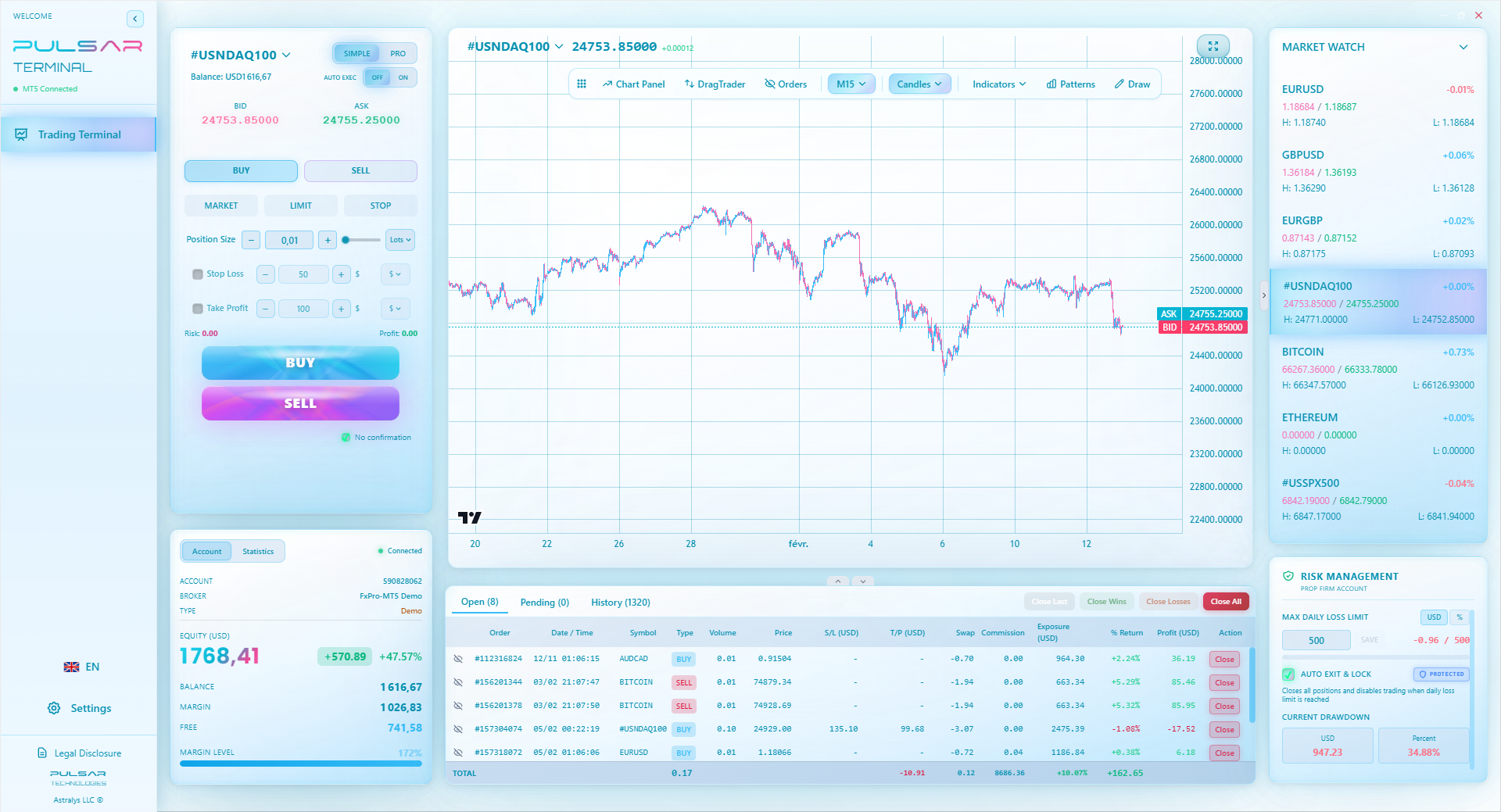
Manually calculating lot sizes for every trade is a chore; Pulsar Terminal's drag-and-drop order entry lets you visualize risk and set precise lot sizes directly on your MT5 chart.
Pulsar Terminal
Das All-in-One MT5-Tool: Drag-and-Drop-Orders, Multi-TP/SL, Trailing Stop, Grid Trading, Volume Profile und Prop-Firm-Schutz. Täglich von 1.000+ Tradern genutzt.
“Mastering lot size is boring. It's unsexy. But it's the skill that keeps you in the game.”
- Open Your Platform. Don't even think about trading. Go to the order entry window for EUR/USD. Change the lot size from 1.00 (standard) to 0.10 (mini) to 0.01 (micro). Watch how the "Estimated Profit/Loss" for a 10 pip move changes dramatically. This is your lightbulb moment.
- Calculate Your True Risk. Take your real account balance. Decide on a fixed risk percentage (I recommend 1% while learning). Use that number, your planned stop loss in pips, and work backwards to find your max lot size for your next trade.
- Review Your Last 5 Trades. Look at the lot sizes you used. Did you choose them deliberately based on risk? Or were they random? Be honest. This review is more valuable than any indicator.
- Pick a Broker That Fits. If you're trading small, ensure your broker allows micro lots and has reasonable minimum deposits. Some brokers like Exness or XM are popular here partly because they cater to smaller account sizes.
Mastering lot size is the foundation of everything. It turns you from someone hoping the market goes your way, into a manager of calculated outcomes. It's boring. It's unsexy. But it's the skill that keeps you in the game long enough to learn all the other sexy stuff.
FAQ
Q1What lot size should a beginner in Nigeria start with?
Start with micro lots (0.01). No debate. With a typical starter account of 50,000-200,000 Naira, a micro lot lets you practice real risk management, feel the emotions of real profit and loss, and survive your inevitable mistakes without catastrophic damage. It's the single best piece of advice for longevity.
Q2How many micro lots are in a standard lot?
There are 100 micro lots in one standard lot. Since a standard lot is 100,000 units and a micro lot is 1,000 units, the math is simple: 100,000 / 1,000 = 100. This also means the pip value of a standard lot is 100 times greater than a micro lot.
Q3Does lot size affect use?
They work together. use is the loan your broker gives you (like 100:1). Lot size is how much of that loan you actually use. High use allows you to open a huge lot size with little margin, but it doesn't force you to. You can have 500:1 use and still trade 0.01 lots. The danger is using high use to justify a lot size your account can't stomach.
Q4How do I calculate the lot size based on my stop loss?
Use this formula: (Account Balance x Risk %) / (Stop Loss in Pips x Pip Value per Standard Lot). Then convert to your desired lot type. Better yet, use an online position size calculator. You input your account balance in USD or Naira, your risk percentage, your stop loss in pips, and the pair. It spits out the exact lot size you should use. Do this for every trade.
Q5Are there brokers that offer nano lots for Nigerian traders?
Yes, several international brokers that accept Nigerian clients offer nano lots (0.001) or volume in units, allowing you to trade as little as 100 units of currency. This is often available on their standard or cent accounts. Always check the specifications of the specific account type before you fund it.
Q6If I have a small account, should I just use a bigger lot size to make more profit?
This is the most tempting and destructive thought. No. Using a bigger lot size on a small account doesn't increase your chance of profit, it only increases the volatility of your results. You might win big once, but a single loss will wipe you out. Consistent growth comes from compounding small, controlled gains, not gambling on home runs.
Prof. Winstons Lektion
Wichtige Erkenntnisse:
- ✓A standard lot (1.0) is 100,000 currency units.
- ✓Start with micro lots (0.01) to learn risk management.
- ✓Never risk more than 2% of your account on one trade.
- ✓Your lot size should be calculated, not guessed.
Wie nützlich war dieser Artikel?
Klicken Sie auf einen Stern
Wöchentliche Trading-Einblicke
Kostenlose wöchentliche Analysen & Strategien. Kein Spam.
Über den Autor
Olumide Adeyemi
Pionier des Tradings in Westafrika
Einer der aktivsten Forex-Trading-Ausbilder Nigerias. 8 Jahre Trading-Erfahrung aus Lagos. Spezialisiert auf Strategien mit geringem Kapital und Prop-Firm-Challenges für afrikanische Trader.
Kommentare
Risikohinweis
Der Handel mit Finanzinstrumenten birgt erhebliche Risiken und ist möglicherweise nicht für alle Anleger geeignet. Vergangene Ergebnisse garantieren keine zukünftigen Renditen. Dieser Inhalt dient ausschließlich Bildungszwecken und stellt keine Anlageberatung dar. Führen Sie immer Ihre eigene Recherche durch, bevor Sie handeln.
Das könnte Sie auch interessieren

Cara Trading Forex Sukses: 7 Prinsip dari Trader Profesional
Cara trading forex sukses dengan 7 prinsip trader pro: manajemen modal, disiplin, journal trading, backtest. Data nyata, bukan janji profit palsu.
Jam Trading Forex Terbaik untuk Trader Indonesia: Panduan Lengkap dengan Tabel Waktu
Panduan jam trading forex untuk trader Indonesia. Tabel 4 sesi dunia, jam emas 20:00-00:00, sesi mana yang harus dihindari. Data akurat + tips dari trader berpengalaman.
Top 5 Sàn Forex Uy Tín Nhất 2026: Review Jujur dari Trader Indonesia
Top 5 sàn forex uy tín 2026 untuk trader Indonesia. Review jujur: spread, deposit, withdraw, dukungan lokal. Exness, XM, IC Markets & lebih.
Pulsar Terminal herunterladen
Alle diese Rechner sind in Pulsar Terminal mit Echtzeit-Daten Ihres MT5-Kontos integriert.
Pulsar Terminal herunterladen