


I remember staring at my screen in 2018, watching the USD/ZAR rip higher after a surprise SARB statement.

David van der Merwe
Schwellenland-Trader ·  South Africa
☕ 13 Min. Lesezeit
Was Sie lernen werden:
- 1Credit, Margin, use: Untangling the Jargon Jungle
- 2How Forex Credit Actually Works for a South African Trader
- 3The FSCA Rules: Your Safety Net (Sort Of)
- 4The Real Costs of Using Credit (It's Not Free)
- 5How to Use Credit Smartly: A Strategy for the SA Market
- 6Pitfalls I've Fallen Into (So You Don't Have To)
- 7Choosing a Broker: What to Look for in Credit Terms
- 8The Final Verdict: Is Using Credit Worth It?
I remember staring at my screen in 2018, watching the USD/ZAR rip higher after a surprise SARB statement. My account had R5,000 in it. Using the 'credit' my broker offered, I'd opened a position worth R500,000. For a few glorious hours, I was up R12,000. Then the tide turned. I learned, the hard way, that credit in forex isn't free money - it's a double-edged sword that can make or break you faster than load-shedding hits in mid-winter. Let's break down what this 'credit' really is, how it works under South Africa's FSCA rules, and how to handle it without getting your fingers burnt.
Right, let's clear this up first because even seasoned guys get it twisted. People throw these terms around like they're the same thing. They're not.
Credit is the actual loan. It's the extra buying power your broker fronts you. Think of it like a bank approving you for a R1 million home loan. That approved amount is your credit facility.
Margin is your skin in the game. It's the cash you must put down from your own pocket to open and hold that trade. Using the home loan analogy, it's your deposit. If your broker offers 1:100 use and you want to trade one standard lot of USD/ZAR (that's 100,000 units), the margin required might be around $1,000 (or roughly R18,000, depending on the rate).
use is the multiplier. It's the ratio (like 1:50, 1:100, 1:500) that determines how much credit you get relative to your margin. 1:100 use means for every R1 of your money, the broker lends you R99.
Here’s the kicker: when you see a broker ad shouting 'Get 70% Trading Credit on your deposit!' that's a different animal. That's often a non-withdrawable bonus they add to your equity. Sounds great, but there's always a catch. Usually, you can't use it to cover a loss. If your equity drops to the value of that credit, poof, it vanishes. I once got lured by a R7,000 credit on a R10,000 deposit. Felt like a king until a bad EUR/USD trade evaporated my real money, and the 'credit' got yanked before I could even blink. It's a marketing tool, not a safety net.

Warning: That 'free trading credit' bonus? Read the terms. If it says 'cannot be used in a drawdown situation,' it means the second your real money is gone, so is their 'gift.' It's there to let you open bigger positions, not to save you from a margin call.
So you've funded your account with, say, R10,000. You log into your MT5 platform from your flat in Sandton or your home in Durban. You pick a broker like IC Markets or Pepperstone, both FSCA-regulated. You set your account use to 1:100 (common for major pairs).
Now you want to buy 1 standard lot of EUR/USD. The full value of that position is $100,000. Without credit, you'd need the full $100,000 in your account. With 1:100 use, you only need 1% as margin: $1,000.
Your R10,000 (about $530) is more than enough to cover that $1,000 margin. The broker effectively lends you the remaining $99,000. That's the credit.
The Nuts and Bolts of the Loan
This isn't a formal loan with a contract. It's a facility that exists only for the life of the trade. You don't pay interest on it directly. The cost is baked into other things:
- The Spread: You pay this on the full, leveraged position size. On $100,000, even a 1-pip spread costs you $10.
- The Swap: If you hold the trade overnight, you pay or receive interest on the full borrowed amount. This is where those overnight financing charges come from.
Your broker's number one job is to make sure you can cover potential losses. If your trade moves against you and your equity (account balance + floating P/L) gets too close to the required margin, they'll issue a margin call. If you don't top up, they close your trades to protect their credit. Their money comes first, always.

Example: You deposit R20,000 (~$1,060). With 1:100 use, you have roughly $106,000 in buying power (credit + your capital). You use $1,000 margin to open that 1-lot EUR/USD trade. If EUR/USD falls 100 pips, you lose $1,000. That's a 50% loss on your R20,000 deposit. That's the power - and danger - of using their credit.

💡 Winstons Tipp
use is a magnifying glass. It makes your good decisions brilliant and your bad decisions catastrophic. Always know which one you're looking at before you turn it on.
“The moment you start thinking of credit as 'power' instead of 'responsibility,' you've already lost.”
In South Africa, we have the Financial Sector Conduct Authority (FSCA). They're the guys who replaced the FSB. Trading with an FSCA-licensed broker isn't just a good idea; it's your main line of defence against outright scams.
Here’s what their regulation means for credit and use:
- They Force Broker Responsibility: FSCA-regulated brokers must maintain sufficient capital themselves. They can't just be a bucket shop operating from a garage in Randburg. They have to keep client funds in segregated accounts. This means if the broker goes belly-up (it happens), your money is separate from their operating funds. Your credit facility disappears, but your deposit should be safer.
- They Don't Cap use (for professionals): Unlike Europe or the US, the FSCA hasn't slapped a hard retail use cap of 1:30 or 1:50 on everyone. They use a tiered system. For retail clients, use might be lower. But if you qualify as a professional client (based on experience, portfolio size, etc.), you can often access higher use like 1:200 or 1:500. This is a double-edged sword. More rope to climb, or more rope to hang yourself.
- They Enforce Fair Terms: Those tricky 'trading credit' bonuses? The FSCA requires brokers to make the terms clear. No hidden clauses that snatch the credit away unfairly (though 'fairly' is still debatable).
My strong opinion? Always verify the FSCA license number on the broker's website and cross-check it on the FSCA's own database. If you're considering an offshore broker like Exness or XM, check if they have a local FSCA entity. If they don't, you're on your own. When things go wrong, trying to get help from a regulator in Cyprus or the Seychelles is a nightmare. I've been there, sending emails into the void. Stick with FSCA-regulated brokers for your main account.

Pro Tip: Before you get excited about high use, use a position size calculator. Input your account balance (in Rands), your risk percentage (e.g., 1%), and your stop-loss distance. It will tell you the correct lot size. This single tool does more to manage credit risk than any regulator ever could.
Brokers aren't charities. They lend you that credit because they make money from your trading activity. Here’s where it comes from in the South African context:
| Cost | What It Is | Typical South African Impact |
|---|---|---|
| Spread | Difference between buy/sell price. Your first cost. | On USD/ZAR, expect 8-15 pips on a standard account. On a 1-lot trade, that's R80-R150 gone before you even start. |
| Commission | Fee per lot traded. Common on ECN/RAW accounts. | Around $7 per 100k lot (R130). Often paired with super-tight spreads (0.1 pip). |
| Overnight Swap | Interest for holding a position past 10pm GMT. | Can be huge on ZAR pairs. Holding a short USD/ZAR position might pay you R150 per lot nightly. Holding a long might cost you R200. It adds up. |
| Currency Conversion | Cost to change your ZAR to USD/EUR for trading. | If your account is in USD, funding with Rands costs ~1% at your bank AND at the broker. That's R100 lost on a R10,000 deposit immediately. |
| Inactivity Fee | Penalty for not trading. | Usually $10/R180 per month after 3-12 months of no activity. A tax on hesitation. |
The biggest hidden cost? Psychological pressure. Controlling R500,000 with R10,000 of your own money makes every pip movement feel massive. You make emotional decisions. You move stop-losses. That's where the real account damage happens. I've seen more accounts blown from panic during volatility (like during a SARB announcement) than from slow, steady losses. Using credit amplifies your emotions as much as your potential profit.
💡 Winstons Tipp
The FSCA protects you from fraud, not from yourself. Their license means the broker is probably legitimate, not that their credit terms are wise for you.
“Your trading plan must include rules for losing. What's your max daily loss? When do you walk away? The credit available is not an invitation to use it all.”
Okay, so credit is dangerous but necessary. How do we use it without self-destructing? Forget the get-rich-quick stuff. This is about survival and steady growth.
1. Match use to Your Strategy:
- Scalping: You're in and out for 5-10 pips. You might use higher use (1:100) on small positions to make those pips meaningful. But your stop-loss is tight. This is advanced and stressful. I don't recommend scalping for beginners, period.
- Swing Trading: This is where most successful retail traders live. You hold trades for days or weeks, aiming for 100-300 pip moves. Here, use lower use. I never use more than 1:30 for swing trading. Why? It gives the trade room to breathe. A 50-pip drawdown on a 1:30 leveraged position is uncomfortable but manageable. On 1:100, it's a crisis.
2. The ZAR-Specific Play: Trading USD/ZAR or EUR/ZAR? These are exotic pairs. They're less liquid and have wider spreads. Using high use on them is suicidal. The spread alone can wipe out your margin on a small move. If you trade ZAR pairs, cut your normal position size in half. Seriously.
3. Risk Management is Non-Negotiable: This is the golden rule. Before you even think about entry, know your exit.
- Never risk more than 1-2% of your account on a single trade. On a R20,000 account, that's R200-R400 max loss.
- Always use a stop-loss. And don't move it unless you have a strategic reason, not an emotional one.
- Use tools to lock in profits. A trailing stop can help you ride a trend without giving back all your gains. Setting multiple take-profit levels lets you bank some profit early.
Here's a real example from last year on Gold (XAU/USD). I bought at $1,820 with a 1:50 use position. My stop was at $1,800 (risk: 1.5% of account). I set three take-profits at $1,840, $1,850, and let a trailing stop run from $1,845. I banked partial profits along the way and the trail caught the rest at $1,868. I used credit to get in, but my risk rules dictated the size, not my greed.
For more on trading gold, our XAU/USD guide covers the specifics.
Let me be brutally honest about my own screw-ups. You'll learn more from these than from any winning trade story.
Mistake 1: Overleveraging on 'Sure Things.' It was 2021. Everyone was convinced the EUR was going to collapse. The MACD indicator was bearish, news was bad. I used 1:200 use on a short EUR/USD trade, committing 40% of my margin. It was a 'no-brainer.' The trade went my way for 20 pips, then reversed hard. I was in a margin call within hours, facing a 35% account loss. The 'sure thing' didn't exist. The market doesn't care about your convictions.
Mistake 2: Ignoring Swap Rates on ZAR Trades. I went long USD/ZAR, expecting Rand weakness. I was right on direction for a week, making a few hundred Rands. But the daily swap cost for holding that long position was about R180 per lot. After 7 days, I'd paid R1,260 in swaps. My profit was R1,500. My 'winning' trade netted me R240 before spreads. I was basically working for the broker.
Mistake 3: Chasing Losses with More Credit. A losing day hurts. The instinct is to 'get it back' by doubling down, using the remaining credit to open a bigger position. This is the fastest known path to a zero balance. I did it in 2019. Lost R2k on a bad GBP trade. In a rage, I opened a position three times the size on the same pair. Lost another R6k in 15 minutes. I had to walk away from my desk for a week. The credit facility is not a recovery tool. It's a risk amplifier.
The lesson? Your trading plan must include rules for losing. What's your max daily loss? When do you walk away? Write it down. Stick to it. The credit available to you is not an invitation to use it all.
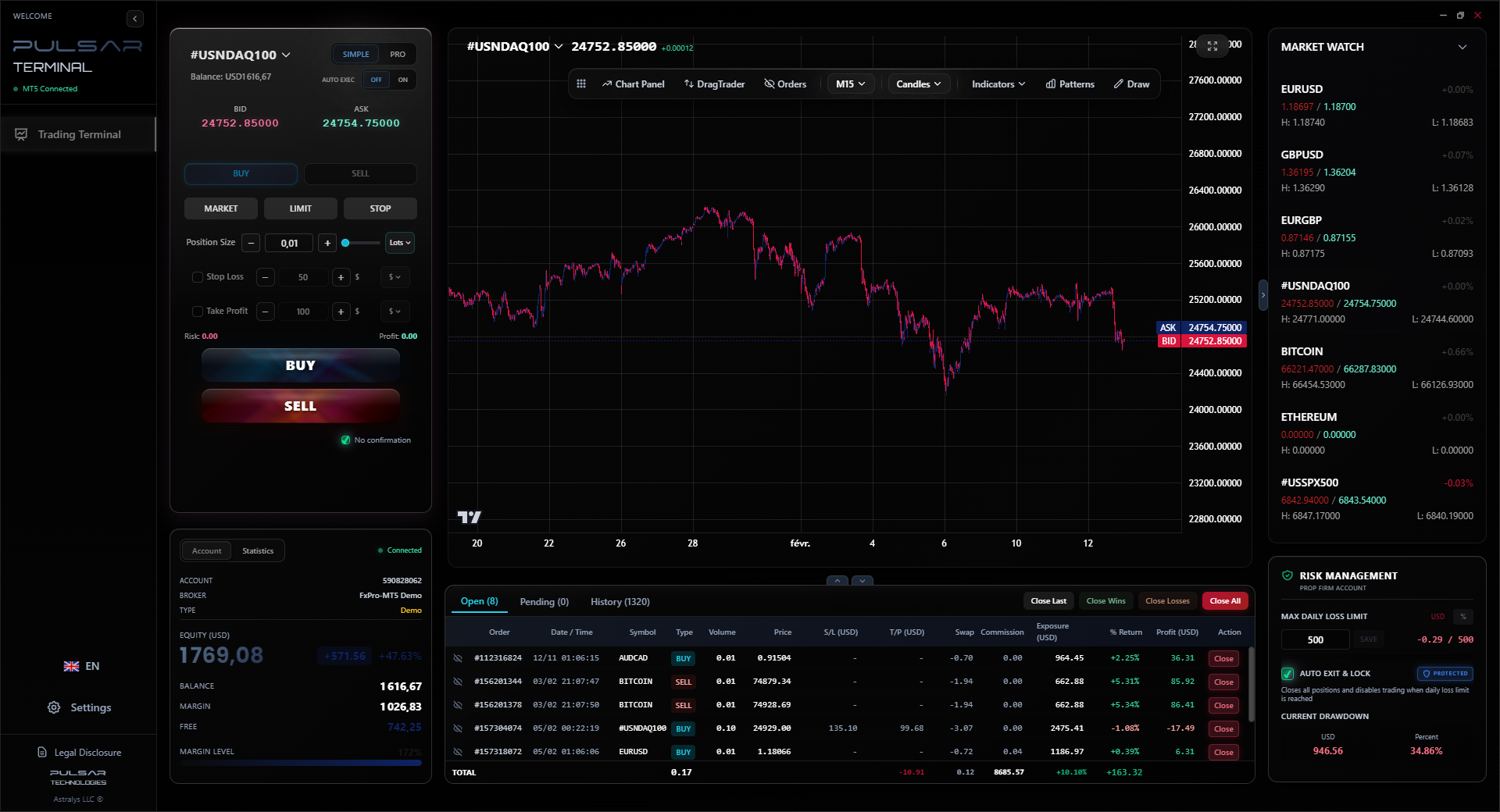
Managing the risk that comes with high leverage requires precision tools; Pulsar Terminal's drag-and-drop orders and automated trailing stops on MT5 help you execute your exit strategy without emotional interference.
Pulsar Terminal
Das All-in-One MT5-Tool: Drag-and-Drop-Orders, Multi-TP/SL, Trailing Stop, Grid Trading, Volume Profile und Prop-Firm-Schutz. Täglich von 1.000+ Tradern genutzt.
“The goal isn't to use all the credit they offer you. The goal is to use the smallest amount necessary to execute your strategy.”
Not all credit facilities are created equal. When you're comparing FSCA-regulated brokers, look past the shiny use number.
1. Understand Their Margin Call Policy: At what percentage of margin used will they issue a warning (Margin Call Level)? At what point do they start automatically closing positions (Stop Out Level)? This is critical.
- Good: Stop Out at 50%. This means if your equity falls to 50% of your used margin, they close the worst-performing trade to free up margin. It gives you a fighting chance.
- Bad: Stop Out at 100% or 20%. At 100%, they close everything the second you hit zero, often at terrible prices due to slippage. At 20%, they're very aggressive and can close trades on minor volatility.
2. Check the Fine Print on 'Free Credit' Bonuses: If a deposit bonus sounds too good to be true, it is. Ask: Can I withdraw the bonus? (No). Does it increase my margin? (Maybe). What are the trading volume requirements to 'release' it? (Often massive). I treat these as irrelevant. Focus on the core offering: spreads, commissions, execution speed.
3. Platform and Tools: You're going to be managing this leveraged risk on a platform. MT4/MT5 are industry standards. But managing multiple take-profits, trailing stops, and partial closures on vanilla MT5 is clunky. You need precision when using high use. Tools that let you drag and drop orders, set a breakeven point automatically, or manage a grid of orders can be the difference between a controlled win and a messy loss.
Brokers like IC Markets and Pepperstone offer great raw spreads. But your ability to manage the risk that comes with their credit depends heavily on your own tools and discipline. For mastering the core pairs you'll likely trade, our EUR/USD guide is a solid starting point.
💡 Winstons Tipp
If you feel a thrill when you see your potential profit on a leveraged trade, you're over-leveraged. Trading should feel boring and procedural, not like a casino.
Yes, but only if you redefine 'worth it.'
Credit (via use) is not a tool for turning R5,000 into R500,000. That's lottery thinking, and the market will punish it every single time.
Credit is a tool for efficiency. It allows a disciplined trader with R50,000 to gain meaningful exposure to the forex market without needing R5 million in capital. It lets you diversify across a few pairs while keeping your risk per trade small in absolute Rands.
For the South African trader, with a volatile Rand and often limited starting capital, it's practically a necessity to access majors like EUR/USD. But the moment you start thinking of it as 'power' instead of 'responsibility,' you've already lost.
Start low. Use 1:10 or 1:20 use. Get used to the psychology of seeing your equity fluctuate in Rand terms. Practice with a strict 1% risk rule using a position size calculator. Once that feels boring and mechanical - once you're more focused on your RSI indicator readings than your P/L in Rands - then you can consider gradually increasing your use within a strict, written plan.
Remember, the goal isn't to use all the credit they offer you. The goal is to use the smallest amount necessary to execute your strategy effectively, and to always, always live to trade another day. In a country with enough economic volatility already, don't add to it with your trading account.
FAQ
Q1Is forex credit the same as a loan from a bank?
No, not at all. A bank loan gives you cash to spend. Forex credit is a temporary facility that only exists to hold a specific trading position. You can't withdraw it. The moment you close the trade, the credit vanishes. It's a performance-based loan for one purpose only.
Q2What's the maximum use I can get in South Africa?
There's no universal FSCA cap for all clients. For retail traders, brokers often offer up to 1:500 on certain instruments for professional clients who qualify. However, most major FSCA-regulated brokers will offer 1:100 to 1:200 as standard for retail traders on major pairs. Never choose a broker based on the highest use alone.
Q3Do I pay interest on the credit from my broker?
Not as a separate line item, no. The cost is embedded in the swap/rollover rate if you hold a position overnight, and they make money from the spread on your trades. Think of it as the broker's fee for providing you with the trading facility.
Q4Can I lose more money than I deposit using credit?
With a standard retail account at an FSCA-regulated broker, you generally cannot. Your maximum loss is limited to the funds in your trading account due to forced liquidation (stop out). However, in extreme market gaps (like a major news event), it's theoretically possible to slip into a negative balance. Reputable brokers often have negative balance protection to prevent this.
Q5Is trading with a credit bonus a good idea for beginners?
Almost never. These bonuses come with complex terms that tie up your funds and often require you to trade a huge volume before you can withdraw anything. They distract you from learning proper risk management. Focus on finding a broker with low spreads and reliable execution, not the biggest bonus.
Q6How does credit affect my tax in South Africa?
SARS taxes your net profit (profit minus losses, minus allowable expenses). The credit itself isn't taxable because it's not income. However, the profits you make using that leveraged capital are fully taxable as income. Keep careful records of all your trades, including spreads and commissions, as these are deductible expenses.
Q7What happens to my open positions if the broker cancels my credit facility?
If your equity falls to or below the level of a 'trading credit bonus,' that bonus may be cancelled. This reduction in your equity can instantly push your margin usage too high, triggering immediate closure of some or all of your positions by the broker to maintain their margin requirements.
Prof. Winstons Lektion
Wichtige Erkenntnisse:
- ✓Credit is a temporary loan for trading, not withdrawable cash.
- ✓use of 1:100 turns a R10,000 deposit into R1,000,000 of market exposure.
- ✓Never risk more than 1-2% of your capital on a single trade.
- ✓FSCA regulation protects your deposit, not your trading decisions.
- ✓The real cost of credit is in spreads, swaps, and emotional pressure.
Wie nützlich war dieser Artikel?
Klicken Sie auf einen Stern
Wöchentliche Trading-Einblicke
Kostenlose wöchentliche Analysen & Strategien. Kein Spam.
Über den Autor
David van der Merwe
Schwellenland-Trader
In Johannesburg ansässiger Trader mit 11 Jahren Erfahrung in Schwellenländerwährungen. Spezialisiert auf ZAR-Paare, FSCA-regulierten Handel und Analyse des südafrikanischen Marktes.
Kommentare
Risikohinweis
Der Handel mit Finanzinstrumenten birgt erhebliche Risiken und ist möglicherweise nicht für alle Anleger geeignet. Vergangene Ergebnisse garantieren keine zukünftigen Renditen. Dieser Inhalt dient ausschließlich Bildungszwecken und stellt keine Anlageberatung dar. Führen Sie immer Ihre eigene Recherche durch, bevor Sie handeln.
Das könnte Sie auch interessieren

Cara Trading Forex Sukses: 7 Prinsip dari Trader Profesional
Cara trading forex sukses dengan 7 prinsip trader pro: manajemen modal, disiplin, journal trading, backtest. Data nyata, bukan janji profit palsu.
Jam Trading Forex Terbaik untuk Trader Indonesia: Panduan Lengkap dengan Tabel Waktu
Panduan jam trading forex untuk trader Indonesia. Tabel 4 sesi dunia, jam emas 20:00-00:00, sesi mana yang harus dihindari. Data akurat + tips dari trader berpengalaman.
Top 5 Sàn Forex Uy Tín Nhất 2026: Review Jujur dari Trader Indonesia
Top 5 sàn forex uy tín 2026 untuk trader Indonesia. Review jujur: spread, deposit, withdraw, dukungan lokal. Exness, XM, IC Markets & lebih.
Pulsar Terminal herunterladen
Alle diese Rechner sind in Pulsar Terminal mit Echtzeit-Daten Ihres MT5-Kontos integriert.
Pulsar Terminal herunterladen