


I remember staring at my screen in 2019, watching my account bleed.

Olumide Adeyemi
Pionier des Tradings in Westafrika ·  Nigeria
☕ 11 Min. Lesezeit
Was Sie lernen werden:
- 1The Absolute Basics: Long, Short, and Size
- 2Opening and Closing: It's Not Just a Click
- 3Position Types and Trading Strategies
- 4Risk Management: The Nigerian Context is Everything
- 5The Real Costs: What You Actually Pay
- 6Nigerian Realities: Payments, Platforms, and Patience
- 7Mistakes I've Made (So You Don't Have To)
I remember staring at my screen in 2019, watching my account bleed. I had a 'position' on GBP/USD. It was a simple buy order, 0.5 lots. I was up $120 at one point, got greedy, didn't set a stop loss. A news event hit, and before I could react, I was down $780. My entire two-month profit, gone. That loss, more than any win, taught me that understanding what a position in forex truly is - its size, its direction, its inherent risk - is the difference between gambling and trading. For us trading from Nigeria, with our unique challenges, getting this foundation right isn't just helpful, it's survival.
Let's strip it right back. In forex, a position is simply your stake in the market. It's your answer to the question: "What do I think this currency pair will do?" You commit real money to that belief. There are only two directions.
A long position means you're buying. You buy EUR/USD because you believe the Euro will strengthen against the Dollar. You profit if the price goes up. We call it 'going long'.
A short position means you're selling. You sell USD/NGN (if your broker offers it) because you think the Naira will appreciate. You profit if the price goes down. This confused me at first - how do you sell something you don't own? Your broker lends it to you for the trade. It's called 'going short'.
The other half of the equation is size. This is your volume, measured in lots. A standard lot is 100,000 units of the base currency. That's huge for most of us. Thankfully, we have mini lots (0.1 = 10,000 units) and micro lots (0.01 = 1,000 units).
My early mistake? I traded 1.0 standard lots on a $2,000 account because a signal service said to. The volatility alone would wipe out 5% of my account on a normal wiggle. I was over-positioned, plain and simple. I now rarely exceed 0.1 lots unless my account is significantly larger. Your position size is your first and most important risk control. Don't let anyone, not even a profitable mentor, tell you what size to trade. That's a personal calculation based on your capital and pain threshold. I always run my trades through a position size calculator before hitting the button. It removes the emotion.
“Understanding what a position in forex truly is - its size, its direction, its inherent risk - is the difference between gambling and trading.”
Opening a position seems straightforward: click buy or sell. But the how matters more than you think, especially with Nigerian internet speeds. A market order gets you in immediately at the current price. A pending order (like a buy limit or sell stop) sets your entry in advance.
I learned this the hard way trading gold (XAU/USD). I tried to enter with a market order during a major US data release. My click took 3 seconds to register due to lag, and I entered $15 above my intended price. The trade still went my way, but my risk/reward was destroyed before it started. Now, if I'm trading around news, I use pending orders set well in advance.
Closing is where many traders, myself included, struggle psychologically. You can close manually by clicking the 'close' button on your trade. Or, you can use take-profit (TP) and stop-loss (SL) orders to close automatically.
Here's my rule, forged from losses: Never, ever open a position without a stop loss in place. Your stop loss defines the maximum loss for that trade. It's not a suggestion; it's a contract with yourself. The same goes for a take-profit. Deciding your exit points before you enter is the hallmark of a disciplined trader. It stops you from turning a 20-pip loss into a 200-pip disaster because 'it'll come back' (it often doesn't).
The Nigerian Reality Check
Our market volatility can be different. When there's a CBN announcement on Naira rates, pairs like USD/NGN can gap massively. A stop loss won't protect you from a gap if the price jumps right past it. This is why I avoid holding significant positions over major local economic events unless I'm consciously speculating on the outcome.

💡 Winstons Tipp
Your first loss is your best loss. Cut it quickly. A position that's immediately wrong teaches you more than one that waffles.
“Never, ever open a position without a stop loss in place. It's not a suggestion; it's a contract with yourself.”
Not all positions are held for the same reason or duration. Your strategy dictates your position's lifespan.
Scalping: You're in and out in minutes, sometimes seconds. Positions are small, targeting 5-15 pips. It's intense. I tried a scalping strategy for a month. The stress was immense, and spreads ate a huge portion of my tiny profits. On a broker with a 2-pip spread on EUR/USD, you need a 3-pip move just to break even on a scalp. It's tough to do consistently from Lagos with occasional power dips.
Day Trading: You open and close within the same day. No overnight positions. This is my sweet spot. I analyze in the London session, execute, and close before New York closes. It fits a schedule and avoids overnight swap fees (which can be positive or negative).
Swing Trading: You hold for days or weeks, aiming to catch a larger trend. This requires more patience and a larger stop loss. Swing trading suits those who can't watch screens all day. The key is position size - because your stop is wider, your lot size must be smaller to keep the monetary risk the same.
Position Trading: The long game. Holding for months or years based on fundamental economic trends. Honestly, I don't have the capital or patience for this in forex. The rollover costs and margin requirements tie up funds for too long.

Warning: Your strategy must match your personality and lifestyle. Don't try to scalp if you have a full-time job and unreliable internet. You'll lose. I did.
“Never, ever open a position without a stop loss in place. It's not a suggestion; it's a contract with yourself.”
This is the chapter my 2019 self needed. Risk management isn't a generic concept; it's applied specifically to your situation.
1. The 1% Rule (and Why I Use 0.5%): The classic rule is to never risk more than 1% of your account on a single trade. On a $1,000 account, that's $10. Given the volatility and our sometimes-unstable connectivity, I'm stricter. I use a 0.5% rule. So, on that $1,000, my max loss per trade is $5. It forces me to be precise with my entry and stop loss. If my stop is 20 pips away, I can only afford a position size where 20 pips = $5. That keeps me in the game after a few losses.
2. The Naira and Tax Reality: Your profits are in USD, but your life is in Naira. You must factor in the exchange rate when you withdraw. A $500 profit might be NGN 700,000 today and NGN 650,000 next week. More critically, the FIRS wants 10% Capital Gains Tax on your gross annual profit. You have to file this. I set aside 10% of every profitable withdrawal into a separate account. It's not your money; it's the government's. Trying to trade to make up a tax bill is a surefire way to blow your account.
3. Broker Choice is Risk Management: Using an unregulated broker is the biggest risk of all. I only use brokers with top-tier international licenses like the UK's FCA or Australia's ASIC. Why? Because when I had a withdrawal issue with a sketchy broker years ago, I had zero recourse. Now, I stick with well-reviewed entities. You can see detailed breakdowns in our reviews of brokers like IC Markets or XM. Their regulation and reliable withdrawal processes are part of my risk plan.
4. The Margin Call Monster: This is when your broker automatically closes your losing positions because your losses have eaten too much of your deposited funds. It's a death knell. The formula is simple: Used Margin / Equity. If this ratio gets too high (often 100%), you get the call. To avoid it, never use more than 5-10% of your equity as margin for all your open positions combined. I keep a spreadsheet. It's boring, but it keeps the monster away.
💡 Winstons Tipp
In Nigeria, your greatest asset isn't use; it's patience. Wait for the clear setup. The market will always be there tomorrow.
“In Nigeria, your greatest asset isn't use; it's patience.”
Your position isn't free to open. The costs eat into your profit, so you must understand them.
The Spread: This is the difference between the buy (ask) and sell (bid) price. It's the broker's primary fee. If EUR/USD is quoted as 1.0850 / 1.0852, the spread is 2 pips. You start your long trade $20 in the hole on a standard lot. Always check typical spreads. An ECN account might have a 0.1 pip spread but charge a $3.50 commission per lot. A standard account might have a 1.8 pip spread but no commission. Do the math for your typical trade size. For more on this core concept, see our guide on the spread definition.
Overnight Financing (Swap): If you hold a position past 5 PM EST (10 PM Nigerian time), you pay or receive swap interest. It's based on the interest rate differential between the two currencies. Holding a USD/JPY long might pay you a tiny daily amount if US rates are higher than Japan's. Holding a USD/NGN short (betting on Naira strength) could cost you heavily if local rates are high. I check the swap rates on my platform's specification sheet before holding a trade overnight.
Commission: As mentioned, charged on raw spread accounts.

Example: Let's say you make 10 trades a day, each 0.1 lots, on a pair with a 2-pip spread. Cost per trade: 0.1 lots * 2 pips * $1 per pip (for a micro lot, it's $0.10) = $2 per trade. Daily cost: 10 trades * $2 = $20. You need to make at least $20 in profit just to cover costs. This is why overtrading kills accounts.
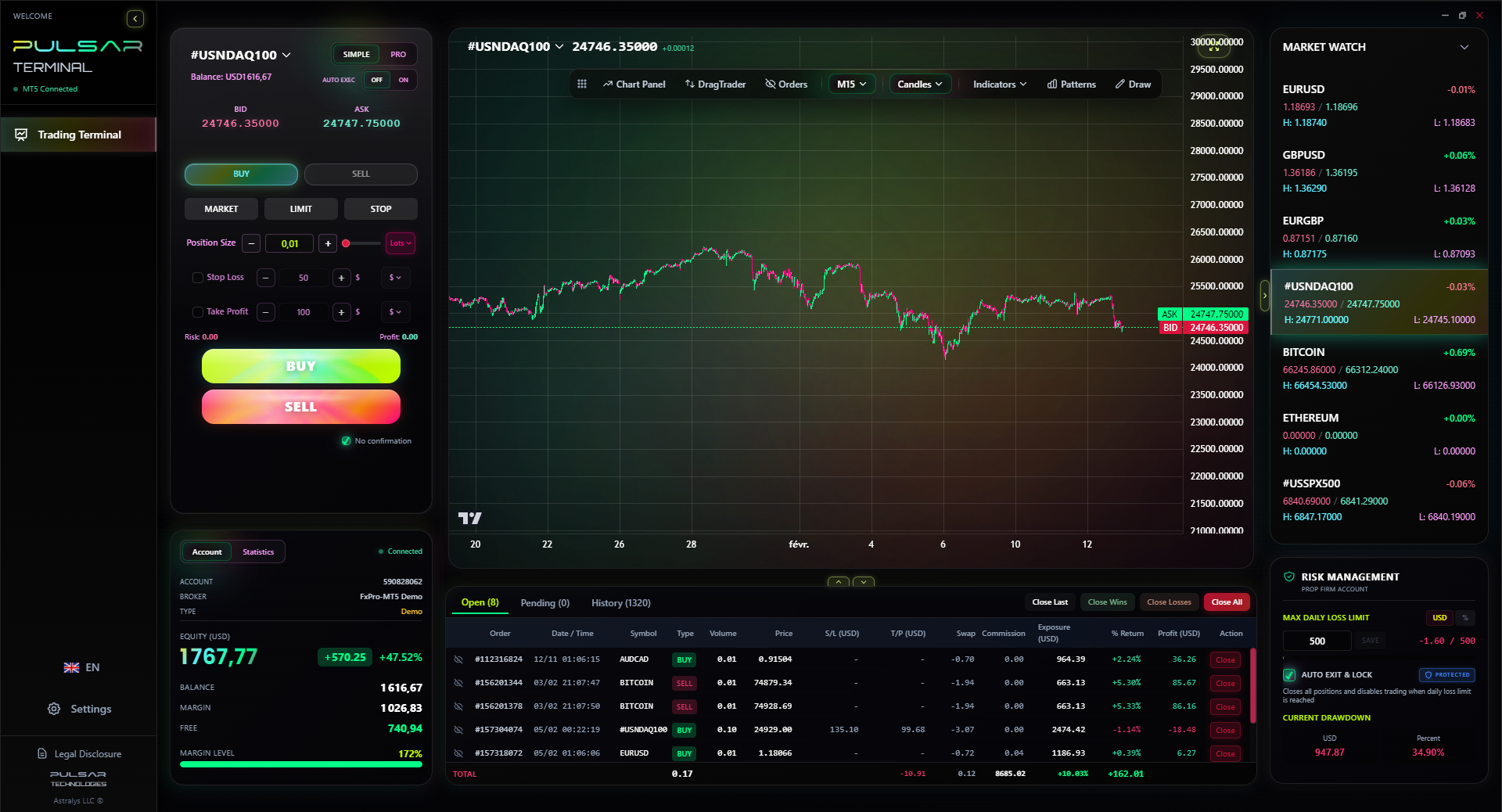
Managing multiple positions and their exits is complex, but tools like Pulsar Terminal for MT5 let you set multi-level take-profits and trailing stops with a single drag-and-drop, automating your risk management plan.
Pulsar Terminal
Das All-in-One MT5-Tool: Drag-and-Drop-Orders, Multi-TP/SL, Trailing Stop, Grid Trading, Volume Profile und Prop-Firm-Schutz. Täglich von 1.000+ Tradern genutzt.
“In Nigeria, your greatest asset isn't use; it's patience.”
Our trading environment has unique wrinkles. Navigating them is part of the job.
Funding Your Account: The CBN's restrictions mean direct Naira card deposits to international brokers are often blocked or limited. We've adapted.
- E-wallets: Skrill and Neteller are lifesavers. Fund them via your bank transfer or card, then transfer to your broker. Fees apply, but it's reliable.
- Cryptocurrency: Many brokers now accept USDT (Tether). I transfer Naira to a local crypto exchange, buy USDT, and send it to my broker. It's often the fastest and cheapest method, but be aware of crypto price volatility during the transfer.
- Domiciliary Account: If you have one, you can wire USD directly. It's the most straightforward but has higher bank fees.
Choosing a Platform: MT4 and MT5 are kings here for a reason. They're stable, familiar, and have a million indicators. But don't ignore a broker's own platform if it's good. Test their demo. Your platform is your cockpit; you need to feel comfortable in it.
Mental Capital: This is intangible but real. The stress of unstable power, expensive data, and economic headlines can lead to rushed decisions. I schedule my trading sessions, use a UPS for my router, and avoid trading when I'm anxious about 'off-chart' life stuff. Protecting your mental capital is as important as protecting your financial capital.
💡 Winstons Tipp
Write down the reason for every position you open. If the reason is no longer valid, close the trade. Don't get married to a price on a screen.
“Your position size should be determined by your risk parameters, not by your conviction in the trade.”
Let's get painfully honest. Here's where I've blown up, and the lesson each time.
Mistake 1: Averaging Down on a Loser. I bought USD/JPY at 110.00. It fell to 109.50. I bought more, thinking, "Now my average price is better!" It fell to 108.50. I was out of capital and took a massive loss. Lesson: A losing position is wrong until proven otherwise. Adding to it is doubling down on a mistake. Add to winners, not losers.
Mistake 2: Ignoring the Trend for a 'Clever' Reversal. The MACD indicator showed EUR/USD in a strong downtrend on the 4-hour chart. On the 5-minute chart, I saw an oversold RSI indicator and went long for a 'bounce.' I was right for 10 pips, then it resumed crashing. I lost. Lesson: The higher timeframe trend is king. Don't use a short-term signal to fight the major trend.
Mistake 3: Letting a Winner Turn into a Loser. I was up 60 pips on GBP/USD. Greed set in. "Let's go for 100!" I moved my stop loss to breakeven. The price reversed, hit my breakeven stop, and I made nothing. All that risk for zero reward. Lesson: Have a profit target and stick to it. At the very least, move your stop loss to lock in some profit as the trade moves in your favor. Don't give back all your gains.
Mistake 4: Trading Too Big for a 'Sure Thing.' A friend had 'insider info' on a CBN move. I put 30% of my account into one USD/NGN position. The info was wrong. The loss was catastrophic. Lesson: There is no sure thing. Your position size should be determined by your risk parameters, not by your conviction in the trade. Maximum conviction gets you a standard 0.5-1% risk, nothing more.
FAQ
Q1Is forex trading legal in Nigeria?
Yes, for individual retail traders, it is legal. There's no law against you opening an account with an international broker. However, the CBN restricts local banks from facilitating transactions for speculation, which is why funding brokers can be tricky. The SEC warns against unregistered platforms promising guaranteed returns, but regulated individual trading is permitted.
Q2How much money do I need to start a forex position in Nigeria?
Technically, some brokers allow you to start with as little as $1. Practically, I wouldn't recommend starting with less than $200-$300. With a $100 account, proper risk management (e.g., risking 0.5% or $0.50 per trade) is almost impossible after accounting for spreads. A $500-$1,000 start gives you breathing room to use sensible micro-lot positions and absorb a few losses while learning.
Q3What is the best position size for a beginner?
Start with the smallest size your broker allows - usually a micro lot (0.01). This represents 1,000 units of currency. At this size, each pip of movement is worth roughly $0.10 (for pairs where the USD is the quote currency). This lets you practice real trading with minimal financial stress. Use a position size calculator to make it a habit.
Q4How do I pay taxes on my forex profits in Nigeria?
You are required to pay a 10% Capital Gains Tax (CGT) on your net annual trading profits to the Federal Inland Revenue Service (FIRS). You need to file an annual tax return. Keep detailed records of all your trades, deposits, and withdrawals. It's wise to set aside 10% of every profitable withdrawal into a separate account so you're not scrambling at tax time.
Q5What's the difference between a position and a trade?
In everyday talk, we use them interchangeably. But technically, a 'trade' is the act of opening or closing. A 'position' is your ongoing market exposure after the trade is opened. You execute a trade to open a position. You close the position with another trade.
Q6Can I go to jail for forex trading in Nigeria?
No, you cannot go to jail for simply trading forex as an individual through a legitimate international broker. Legal issues arise from fraud, running unlicensed investment schemes that scam people, or blatant money laundering. Trading your own capital responsibly is not a criminal offense.
Q7Why did my position close automatically?
This is most likely a margin call. It means your losses have consumed most of your available funds, and your broker closed the position to prevent further losses (which could put you in debt to them). To avoid it, use much smaller position sizes and always use a stop loss.
Prof. Winstons Lektion
Wichtige Erkenntnisse:
- ✓A position is a commitment, defined by direction (long/short) and size (lots).
- ✓Risk a maximum of 0.5-1% of your account on any single trade.
- ✓Always use a stop-loss order; define your exit before you enter.
- ✓Factor in the 10% Capital Gains Tax on profits for FIRS.
- ✓Choose brokers with strong international regulation for safety.
Wie nützlich war dieser Artikel?
Klicken Sie auf einen Stern
Wöchentliche Trading-Einblicke
Kostenlose wöchentliche Analysen & Strategien. Kein Spam.
Über den Autor
Olumide Adeyemi
Pionier des Tradings in Westafrika
Einer der aktivsten Forex-Trading-Ausbilder Nigerias. 8 Jahre Trading-Erfahrung aus Lagos. Spezialisiert auf Strategien mit geringem Kapital und Prop-Firm-Challenges für afrikanische Trader.
Kommentare
Risikohinweis
Der Handel mit Finanzinstrumenten birgt erhebliche Risiken und ist möglicherweise nicht für alle Anleger geeignet. Vergangene Ergebnisse garantieren keine zukünftigen Renditen. Dieser Inhalt dient ausschließlich Bildungszwecken und stellt keine Anlageberatung dar. Führen Sie immer Ihre eigene Recherche durch, bevor Sie handeln.
Das könnte Sie auch interessieren

Cara Trading Forex Sukses: 7 Prinsip dari Trader Profesional
Cara trading forex sukses dengan 7 prinsip trader pro: manajemen modal, disiplin, journal trading, backtest. Data nyata, bukan janji profit palsu.
Jam Trading Forex Terbaik untuk Trader Indonesia: Panduan Lengkap dengan Tabel Waktu
Panduan jam trading forex untuk trader Indonesia. Tabel 4 sesi dunia, jam emas 20:00-00:00, sesi mana yang harus dihindari. Data akurat + tips dari trader berpengalaman.
Top 5 Sàn Forex Uy Tín Nhất 2026: Review Jujur dari Trader Indonesia
Top 5 sàn forex uy tín 2026 untuk trader Indonesia. Review jujur: spread, deposit, withdraw, dukungan lokal. Exness, XM, IC Markets & lebih.
Pulsar Terminal herunterladen
Alle diese Rechner sind in Pulsar Terminal mit Echtzeit-Daten Ihres MT5-Kontos integriert.
Pulsar Terminal herunterladen