


Most Nigerian traders think swaps are just a tiny, annoying fee.

Olumide Adeyemi
Pionier des Tradings in Westafrika ·  Nigeria
☕ 12 Min. Lesezeit
Was Sie lernen werden:
- 1Swap 101: It's Not a Fee, It's an Interest Payment
- 2How Swap is Calculated: A Practical Example with Naira Logic
- 3Positive vs. Negative Swap: How to Get Paid to Hold a Trade
- 4Swap Rates with Nigerian Brokers: What to Expect
- 5How Swap Can Make or Break Your Long-Term Trading
- 6Practical Ways to Manage Swap Costs as a Nigerian Trader
- 7The Nigerian Taxman and Your Swap: What You Need to Know
- 8Common Swap Mistakes Every Nigerian Trader Makes (And How to Stop)
Most Nigerian traders think swaps are just a tiny, annoying fee. They're wrong. Ignoring the swap is like ignoring the fuel cost on a Lagos-to-Abuja road trip - you might reach your destination, but the profit gets eaten up along the way. I learned this the hard way, watching a promising long-term position in AUD/JPY slowly bleed for weeks because I was paying the swap. This guide will break down exactly what a swap is, how it's calculated with Naira in mind, and how you can actually use it to get paid while you sleep, instead of getting robbed.
Let's cut through the jargon. A swap (or rollover) isn't some mysterious broker charge. It's simple interest. When you open a forex trade, you're not just betting on a price. You're borrowing one currency to buy another. If you buy EUR/USD, you're borrowing USD to buy EUR. Holding that position overnight means you owe interest on the USD you borrowed, but you earn interest on the EUR you now own.
The swap is the net difference between those two interest rates. That's it. It gets applied daily, around 10 PM or 11 PM Nigerian time (5 PM New York time). If the currency you bought has a higher interest rate than the one you sold, you earn a positive swap. If it's lower, you pay a negative swap.

Warning: Many new traders see a swap charge and think their broker is cheating them. It's not a scam; it's a fundamental part of how global currency markets work. The real issue is not knowing whether you'll pay or earn before you enter the trade.
In Nigeria, with our own interest rate dynamics set by the CBN, understanding this global interest rate game is crucial. You're playing on a field where major central banks set the rules.

💡 Winstons Tipp
Professor Winston always said, 'The market charges rent for your opinions held overnight. Know your lease terms.' Check the swap before you click buy or sell, every single time.
Brokers show swap rates in points (pips), but behind that is a formula. Here’s the breakdown so you can stop guessing:
Swap = (Lot Size × Contract Size × (Interest Rate Differential)) / Number of Days in a Year
Let's make it real. Say you're buying 1 standard lot (100,000 units) of AUD/JPY. Assume the Reserve Bank of Australia has a cash rate of 4.35% and the Bank of Japan has a rate of 0.10%. The differential is 4.25% (4.35 - 0.10).
- Interest per year: 100,000 AUD × 4.25% = 4,250 AUD
- Interest per day: 4,250 AUD / 365 ≈ 11.64 AUD
That 11.64 AUD is the gross interest you'd earn. Your broker then converts it to your account currency (usually USD) and may add a small markup. So, you might see a credit of, say, $7.50 daily for holding that AUD/JPY long position.
Now, flip it. If you sold AUD/JPY, you'd be borrowing the high-yielding AUD and buying the low-yielding JPY. You'd pay the interest rate differential. That same 1-lot position could cost you $7.50 per night.

Example: On a $5,000 account, a $7.50 daily charge is 0.15% of your equity. Over 30 days, that's $225, or 4.5% of your account - just for holding the trade. That's a massive drag on returns. This is why using a position size calculator is non-negotiable for longer-term trades; it helps you understand if the potential profit can overcome the swap cost.
The Wednesday Triple Swap
Here's the kicker most beginners miss. The forex market settles trades in two business days (T+2). When you hold a position past Wednesday's rollover, it will settle on Friday. But since banks are closed Saturday and Sunday, the interest for those two days gets applied on Wednesday night. You'll see a triple swap charge (or credit) every Wednesday. Mark it on your calendar. I once got a nasty surprise on a Thursday morning because I forgot this rule on a large GBP/USD short position.
“Ignoring the swap is like ignoring the fuel cost on a Lagos-to-Abuja road trip - you might reach your destination, but the profit gets eaten up along the way.”
This is where swaps move from a cost to a strategic tool. A positive swap is when you earn money overnight. This happens when you buy the currency with the higher interest rate and sell the one with the lower rate (a "carry trade").
A negative swap is when you pay money overnight. This happens when you buy the low-rate currency and sell the high-rate one.
My biggest lesson came from a long-term swing trading idea on USD/ZAR a few years back. The US Fed had rates near zero, while the South African Reserve Bank had rates above 7%. I wanted to short USD/ZAR (buy ZAR, sell USD).
The Mistake: I looked only at the chart, which looked bearish. I entered the short.
The Reality: By shorting USD/ZAR, I was selling the high-yield ZAR and buying the low-yield USD. I was on the wrong side of the carry. I was paying a massive negative swap, about $25 per lot per night. The trade went sideways for a month. Even though the price didn't move much against me, the swap charges eroded over $700 from my position. I closed it out of frustration, only for the price to finally drop a week later. The swap killed my patience and my profit.
The Correction: I learned to check the swap calendar on my broker's site before entering any trade I planned to hold for more than a day. Now, if I have a bearish view on a high-yielding currency, I'll either:
- Use a much shorter timeframe (like scalping) to avoid overnight swaps.
- Accept the swap cost as a necessary expense for the trade, but I'll factor it into my required take-profit distance. If I need 200 pips to make it worthwhile, and swap costs 5 pips a night, I can't hold for 40 days expecting the same profit.

Pro Tip: Brokers like XM and Exness offer Islamic (swap-free) accounts. These don't charge or pay interest for religious compliance. Instead, they might charge a fixed administration fee for holding positions overnight. If you're a day trader, this can simplify things. But if you're hunting for positive swap, a standard account is your tool.
As a Nigerian trader, you're likely using an international broker. Swap rates aren't set by Nigeria's CBN rates; they're based on the interbank interest rates of the currencies you're trading (like the US Fed Funds Rate or the ECB rate).
However, your choice of broker affects the final swap you see. All brokers add a small markup to the interbank swap rate. This is how they make money on overnight positions. The markup varies.
From my experience:
- ECN/RAW Spread Brokers (like IC Markets or Pepperstone): Their swaps tend to be closer to the interbank rate, as they make money on commissions. The swaps can be larger (both positive and negative) because there's less smoothing.
- Standard/Market Maker Brokers: May have slightly more favorable (i.e., less punitive) negative swaps, but their positive swaps might also be trimmed. It's part of their pricing model.
You must check your broker's swap/rollover rate sheet. It's always in the contract specifications for each instrument. Don't assume EUR/USD always has the same swap across brokers. I've seen differences of 0.5 pips per lot between brokers, which adds up.
Also, note that for pairs involving the Nigerian Naira (like USD/NGN, if offered), the swap would be calculated using the CBN's Monetary Policy Rate (MPR). Given Nigeria's high inflation and interest rates, holding a long Naira position (short USD/NGN) could, in theory, yield a huge positive swap. But frankly, most of us trade major and cross pairs like EUR/USD or XAU/USD, where G7 central bank policies matter more.
“The swap killed my patience and my profit. I learned to check the swap calendar before entering any trade I planned to hold for more than a day.”
For a day trader, swaps are noise. For a swing or position trader, they're part of the foundation. Here’s how they directly impact your bottom line.
Scenario 1: The Silent Account Drain You deposit ₦500,000 (approx. $330). You go short on GBP/JPY, a classic pair where the swap is often negative for shorts. The swap is -$4.50 per lot per night. You hold a 0.5-lot position for 3 months (90 days).
Total Swap Cost: -$4.50 * 0.5 lots * 90 days = -$202.50. That's over 60% of your initial deposit in costs, before the price has even moved! If the trade is only mildly profitable, you could net a loss. This is how people blow accounts without a single dramatic margin call.
Scenario 2: The Snowball Effect You go long on AUD/CAD when the RBA rate is high. Positive swap is +$3.00 per lot per night. You hold 1 lot for 6 months (180 days).
Total Swap Earned: +$3.00 * 180 = $540. That's free money adding to your equity, giving you a bigger buffer and compounding your gains. The trade doesn't just have to be right; it gets a daily tailwind.
My strategy now? I have a simple spreadsheet. Before I enter any swing trade, I input:
- Planned position size (from my position size calculator)
- Daily swap rate from my broker
- Estimated hold time
It gives me a total swap cost/credit. If it's a significant cost, I either reduce my position size to make it tolerable, or I reconsider the trade entirely. This one habit has saved me more money than any fancy indicator.
💡 Winstons Tipp
In his office, Winston had a jar. Every time he paid a negative swap, he'd put a coin in. At year's end, it was a stark reminder of the cost of inattention. Track your swaps like a hawk.
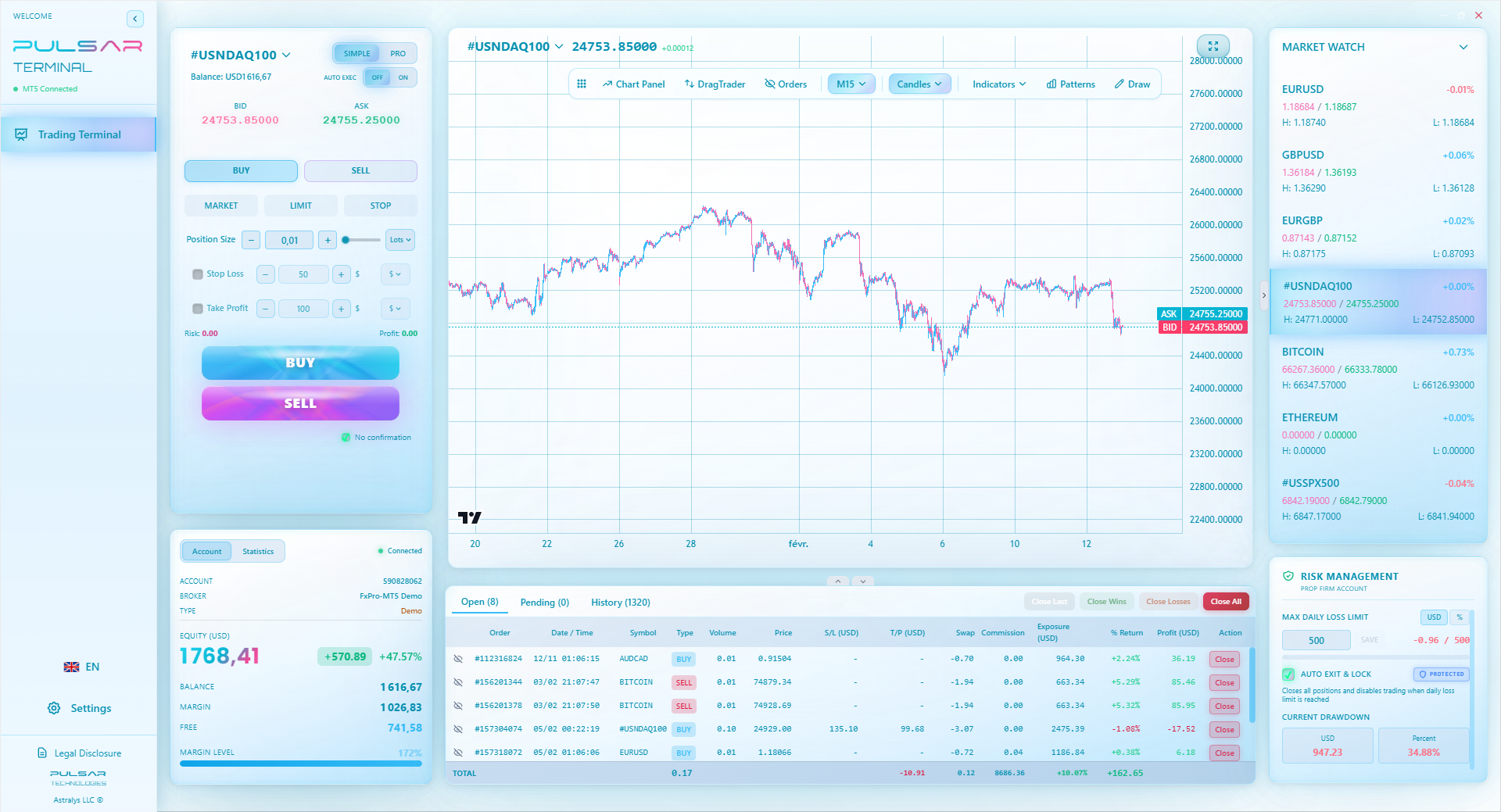
When managing long-term trades where swap costs are a critical factor, having a tool that lets you set multiple take-profit levels and partial closures helps you secure profit and manage that swap-adjusted risk more precisely.
Pulsar Terminal
Das All-in-One MT5-Tool: Drag-and-Drop-Orders, Multi-TP/SL, Trailing Stop, Grid Trading, Volume Profile und Prop-Firm-Schutz. Täglich von 1.000+ Tradern genutzt.
You can't avoid swaps, but you can manage them intelligently.
- Trade Direction with Intent: Align your long-term bias with the positive swap direction. Use an economic calendar to track central bank meetings. If the Fed is hiking and the ECB is holding, consider long-term longs on USD pairs against the EUR. You get paid for your conviction.
- Use Swap-Free Accounts Judiciously: As mentioned, Islamic accounts remove swap. But they often charge a fixed fee (e.g., $10 per lot per week for holding). For very short-term holds (2-3 days), a swap-free account might be cheaper than a large negative swap. Do the math.
- Close Before Rollover: If you're day trading, make it a rule to close all positions before 10 PM Nigerian time. No swap, no surprise.
- Factor Swap into Your Risk-Reward: If a trade has a -$5/day swap, and you plan to hold for 20 days, that's a $100 cost. Your take-profit needs to be far enough away to cover that $100 plus your desired profit. If your pip definition value is $10 per pip, you need an extra 10 pips of profit just to break even on the swap.
- Beware of the Wednesday Triple: If you must hold over Wednesday, know the triple charge is coming. Ensure your account equity can handle it without triggering a margin alert.
Warning: Some shady brokers advertise "zero swaps forever!" This is often a marketing trick for standard accounts and might be a sign of poor regulation. True swap-free accounts are for religious compliance and are clearly labeled as such. Always verify a broker's license. Reviews for brokers like Exness or XM will clarify their swap policies.
“Swap Credits are Taxable Income. Swap Debits are Potentially Deductible Expenses. Your broker's statement won't tell you this; your journal must.”
This is critical and often overlooked. According to the Personal Income Tax Act (PITA) and the Capital Gains Tax Act, Nigerian residents are taxed on worldwide income.
Swap Credits (Earned Interest) are Taxable Income. If you earn $500 in positive swaps over a year, that is considered income. It should be declared alongside your trading profits.
Swap Debits (Paid Interest) are Potentially Deductible Expenses. If you pay $300 in negative swaps, these can be considered costs incurred in generating your trading income. You can deduct them from your gross profits to arrive at your taxable profit.
The Problem: Most brokers' end-of-year statements simply show a net profit/loss. They don't always neatly separate swap earnings/costs from trading gains/losses.
My Advice: Keep a detailed trading journal. Use a spreadsheet or journaling software to track each trade's P/L and the swap charged/credited separately. At the end of the year, you have a clear record:
- Total Trading Profit (from price movement): ₦2,000,000
- Total Swap Earned: ₦150,000
- Total Swap Paid: (₦50,000)
- Net Taxable Income: ₦2,000,000 + ₦150,000 - ₦50,000 = ₦2,100,000
You would then apply the 10% Capital Gains Tax to the ₦2,100,000. Trying to reconstruct this from a messy broker statement during tax season is a nightmare. I learned this after a stressful audit query. Now, my journal is my bible.
Let's finish with the pitfalls I've seen (and stepped in) over the years.
Mistake 1: Ignoring Swap on "Small" Positions. "It's just a 0.01 lot, the swap is pennies." Hold that for a year, and those pennies become thousands of Naira. Every position size matters.
Mistake 2: Not Checking the Swap Before Entering. This was my USD/ZAR error. It takes 10 seconds to look at your platform's order window. It shows the estimated swap for the position. Don't be blind to it.
Mistake 3: Assuming All Pairs Behave the Same. EUR/USD often has a minimal swap because US and EU rates are often close. AUD/JPY or USD/TRY can have enormous swaps. Treat each pair as unique.
Mistake 4: Forgetting About the Spread. You find a pair with a juicy positive swap and think you've found free money. But if the spread definition is 10 pips wide, you start the trade deeply in the red. The swap might not cover that cost for weeks. Always consider the total cost of trading: spread + potential swap + commission.
Mistake 5: Letting Swap Dictate Your Analysis. This is the reverse error. You should consider swap, not be ruled by it. Don't take a bad trade just because it has a positive swap. The primary reason for a trade should always be your price analysis. The swap is a secondary factor that improves or worsens the trade's math. Use tools like the MACD indicator or RSI indicator for your primary direction, then check if the swap aligns.
FAQ
Q1Do I pay swap on weekends?
You don't pay separate swaps on Saturday and Sunday. Instead, the interest for those two days is bundled and applied as a triple charge (or credit) on Wednesday night. So, holding a position from Wednesday to Thursday incurs three days' worth of swap.
Q2Can I avoid paying swap entirely?
Yes, but with conditions. You can use an Islamic (swap-free) account offered by many brokers, which replaces interest with a fixed admin fee. Alternatively, you can close all your positions before the daily rollover time (usually around 10-11 PM Nigerian time), which means you're strictly a day trader and never hold overnight.
Q3Is a positive swap guaranteed profit?
Absolutely not. A positive swap is a small daily credit, but the price movement of the currency pair determines your main profit or loss. If the price moves 100 pips against you, the small swap earned won't come close to covering that loss. It's a supporting factor, not a primary strategy.
Q4How do I find the swap rate for a currency pair?
In your trading platform (MT4/MT5), right-click on the symbol in the Market Watch window and select 'Specification'. A window will pop up showing the detailed contract specs, including the approximate swap rate for long and short positions in points. Your broker's website will also have a full swap rate sheet.
Q5Does the swap rate change?
Yes. Swap rates are based on the underlying interbank interest rates, which are set by central banks. When a central bank like the US Federal Reserve or the CBN changes its policy rate, the swap rates for pairs involving that currency will change, usually after a short lag.
Q6As a Nigerian, do I pay swap in Naira?
Typically, no. Most international brokers calculate swaps in the quote currency of the pair (e.g., USD for EUR/USD, JPY for USD/JPY) and then convert it to your account currency. If your account is in USD, you see USD swaps. If your account is denominated in Naira (offered by some brokers), the USD swap amount will be converted to Naira at the prevailing rate when it's applied.
Q7Are swaps higher with higher use?
No, not directly. Swap is calculated based on your position size (lot size), not your use or margin. However, higher use allows you to open a larger position size with less capital, which would result in a larger absolute swap charge or credit. The swap cost as a percentage of your margin will be higher with higher use, which increases risk.
Prof. Winstons Lektion
Wichtige Erkenntnisse:
- ✓Swap is interest, not a random fee. It's the cost of borrowing one currency to buy another.
- ✓A negative swap on a 1-lot trade can cost you over $200 in 90 days, silently draining your account.
- ✓Always check the swap rate in your platform's 'Specifications' before entering a swing trade.
- ✓Factor the total swap cost into your risk-reward calculation. Need an extra 10 pips? Plan for it.
- ✓Swap earnings are taxable, and swap costs are deductible in Nigeria. Keep separate records.
Wie nützlich war dieser Artikel?
Klicken Sie auf einen Stern
Wöchentliche Trading-Einblicke
Kostenlose wöchentliche Analysen & Strategien. Kein Spam.
Über den Autor
Olumide Adeyemi
Pionier des Tradings in Westafrika
Einer der aktivsten Forex-Trading-Ausbilder Nigerias. 8 Jahre Trading-Erfahrung aus Lagos. Spezialisiert auf Strategien mit geringem Kapital und Prop-Firm-Challenges für afrikanische Trader.
Kommentare
Risikohinweis
Der Handel mit Finanzinstrumenten birgt erhebliche Risiken und ist möglicherweise nicht für alle Anleger geeignet. Vergangene Ergebnisse garantieren keine zukünftigen Renditen. Dieser Inhalt dient ausschließlich Bildungszwecken und stellt keine Anlageberatung dar. Führen Sie immer Ihre eigene Recherche durch, bevor Sie handeln.
Das könnte Sie auch interessieren

Cara Trading Forex Sukses: 7 Prinsip dari Trader Profesional
Cara trading forex sukses dengan 7 prinsip trader pro: manajemen modal, disiplin, journal trading, backtest. Data nyata, bukan janji profit palsu.
Jam Trading Forex Terbaik untuk Trader Indonesia: Panduan Lengkap dengan Tabel Waktu
Panduan jam trading forex untuk trader Indonesia. Tabel 4 sesi dunia, jam emas 20:00-00:00, sesi mana yang harus dihindari. Data akurat + tips dari trader berpengalaman.
Top 5 Sàn Forex Uy Tín Nhất 2026: Review Jujur dari Trader Indonesia
Top 5 sàn forex uy tín 2026 untuk trader Indonesia. Review jujur: spread, deposit, withdraw, dukungan lokal. Exness, XM, IC Markets & lebih.
Pulsar Terminal herunterladen
Alle diese Rechner sind in Pulsar Terminal mit Echtzeit-Daten Ihres MT5-Kontos integriert.
Pulsar Terminal herunterladen