


I bought GBP/NGN at 1,850 in late 2022, convinced the Naira couldn't fall further.

Olumide Adeyemi
Pionier des Tradings in Westafrika ·  Nigeria
☕ 12 Min. Lesezeit
Was Sie lernen werden:
- 1The Foundation: Understanding What You're Actually Trading
- 2The Three Pillars of Timing: Price Action, Momentum, and News
- 3Concrete Buy and Sell Signals You Can Use Today
- 4The Nigerian Context: Unique Factors That Move Your Trades
- 5Risk Management: This is Your Real Edge
- 6Putting It All Together: A Live Trade Example
- 7Common Mistakes to Avoid (I've Made Them All)
- 8Your Actionable Trading Plan
I bought GBP/NGN at 1,850 in late 2022, convinced the Naira couldn't fall further. I was wrong. Dead wrong. By mid-2023, it hit 2,100, and my stop-loss at 1,920 got taken out for a 70-pip loss that felt like a thousand. That trade taught me the hard way that knowing when to buy and sell in forex trading isn't about gut feelings or patriotic hope for the Naira. It's about a system, discipline, and understanding the forces that move prices. Let me save you that tuition fee.
Before you place a single trade, you need to know what's moving the price. In Nigeria, we have a unique perspective because we're trading the Naira every day just by living here. But trading it on a chart is different.
Forex is about the relative strength of one economy against another. When you buy EUR/USD, you're betting the Eurozone economy will outperform the US economy, or at least that the market thinks it will. For us, trading pairs like USD/NGN is a direct bet on perceptions of Nigerian economic stability versus the US. The Central Bank of Nigeria (CBN) policies, oil prices, and inflation reports aren't just news headlines, they're direct market drivers.

Warning: Trading USD/NGN with a local broker? Be extra careful. The CBN restricts local institutions from facilitating speculative forex trades. Most serious Nigerian traders I know use internationally regulated brokers like Exness or IC Markets for better liquidity and protection. Your capital isn't just at market risk, it's at regulatory risk too.
The first rule of knowing when to buy and sell in forex trading is this: know what story the pair is telling. Is it a growth story? An interest rate story? A political stability story? If you can't articulate it in one sentence, you shouldn't be in the trade.
Timing isn't magic. It's the intersection of three concrete things. Miss one, and your odds drop fast.
Price Action: What the Chart is Screaming
This is your map. It shows where the price has been and where it might be going. I don't use 20 indicators that all say the same thing. I look for key levels: previous highs and lows, round numbers (like 1.1000 on EUR/USD), and areas where the price has bounced or broken before. A buy signal for me isn't just a green candle. It's a strong bullish candle closing above one of these key levels after the price has tested it a few times.
I got long on XAU/USD (Gold) at $1,820 in early 2023. Why? It had bounced from the $1,800 level three times in the previous month. The market was screaming that $1,800 was a floor. That trade ran to $1,950. The chart told the story.
Momentum: Is the Train Leaving the Station?
Price action tells you the where, momentum tells you the when. I use the RSI indicator and the MACD indicator, but simply. RSI above 50? Momentum is bullishish. MACD histogram turning up and crossing the signal line? Momentum is shifting. The sweet spot is when price breaks a key level and momentum confirms it. Buying a breakout when the RSI is already at 85 is a great way to buy the top.
News: The Scheduled Earthquake
This is non-negotiable. You must know the economic calendar. For a Nigerian trading EUR/USD, US Non-Farm Payrolls and ECB interest rate decisions are massive. For USD/NGN, it's CBN MPC meeting dates and oil inventory reports. I don't trade during high-impact news releases. I wait. The volatility is insane and spreads widen to ridiculous levels. I let the news hit, let the market have its panic attack, and then look for the new trend that forms in the aftermath. That's where the clean moves happen.

Pro Tip: Set alerts for key levels on your phone. Don't sit and stare at the chart. When price hits your level, then open the chart and check for momentum confirmation. This saves you from emotional, impulsive trades.

💡 Winstons Tipp
The market's job is to make you feel stupid for being right too early. Your job is to have the capital still there when you're proven right.
“Trade the price, not your patriotism. The market doesn't care about your opinion on the Naira.”
Enough theory. Here's what I actually look for on the chart. These are not holy grails, but they're high-probability setups I've used for years.
The Pullback Buy (My Bread and Butter):
- Identify a strong, clear uptrend (higher highs, higher lows).
- Wait for the price to pull back to a key support level. This could be a moving average (like the 50-period EMA) or a previous resistance-turned-support.
- Look for momentum to slow down (RSI moves out of overbought) and then start turning back up.
- Buy when you get a strong bullish candle closing above the low of the pullback.
The Breakout Sell:
- Identify a clear range or consolidation area.
- Wait for the price to break below the support level of the range.
- Don't jump in immediately. Wait for a "retest." The price often pops back up to kiss the broken support (now resistance) before falling.
- Sell on a bearish rejection candle at that old support level.
I used this breakout sell on GBP/USD in September 2023. It broke below 1.2650, retested it, formed a nasty bearish pin bar, and then tanked. Entry at 1.2640, stop at 1.2685 (45 pips), target at 1.2550. It worked like a textbook.
The Divergence Signal (A Warning Bell): This is for spotting potential reversals. If the price makes a new high, but the RSI makes a lower high, that's bearish divergence. It means upward momentum is fading even though price is rising. It's not an instant sell signal, but it's a red flag to tighten stops or take partial profits. The same works in reverse for buy signals.
Remember, a signal is just an invitation to a trade. You still need to manage it. Always know your pip risk before you click buy.
Trading from Nigeria isn't the same as trading from London. Our reality adds layers you can't ignore.
Internet & Power: A signal means nothing if your light goes off or your data fails during a trade. I use a broker with a reliable mobile app and always have a backup power source (inverter, generator). I also set stop-losses on every single trade, no exceptions. If I get disconnected, my risk is still managed. A missed connection once turned a potential 50-pip win into a 120-pip loss for me. Never again.
Liquidity and Pairs: Stick to major and minor pairs (EUR/USD, GBP/USD, USD/JPY, AUD/USD). They have the tightest spreads and most liquidity. Exotic pairs involving the Naira can have massive, unpredictable spreads. That beautiful 20-pip profit can vanish into a 50-pip spread cost faster than you can say "CBN."
use: A Double-Edged Sword: Nigerian brokers often offer insane use like 1:1000. This is a trap for new traders. Yes, it magnifies gains. But it magnifies losses faster. With a $100 account and 1:1000 use, a 10-pip move against you can cause a margin call. I never use more than 1:50 use on my main account, no matter what the broker offers. Preserve your capital first.
The Prop Firm Route: Many traders now use prop firms to trade with larger capital. If you go this route, your timing needs to be even sharper. These challenges have strict drawdown rules. A strategy based on catching big news spikes is too risky. You need consistent, disciplined swing trading or precise scalping with impeccable risk management.
“Your stop-loss is not a suggestion. It's a pre-planned admission that your trade idea was wrong.”
Knowing when to buy is only 40% of the game. Knowing when and how to sell is the other 60%. And I'm not just talking about taking profit.
The Stop-Loss: Your Life Insurance: Your stop-loss is not a suggestion. It's a pre-planned admission that your trade idea was wrong. Before you enter, calculate your risk. Use a position size calculator. If your stop is 30 pips away, and you only want to risk $10 on a trade, your position size is automatically determined. Placing a stop-loss 5 pips away from your entry on a volatile pair is just paying the spread to your broker. Give your trade room to breathe, but not so much room it blows up your account.
Take Profit: The Art of Exiting: There are two schools: one target or multiple targets. I use multiple targets. On a long trade, I'll sell half my position at a 1:1 risk-reward ratio (if I risk 30 pips, I take profit on half at +30 pips). This covers my risk. I then move my stop-loss to breakeven on the remaining half and let it run. This way, I never have a losing trade, and I get a shot at a home run.
The Psychology of Selling: The hardest sell is the one that gets you out of a losing trade before it gets worse. Holding a losing trade, hoping it will come back, is the number one account killer in Nigeria. We call it "praying the trade." Don't pray. Execute your plan. If your stop-loss level is hit, you're out. No debate.

Example: You have a $1,000 account. You decide to risk 1% per trade ($10). You see a buy setup on EUR/USD with a stop-loss 25 pips away. Your position size = ($10) / (25 pips * $0.10 per pip on a micro lot) = 4 micro lots. That's it. No guessing.
💡 Winstons Tipp
If you're looking at your P&L more than your charts, you're a gambler, not a trader. Close the balance tab.
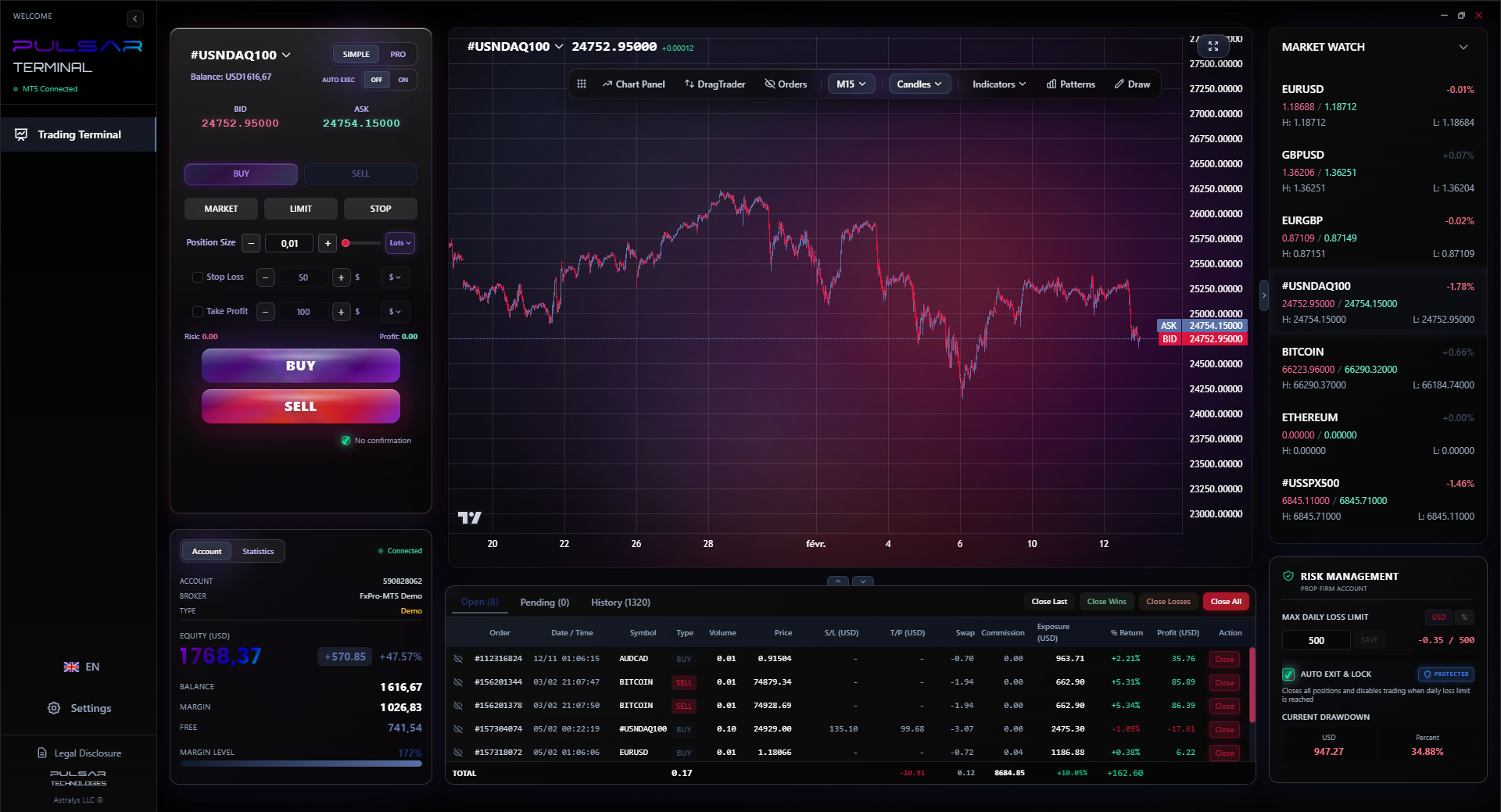
Managing multiple take-profit levels and moving stops to breakeven manually is a hassle; Pulsar Terminal automates this directly on your MT5 platform, so you can focus on your next setup.
Pulsar Terminal
Das All-in-One MT5-Tool: Drag-and-Drop-Orders, Multi-TP/SL, Trailing Stop, Grid Trading, Volume Profile und Prop-Firm-Schutz. Täglich von 1.000+ Tradern genutzt.
Let's walk through a recent trade I took on USD/JPY, step-by-step.
1. The Story: The Bank of Japan was hinting at shifting away from ultra-low interest rates, while the US Fed was pausing hikes. Potential Yen strength vs. Dollar weakness.
2. The Chart & Timing (Early Dec 2023):
- Price Action: USD/JPY was in a clear downtrend from 151.90. It pulled back up to a key resistance zone around 148.00-148.30.
- Momentum: The RSI indicator on the 4-hour chart was hitting 60 but starting to curl down. Not overbought, but momentum was stalling at resistance.
- Signal: I waited for a bearish rejection candle at the 148.30 resistance. Got a clear bearish engulfing candle.
3. The Trade:
- Action: SELL order placed at 148.15.
- Stop-Loss: Placed at 148.75 (60 pips above). This was above the recent swing high.
- Take Profit 1: Set at 147.15 (100 pips, ~1:1.6 R:R) for half the position.
- Take Profit 2: Set at 146.00, aiming for the next major support.
4. The Result: Price moved down smoothly. TP1 hit two days later. I moved my stop-loss on the remaining half to breakeven (148.15). Price eventually slid down to near 146.00 but reversed sharply on some Fed comments. My breakeven stop was hit on the second half. Final result: First half profit = 100 pips. Second half = scratch (no loss). A great, managed trade.
This is the process. Story, chart, level, signal, execute, manage. No emotion.
“Discipline is what separates the guy who knows when to buy and sell from the guy who just knows how to click the buttons.”
Let me shortcut your learning curve by telling you where you'll likely mess up.
Trading Naira Sentiment: Just because you believe the Naira should strengthen doesn't mean it will. I lost money in 2021 trying to short USD/NGN against CBN intervention rumors. The market doesn't care about your opinion. Trade the price, not your patriotism.
Overleveraging for Quick Gains: You see a 10-pip move and think, "With 1:500 use, that's huge!" It is. Until the next 10-pip move goes against you and wipes out your deposit. Start small. Use a demo account to test your strategy with realistic use first.
Ignoring Total Cost: It's not just the spread. Factor in potential swap fees if you hold overnight, and remember that 10% Capital Gains Tax on your profits. A trade that nets you 50 pips might only be 45 pips after spreads and commissions. Plan for it.
Chasing the News: You see USD/NGN spiking 500 pips on a CBN announcement and FOMO in. That's the fastest way to buy the very top. The smart money sold to you. If you miss the news move, you missed it. Wait for the next setup.
Broker Choice: Using an unregulated "local expert" with a fancy WhatsApp group. Your funds are not safe. Stick to reputable, internationally regulated brokers with a track record. Read reviews like our XM review or Pepperstone review to compare.
💡 Winstons Tipp
The perfect entry doesn't exist. The perfect exit does - it's the one defined by your risk management plan before you entered.
Knowing when to buy and sell in forex trading boils down to a repeatable checklist. Here's yours:
- Market Filter: Are you trading during a major news event? If yes, wait. Check the economic calendar.
- Trend & Level: What's the higher timeframe trend? Identify one clear key level (support for buy, resistance for sell).
- Signal: Wait for a price action signal (pullback, breakout, rejection) at that level.
- Momentum Check: Does the RSI or MACD support the signal? (e.g., bullish signal not in overbought territory).
- Risk Calculation: Use your position size calculator. Determine your entry, stop-loss (1.5-2x the recent average volatility), and take-profit levels (minimum 1:1 risk-reward).
- Execute & Walk Away: Place the trade with stop and limit orders. Set a price alert for your key levels. Close the chart. Staring at it won't help.
- Manage: If price hits your first profit target, move stop to breakeven. Let the rest run until the market tells you the trend is over.
Print this out. Stick it next to your screen. Don't deviate from it for your first 50 trades. Discipline is what separates the guy who knows when to buy and sell from the guy who just knows how to click the buttons.
FAQ
Q1What is the best time of day to trade forex in Nigeria?
The most liquid overlaps are when London and New York sessions are open (2 pm - 10 pm Nigerian Time). This is when spreads are tightest and moves are cleanest. Avoid the dead zone between New York close and Asian open (10 pm - 4 am).
Q2How much money do I need to start forex trading in Nigeria?
You can start with as little as $10-$20 with some international brokers. But realistically, to trade properly with sane risk management, aim for at least $200-$500. This lets you use sensible position sizes without being forced to use dangerous levels of use just to make a meaningful gain.
Q3Do I pay tax on forex trading profits in Nigeria?
Yes. The Federal Inland Revenue Service (FIRS) considers forex trading profits as capital gains, subject to a 10% Capital Gains Tax (CGT). It's your responsibility to declare this income, regardless of whether your broker is local or international.
Q4Is there a difference between when to buy/sell for scalping vs. swing trading?
Absolutely. Scalping looks for tiny, frequent moves (5-15 pips) on lower timeframes (1-min, 5-min), often using pure price action and order flow. Swing trading looks for larger moves (50-200 pips) on higher timeframes (4-hour, daily), relying more on fundamental trends and key chart levels. Your timing framework changes completely.
Q5How do I know if my buy/sell signal is false?
A false signal often lacks confirmation. The price might break a level but then immediately reverse and close back beyond it. Or momentum (RSI) will be extreme (above 80/below 20) on the breakout, suggesting exhaustion. The best defence is a sensible stop-loss. Assume every signal could be false and protect your capital accordingly.
Q6Can I automate my buy and sell decisions?
You can use Expert Advisors (EAs) in MetaTrader, but they require rigorous backtesting and monitoring. Market conditions change. Most profitable traders I know use discretion for entry/exit, but strict automation for risk management (like guaranteed stop-loss orders). Don't buy a "magic" EA from a WhatsApp group.
Prof. Winstons Lektion
Wichtige Erkenntnisse:
- ✓Identify the story behind the pair before trading.
- ✓Time entries with price action at key levels + momentum confirmation.
- ✓Never risk more than 1-2% of your capital per trade.
- ✓Use multiple take-profit levels to secure profit and let winners run.
- ✓Your broker choice is a foundational risk management decision.
Wie nützlich war dieser Artikel?
Klicken Sie auf einen Stern
Wöchentliche Trading-Einblicke
Kostenlose wöchentliche Analysen & Strategien. Kein Spam.
Über den Autor
Olumide Adeyemi
Pionier des Tradings in Westafrika
Einer der aktivsten Forex-Trading-Ausbilder Nigerias. 8 Jahre Trading-Erfahrung aus Lagos. Spezialisiert auf Strategien mit geringem Kapital und Prop-Firm-Challenges für afrikanische Trader.
Kommentare
Risikohinweis
Der Handel mit Finanzinstrumenten birgt erhebliche Risiken und ist möglicherweise nicht für alle Anleger geeignet. Vergangene Ergebnisse garantieren keine zukünftigen Renditen. Dieser Inhalt dient ausschließlich Bildungszwecken und stellt keine Anlageberatung dar. Führen Sie immer Ihre eigene Recherche durch, bevor Sie handeln.
Das könnte Sie auch interessieren

Cara Trading Forex Sukses: 7 Prinsip dari Trader Profesional
Cara trading forex sukses dengan 7 prinsip trader pro: manajemen modal, disiplin, journal trading, backtest. Data nyata, bukan janji profit palsu.
Jam Trading Forex Terbaik untuk Trader Indonesia: Panduan Lengkap dengan Tabel Waktu
Panduan jam trading forex untuk trader Indonesia. Tabel 4 sesi dunia, jam emas 20:00-00:00, sesi mana yang harus dihindari. Data akurat + tips dari trader berpengalaman.
Top 5 Sàn Forex Uy Tín Nhất 2026: Review Jujur dari Trader Indonesia
Top 5 sàn forex uy tín 2026 untuk trader Indonesia. Review jujur: spread, deposit, withdraw, dukungan lokal. Exness, XM, IC Markets & lebih.
Pulsar Terminal herunterladen
Alle diese Rechner sind in Pulsar Terminal mit Echtzeit-Daten Ihres MT5-Kontos integriert.
Pulsar Terminal herunterladen