


Here's a fact that might unsettle you: when you click 'buy' on your broker's platform, there's a 70% chance you're not trading against another trader in London or New York.

David van der Merwe
Schwellenland-Trader ·  South Africa
☕ 11 Min. Lesezeit
Was Sie lernen werden:
- 1The Simple Truth: What a Forex Market Maker Actually Does
- 2The Local Players: From JSE Giants to Your Broker
- 3How This Directly Impacts Your Trades and Profits
- 4Market Maker vs. ECN/STP: Choosing Your Battlefield
- 5The FSCA's Role: Your Shield Against Bad Actors
- 6How to Tell What Model Your Broker Uses
- 7Trading Strategies: Adapting to the Market Maker Reality
- 8The Future: Where is This All Heading for SA Traders?
Here's a fact that might unsettle you: when you click 'buy' on your broker's platform, there's a 70% chance you're not trading against another trader in London or New York. You're trading directly against your broker. That's the reality of the market maker model that dominates retail forex, especially here in South Africa. I've traded through this system for over a decade, and understanding who's on the other side of your trade isn't just theory, it's survival. Let's break down exactly who these market makers are, from our own big banks to the international brokers, and what their presence means for your ZAR account.
Forget the complex jargon. A market maker's job is simple: they make a market. That means they stand ready to buy when you want to sell, and sell when you want to buy, at a price they quote. They're the shopkeeper, and you're the customer.
Their profit comes from the spread, the difference between their buy price (bid) and sell price (ask). If USD/ZAR is quoted at 18.5000/18.5020, that 20 pip difference is their bread and butter. They don't need the market to move in a direction to profit, they just need you to trade. This is fundamentally different from an ECN (Electronic Communication Network) model, where your order is matched with another participant's order.
In South Africa, when you trade with many popular brokers, especially those offering 'instant execution' and no commissions, you are almost certainly trading with a market maker. They act as the counterparty to your trade. This isn't inherently evil, but it creates a specific dynamic you must understand.

Warning: A common misconception is that market makers 'trade against you.' A legitimate, regulated market maker like those under the FSCA doesn't have a vested interest in you losing. Their interest is in you trading frequently. They hedge their overall risk in the interbank market. The shady ones, the 'bucket shops,' do bet against you, which is why FSCA regulation is non-negotiable.

💡 Winstons Tipp
The spread isn't a fee, it's a distance. Your trade must travel that distance before it's in profit. Choose your broker based on who builds the shortest road.
The market maker landscape in South Africa has two main layers: the institutional liquidity providers and the retail-facing brokers.
The Big Banks: The Real Liquidity Source
The heavyweights are the major banks you know. Absa, Investec, Nedbank, Rand Merchant Bank (RMB), and Standard Bank aren't just places for your savings. They are officially listed as market makers on the Johannesburg Stock Exchange (JSE). This means they provide continuous buy and sell quotes for various instruments. For forex, especially for the Rand, these banks are crucial. They help the massive institutional flow that determines the real USD/ZAR rate. When a mining company needs to convert billions of Rands from dollar exports, they go here. This is the 'wholesale' market.
The Retail Brokers: Your Gateway (and Often, Your Counterparty)
This is where you come in. Most brokers serving the South African public operate on a market maker or 'dealing desk' model for their standard accounts. They aggregate all their clients' orders and then manage the net exposure, often by hedging with those big banks mentioned above. Some well-known international brands popular here, like XM or Exness, primarily use this model for their commission-free accounts.
I learned this the hard way early on. I was scalping EUR/USD on a popular market maker platform. I'd get these annoying 'requotes' (where your order is rejected and a new, worse price is offered) every time news hit. That was the broker's dealing desk manually widening the spread because their risk spiked. I switched to a broker offering a true ECN model for active scalping, and the requotes vanished, replaced by a small commission. The cost was clearer, and the execution was cleaner.
“A legitimate market maker doesn't profit from your loss; they profit from your activity.”
So, you're trading with a market maker. What does that mean for your screen time?
1. Spreads are Your Primary Cost (and Their Primary Income). You won't pay a commission, but you'll pay a wider, fixed spread. On a quiet day, EUR/USD might be 1.2 pips instead of 0.2 on an ECN. That extra pip goes to the broker. Over 100 trades, that's 100 pips of pure cost before you even break even. You need to factor this into your position size calculator because it eats directly into your potential profit.
2. Execution Quirks You Need to Watch.
- Slippage: Can be worse during volatility, as the broker protects itself.
- Requotes: The classic market maker hallmark. Your order isn't filled at the clicked price.
- Fixed vs. Variable Spreads: Many market makers offer 'fixed' spreads. This seems great for planning, but these spreads are usually much wider than the raw market. During major news, they might disappear entirely, and your order won't execute.
3. The Psychology of 'Trading Against the House'. There's a mental hurdle. Knowing your broker profits from the spread can create a subtle 'us vs. them' feeling. You must move past this. A regulated FSCA broker isn't out to 'get you.' They provide a service for a cost. Your job is to ensure that cost is fair and transparent.

Example: Let's say you trade 2 standard lots of USD/ZAR with a market maker spread of 15 pips. Your cost to enter that trade is 15 pips * R1.34 per pip (approx.) = R20.10, gone immediately. On an ECN-style account with a 2-pip raw spread + R50 commission, your cost is (2 pips * R1.34) + R50 = R52.68. For this size, the market maker is cheaper. For a 0.1 lot trade, the math flips. You have to do the calculation for your typical trade size.
It's not that one is universally better. It's about which suits your style. Here’s the breakdown for a South African trader:
| Feature | Market Maker (Dealing Desk) | ECN/STP (No Dealing Desk) |
|---|---|---|
| Counterparty | Your broker is the other side of your trade. | Your order is matched with another participant (bank, fund, other trader). |
| Pricing | Broker sets its own prices, often derived from liquidity providers. | You see aggregated prices from multiple liquidity providers. |
| Spreads | Usually wider, but can be fixed. | Tighter, variable, and raw. Can widen massively in news. |
| Commissions | Usually none. Cost is built into the spread. | Usually a per-lot commission. Total cost = spread + commission. |
| Execution | Instant, but risk of requotes. | Market execution, faster, no requotes. |
| Best For | Newer traders, smaller accounts, those who prefer simple, predictable costs. | Active traders, scalpers, algorithmic trading, larger accounts. |
My personal shift happened when I moved from casual swing trading to more active day trading. The 1.5 pip spread on my old market maker account was killing my scalp profits. I moved to a broker like IC Markets or Pepperstone on their raw account. Yes, I paid R70 ($3.50) per lot in commission, but the spread was often 0.1 pip. My total cost per trade dropped by over 60% for my strategy. It was a game-changer for my bottom line.
💡 Winstons Tipp
If you're constantly getting requotes, the market isn't rejecting you. Your broker's risk model is. It's a sign to either change your timing or change your broker.
“The FSCA license isn't just a logo on a website; it's your only local lifeline if things go wrong.”
This is the most critical part for any South African trader. The Financial Sector Conduct Authority (FSCA) is what separates a legitimate market maker from a fraudulent bucket shop.
A regulated market maker under the FSCA (like an FSP with a license number) MUST:
- Segregate client funds. Your money is held in a separate bank account. If the broker goes under, your funds are protected (in theory).
- Maintain minimum capital requirements. They can't just operate from a garage.
- Provide fair pricing. They can't manipulate prices to intentionally trigger your stop-loss.
- Adhere to the 30:1 use cap for retail clients, a crucial risk control.
The FSCA has teeth. In 2024, they debarred a guy for 10 years for selling signals without a license. In 2023, they fined JP Markets SA. This active enforcement is what allows you to trade with a local market maker with some peace of mind.
The Golden Rule: Always, always check the FSCA's website to verify your broker's license. If they're not regulated here, you have zero recourse if something goes wrong. The FSCA can't help you with an offshore broker that freezes your withdrawals.

Pro Tip: When evaluating a broker, don't just look for 'regulation.' Look for FSCA regulation. An ASIC (Australia) or FCA (UK) license is excellent, but the FSCA is your local champion. Brokers like AvaTrade and FP Markets hold FSCA licenses, which is a strong positive signal for South African clients.
Brokers won't always shout 'WE ARE A MARKET MAKER!' They use marketing terms. Here’s how to decode it:
Signs it's likely a Market Maker:
- They advertise 'No Commissions!' or 'Commission-Free Trading.' The cost is in the spread.
- They offer 'Fixed Spreads.'
- They provide 'Instant Execution.' This often means a dealing desk is approving your trade.
- The account types are named 'Standard,' 'Mini,' or 'Classic.'
Signs it's likely an ECN/STP:
- They advertise 'Raw Spreads' or 'ECN Pricing.'
- They charge a clear per-lot commission (e.g., $3.50 per side per 100k).
- They offer 'Market Execution.'
- Account types are named 'Raw,' 'ECN,' 'Pro,' or 'Zero.'
You can also just ask their support: "Do you act as the counterparty to my trades, or do you pass them directly to liquidity providers?" A straight answer is a good sign.
Another clue is during high volatility. On a market maker platform, you might get requotes or the platform might freeze briefly. On a true ECN, the spread on your platform will blow out to reflect the real interbank market chaos - you might see EUR/USD with a 50 pip spread for a few seconds, but you can still usually get an execution, albeit with massive slippage.
“Your strategy isn't complete until you've accounted for who's on the other side of the trade.”
Your strategy needs to acknowledge who's on the other side.
If you trade with a Market Maker:
- Avoid scalping ultra-thin ranges. The spread is your enemy. Aim for trades with a larger potential profit target (e.g., 50+ pips) to make the spread cost insignificant as a percentage.
- Beware of news trading. This is when requotes and slippage are highest. Either avoid trading 30 seconds before and after major news, or use pending orders placed well in advance.
- Use indicators that account for spread. If your strategy uses the RSI indicator or MACD indicator on a 1-minute chart, remember the spread can cause false signals on tiny movements.
- Hunt for brokers with the tightest consistent spreads. Compare the live spreads on USD/ZAR and EUR/USD at different times of day (London open, SA afternoon).
A Personal Mistake: I once tried to run a grid trading bot on a market maker account. The idea was to place 10 buy and sell orders around the price. The constant small trades generated a mountain of spread costs that completely erased the profits from the winning trades. The broker loved it. I lost. It was a costly lesson in how your strategy interacts with the broker's business model.
Managing multiple orders and stop-losses in such an environment is a headache. This is where a tool that lets you set complex order structures easily becomes valuable.
💡 Winstons Tipp
A market maker's fixed spread is like an all-you-can-eat buffet: comforting and predictable, but you often pay for more than you use. Variable spreads are a la carte: you pay for what you actually get.
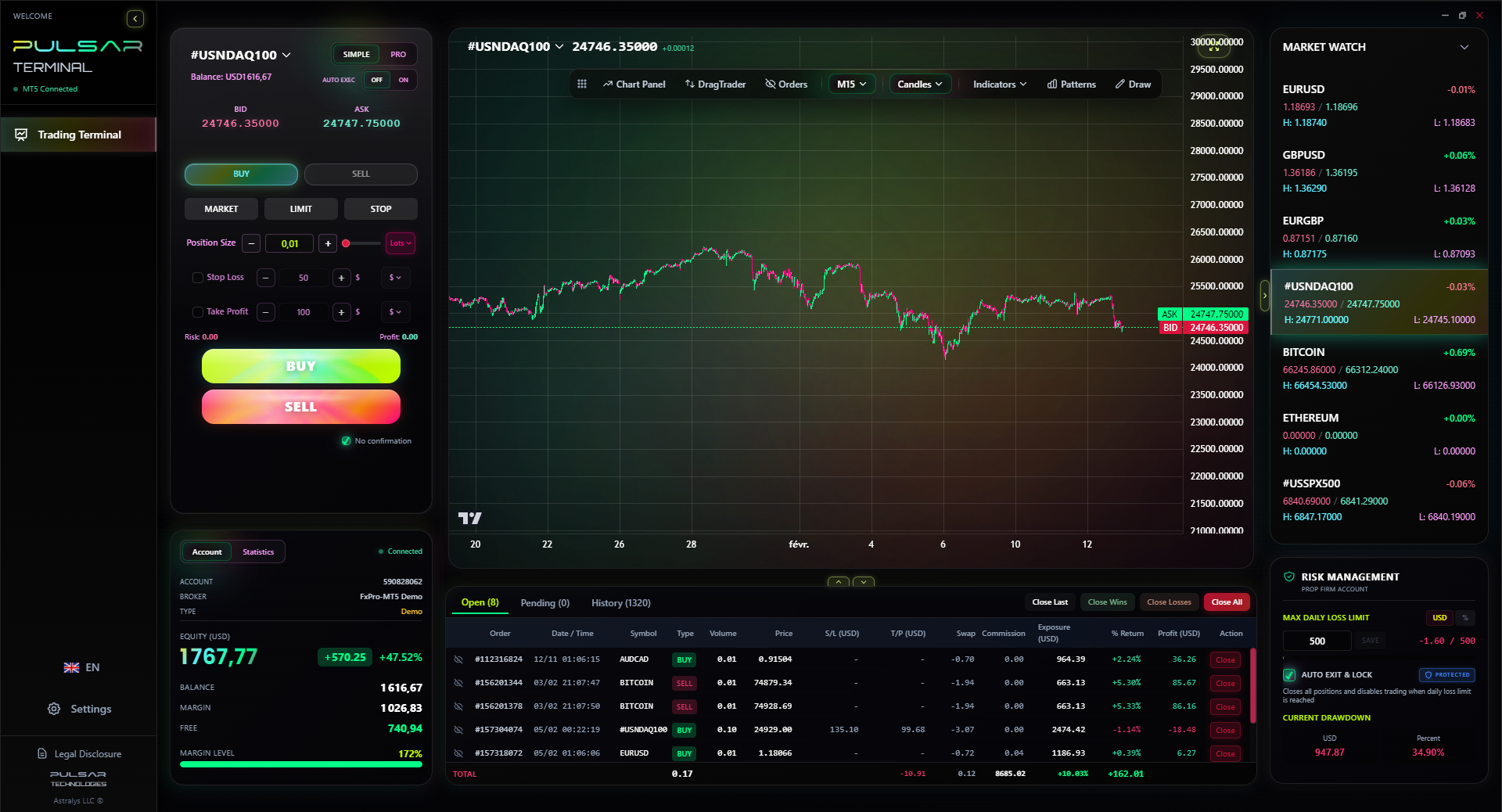
Managing complex orders and stop-losses across multiple trades is key when adapting to any broker model, and Pulsar Terminal's drag-and-drop order system makes this effortless directly on your MT5 chart.
Pulsar Terminal
Das All-in-One MT5-Tool: Drag-and-Drop-Orders, Multi-TP/SL, Trailing Stop, Grid Trading, Volume Profile und Prop-Firm-Schutz. Täglich von 1.000+ Tradern genutzt.
The trend is towards transparency, but market makers aren't going away. Here's what I see:
- Blurring of Models: Many brokers now offer both. A 'Standard' market maker account for beginners and a 'Raw' ECN account for pros. This is the best of both worlds and gives you a path to graduate as your skills and account size grow.
- Technology is Levelling the Field: Better connectivity means even market maker brokers can offer tighter spreads by automating their hedging. The gap between 'market maker spread' and 'ECN spread+commission' is narrowing for major pairs.
- The Rand's Volatility is a Constant: USD/ZAR will remain a spread-widening pair. Local brokers who specialize in ZAR pairs, like Khwezi Trade, might offer better conditions here than international giants.
- Regulation Will Tighten: Following global trends, the FSCA will likely impose more stringent reporting and client protection rules. This is good for you. It will push out the shady operators.
The key takeaway? Don't fear market makers. Understand them. Choose the model that fits your trading personality and size. Verify their FSCA license. And always, always know that the spread isn't just a number, it's the price of admission to the game, and who you pay it to changes the game itself.
FAQ
Q1Is it bad to trade with a forex market maker?
Not at all, if they are properly regulated (like by the FSCA). For many South African traders, especially beginners or those with smaller accounts, a market maker broker offers a simple, commission-free way to start. The potential downsides (wider spreads, requotes) are a trade-off for that simplicity and predictability.
Q2How do I know if my South African broker is a market maker?
Check for 'commission-free trading,' 'fixed spreads,' and 'instant execution' on their website. These are classic hallmarks. You can also look at their account types: 'Standard' or 'Classic' accounts are almost always market maker models. When in doubt, ask their support directly.
Q3Do market makers manipulate prices to hit my stop loss?
A legitimate, FSCA-regulated market maker should not. Their profit comes from the spread, not from your individual loss. However, unregulated or fraudulent 'bucket shops' might engage in this practice. This is why trading only with FSCA-licensed brokers is your primary defense.
Q4What's better for scalping: a market maker or an ECN?
Almost always an ECN/STP model. Scalping aims for small profits (5-10 pips), so a 1-2 pip market maker spread consumes a huge percentage of your gain. An ECN with a 0.1 pip spread + a small commission gives you a much lower cost per trade, which is critical for scalping.
Q5Are South African banks like Standard Bank market makers?
Yes, absolutely. Major banks like Standard Bank, Absa, and RMB are primary market makers in the interbank forex market. They provide the core liquidity for the Rand. Your retail broker often connects to these banks to hedge their own book.
Q6What is the maximum use I can get with an FSCA broker?
For retail clients, the FSCA has capped use at 30:1 for major forex pairs since 2021. Some brokers may offer professional accounts with higher use if you qualify, but for most traders, 30:1 is the legal maximum. Always use a position size calculator to manage this responsibly.
Prof. Winstons Lektion
Wichtige Erkenntnisse:
- ✓Market makers profit from the bid-ask spread, not your directional loss.
- ✓FSCA regulation is the critical line between a legitimate broker and a bucket shop.
- ✓For scalping under 10 pips, ECN models usually offer lower total costs.
- ✓Always verify a broker's FSCA license number on the official register.
Wie nützlich war dieser Artikel?
Klicken Sie auf einen Stern
Wöchentliche Trading-Einblicke
Kostenlose wöchentliche Analysen & Strategien. Kein Spam.
Über den Autor
David van der Merwe
Schwellenland-Trader
In Johannesburg ansässiger Trader mit 11 Jahren Erfahrung in Schwellenländerwährungen. Spezialisiert auf ZAR-Paare, FSCA-regulierten Handel und Analyse des südafrikanischen Marktes.
Kommentare
Risikohinweis
Der Handel mit Finanzinstrumenten birgt erhebliche Risiken und ist möglicherweise nicht für alle Anleger geeignet. Vergangene Ergebnisse garantieren keine zukünftigen Renditen. Dieser Inhalt dient ausschließlich Bildungszwecken und stellt keine Anlageberatung dar. Führen Sie immer Ihre eigene Recherche durch, bevor Sie handeln.
Das könnte Sie auch interessieren

Cara Trading Forex Sukses: 7 Prinsip dari Trader Profesional
Cara trading forex sukses dengan 7 prinsip trader pro: manajemen modal, disiplin, journal trading, backtest. Data nyata, bukan janji profit palsu.
Jam Trading Forex Terbaik untuk Trader Indonesia: Panduan Lengkap dengan Tabel Waktu
Panduan jam trading forex untuk trader Indonesia. Tabel 4 sesi dunia, jam emas 20:00-00:00, sesi mana yang harus dihindari. Data akurat + tips dari trader berpengalaman.
Top 5 Sàn Forex Uy Tín Nhất 2026: Review Jujur dari Trader Indonesia
Top 5 sàn forex uy tín 2026 untuk trader Indonesia. Review jujur: spread, deposit, withdraw, dukungan lokal. Exness, XM, IC Markets & lebih.
Pulsar Terminal herunterladen
Alle diese Rechner sind in Pulsar Terminal mit Echtzeit-Daten Ihres MT5-Kontos integriert.
Pulsar Terminal herunterladen