


Everyone thinks a 1 hour forex trading strategy is about finding a magic indicator and getting rich quick.

David van der Merwe
Emerging Markets Trader ·  South Africa
☕ 11 min read
What you'll learn:
- 1Why the 1-Hour Chart Actually Works for Us
- 2FSCA Rules & What They Mean for Your Strategy
- 3The Core 1-Hour Trading Setup (Keep It Simple)
- 4Entry & Exit Rules (With My Real Trade Examples)
- 5South African Brokers, Spreads & Execution
- 6Risk Management: The Non-Negotiables
- 7Trading the ZAR Pairs: Your Home Advantage
- 8Common Pitfalls & How to Avoid Them
Everyone thinks a 1 hour forex trading strategy is about finding a magic indicator and getting rich quick. They're wrong. I've watched more traders blow up accounts on the H1 chart than any other timeframe, usually because they treat it like a slot machine. The truth is, the 1-hour chart is a sniper's scope, not a machine gun. It requires more patience, not less. Let me show you how to trade it properly under South African rules, with real numbers from our market.
The 1-hour (H1) chart sits in a sweet spot. It's fast enough to catch decent moves within a day, but slow enough to filter out the market noise that destroys accounts on the 5 or 15-minute charts. For a South African trader, this is crucial. Our most active trading window - when London and New York overlap - is from 3 PM to 7 PM SAST. That's only 4 hours. A daily chart strategy might give you one signal a week. An H1 strategy can give you a clear, high-probability setup right in the heart of that volatile, liquid session.
I learned this the hard way. Back in 2018, I was trying to scalp the USD/ZAR on a 5-minute chart during the Asian session. The spreads were wide, the moves were erratic, and I was basically donating money to my broker. I switched to the H1, waited for the London open, and my win rate improved overnight. The noise vanished.

Warning: The H1 is not for impatient people. You might only get 1-3 clean signals per pair per day. If you're the type to force trades, you'll lose. This timeframe rewards discipline above all else.
The local advantage? We trade the ZAR. Pairs like USD/ZAR and EUR/ZAR can have massive daily ranges, often 500-1000 pips. On an H1 chart, these translate into clean, tradable waves. While everyone else is fighting over 10-pip moves on EUR/USD, you can ride a 150-pip wave on USD/ZAR in the same afternoon. You just need the right broker with tight spreads on these pairs, which I'll get to.
You can't talk trading in South Africa without talking about the Financial Sector Conduct Authority (FSCA). They're not the bad guys. Their 30:1 use limit for retail traders, introduced in 2021, probably saved my account. When I started, offshore brokers were offering 500:1. It was addictive and dangerous. I once turned R5,000 into R25,000 on a single USD/ZAR trade with insane use. I felt like a genius. The next week, I lost R7,000 in 20 minutes. The 30:1 cap forces you to use proper position sizing. It makes you a better trader.
Your Legal Checklist
- Broker License: Only use an FSCA-licensed broker. Check the FSP number on their site and verify it on the FSCA's public register. This isn't optional. It guarantees client money segregation and gives you a local recourse if things go south.
- Taxes: SARS sees trading profits as income. Keep a detailed log of all trades. You can deduct legitimate expenses (data fees, platform costs, education). I use a simple spreadsheet, but a proper journal is better.
- Sending Money Abroad: You can use your annual R1 million single discretionary allowance to fund an international broker if you choose. But honestly? With so many good brokers like Pepperstone and IC Markets now holding FSCA licenses, there's less need to complicate your life. Keep it local and regulated.
The use limit directly shapes your 1 hour forex trading strategy. At 30:1, a 2% risk on a R10,000 account is R200. On USD/ZAR, where a pip on a standard lot is about R70, your position size has to be calculated precisely. You can't just YOLO into a trade. You must use a position size calculator for every single entry.
“The FSCA's 30:1 use limit probably saved my account.”
Forget a dashboard cluttered with 20 indicators. You need clarity. Here’s the exact setup I've used for the last five years.
Chart: MetaTrader 5 (MT5). Most FSCA brokers offer it. It's more strong than MT4 for advanced order types.
Indicators (Only 3):
- 200-period Exponential Moving Average (EMA): Smoothed line on the H1 chart. This defines the long-term trend. Price above it = general uptrend bias. Price below it = downtrend bias. It's your filter.
- 50-period EMA: The dynamic support/resistance in a trend. In an uptrend, price will often pull back to the 50 EMA before bouncing. That's your potential entry zone.
- Relative Strength Index (RSI): Set to 14 periods. I don't use it for overbought/oversold signals. I use it for divergence. When price makes a new high but the RSI makes a lower high? That's bearish divergence and a potential reversal signal. It's saved me from chasing tops more times than I can count. Learn more about this powerful concept in our RSI indicator guide.
The Rule: Only take trades in the direction of the 200 EMA. If price is above the 200 EMA, I only look for buys. Below, only sells. This one rule eliminates 50% of the losing trades most beginners take.

Pro Tip: Draw horizontal support and resistance lines on your H1 chart. The best trades happen when a trend pullback (to the 50 EMA) coincides with a previous support or resistance level. That's a confluence, and it massively increases your odds.

💡 Winston's Tip
The 200 EMA isn't just a line. It's a crowd psychology gauge. Price holding above it means the majority of buyers over the last 200 hours are still in profit. Don't fight that crowd.
Theory is useless without practice. Here are two real trades from my journal.
Trade 1: USD/ZAR Buy (April 2024)
- Context: USD/ZAR was in a strong uptrend, price consistently above the 200 EMA on H1.
- Setup: Price pulled back during the Asian session and touched the rising 50 EMA. The 50 EMA was also near a previous resistance level that had now turned into support (around 18.85).
- Entry: I bought at 18.87. Stop loss placed at 18.72, just below the swing low. Risk: 150 pips.
- Exit: Price rallied into the London/New York overlap. I took half profit at 19.07 (+200 pips) and let the rest run with a trailing stop. Final exit at 19.15. Total gain: 280 pips on the full position.
- Why it worked: Trend alignment + EMA pullback + support confluence. No guesswork.
Trade 2: EUR/USD Sell (That Went Wrong)
- Context: EUR/USD was below the 200 EMA. I saw a pullback to the 50 EMA and a bearish MACD indicator crossover. I got excited.
- Mistake: I ignored a major horizontal resistance level just 10 pips above my entry. I sold at 1.0720.
- Result: Price tapped the resistance, rejected it briefly, then blasted straight through. My stop loss at 1.0750 was hit. Loss: 30 pips.
- Lesson: Confluence is king. One signal (EMA) isn't enough. I needed price to reject that horizontal level. This is why a pure scalping strategy on lower timeframes is so hard - you often miss these bigger picture levels.
Your exit strategy is more important than your entry. My rule: Take 50-60% of your position off at a 1:1.5 risk-to-reward ratio. Move your stop loss to breakeven on the remainder. Then, you can trail it or target the next obvious resistance level. This locks in profit and removes the stress.
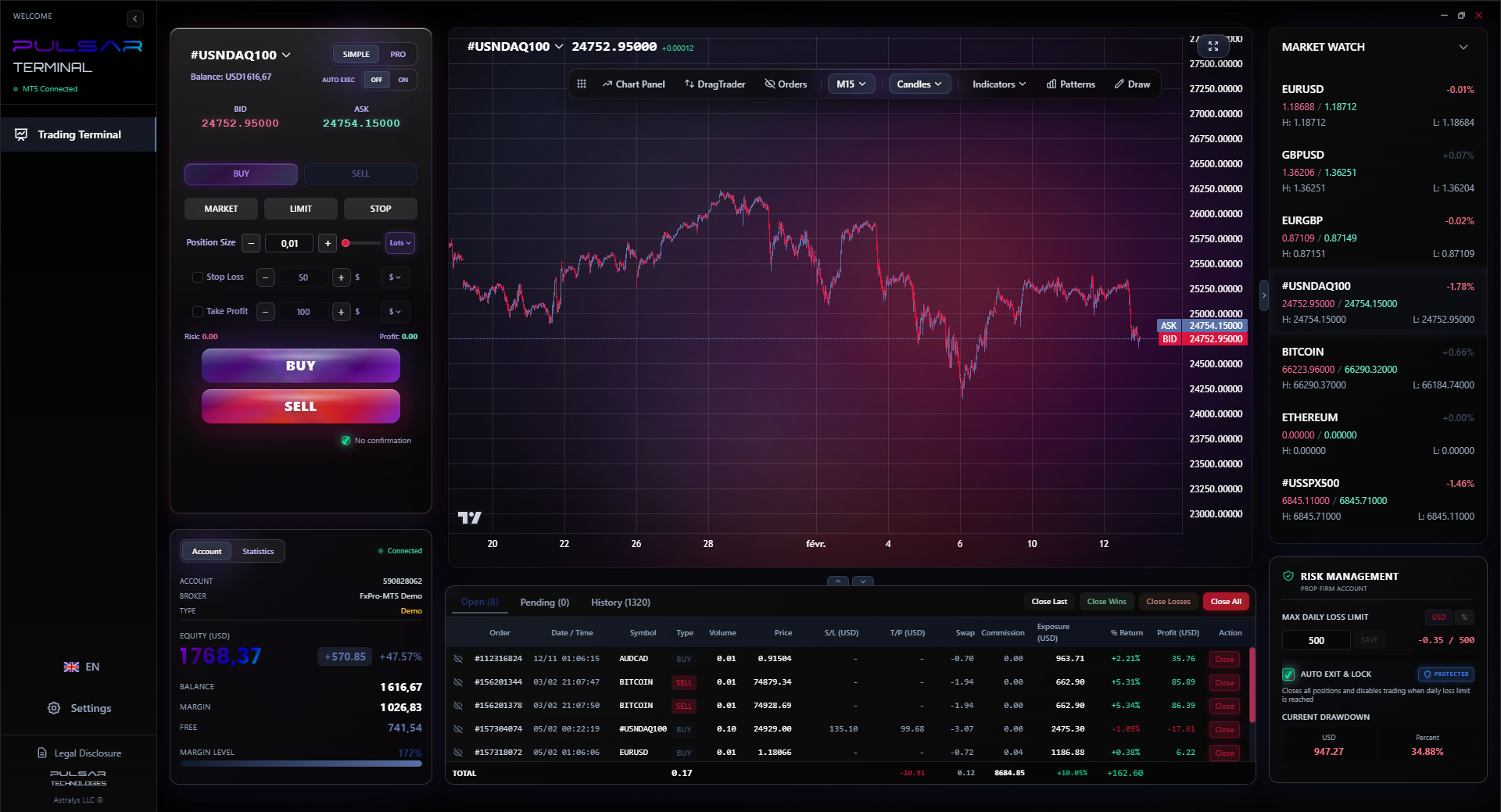
Managing multiple take-profit levels and moving stops to breakeven on the H1 chart is time-consuming, but tools like Pulsar Terminal automate this directly on your MT5 platform.
Pulsar Terminal
The all-in-one MT5 companion: drag-and-drop orders, multi-TP/SL, trailing stop, grid trading, Volume Profile, and prop firm protection. Used by 1,000+ traders daily.
“Your exit strategy is more important than your entry.”
This is where your strategy lives or dies. A 5-pip spread on USD/ZAR turns a winning strategy into a loser. You need a broker with tight spreads, FSCA regulation, and fast execution. Here’s the data you care about.
| Broker | FSCA Licensed? | Avg. EUR/USD Spread | Avg. USD/ZAR Spread | Min. Deposit | Good for H1? |
|---|---|---|---|---|---|
| IC Markets | Yes | 0.1 pips (Raw) | 45-60 pips | $200 (≈R3,700) | Excellent (Raw spreads) |
| Pepperstone | Yes | 0.1 pips (Razor) | 50-70 pips | No minimum | Excellent (Execution) |
| Exness | Yes | 0.3 pips (Pro) | 55-80 pips | $10 (≈R185) | Good (Low deposit) |
| XM | Yes | 0.8 pips (Standard) | 90-120 pips | $5 (≈R93) | Okay (Wider ZAR spreads) |
My take: For a serious 1 hour forex trading strategy, I use IC Markets or Pepperstone. Their raw spread accounts charge a commission (e.g., $3.50 per lot), but the spreads are near zero. On EUR/USD, that means your trade starts in profit faster. On USD/ZAR, a 45-pip spread vs. a 90-pip spread is the difference between a viable trade and a non-starter.
Warning: Some international brokers offer "ZAR accounts." This can be useful to avoid currency conversion fees from your bank. But if that broker isn't FSCA licensed, you're giving up crucial legal protections. It's not worth it.
Execution speed matters. During the 3 PM SAST volatility spike, you want your orders filled at the price you see, not "slipped" 5 pips against you. I've found the FSCA-regulated entities of major international brokers provide the best balance of local safety and global infrastructure.
💡 Winston's Tip
Your first profit target should be based on recent market structure, not a random number. Look for the previous swing high (for a sell) or swing low (for a buy) on the H1 chart. That's where the other side will likely step in.
You will have losing trades. I have a 55-60% win rate with this H1 strategy. That means I lose 4 or 5 out of every 10 trades. The only reason I'm still here is risk management.
- Never Risk More Than 1-2% Per Trade: On a R20,000 account, that's R200-R400 max. Calculate your position size based on the distance to your stop loss. If your stop is 50 pips away, and a pip on your lot size is R10, you can only trade 0.4 lots (R200 risk / (50 pips * R10 per pip)). Use the position size calculator every time.
- Daily Loss Limit: If you lose 5% of your account in a day, stop. Turn off the screen. I've broken this rule twice, and both times I gave back a week's profits in an hour of revenge trading.
- Understand Margin: With 30:1 use, a R10,000 account gives you R300,000 in buying power. That's not a target to use! It's a ceiling. If you're using more than 10-15% of your available margin on a single trade, your position is too big. A sharp move can trigger a margin call.
- Correlation Risk: Don't take the same H1 setup on EUR/USD, GBP/USD, and AUD/USD at the same time. They all move with the US dollar. If you're wrong, you'll get triple-whammied. One correlated pair at a time.
This discipline lets you survive the losing streaks so you can compound the winners. It's boring. It's essential.
“Watching more than 3-4 H1 charts at once leads to impulsive, poorly analyzed decisions.”
As a South African, you have an innate feel for the Rand. Use it. The most liquid ZAR pair is USD/ZAR. Its average daily range is your friend on the H1 chart.
Best Times to Trade USD/ZAR on H1:
- 7 AM - 10 AM SAST: Often quiet, can set up ranges.
- 10 AM SAST (London Open): Volatility picks up. Watch for breakout of the Asian range.
- 3 PM - 7 PM SAST (London/NY Overlap): The sweet spot. High liquidity, strong trends. This is when most of my H1 signals trigger.
- Post-7 PM: Usually avoid. Liquidity dries up, spreads widen.
What Moves the ZAR?
- SA Data (CPI, SARB Rates, Budget Speech): These cause huge spikes. You can trade the volatility if you're quick, but I prefer to wait 1-2 hours after the news for a cleaner technical setup.
- Global Risk Sentiment: The ZAR is a "risk-on" currency. When global markets are fearful (stocks down), USD/ZAR tends to rise. Use the S&P 500 as a sentiment gauge.
A classic H1 play: If USD/ZAR is in an uptrend (above 200 EMA) and pulls back to the 50 EMA during the Asian session, I'm looking for a buy entry to ride the move up into the London/NY overlap. The profit potential on these moves often justifies the slightly wider spread definition compared to majors like EUR/USD.
💡 Winston's Tip
If you find yourself constantly moving your stop loss, reduce your position size by half. The problem is usually that you're risking more than you're emotionally comfortable with.
I've fallen into every one of these traps. Learn from my Rands.
Pitfall 1: Overtrading. The H1 doesn't give constant signals. On a slow day, you might get none. Forcing a trade because you're bored is a guaranteed loser. Solution: Have a checklist for every trade (Trend? Confluence? Risk set?). If all boxes aren't ticked, don't trade.
Pitfall 2: Moving Stop Losses. You put your stop 50 pips away. Price moves 30 pips against you. "It'll come back," you think, and you widen the stop. This is how a R200 loss becomes a R2,000 loss. Your stop is sacred. It's the price that proves your trade idea wrong.
Pitfall 3: Chasing. You see USD/ZAR rocket up 100 pips. You FOMO buy at the top, right as it's exhausting. The H1 RSI will show you overbought conditions and potential divergence. Wait for the pullback. The market will give you a second chance. It always does.
Pitfall 4: Ignoring Higher Timeframes. Always glance at the H4 and Daily chart before taking an H1 trade. If the Daily chart shows price at a massive 5-year resistance level, maybe that nice-looking H1 buy signal isn't so great. This is where a swing trading perspective helps even a short-term trader.
The biggest pitfall? Thinking you've mastered it after a few wins. This game humbles everyone. Stay a student.
FAQ
Q1Is a 1-hour strategy good for beginners in South Africa?
It's better than scalping lower timeframes, but it's not easy. It requires patience to wait for high-quality setups. A beginner should paper trade this strategy for at least 2-3 months, focusing entirely on risk management and following the rules, before using real money.
Q2How much money do I need to start a 1-hour forex strategy?
Realistically, at least R5,000-R10,000. With FSCA's 30:1 use, a smaller account makes proper position sizing very difficult. You need enough capital so that a 1-2% risk (R50-R200) allows you to trade a sensible lot size after accounting for the broker's spread, especially on ZAR pairs.
Q3What's the best time of day to use this strategy in SA?
The London/New York overlap from 3 PM to 7 PM SAST is prime time. The London session open (10 AM SAST) is also good. Avoid the Asian session (midnight to 8 AM SAST) for this strategy - spreads are wider and moves are often directionless, leading to false signals.
Q4Can I use this strategy on exotic pairs like USD/ZAR?
Absolutely, but you must account for the wider spreads. Your profit target needs to be significantly larger than the spread to be worthwhile. A 50-pip target on a pair with a 60-pip spread is a losing game. Aim for swings of 150+ pips on exotics.
Q5How many pairs should I trade with this 1-hour strategy?
Start with one or two. Master them. I recommend EUR/USD for its tight spreads and liquidity, and USD/ZAR if you want to trade the Rand. Watching more than 3-4 H1 charts at once leads to impulsive, poorly analyzed decisions.
Q6Do I need to quit my job to trade a 1-hour strategy?
No, and please don't. The active hours (10 AM-7 PM SAST) fit around many jobs. You can analyze charts before work, set price alerts, and manage trades on a phone app during breaks. Trading with "need-to-make-money" pressure is a recipe for disaster.
Q7How do I handle news events like SARB interest rate decisions?
The safest approach is to close all positions 30 minutes before a major news release and not trade for the first hour after. The spreads widen massively, and price can spike 200 pips in seconds, hitting your stop loss. Wait for the dust to settle and look for a technical setup on the H1 chart.
Prof. Winston's Lesson
Key Takeaways:
- ✓Use the 200 EMA as your primary trend filter.
- ✓Never risk more than 2% of your capital on a single H1 trade.
- ✓Trade the London/NY overlap (3-7 PM SAST) for best liquidity.
- ✓Always check for support/resistance confluence before entering.
- ✓Start with just one or two currency pairs to master.
How useful was this article?
Click a star to rate
Weekly Trading Insights
Free weekly analysis & strategies. No spam.
About the Author
David van der Merwe
Emerging Markets Trader
Johannesburg-based trader with 11 years in emerging market currencies. Specializes in ZAR pairs, FSCA-regulated trading, and South African market analysis.
Comments
Risk Disclaimer
Trading financial instruments carries significant risk and may not be suitable for all investors. Past performance does not guarantee future results. This content is for educational purposes only and should not be considered investment advice. Always conduct your own research before trading.
You Might Also Like

Cara Trading Forex Sukses: 7 Prinsip dari Trader Profesional
Cara trading forex sukses dengan 7 prinsip trader pro: manajemen modal, disiplin, journal trading, backtest. Data nyata, bukan janji profit palsu.
Jam Trading Forex Terbaik untuk Trader Indonesia: Panduan Lengkap dengan Tabel Waktu
Panduan jam trading forex untuk trader Indonesia. Tabel 4 sesi dunia, jam emas 20:00-00:00, sesi mana yang harus dihindari. Data akurat + tips dari trader berpengalaman.
Top 5 Sàn Forex Uy Tín Nhất 2026: Review Jujur dari Trader Indonesia
Top 5 sàn forex uy tín 2026 untuk trader Indonesia. Review jujur: spread, deposit, withdraw, dukungan lokal. Exness, XM, IC Markets & lebih.
Get Pulsar Terminal
All these calculators are built into Pulsar Terminal with real-time data from your MT5 account. One-click position sizing, automatic risk management, and instant calculations.
Get Pulsar Terminal