


Everyone's looking for the magic 1 minute strategy forex.

David van der Merwe
Emerging Markets Trader ·  South Africa
☕ 11 min read
What you'll learn:
- 1What 1-Minute Forex Scalping Really Is (And Isn't)
- 2The South African Rules You Can't Ignore
- 3The Real Costs That Kill Profits
- 4My Go-To 1-Minute Setup (The One That Actually Works)
- 5Risk Management: The Non-Negotiables
- 6Choosing the Right Broker and Tools in SA
- 7Common Pitfalls (And How I Fell Into Them)
Everyone's looking for the magic 1 minute strategy forex. The promise is intoxicating: quick profits, constant action, and the thrill of the fast lane. I chased it for years. Let me save you some time and money: it's not what the YouTube gurus sell. It's a brutal, expensive game of discipline and math, especially under South Africa's FSCA rules. I'll walk you through the real setup, the exact numbers that matter, and the mistakes I made so you don't have to.
Let's clear this up first. A 1 minute strategy forex, or scalping, isn't about getting rich quick. It's a high-frequency trading method where you aim to capture 5 to 15 pips per trade, holding positions for seconds to a few minutes. You're trying to profit from tiny market inefficiencies and momentum bursts.
The big myth? That it's easy money. It's the opposite. It's one of the most demanding styles. You need razor-sharp focus, instant execution, and emotional control that borders on robotic. In South Africa, you're also playing on a specific field. The Financial Sector Conduct Authority (FSCA) caps use for retail traders at 1:30 on major pairs. That means you can't just throw insane use at a tiny move and hope it works. Your capital efficiency is limited from the start.
I learned this the hard way early on. I'd see a setup, get excited, and chase it with a position size that was way too big for a 1-minute chart. A 10-pip stop-loss felt tiny, but with poor position sizing, it could wipe out a day's careful work. The real skill isn't in spotting the trade, it's in managing it with surgical precision. Tools like a good position size calculator become non-negotiable, not optional.

Warning: This isn't a side hustle. You can't casually check a 1-minute chart while at your day job. It demands your full, undivided attention. The market moves fast, and so do your losses if you're distracted.

💡 Winston's Tip
On a 1-minute chart, the spread isn't a fee, it's a trench you have to climb out of before you can even start fighting the market. Pick your broker accordingly.
Trading a 1 minute strategy forex in South Africa isn't a free-for-all. The FSCA has rules to protect you, even if they sometimes feel restrictive. Ignoring them is a surefire way to get into trouble.
First, only use an FSCA-regulated broker. This isn't a suggestion. It means your funds are segregated (the broker can't use them for their own bills), and you have a local recourse if something goes wrong. Trading with an unregulated offshore broker might offer higher use, but you're on your own if they disappear with your money.
That use cap of 1:30 for retail clients is a big one. For a major pair like EUR/USD, it means for every R1,000 in your margin account, you can control a position worth R30,000. It sounds like a lot, but for scalping, it forces you to be more precise. You can't rely on 1:500 use to turn a 2-pip win into a meaningful profit. Your profit per pip is smaller, so your strategy needs to be cleaner and your win rate more consistent.
The Cost of Speed
High-frequency strategies fall under specific oversight. Brokers must report fill rates and have secure systems. For you, this translates to two things: slippage and execution speed. On a 1-minute chart, a few milliseconds of delay or a 0.3-pip slippage on entry can turn a winning trade into a loser. I've had trades on the EUR/USD guide where I entered at 1.0850, but my order filled at 1.0853. On a target of 1.0860, that slippage ate 30% of my potential profit before the trade even started moving. This is why broker choice is critical. I've had better raw execution with brokers like IC Markets review or Pepperstone review for these strategies, thanks to their tighter spreads and faster servers.
“The 1-minute chart is noisy. It throws up what looks like a signal every few minutes. Early on, I'd take 20-30 trades a day. Most were mediocre. The commissions and spreads slaughtered me.”
This is where most new scalpers fail. They look at the price chart and forget the financial chart of their account. On a 1-minute strategy, costs aren't just a factor, they are the main opponent.
Let's break down the numbers with a real example from last month. I was scalping GBP/USD.
- The Spread: My broker's average spread was 1.2 pips on the standard account. That's the cost just to get into the trade.
- My Target: I was aiming for a 7-pip profit.
- The Math: The trade needs to move 8.2 pips in my favor just for me to break even (7 pips target + 1.2 pips spread). I'm giving away over 17% of my target before I start. If my stop-loss is 5 pips away, my risk-to-reward is already skewed. I'm risking 5 pips to make a net 5.8 pips (7 - 1.2). That's a ratio of about 1:1.16, which is terrible.

Example: A better setup is using a raw spread account. Say the spread is 0.1 pips with a $7 commission per lot. For a 1-lot trade, the commission is about 0.7 pips. My total entry cost is 0.8 pips. Now, aiming for 7 pips, I only need 7.8 pips of movement. My net profit is 6.2 pips. With a 5-pip stop, my risk-to-reward improves to 1:1.24. It's still tight, but more feasible.
Overnight fees (swaps) usually don't matter for 1-minute trades, but inactivity fees might if you have a slow week. Always read the fee schedule. That R50 inactivity fee from some brokers can wipe out a few small wins. The spread definition is your enemy number one in scalping. Choose your broker and account type accordingly.
After blowing up a small account and countless hours of screen time, I settled on one core setup. It's boring. It's repetitive. But it works because it's mechanical. I combine price action with one momentum indicator.
I only trade during high liquidity sessions: the London open (10:00 SAST) and the overlap with New York (15:00-17:00 SAST). More volume means tighter spreads and cleaner moves.
The Strategy:
- I watch for a strong, clear trend on the 15-minute chart. If EUR/USD is consistently making higher highs and higher lows, I only look for long setups on the 1-minute. I never trade against the higher-time-frame trend.
- On the 1-minute chart, I wait for price to pull back to a key level. This could be a previous high/low that turned into support/resistance, or a simple moving average (like the 20 EMA).
- I use the RSI indicator set to 6 periods (not the default 14). On a pullback in an uptrend, I want to see the RSI dip near or below 30 and then start curling back up.
- Entry is on a confirming candle close. If price is at support, RSI is oversold and rising, and a 1-minute candle closes strongly above the low of the pullback, I enter.
- My stop-loss goes 3-5 pips below the low of that pullback candle. My take-profit is 7-10 pips away, always ensuring at least a 1:1.5 risk-to-reward after accounting for spread.
I remember a specific trade on USD/ZAR last year. 15-minute trend was up. Price pulled back to 18.2500 on the 1-minute. RSI(6) hit 28 and turned. I entered long at 18.2525. Stop at 18.2480 (4.5 pips risk). Target at 18.2595 (7 pips goal). It hit target in about 3 minutes. Net profit after spread was about R65 on a 0.1 lot position. Small, but clean. The key was patience to wait for all three elements: trend, level, and momentum confirmation.
💡 Winston's Tip
Your first profit target in scalping should be your broker's spread. Once you've covered that cost, you're trading with the market's money. Move your stop to breakeven.
“Your broker and platform are not just a place to execute trades. They are part of your strategy's infrastructure.”
You can have the best 1 minute strategy forex setup in the world, and poor risk management will still destroy you. Here are my iron-clad rules, written in blood (metaphorically, from my old account statements).
1. The 1% Rule. Always. No single trade can risk more than 1% of my current account balance. On a R10,000 account, that's R100. If my stop-loss is 5 pips away, I use a position size calculator to figure out exactly how many lots I can trade so that a 5-pip loss equals R100 or less. This rule alone saved me from account death when I had a string of 6 losses in a row once.
2. Daily Loss Limit. I stop trading for the day if I hit a 3% loss from my starting daily balance. No excuses, no "revenge trading." The emotional spiral that follows a few losses will make you do stupid things. Hitting a margin call is often preceded by ignoring a daily stop-loss.
3. Use a Trailing Stop. Once a trade goes in my favor by about 5 pips, I move my stop-loss to breakeven. It costs nothing and protects the trade from turning into a loss. For longer runners, I might trail it by 3-5 pips. Doing this manually on a 1-minute chart is stressful. This is where automation helps immensely.

Pro Tip: Your trading platform is your cockpit. You need tools that act fast. Manually dragging stops on a 1-minute chart while watching 3 other pairs is a recipe for a missed move or a typo. Look for tools that let you set breakeven and trailing stops with one click as part of your order entry.
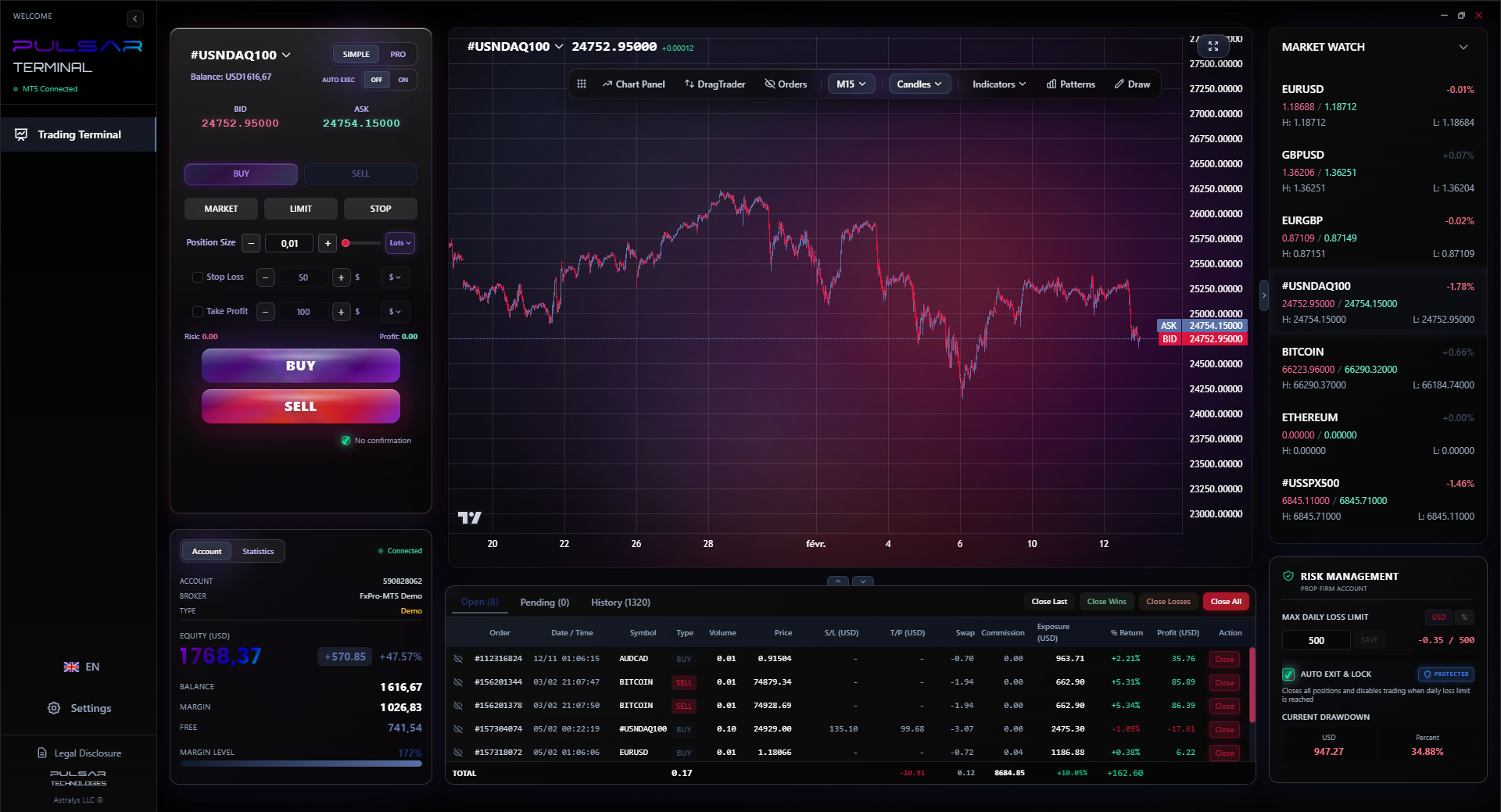
Managing multiple trades and moving stops to breakeven on a 1-minute chart is frantic manual work, which is why I use Pulsar Terminal to automate these risk management rules directly within my MT5 platform.
Pulsar Terminal
The all-in-one MT5 companion: drag-and-drop orders, multi-TP/SL, trailing stop, grid trading, Volume Profile, and prop firm protection. Used by 1,000+ traders daily.
Your broker and platform are not just a place to execute trades. They are part of your strategy's infrastructure. For 1-minute scalping in South Africa, here’s what I prioritize:
| What Matters | Why It Matters for 1-Minute Trading | What to Look For |
|---|---|---|
| Regulation | Safety of your funds and fair practice. | FSCA license number, clear on their website. |
| Spreads & Commissions | Directly eats into your small profits. | Raw/ECN accounts with tight spreads (under 0.5 pips on majors) and low commission. |
| Execution Speed & Slippage | A slow fill can ruin your entry/exit price. | Look for broker reviews mentioning fast execution. XM review often highlights their execution servers. |
| Platform Stability | A platform crash during a trade is a nightmare. | MetaTrader 4/5 is industry standard and stable. Check if the broker supports it. |
| Minimum Deposit | Allows you to start with sensible risk. | R500 - R2000 is common. Avoid brokers requiring R10,000 to start a scalping account. |
I use MetaTrader 5. It's reliable, and most importantly, it supports a environment of tools that automate my risk rules. After a bad experience manually missing a trailing stop, I started using tools that could automate partial closures and move stops to breakeven automatically. It took the emotion and the frantic clicking out of the equation.
For brokers, I've personally had good execution with Tickmill and IC Markets for this style. Their FSCA-regulated entities offer the raw spreads I need. Always check the specific legal entity you're signing up with to ensure it's the FSCA-regulated one, not their global brand.
💡 Winston's Tip
If you feel the urge to move your stop-loss further away, that's your signal to close the trade immediately. Your analysis was wrong. Accept the small loss.
“You can have the best 1 minute strategy forex setup in the world, and poor risk management will still destroy you.”
Let me be the cautionary tale so you don't have to be.
Pitfall 1: Overtrading. This is the biggest one. The 1-minute chart is noisy. It throws up what looks like a signal every few minutes. Early on, I'd take 20-30 trades a day. Most were mediocre. The commissions and spreads slaughtered me. I was busy, but not profitable. Solution: Define your A+ setup only. If it's not perfect, don't take it. 5 great trades are better than 25 okay ones.
Pitfall 2: Ignoring the Higher Time Frame. I'd see a beautiful bullish pin bar on the 1-minute chart and go long, only to get steamrolled because the 15-minute chart was in a strong downtrend. Solution: Always, always check the 15-minute or 1-hour trend direction. Trade in line with it. Swing trading principles still apply, even for scalpers.
Pitfall 3: Moving Stop-Losses. I'd put my stop 5 pips away. Price would move against me 4 pips, and in a panic, I'd move my stop to 10 pips away, "giving the trade room to breathe." Nine times out of ten, it would hit the new, bigger stop. Solution: Set your stop based on your strategy's logic (like below a swing low). Once it's set, DO NOT TOUCH IT unless you're moving it to breakeven or trailing it for profit protection. The stop-loss is there to protect you from you.
Pitfall 4: Trading During News. The 1-minute chart goes wild during major news like US Non-Farm Payrolls. Spreads widen to 10-20 pips, and price can spike 30 pips in a second. I learned this by getting stopped out instantly on what should have been a winning trade. Solution: Use an economic calendar. Don't trade the major pair 5 minutes before and 15 minutes after a high-impact news release. It's not worth the randomness.
FAQ
Q1Is 1-minute scalping forex profitable in South Africa?
It can be, but it's exceptionally difficult and not for most traders. Profitability depends entirely on your discipline, risk management, and ability to control costs (spreads, commissions). The FSCA's 1:30 use cap also means you need more precision, as you can't rely on extreme use to amplify tiny wins.
Q2What is the best broker for 1-minute scalping in South Africa?
There's no single 'best,' but you must choose an FSCA-regulated broker. Prioritize those offering Raw/ECN accounts with the tightest possible spreads (ideally under 0.5 pips on EUR/USD) and fast, reliable execution. Brokers like Tickmill, IC Markets, and Pepperstone have FSCA-licensed entities that are popular among experienced scalpers for these reasons.
Q3How much money do I need to start 1-minute forex trading?
You can start with a few thousand Rand, but it's about how you use it. With a R5,000 account and 1:30 use, you could control a position worth R150,000. However, to properly manage risk (e.g., risking 1% or R50 per trade with a 5-pip stop), your position size will be small. Many brokers have minimum deposits of R500-R2000. Start small to learn the strategy without significant financial pressure.
Q4What is a good win rate for a 1-minute strategy?
Because your profit targets are small (5-10 pips), you don't need a 90% win rate. A win rate between 55% and 65% can be very profitable if your risk-to-reward ratio is solid (e.g., 1:1.5 or better). The key is ensuring your average winning trade is larger than your average losing trade after accounting for all costs.
Q5Can I use a 1-minute strategy on USD/ZAR?
You can, but be cautious. USD/ZAR is less liquid than majors like EUR/USD, which often means wider spreads and more potential for slippage. These costs are magnified on a 1-minute strategy. If you do trade it, ensure you understand the average spread during your trading session and factor it directly into your profit targets and stop-loss distances.
Q6Do I need special software or a VPS to scalp?
It's highly recommended. A Virtual Private Server (VPS) keeps your trading platform running 24/7 with a super-fast, stable connection to the broker's servers. This minimizes latency, which is critical for fast execution. For the platform itself, MetaTrader 4/5 is standard, but using advanced tools that automate order management (like trailing stops) can give you a significant edge.
Prof. Winston's Lesson
Key Takeaways:
- ✓The spread is your primary enemy; choose ECN accounts.
- ✓Never risk more than 1% of your account on a single trade.
- ✓Always align your 1-minute direction with the 15-minute trend.
- ✓Set a strict daily loss limit of 3% and walk away.
- ✓Automate your stop-loss and take-profit management to remove emotion.
How useful was this article?
Click a star to rate
Weekly Trading Insights
Free weekly analysis & strategies. No spam.
About the Author
David van der Merwe
Emerging Markets Trader
Johannesburg-based trader with 11 years in emerging market currencies. Specializes in ZAR pairs, FSCA-regulated trading, and South African market analysis.
Comments
Risk Disclaimer
Trading financial instruments carries significant risk and may not be suitable for all investors. Past performance does not guarantee future results. This content is for educational purposes only and should not be considered investment advice. Always conduct your own research before trading.
You Might Also Like

Cara Trading Forex Sukses: 7 Prinsip dari Trader Profesional
Cara trading forex sukses dengan 7 prinsip trader pro: manajemen modal, disiplin, journal trading, backtest. Data nyata, bukan janji profit palsu.
Jam Trading Forex Terbaik untuk Trader Indonesia: Panduan Lengkap dengan Tabel Waktu
Panduan jam trading forex untuk trader Indonesia. Tabel 4 sesi dunia, jam emas 20:00-00:00, sesi mana yang harus dihindari. Data akurat + tips dari trader berpengalaman.
Top 5 Sàn Forex Uy Tín Nhất 2026: Review Jujur dari Trader Indonesia
Top 5 sàn forex uy tín 2026 untuk trader Indonesia. Review jujur: spread, deposit, withdraw, dukungan lokal. Exness, XM, IC Markets & lebih.
Get Pulsar Terminal
All these calculators are built into Pulsar Terminal with real-time data from your MT5 account. One-click position sizing, automatic risk management, and instant calculations.
Get Pulsar Terminal