


I remember a student, let's call him Thabo, emailing me in a panic.

David van der Merwe
Emerging Markets Trader ·  South Africa
☕ 10 min read
What you'll learn:
- 1What 1st Contact Forex Really Is (Spoiler: Not a Broker)
- 2The South African Rules You Can't Ignore
- 3Costs: Money Transfer Margins vs. Trading Spreads & Commissions
- 4So, Where Should South Africans Actually Trade Forex?
- 5Your First Real Steps into Forex Trading
- 6Pitfalls I See South African Beginners Make Every Time
- 7The Final Verdict on 1st Contact Forex
I remember a student, let's call him Thabo, emailing me in a panic. He'd deposited R15,000 with '1st Contact Forex' and couldn't find the MT4 login. He'd spent a week trying to 'analyse the charts' on their website, which only showed transfer rates. He'd confused a currency exchange service for a leveraged trading broker. It's a common, expensive mix-up. This isn't a story about a clever trade; it's about preventing a costly mistake before you even start. If you're in South Africa and hearing about '1st Contact Forex', you need to understand exactly what it is, what it isn't, and where you should actually go if you want to trade.
Let's get this straight from the start. 1st Contact Forex is not a forex trading broker where you speculate on currency prices with use. It never was. It's an international money transfer and currency exchange service. Think of it like a more sophisticated version of your bank's forex desk for sending money overseas. They've now been absorbed into a larger company called Sable International, but the core service remains the same: helping individuals and businesses convert and send Rands to Pounds, Euros, Dollars, and other currencies.
Their clients are typically people emigrating, paying for international tuition, buying property abroad, or businesses paying overseas suppliers. They make money by adding a margin (typically between 1.5% and 2%) to the interbank exchange rate. It's a straightforward service, but it has absolutely nothing to do with the fast-paced, leveraged world of retail forex trading on platforms like MT4 or MT5. Confusing the two is like confusing a bus ticket with a Formula 1 car.

Warning: If you landed here looking for MT4/MT5 login details for 1st Contact Forex, stop. You have the wrong company. You cannot trade CFDs or use use with them. You need a regulated broker like Exness, IC Markets, or XM.

💡 Winston's Tip
If a company's website talks more about 'sending money to the UK' than about charts and pips, you're not looking at a trading broker. You're in the wrong queue.
“Confusing a money transfer service for a trading broker is like confusing a bus ticket with a Formula 1 car.”
Whether you're sending money or trading, South Africa has strict rules. Get them wrong, and you're looking at fines or frozen accounts.
For Money Transfers (The 1st Contact World)
The South African Reserve Bank (SARB) controls how much money you can move out of the country. As a resident, you get two main allowances:
- Single Discretionary Allowance: R1 million per year. You can send this for any reason (holidays, online shopping) without tax clearance.
- Foreign Investment Allowance: R10 million per year. This requires a Tax Compliance Status (TCS) PIN from SARS first.
Services like 1st Contact Forex (Sable International) are licensed by the Financial Sector Conduct Authority (FSCA) to handle these transfers legally. They do the compliance paperwork for you. Trying to bypass these channels is illegal.
For Trading (The Real Forex World)
This is where the FSCA wears its other hat. If you want to trade forex CFDs (Contracts for Difference), you must use a broker regulated by the FSCA or another top-tier regulator. An FSCA license means the broker must segregate your funds from their own, provide clear risk warnings, and adhere to use limits. Trading with an unregulated offshore bucket shop might seem tempting with their crazy 1:3000 use, but when they disappear with your deposit, you have exactly zero recourse. The FSCA can't help you.
I learned this the hard way early on. I chased high use with an unregulated firm, made a few quick wins, and then couldn't withdraw my 'profits'. The site just vanished. Consider that tuition fees paid.
“Starting with R500 is a guaranteed way to blow up because your position sizing will be insane.”
This is where the financial reality hits. The costs for these two services are structured completely differently.
With 1st Contact Forex / Sable International: You pay a margin on the exchange rate. If the interbank rate for GBP/ZAR is 23.00, they might offer you 23.35. That 0.35 difference is their fee, baked into the rate. It's simple, transparent, and usually a one-time cost for your transfer. There are no hidden overnight fees or commissions per trade.
With a Forex Trading Broker: Your costs are ongoing and transactional. They come in three main forms:
- The Spread: The difference between the buy and sell price. This is how most 'commission-free' brokers make money. A typical spread on EUR/USD might be 0.6 to 1.2 pips. On a standard lot (100,000 units), a 1-pip spread equals a $10 cost to open the trade.
- Commissions: Some brokers, especially those offering raw spreads from 0.0 pips, charge a separate commission. It might be $3.50 per lot, per side. So, opening and closing a 1-lot trade costs $7.
- Swap Fees: If you hold a position overnight, you pay or receive a fee based on the interest rate differential between the two currencies. This can add up on longer-term swing trades.
Here’s a quick comparison of what you might actually pay:
| Service Type | Example Transaction | Typical Cost Structure |
|---|---|---|
| Money Transfer (1st Contact) | Converting R100,000 to GBP | 1.5-2% margin = R1,500 - R2,000 |
| Forex Trading (Broker) | Buying 1 standard lot of EUR/USD | Spread (0.6 pips = $6) + Possible Commission ($7) = ~$13 to enter & exit |

Example: Let's say you use a broker with a 0.8 pip spread on EUR/USD and no commission. You buy 1 mini lot (10,000 units). Each pip is worth $1. Your cost to enter is 0.8 * $1 = $0.80. That's far less than a money transfer margin, but remember, you'll pay it on every single trade you make.
“Starting with R500 is a guaranteed way to blow up because your position sizing will be insane.”
If your goal is active trading, you need a proper broker. Here’s the blunt truth about the local scene, based on my 12 years of testing platforms and watching students succeed and fail.
You want an FSCA-regulated broker. Full stop. It’s your first line of defence. Here are a few that consistently come up for South African traders, along with my take:
- IC Markets: My go-to for raw spreads and low commissions. Their Raw Spread account is fantastic for scalping and high-volume trading. Minimum deposit is $200 (about R3,700). Execution is solid.
- Exness: They’re huge in Africa for a reason. Their registration process is smooth for SA clients, and they offer unique features like unlimited use (use with extreme caution!). Minimum deposit can be as low as $10, but starting with that is a recipe for a quick margin call.
- XM: Excellent for beginners. Their minimum deposit is just $5, they have tons of educational material, and they offer ZAR-based accounts. Spreads are slightly higher than IC Markets, but it’s a fair trade-off for the user-friendly environment.
- Pepperstone: Another top-tier, FSCA-regulated option. Their Razor account is similar to IC Markets, with tight spreads and a commission. Their customer support is very responsive.
My personal experience? I ran a 6-month test between IC Markets and a larger, more ‘beginner-friendly’ broker. On 100 identical EUR/USD trades, the lower spreads and commissions at IC Markets saved me over $420 in trading costs. That’s real money that stays in your pocket.

Pro Tip: Don’t get hypnotised by the ‘ZAR Account’ label. Often, it just means your deposit is converted from Rands once, and then you trade in USD, EUR, etc. The real questions are: Are they FSCA regulated? What are the spreads on the pairs you will trade? What’s the withdrawal process like?
💡 Winston's Tip
Your first R5,000 in trading isn't capital. It's tuition fees. Expect to pay it to the market while you learn. The goal is to make that tuition last as long as possible.
“use is a tool, not a trophy. A 0.05% move against you at 1:2000 use wipes out your entire margin.”
Okay, you know 1st Contact Forex isn't the answer. You've picked a regulated broker. Now what? Let's build your foundation, brick by brick.
1. Start with a Demo Account. No, Really. Every broker offers one. Use it for at least two months. Treat the virtual $50,000 as if it were your R5,000. This is where you learn the platform - how to place orders, set stops, use the position size calculator - without the gut-churning fear of loss.
2. Keep Your Real Capital Small and Sacred. The biggest lie in forex is that you need little money to start. Technically true, psychologically false. Starting with $50 (R900) is a guaranteed way to blow up because your position sizing will be insane. My strong advice for South Africans? Start with no less than R5,000. With R5,000, you can risk a sane 1% (R50) per trade and actually learn. I started with R2,000 and wiped it out in three trades because my risk was 10% per shot. Stupid.
3. Learn One Strategy, One Pair. Don't jump from EUR/USD to gold to the JSE Top 40. Pick one major pair like EUR/USD or XAU/USD (gold). Learn its personality. Then, learn one simple strategy. Maybe it's price action with support/resistance. Maybe it's a basic MACD and RSI crossover. Master it on your demo account. Document every trade.
4. Understand What You're Actually Trading. You're not buying physical dollars. You're trading CFDs (Contracts for Difference). This is a critical distinction. It means you're speculating on the price movement. You can go long (buy) if you think the base currency will rise, or short (sell) if you think it will fall. This ability to profit in a falling market is a key advantage over traditional investing.
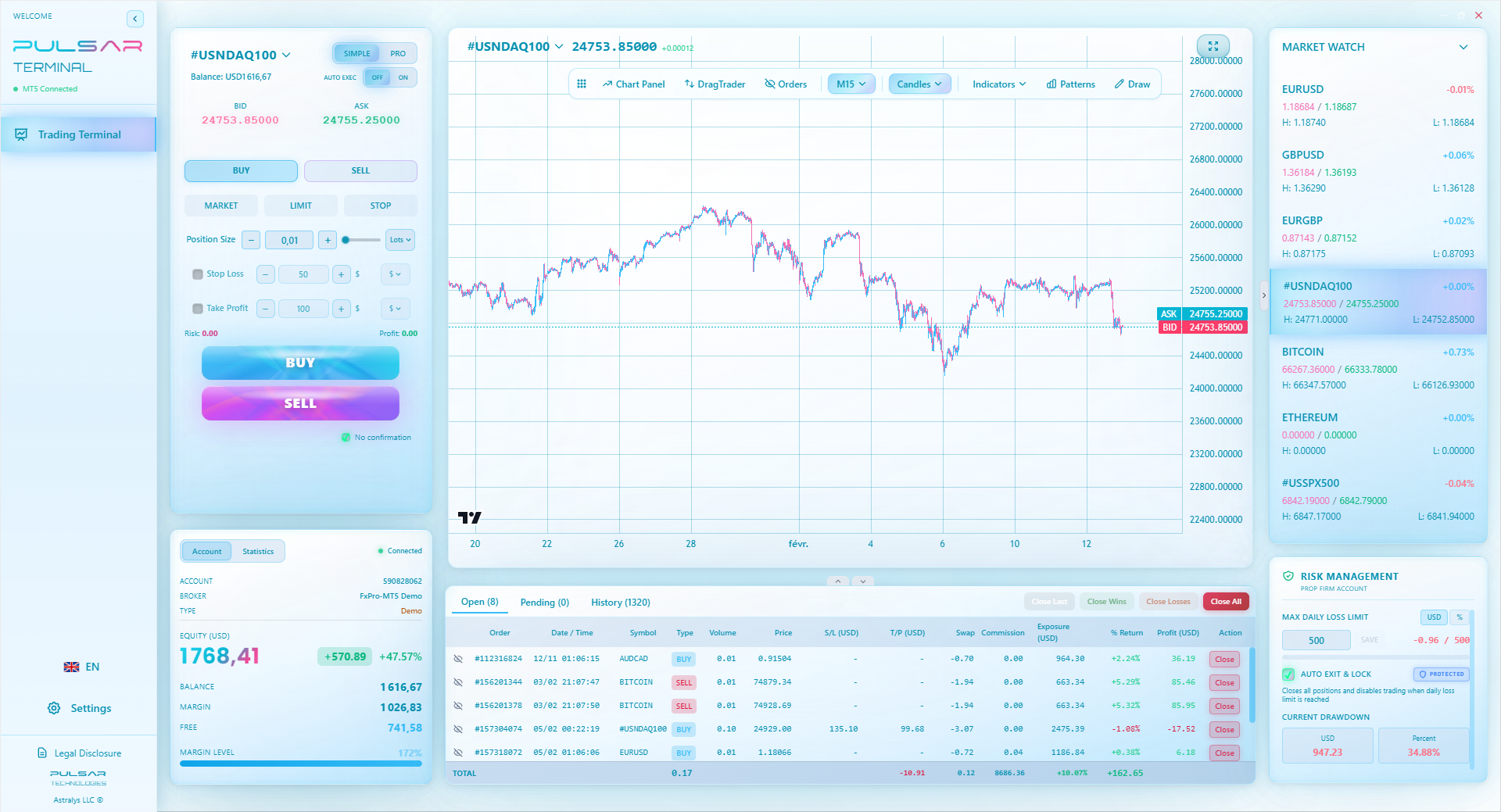
When you're ready to move from demo to live trading, managing multiple orders and stops manually on MT5 becomes a headache; Pulsar Terminal automates this with drag-and-drop order grids and one-click trailing stops.
Pulsar Terminal
The all-in-one MT5 companion: drag-and-drop orders, multi-TP/SL, trailing stop, grid trading, Volume Profile, and prop firm protection. Used by 1,000+ traders daily.
“use is a tool, not a trophy. A 0.05% move against you at 1:2000 use wipes out your entire margin.”
After mentoring hundreds of local traders, the same mistakes pop up like weeds. Let's spray them now.
Pitfall 1: Chasing use. Just because a broker like Exness offers 1:2000 use doesn't mean you should use it. At 1:2000, a 0.05% move against you wipes out your entire margin. I once used 1:500 use on a 'sure thing' in GBP/JPY. The news spike lasted 8 seconds and took 60% of my account with it. use is a tool, not a trophy. Start at 1:10 or 1:20 max.
Pitfall 2: Ignoring the Rand's Volatility. Trading ZAR pairs (like USD/ZAR) can be tempting because you 'understand' the Rand. It's a trap. The spreads are wide (often 50-100 pips), and the volatility is brutal. News about Eskom or a cabinet reshuffle can cause 500-pip moves in minutes. It's not a beginner's playground. Stick to the major pairs where liquidity is high and spreads are tight.
Pitfall 3: Withdrawal Day Surprises. You made a profit! Now you want your Rands. Before you deposit, understand the broker's withdrawal policy. How long does it take (2-5 business days is normal)? What are the fees? Do they require verified SA bank accounts in your name? Test this with a small amount first. Nothing kills morale faster than a successful trade followed by a 3-week withdrawal nightmare.
Pitfall 4: The 'Side Hustle' Mentality. This isn't a side hustle. It's a skill-based profession. Approaching it as a 'quick cash gig' is the fastest path to losing your money. It requires study, discipline, and emotional control. Treat it with the seriousness of learning a new trade.
💡 Winston's Tip
The Rand is a moody beast. Trading it feels familiar, but that familiarity is a liar. Start with the calm, deep waters of EUR/USD.
“Your first R5,000 in trading isn't capital. It's tuition fees.”
Let's wrap this up clearly.
Use 1st Contact Forex (Sable International) IF: You need to send money overseas for emigration, tuition, or property. They are a legitimate, FSCA-regulated money transfer service that will help you navigate SARB allowances and get a competitive exchange rate. They serve a specific, important purpose.
Avoid 1st Contact Forex IF: You are looking for an online platform to speculate on currency price movements with use. You will be disappointed and waste your time. That is simply not their business.
Your journey to trading starts with the right broker, a funded demo account, and a commitment to learn risk management before chasing profits. The fact that you're reading this guide means you're already ahead of Thabo, who confused the two worlds. Learn from his R15,000 lesson. Define your goal - transferring money or trading - and then use the right tool for the job.
FAQ
Q1Can I trade forex with 1st Contact Forex?
No, you absolutely cannot. 1st Contact Forex (now Sable International) is not a leveraged forex trading broker. It is a currency exchange and international money transfer service. You cannot download MetaTrader, use use, or trade CFDs with them.
Q2Is 1st Contact Forex regulated in South Africa?
Yes, but for money transfers, not for trading. Their entity, Sable International FX (PTY) Ltd, is regulated by the Financial Sector Conduct Authority (FSCA) as a financial services provider (FSP No. 517570) for currency exchange and transfer services. They are not licensed to offer speculative CFD trading.
Q3What is the difference between forex trading and money transfer?
Money transfer is exchanging one currency for another at the current rate (plus a fee) to send funds abroad. Forex trading is speculating on the future price movements of currency pairs using leveraged derivatives (CFDs). You aim to profit from the price change without ever needing the physical currency.
Q4What is a good minimum amount to start forex trading in South Africa?
While some brokers allow deposits as low as $5, a psychologically and practically sensible minimum is R5,000. This allows you to risk a responsible 1% (R50) per trade and withstand normal market volatility without being wiped out by a single loss. Starting with too little forces you to use excessive risk.
Q5Which FSCA-regulated brokers are best for South African beginners?
For beginners, XM is a strong choice due to its low minimum deposit ($5), ZAR account options, and extensive education. For those focused on low costs from the start, IC Markets and Pepperstone offer excellent conditions. Always verify the broker's current FSCA license status before depositing.
Q6Can I use my Single Discretionary Allowance to fund a forex trading account?
Technically, yes. Your R1 million annual allowance can be used to transfer funds to an overseas broker. However, you must ensure the broker is reputable and regulated. It is generally safer and simpler for beginners to use an FSCA-regulated broker that accepts direct ZAR deposits via local payment methods.
Q7Why are spreads on USD/ZAR so high compared to EUR/USD?
USD/ZAR is an exotic pair with lower liquidity and higher volatility than major pairs like EUR/USD. The wider spread (often 50-100 pips) compensates the broker for the higher risk of holding the less-liquid Rand. For this reason, it's not recommended for new traders.
Prof. Winston's Lesson
Key Takeaways:
- ✓1st Contact Forex is for money transfers, not trading.
- ✓Always use an FSCA-regulated broker in SA.
- ✓Start with at least R5,000 real capital.
- ✓Use max 1:20 use as a beginner.
- ✓Avoid ZAR pairs at the start.
How useful was this article?
Click a star to rate
Weekly Trading Insights
Free weekly analysis & strategies. No spam.
About the Author
David van der Merwe
Emerging Markets Trader
Johannesburg-based trader with 11 years in emerging market currencies. Specializes in ZAR pairs, FSCA-regulated trading, and South African market analysis.
Comments
Risk Disclaimer
Trading financial instruments carries significant risk and may not be suitable for all investors. Past performance does not guarantee future results. This content is for educational purposes only and should not be considered investment advice. Always conduct your own research before trading.
You Might Also Like

Cara Trading Forex Sukses: 7 Prinsip dari Trader Profesional
Cara trading forex sukses dengan 7 prinsip trader pro: manajemen modal, disiplin, journal trading, backtest. Data nyata, bukan janji profit palsu.
Jam Trading Forex Terbaik untuk Trader Indonesia: Panduan Lengkap dengan Tabel Waktu
Panduan jam trading forex untuk trader Indonesia. Tabel 4 sesi dunia, jam emas 20:00-00:00, sesi mana yang harus dihindari. Data akurat + tips dari trader berpengalaman.
Top 5 Sàn Forex Uy Tín Nhất 2026: Review Jujur dari Trader Indonesia
Top 5 sàn forex uy tín 2026 untuk trader Indonesia. Review jujur: spread, deposit, withdraw, dukungan lokal. Exness, XM, IC Markets & lebih.
Get Pulsar Terminal
All these calculators are built into Pulsar Terminal with real-time data from your MT5 account. One-click position sizing, automatic risk management, and instant calculations.
Get Pulsar Terminal