


I lost ₹47,000 in three days trying to trade a 'proven' strategy from a PDF I downloaded.

Rajesh Sharma
Senior Forex Analyst ·  India
India
☕ 10 min read
What you'll learn:
- 1The PDF Fantasy vs. Market Reality
- 2India's Hidden Trade Taxes: The Silent Strategy Killer
- 3The Brokerage War and Your Strategy's P&L
- 4Regulatory Landmines: The SEBI 2026 Rulebook
- 5Building a Strategy That Survives in India
- 6Real Indicators, Real Setups (For India)
- 7Your Action Plan: Ditch the PDF, Build Your Edge

I lost ₹47,000 in three days trying to trade a 'proven' strategy from a PDF I downloaded. The setup was simple: buy when the 20-period moving average crossed above the 50-period on the Nifty 50. It worked perfectly on the historical charts in the document. In real trading, with slippage, brokerage, and the STT tax on every sell order, it was a consistent loser. That experience taught me a brutal lesson: a strategy without context is just a fancy way to lose money. The hunt for a magical '51 trading strategies pdf' is the first sign a trader is looking for a shortcut, not an edge. Let's talk about why that search is dangerous and what you actually need to know about trading in India.
You've seen the ads. 'Download 51 Proven Trading Strategies PDF Free!' It promises a treasure map to consistent profits. Here's the hard truth: if such a document existed and worked, the person selling it wouldn't need your ₹499. They'd be using it to print money.
Most of these PDFs are generic, often written for Western markets like the US or UK. They ignore the single biggest factor in your profitability: local market structure. Trading a momentum breakout strategy designed for the S&P 500 on the Nifty Bank index without adjusting for India's higher transaction costs is like using a monsoon survival guide in a desert.
The real 'strategy' isn't in the indicator settings. It's in understanding the environment your trade lives in. A 1% gain on paper can vanish into a 0.5% loss after you account for all the bites taken out of your trade. Let's break down those bites.

Warning: Any strategy PDF that doesn't explicitly discuss Securities Transaction Tax (STT), brokerage models (flat fee vs. percentage), and SEBI turnover fees is useless for live Indian trading. It's academic theory, not a practical tool.

This is where most imported strategies die. You can't backtest a strategy honestly without baking these costs into every single simulated trade. Ignoring them is self-deception.
The Cost of Doing Business (Literally)
Let's say you execute a ₹1,00,000 intraday trade in Nifty futures. Here’s where your money goes on the sell side:
| Charge | Rate | Amount (₹) | Who Gets It |
|---|---|---|---|
| Securities Transaction Tax (STT) | 0.05% | ₹50 | Government of India |
| Exchange Transaction Charge | ~0.002% (varies) | ~₹2 | NSE/BSE/MCX |
| SEBI Turnover Fee | 0.0001% + GST | ~₹1.18 | SEBI |
| Stamp Duty | ~0.002% | ~₹2 | State Government |
| Brokerage | ₹20 (flat, discount broker) | ₹20 | Your Broker |
| GST on Brokerage | 18% on ₹20 | ₹3.60 | Government |
| Approximate Total Cost | ₹78.78 |
That's nearly 0.08% gone before your trade even has a chance to breathe. For a delivery-based equity trade, STT is 0.1% on both the buy and sell. These aren't fees, they're friction. A strategy that aims for lots of small, 0.3% gains will be obliterated. This is why understanding your position size calculator is non-negotiable - it has to account for this friction.
The Tax That Changes Everything
STT is unique to India. The 2026 budget hike (0.05% on futures, 0.15% on options) directly attacked high-frequency and scalping strategies. If your '51 trading strategies pdf' includes a scalping strategy that assumes 10 trades a day, it's mathematically doomed here. Each scalp needs to overcome not just the spread, but this government-mandated toll.
My own mistake was using a swing trading method from an American guru. It had a 55% win rate targeting 2% gains. Sounded great. But after STT, brokerage, and the new 12.5% LTCG tax on the winning swings I held over a year, my expected return dropped into negative territory. I was optimizing for a market that didn't exist.

💡 Winston's Tip
A strategy's first test isn't profitability, it's cost survivability. If it can't clear the hurdle of STT + brokerage, it's a loser before you even place the trade.

“Your edge isn't a secret from a PDF; it's the rigorous work of adapting a sound principle to the costly reality of trading in India.”
India's brokerage landscape splits into two camps, and your choice fundamentally alters which strategies are viable.
Discount Brokers (Zerodha, Upstox, 5paisa): They charge a flat fee, often ₹20 per executed order for intraday/F&O, and ₹0 for equity delivery. This is a game-changer. It makes high-frequency, small-position trading prohibitively expensive, but it's a gift for position traders. If your strategy involves taking one or two delivery trades a month, your brokerage cost is effectively zero.
Full-Service Brokers (HDFC Sec, ICICI Direct): They charge a percentage of turnover (often 0.3-0.5% for delivery). This quietly murders long-term compounding. A 0.4% fee on a ₹1 lakh buy and another 0.4% on the sell is ₹800 gone. On a 10% annual return, that's 8% of your profit vanished to fees alone.

Pro Tip: Always, always run your strategy through a cost simulator. For a delivery-based strategy, a full-service broker can cost you 10x more than a discount broker. That difference is the edge you're trying to find in the charts.
The rise of platforms like Zerodha's Kite and Upstox, with their clean APIs, also ties into the new SEBI algo rules. If you're building a systematic strategy, you need a broker that supports it within the regulatory framework. A generic PDF won't tell you that.

This is the most critical, most overlooked section for any serious trader. SEBI's 2026 regulations, especially around algorithmic trading, have redrawn the battlefield.
If your '51 strategies' include any form of automated trading, you are now in a regulated activity. The key rule: retail traders can develop their own algos, but if your system fires more than 10 orders per second per exchange, you must register it.
Think about that. A simple grid trading bot that places 5 buy orders on a dip could easily hit that threshold during volatility. Suddenly, you're not just a trader, you're a software provider needing exchange approval. Brokers like Dhan and Upstox that offer API access are your gatekeepers, and they are now mandated to have kill switches and audit trails on your activity.
The AI/ML Trap
Many modern strategy PDFs tout 'AI-powered signals.' Under SEBI's 2026 focus, any AI/ML algorithm must be transparent and ethical. In practice, this means you need to be able to explain why it took a trade. A black-box neural network from a PDF that you don't understand could get your broker's API access revoked.
The lesson? The era of casually downloading and running a Python script from a forum is over. Your strategy's infrastructure is now as important as its logic. Tools that help manage this complexity, like trade management terminals that work within your broker's platform, are becoming essential. For example, managing a prop firm challenge with strict daily loss limits is a huge manual burden. Automating that protection directly on your MT5 terminal prevents a simple mistake from blowing your account - and your chance at funded capital.
This regulatory shift makes a mockery of static PDFs. The rules changed in April 2026. Is your PDF updated? Probably not.
💡 Winston's Tip
Your broker's P&L statement is a lie. It shows pre-tax, pre-cost 'gross' profit. Your real profit is what hits your bank account after all deductions. Track that number religiously.

“A 1% gain on paper can vanish into a 0.5% loss after STT, brokerage, and GST. That's the market's silent tax on the unprepared.”
Forget 51 strategies. You need one strong one. Here’s how to build it for the Indian context.
1. Start with the Instrument, Not the Indicator. Are you trading Nifty Futures, Bank Nifty Options, or Reliance delivery? Each has a different cost structure and liquidity. Nifty Futures have tight spreads but STT. A XAU/USD guide is irrelevant here - focus on the instruments your broker offers on Indian exchanges.
2. Choose Your Timeframe Based on Costs.
- Scalping (Minutes): Nearly impossible profitably due to STT + brokerage. Needs a massive edge.
- Intraday (Hours): Possible, but you must factor in the 0.025% STT on every sell order. Strategies need wider stops and targets.
- Swing Trading (Days/Weeks): More viable. STT is lower for delivery (0.1%), but you face margin call risks if over-leveraged.
- Investing (Months/Years): Costs are minimal (mostly brokerage), but you face the 12.5% LTCG tax on gains over ₹1.25 lakh.
3. Integrate Taxes into Your Backtest. Your trading journal must have columns for STT, Brokerage, and GST. Your profit is what's left after these. I now add a flat 0.15% 'friction cost' to every trade in my initial testing. If a strategy isn't profitable with that handicap, I scrap it.
4. Risk Management is Your Only Sacred Rule. A strategy is just an idea. Risk management is the law. No PDF can give you the discipline to follow it. This means:
- Never risking more than 1-2% of capital on a single trade.
- Having a clear stop-loss that's determined before you enter.
- Knowing your exit plan for both profit and loss.

Example: You have a ₹1,00,000 account. Your 1% risk is ₹1,000. You buy Reliance at ₹2,900, with a stop-loss at ₹2,850. That's a ₹50 risk per share. Your position size is ₹1,000 / ₹50 = 20 shares. Not 50, not 100. Twenty. This is non-negotiable.
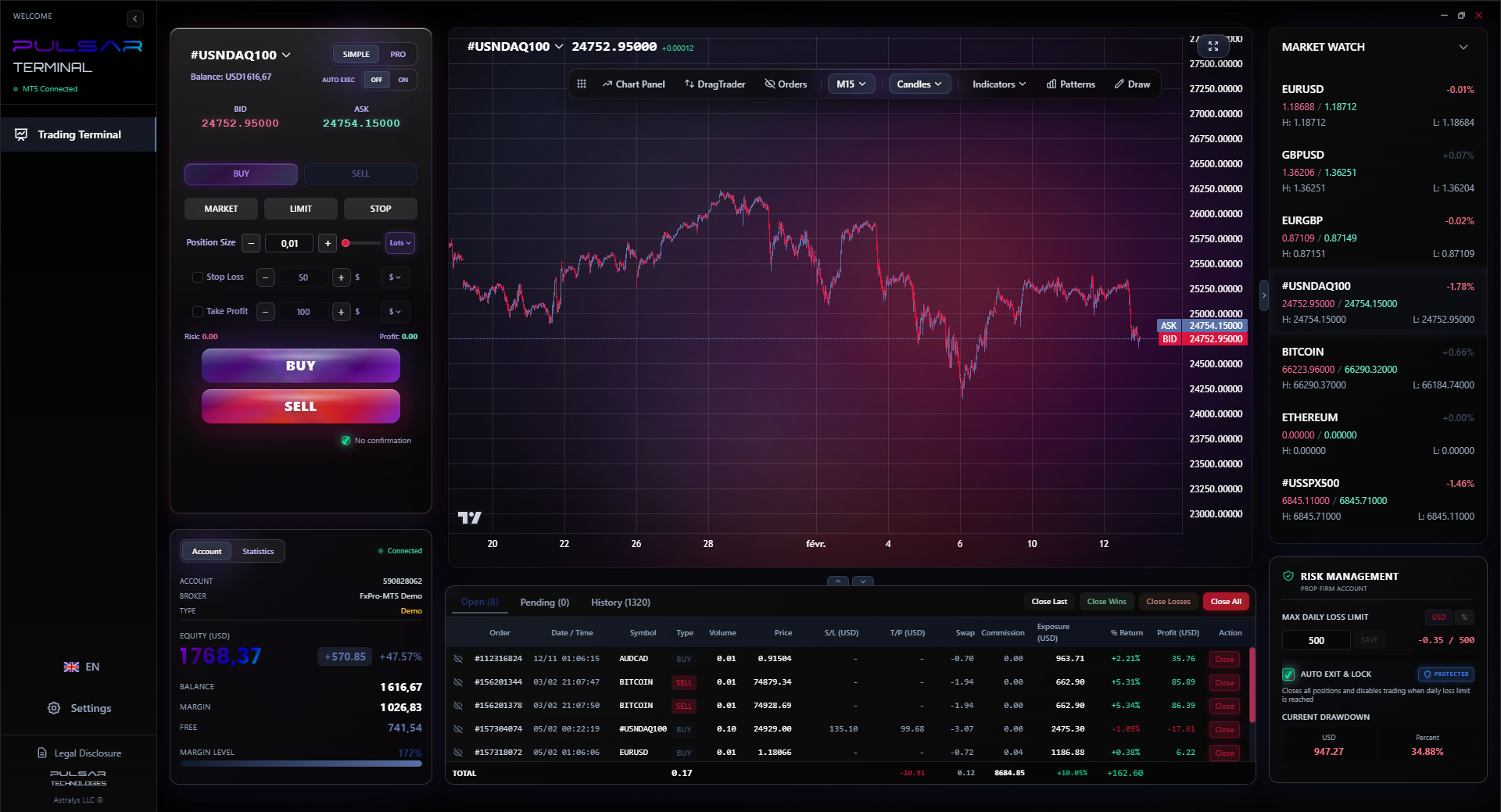
Managing complex strategies and strict risk rules like prop firm daily loss limits is exhausting to do manually; a tool that automates this on your MT5 terminal turns discipline from a struggle into a system.
Pulsar Terminal
The all-in-one MT5 companion: drag-and-drop orders, multi-TP/SL, trailing stop, grid trading, Volume Profile, and prop firm protection. Used by 1,000+ traders daily.
Let's get specific. Here are two simple, cost-aware concepts that are more valuable than 51 vague PDF pages.
Concept 1: Volume-Price Breakout (For Delivery Swing Trades) Goal: Catch sustained moves in large-cap stocks, holding for weeks to minimize turnover costs.
- Setup: Stock consolidates for several weeks on declining volume.
- Trigger: Price breaks above consolidation high on volume > 150% of 20-day average.
- Entry: On close above the high.
- Stop Loss: Below the consolidation low.
- Why it works here: Low frequency (few trades a year). Aims for larger moves (10%+) to absorb delivery STT and LTCG tax. Uses volume to filter false breakouts common in Indian markets.
Concept 2: Options Selling for Premium (Understanding the 2026 STT Hike) Selling options (writing) is popular, but the 2026 STT hike to 0.15% on the premium is a major headwind.
- Old Thinking: Sell weekly options for small premium.
- New Reality: The STT eats a huge chunk of small premiums. A ₹50 premium now has ₹0.075 STT + brokerage + GST.
- Adaptation: Move to selling monthly or wider out-of-the-money options for larger premiums. The STT as a percentage of your total premium collected becomes smaller. It forces you to be more selective and strategic, not just selling premium mechanically.
These aren't 'signals.' They are frameworks. You must test them, measure the slippage and costs on your broker, and see if they fit your psychology. An RSI indicator divergence might work, but only if the resulting trade can overcome ₹80 in costs. A MACD indicator crossover needs a wide enough subsequent move to be worth the tax bill.

“The SEBI 2026 algo rules didn't ban retail trading. They banned careless, unaccountable automation. And that's a good thing.”
- Audit Your Costs: Log into your broker's console. Download your last 20 trades. Add a column and calculate the total charges (STT, Brokerage, GST, etc.) for each. Divide this by your net P&L. This percentage is your personal friction coefficient. If it's above 30%, your strategy is too sensitive to costs.
- Pick ONE Market: Nifty Futures, Bank Nifty Options, or a single large-cap stock. Learn everything about its rhythm, liquidity, and typical daily range.
- Learn ONE Setup: Based on your cost audit and timeframe, choose one simple setup. Could be a moving average crossover, a support/resistance bounce, anything. But you must define every rule: entry, stop loss, target, position size.
- Paper Trade for 100 Trades: Use a demo account or a detailed spreadsheet. Record every trade with all costs simulated. Do not skip this. This is where you discover if your 2% target turns into a 1.2% net gain.
- Scale with Discipline: After 100 statistically significant paper trades with a positive expectancy, start with a tiny live capital amount. The goal is to validate your psychology, not get rich.
The market doesn't care about your 51 strategies. It cares about your net balance after all deductions. Your edge isn't a secret from a PDF; it's the rigorous, boring work of adapting a sound principle to the specific, costly, and regulated reality of trading in India. Start there.
FAQ
Q1I found a free 51 trading strategies PDF. Is it worth reading?
As a reference for general concepts, maybe. As a literal trading manual, absolutely not. It will not account for STT, SEBI turnover fees, Indian brokerage models, or the 2026 algo trading regulations. Using it without adjusting for these will lose you money.
Q2What is the single biggest mistake Indian traders make with strategies?
Ignoring transaction costs. They see a 1% gain on a chart and think they made money. After 0.1% STT (buy & sell), brokerage, GST, and fees, that 'gain' is often a net loss. They're trading against an invisible tax drag that's guaranteed, while their profits are uncertain.
Q3Has SEBI really banned retail algo trading?
No. SEBI has regulated it (2025-2026 framework). Retail traders can still use their own algorithms. However, if your algo places more than 10 orders per second per exchange, you must register it. Brokers must now provide secure APIs, kill switches, and audit trails. The era of unregulated algo trading is over.
Q4Should I use a discount or full-service broker for my strategy?
It depends entirely on your strategy's frequency. For high-frequency or intraday, discount brokers with flat fees (like ₹20/trade) are usually better. For long-term delivery investing, discount brokers with zero equity delivery brokerage are far superior. Full-service brokers' percentage-based fees are a major long-term drag on compounding.
Q5How do I adjust a foreign strategy for Indian markets?
First, identify all assumed costs in the foreign strategy (e.g., it might assume zero commission). Then, layer in Indian costs: add STT, estimate brokerage, add SEBI fee. This will force you to widen your profit targets or reduce your stop-losses to maintain a positive risk/reward. The strategy's parameters (like indicator periods) may need to be optimized for different market volatility as well.
Q6Is swing trading still viable after the LTCG tax increase?
Yes, but it changes the math. The tax is 12.5% on gains over ₹1.25 lakh in a financial year, with no indexation. This means you need to aim for larger swings to absorb the tax hit, or consider holding positions in segments with different tax treatment (like equity-oriented mutual funds, though they have their own STT). It makes frequent, small swing trades less attractive.
Prof. Winston's Lesson
Key Takeaways:
- ✓STT is a guaranteed loss; your strategy must overcome it first.
- ✓Discount brokers enable swing trading; full-service brokers cripple it.
- ✓SEBI's 10-orders/second rule defines modern algo trading.
- ✓Your real profit is post-tax, post-cost bank credit.
How useful was this article?
Click a star to rate
Weekly Trading Insights
Free weekly analysis & strategies. No spam.
About the Author
Rajesh Sharma
Senior Forex Analyst
Trading Indian and South Asian markets for over 10 years. Started with NSE currency derivatives before moving to international forex. Specializes in USD/INR and emerging market pairs.
Comments
Risk Disclaimer
Trading financial instruments carries significant risk and may not be suitable for all investors. Past performance does not guarantee future results. This content is for educational purposes only and should not be considered investment advice. Always conduct your own research before trading.
You Might Also Like

Cara Trading Forex Sukses: 7 Prinsip dari Trader Profesional
Cara trading forex sukses dengan 7 prinsip trader pro: manajemen modal, disiplin, journal trading, backtest. Data nyata, bukan janji profit palsu.
Jam Trading Forex Terbaik untuk Trader Indonesia: Panduan Lengkap dengan Tabel Waktu
Panduan jam trading forex untuk trader Indonesia. Tabel 4 sesi dunia, jam emas 20:00-00:00, sesi mana yang harus dihindari. Data akurat + tips dari trader berpengalaman.
Top 5 Sàn Forex Uy Tín Nhất 2026: Review Jujur dari Trader Indonesia
Top 5 sàn forex uy tín 2026 untuk trader Indonesia. Review jujur: spread, deposit, withdraw, dukungan lokal. Exness, XM, IC Markets & lebih.
Get Pulsar Terminal
All these calculators are built into Pulsar Terminal with real-time data from your MT5 account. One-click position sizing, automatic risk management, and instant calculations.
Get Pulsar Terminal