


You're probably wondering if you can really make money from forex trading.

Olumide Adeyemi
West African Trading Pioneer ·  Nigeria
☕ 10 min read
What you'll learn:
- 1What is Forex, and Why Do So Many Nigerians Trade It?
- 2The Real Costs of Starting in Nigeria
- 3Your First Trading Account: A Step-by-Step Walkthrough
- 4The Language of Forex: Pips, Lots, and Margin
- 5A Simple Beginner Strategy to Practice
- 6Common Pitfalls Every Nigerian Beginner Faces (And How to Avoid Them)
- 7What Success Really Looks Like (The First Year)
You're probably wondering if you can really make money from forex trading. The ads make it look easy, don't they? Cars, houses, financial freedom. I get it. I started with that same hope back in 2012, sitting in a cyber cafe in Lagos. The truth is, you can make money, but the path is nothing like the ads. It's messy, emotional, and requires a level of discipline most people don't have. This guide isn't about selling you a dream. It's about giving you the straight facts about forex trading for beginners, specifically for someone starting out in Nigeria today.
Forex, short for foreign exchange, is simply the market where you trade one currency for another. When you trade EUR/USD, you're betting on whether the Euro will get stronger or weaker against the US Dollar.
In Nigeria, forex trading exploded for a few hard reasons. First, the constant struggle with the Naira. Seeing the official rate, the black market (sorry, parallel market) rate, and the constant devaluations makes people look for ways to protect their money. Trading major pairs like GBP/USD or EUR/USD feels like accessing a more stable world.
Second, the lack of traditional opportunities. With high unemployment and inflation that eats savings, forex looks like a direct way to generate income. No boss, no office politics, just you and the charts. It's a powerful lure, but that's also where the danger lies. It's not a side hustle you learn in a weekend.

Warning: Many see forex as an escape from economic pressure. This is the worst mindset to start with. Desperation leads to overtrading and huge losses. You must approach it as a skill to be mastered, not a lottery ticket.
I learned this the hard way. In 2015, after the Naira took a hit, I put too much of my savings into a trade, trying to 'make up' for the loss in purchasing power. I was emotional. The trade went against me, and I lost ₦400,000 in a single afternoon. That loss taught me more than any winning trade ever did.
Let's cut through the 'start with $10' nonsense. Can you? Technically, yes. Should you? Absolutely not. Here’s what you really need to budget for.
The Broker Deposit
You need enough capital to survive your learning phase without blowing your account. I recommend a minimum of $200 (roughly ₦300,000+ depending on the rate). Why? With a standard lot (100,000 units), a 10-pip move is $10. On a $50 account, that's a 20% swing from one tiny move. You'll be margin-called constantly. Start with a micro or cent account if you must, but fund it properly. Check our Exness review and XM review for brokers popular here that offer these account types.
The Hidden Cost: Spreads and Commissions
This is how brokers really make money. The spread is the difference between the buy and sell price. If EUR/USD is quoted at 1.0850/1.0852, the spread is 2 pips. You start the trade in a 2-pip hole. On a $10,000 trade (0.1 lot), that's a $2 cost just to enter. Always look for brokers with raw spreads, especially if you're into scalping strategy.
The Education Budget
You will lose money learning. Period. That's your tuition fee. Set aside a specific amount - call it your 'practice capital' - and assume you might lose 100% of it. If that thought terrifies you, you're not ready to trade real money. Use a demo account for at least 3-6 months first.

Example: Your starting budget might look like this:
- Practice Capital (at risk): ₦150,000
- Reliable Internet & Power Backup: ₦50,000
- Education (Courses, Books): ₦30,000
- Total Initial Outlay: ~₦230,000
This isn't chump change. It's an investment in a new skill.

💡 Winston's Tip
Your first profitable strategy will be boring. If it feels exciting, you're probably gambling.
“Success is about consistent, small gains and strict risk management. It's about preserving your capital on bad days.”
- Choose a Regulated Broker: This is non-negotiable. In Nigeria, you'll likely use an international broker. Look for regulation from bodies like CySEC (Cyprus) or ASIC (Australia). Avoid any 'broker' that calls you unsolicited. I use IC Markets review for their raw spreads and reliability.
- Registration: You'll need a valid ID (International Passport, Driver's License, or National ID card) and a proof of address (utility bill or bank statement). The process is fully online.
- Account Type: Select a demo account first. Play with it for months. Then, move to a live account. For beginners, a 'Cent' account (where $1 = 100 cents) or a 'Micro' account (where lots are 1,000 units) is perfect. It lets you trade with real money psychology but with tiny, manageable risk.
- Funding: Most brokers offer bank wire, credit/debit cards, and e-wallets like Skrill, Neteller, or Sticpay. For Nigerians, using a domiciliary account card is often the smoothest. Deposits are usually instant.
- Download the Platform: MetaTrader 4 or 5 (MT4/MT5) is the industry standard. It looks intimidating at first, but you'll learn it. This is your cockpit.
Before you place a single real trade, master the platform on demo. Know how to set a stop loss, take profit, and modify orders. A sloppy platform error can cost you real money.
This is the basic math. Get it wrong, and you'll destroy your account.
- A Pip: The smallest price move a currency pair can make. For most pairs, it's 0.0001. If GBP/USD moves from 1.2600 to 1.2601, it moved 1 pip. For JPY pairs, it's 0.01. Understanding pip definition is your first step.
- A Lot: The standard unit size. One standard lot = 100,000 units of the base currency. Trading 1 lot of EUR/USD means you're trading €100,000. Thankfully, you can trade smaller sizes:
| Lot Size | Units | Nickname |
|---|---|---|
| 1.0 | 100,000 | Standard Lot |
| 0.1 | 10,000 | Mini Lot |
| 0.01 | 1,000 | Micro Lot |
| 0.001 | 100 | Nano Lot (often a Cent) |
- Margin & use: This is the double-edged sword. use lets you control a large position with a small deposit. Your broker might offer 1:500 use. This means with $200, you can control a $100,000 position (1 standard lot).

Pro Tip: High use is not a tool for making more money. It's a tool for using less capital. It amplifies both gains AND losses. I never use more than 1:10 use on my main account. As a beginner, stick to 1:10 or 1:20 max.
The Critical Calculation: Use a position size calculator for every single trade. Decide your risk first (e.g., 1% of your account). If you have a $1,000 account, you risk $10. If your stop loss is 20 pips away, you can only trade a position size where a 20-pip loss equals $10. That works out to 0.05 lots. This math keeps you alive.
💡 Winston's Tip
The Naira's volatility is a distraction. Focus on the pip movement in your chosen pair, not the conversion rate in your head.
“High use is not a tool for making more money. It's a tool for using less capital. It amplifies both gains AND losses.”
You need a rule-based way to enter and exit trades. Here's a dead-simple one I used early on, focusing on the daily chart for less stress. It combines support/resistance with a basic indicator.
- Find the Trend: Look at the daily chart of a major pair like EUR/USD guide. Are the price swings generally making higher highs and higher lows (uptrend)? Or lower highs and lower lows (downtrend)? Only take trades in the direction of the trend.
- Wait for a Pullback: In an uptrend, price won't go straight up. It will dip back down (pullback) to an area of previous support. Draw a horizontal line at a recent swing low.
- Look for a Signal: Add the RSI indicator to your chart (set to 14). Wait for the pullback to bring the RSI down to near 40 (but not below 30). In a downtrend, you'd wait for a rally that pushes RSI to near 60.
- Enter the Trade: Place a buy order if the price shows signs of bouncing off your support line and the RSI is turning back up from near 40. Your stop loss goes just below the recent swing low.
- Exit: Aim for a risk-to-reward ratio of at least 1:2. If your stop loss is 25 pips away, your take profit should be at least 50 pips away. You can use the next area of resistance as your target.
Practice this for 100 trades on a demo account. Write down every trade in a journal: why you took it, your emotion, the outcome. This builds discipline. For a different approach, learn about swing trading which uses similar concepts on longer timeframes.
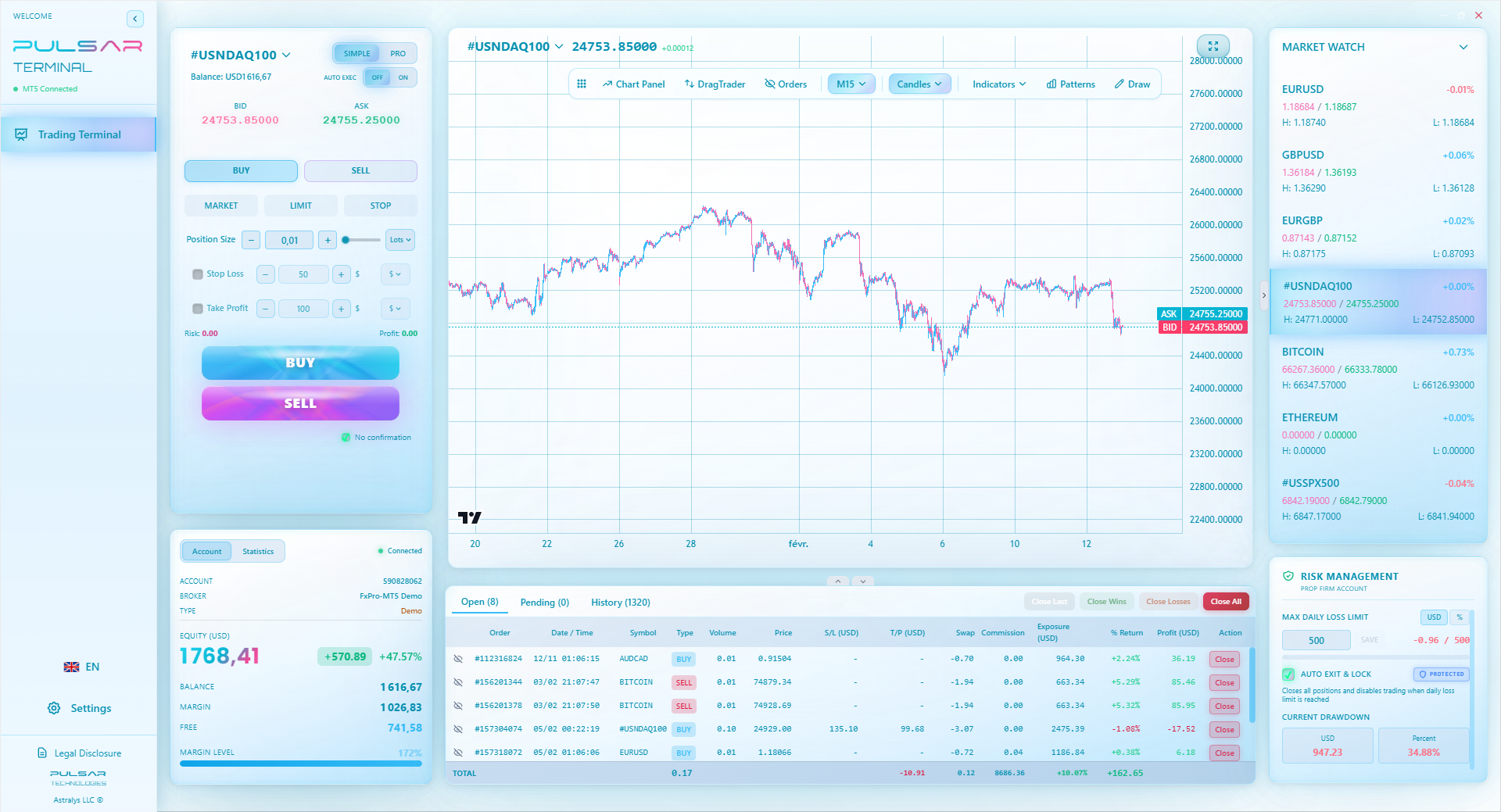
Managing multiple take-profit levels on a single trade, like in the gold example, is complex manually, but tools like Pulsar Terminal automate this directly on your MT5 platform.
Pulsar Terminal
The all-in-one MT5 companion: drag-and-drop orders, multi-TP/SL, trailing stop, grid trading, Volume Profile, and prop firm protection. Used by 1,000+ traders daily.
I've seen these destroy more accounts than any market crash.
- Trading Based on WhatsApp Signals: This is the biggest one. You join a group, someone shouts 'BUY GBPUSD NOW!', and you slam the button without understanding why. You're giving your hard-earned Naira to a stranger's guess. You will not learn, and you will lose. I followed a 'guru' in 2014 and lost three consecutive trades, totaling ₦180,000, before I stopped.
- No Stop Loss: This is suicide. You say 'it will come back.' Sometimes it doesn't. A single trade can wipe you out. A stop loss is your life jacket. A margin call is what happens when you don't wear it.
- Overleveraging: Using 1:500 use because it's there. A 20-pip move against you can wipe out 100% of your capital. It feels like you're making progress fast until you're not.
- Funding Your Account with Rent Money or School Fees: The pressure will make you a terrible trader. Only trade with risk capital you can afford to lose completely.
- Changing Strategies Every Week: You try a strategy, lose two trades, and jump to a new one from a YouTube video. Master one approach. The market isn't the problem; your inconsistency is.
Warning: The 'Naira-saving' mentality is dangerous. Don't look at a USD trade and think, 'If I make $50, that's ₦80,000!' You're trading the USD pair, not the Naira conversion. Focus on the percentage gain in your trading account, not the converted Naira value. That mental shift is crucial.
💡 Winston's Tip
A journal entry for a losing trade is worth ten times more than one for a winner. The lesson is in the loss.
“You will lose money learning. Period. That's your tuition fee.”
Forget the Instagram flex. Here's a realistic first-year journey for a dedicated beginner in Nigeria.
- Months 1-3: You're on demo. You're losing virtual money consistently. You're learning the platform, journaling, and feeling frustrated. This is normal.
- Months 4-6: You start to break even on demo. You understand your strategy's win rate (maybe 55-60%). You move to a live cent account with $50-$100. The psychology changes. You feel real fear and greed.
- Months 7-9: You have a string of losses on your live account and are tempted to quit. You review your journal, see a mistake (like moving your stop loss), and correct it. You end the month slightly up or down. This is the most critical phase.
- Months 10-12: You achieve consistency. You're not making millions, but you're making small, regular profits. Your goal might be a 5-10% return on your account per month, consistently. On a ₦300,000 account, that's ₦15,000 - ₦30,000 per month. It's not flashy, but it's real, sustainable growth.
Success is about consistent, small gains and strict risk management. It's about preserving your capital on bad days. One of my best months ever was only a 12% return, but it came after three months of single-digit gains. Consistency beats a lucky windfall every time. To manage those gains and losses effectively, tools that help with order management are useful. For instance, setting multiple take-profit levels on a gold trade can lock in profits at different stages of a rally, a feature that streamlines a complex process.
FAQ
Q1Is forex trading legal in Nigeria?
Yes, forex trading is legal for individuals in Nigeria. You are allowed to open accounts with international brokers. However, the Central Bank of Nigeria (CBN) has regulations on how you can fund these accounts, typically through your domiciliary account. Always ensure you are using a broker regulated by a reputable international authority.
Q2How much money do I really need to start forex trading in Nigeria?
While you can technically start with as little as $10, I strongly advise against it. A realistic minimum to learn properly without being wiped out by tiny fluctuations is about $200 (approximately ₦300,000+). This should be money you can afford to lose completely. Your main investment should be time and education first.
Q3What is the best time to trade forex in Nigeria?
The most volatile and liquid sessions overlap with the London session (1 PM - 10 PM Nigerian Time) and the overlap between London and New York sessions (3 PM - 5 PM Nigerian Time). These periods often have the clearest moves. Trading during quiet hours (late night Nigerian time) can be frustrating due to wider spreads and erratic price action.
Q4Can I trade forex on my phone?
Yes, all major brokers have mobile apps for MT4/MT5. You can analyze charts, place trades, and manage your account. However, for serious analysis and when you're learning, a computer with a larger screen is highly recommended. It's easier to spot patterns and manage multiple charts.
Q5How do I avoid forex scams in Nigeria?
Avoid any 'broker' or 'investment manager' that is not internationally regulated. Never give your money to someone to trade for you via WhatsApp or a local office promising guaranteed returns. Do not follow 'signal sellers' who pressure you. Only deposit funds into an account in the broker's official company name, never to a personal account. Stick to well-known brokers with long track records.
Q6What's more important, technical or fundamental analysis?
For a beginner, start with technical analysis (reading the charts). It gives you clear rules for entry and exit. Fundamental analysis (news, interest rates) is crucial for understanding the 'why' behind big moves. Start by mastering technical analysis and then slowly incorporate fundamentals, especially for major news events like US Non-Farm Payrolls or central bank meetings.
Q7How are my trading profits taxed in Nigeria?
As of now, personal investment income from international forex trading is not explicitly taxed in Nigeria. However, tax laws can change. It is wise to keep detailed records of all your trades, deposits, and withdrawals for your own financial management and in case of future inquiries. Consult a local tax professional for the most current advice.
Prof. Winston's Lesson
Key Takeaways:
- ✓Start with a minimum of $200 to learn properly.
- ✓Never risk more than 1% of your account on a single trade.
- ✓Use use of 1:10 or 1:20 maximum as a beginner.
- ✓Practice one simple strategy for 100 demo trades first.
- ✓A stop loss is non-negotiable on every trade.
How useful was this article?
Click a star to rate
Weekly Trading Insights
Free weekly analysis & strategies. No spam.
About the Author
Olumide Adeyemi
West African Trading Pioneer
One of Nigeria's most active forex trading educators. 8 years of experience trading from Lagos. Specializes in low-capital strategies and prop firm challenges for African traders.
Comments
Risk Disclaimer
Trading financial instruments carries significant risk and may not be suitable for all investors. Past performance does not guarantee future results. This content is for educational purposes only and should not be considered investment advice. Always conduct your own research before trading.
You Might Also Like

Cara Trading Forex Sukses: 7 Prinsip dari Trader Profesional
Cara trading forex sukses dengan 7 prinsip trader pro: manajemen modal, disiplin, journal trading, backtest. Data nyata, bukan janji profit palsu.
Jam Trading Forex Terbaik untuk Trader Indonesia: Panduan Lengkap dengan Tabel Waktu
Panduan jam trading forex untuk trader Indonesia. Tabel 4 sesi dunia, jam emas 20:00-00:00, sesi mana yang harus dihindari. Data akurat + tips dari trader berpengalaman.
Top 5 Sàn Forex Uy Tín Nhất 2026: Review Jujur dari Trader Indonesia
Top 5 sàn forex uy tín 2026 untuk trader Indonesia. Review jujur: spread, deposit, withdraw, dukungan lokal. Exness, XM, IC Markets & lebih.
Get Pulsar Terminal
All these calculators are built into Pulsar Terminal with real-time data from your MT5 account. One-click position sizing, automatic risk management, and instant calculations.
Get Pulsar Terminal