


If you're looking up Absa forex rates history because you think it will help you trade, you're already making your first major mistake.

David van der Merwe
Emerging Markets Trader ·  South Africa
☕ 10 min read
What you'll learn:
- 1What 'Absa Forex Rates' Really Mean (It's Not What You Think)
- 2The Real Costs of Absa's Forex Services
- 3Why You Can't Trade Bank Rates: The Regulatory Wall
- 4What History *Actually* Matters for Trading (Hint: It's Not Absa's)
- 5The Real Options for a South African Trader
- 6Critical Mistakes to Avoid with Forex in South Africa
- 7A Practical Guide: From Checking Absa to Placing a Real Trade
If you're looking up Absa forex rates history because you think it will help you trade, you're already making your first major mistake. I've seen this hundreds of times. A new trader in Johannesburg or Cape Town looks at their bank's exchange rate, thinks they've spotted a pattern, and tries to 'trade' based on that lagging, retail-level data. It's a surefire way to lose money. This article isn't about tracking Absa's daily ZAR/USD rate. It's about exposing why that's irrelevant for active trading and showing you the real landscape of costs, regulations, and opportunities for South African traders. I'll prove that understanding the spread Absa charges you as a customer is the only 'history' lesson you need.
Let's clear this up immediately. When you, as an individual or business, check Absa's forex rates, you're not looking at a trading price. You're looking at a retail price tag with a massive built-in profit margin for the bank. This isn't the interbank rate. It's the rate after Absa has added its spread, which is how they make money on currency conversion and international transfers.
For major pairs like USD/ZAR, that spread is typically around 1% to 1.5% above the real mid-market rate. For less common currencies, it can balloon to 4%. Think about that. If you convert R100,000 to US Dollars, Absa might take R1,000 to R1,500 right off the top before the money even moves. That's not a trading cost; that's a service fee disguised as an exchange rate.

Warning: Using bank retail rates for trading analysis is like using a car's showroom price to predict auction values. The data is lagged, includes huge fees, and reflects a completely different market (retail banking vs. speculative trading).
Their 'history' of rates is just a history of what they charged customers on a given day. It tells you nothing about liquidity, order flow, or the real-time bid/ask spread that active traders live and die by. I learned this the hard way early on. I tried to arbitrage between Absa's published rate and a quote on my XM review demo account, only to realize the bank rate was already 24 hours old by the time I saw it. The opportunity was a phantom.

💡 Winston's Tip
A bank's customer rate is a destination. A broker's market price is a journey. You can't navigate a journey with a destination billboard.
If you need to send money overseas or receive funds, Absa is a regulated option. But you must understand the fee structure, because it's layered and can be brutal. Here’s what you're actually paying, based on their 2024-2025 fee guides.
International Transfer Fees
Let's say you send $10,000 (roughly R185,000) to the UK via Absa's online banking. Here's the damage:
- Commission: 0.55% of the amount = R1,017.50
- Minimum Commission Applied: R190 (but our 0.55% is higher, so we pay R1,017.50)
- Electronic Fee: + R100
- Potential Correspondent Bank Fee: + R150 to R1,500 (let's assume R300)
- Exchange Rate Margin: ~1.2% on the R185,000 = ~R2,220
Your total cost, just in fees and the spread, is approximately R3,637.50. That's nearly 2% gone before your money lands. Doing it in-branch costs even more.
The Currency Investment Account
This is Absa's product for holding foreign currency. It has no monthly fee, which is good. But the interest you earn is based on LIBID minus a margin that Absa sets. You're not getting the wholesale rate. It's a savings product, not a trading account. The 'history' of rates here is just the history of Absa's applied margin over the underlying benchmark.

Example: If you're a business doing a spot deal with Absa, the cost is baked into the rate with no separate commission. But that rate still includes their margin. Always ask for the mid-market rate first, then ask for their quote. The difference is your true cost.
“Absa's forex rate history is just a ledger of what they charged customers, not a map of the market.”
This is the core reason your search for Absa forex rates history is misguided for trading. South Africa's forex environment is split into two completely separate worlds by regulation.
World 1: Authorised Dealers (Like Absa) They operate under the South African Reserve Bank's (SARB) Exchange Control Regulations. Their job is to help legitimate international payments, investments, and travel. Every transaction is reported for balance of payments. The allowances are strict: the Single Discretionary Allowance (R1 million per year, proposed to increase to R2 million), and the Foreign Investment Allowance (R10 million with SARS clearance). This system is about control and stability.
World 2: FSCA-Licensed CFD/Forex Brokers This is where speculative trading happens. Brokers like IC Markets, Pepperstone, and others licensed by the Financial Sector Conduct Authority (FSCA) offer leveraged trading on currency pairs, including ZAR crosses. You're not actually converting Rands to Dollars; you're entering a contract for difference (CFD) on the price movement. This exists outside the SARB's exchange control allowances for physical conversion.
The two systems do not intersect. The rates, data feeds, and speeds are worlds apart. A broker's EUR/USD feed on MT5 is milliseconds fresh. A bank's published rate is a snapshot for retail customers. Trying to use the latter to trade in the former is like using a sundial to time a Formula 1 lap.
Forget the bank. If you want to trade, you need to study the history of the actual trading markets. This means:
- Price Action History: Candlestick charts on platforms like MT5, showing the pure bid/ask movement over time. This is where you see support, resistance, and patterns.
- Spread History: How does the spread on USD/ZAR behave during the London open vs. the Asian session? Does it widen dramatically around SARB announcements? This is critical for your position size calculator and strategy.
- Volatility History: The Average True Range (ATR) of a pair. Knowing that USD/ZAR has an average daily range of 300 pips tells you more about potential profit and risk than any bank rate ever could.
I keep a trading journal. One entry from 2021 shows a classic lesson: I shorted USD/ZAR based on an overbought RSI indicator reading, but I didn't account for the historical tendency for ZAR to weaken sharply in periods of global risk-off sentiment. The trade hit my stop loss for a 2% account loss. The history that mattered wasn't a price level, but the historical correlation between ZAR and the S&P 500, which I'd ignored.

Pro Tip: Use the Volume Profile tool on your trading platform. Studying where the market has historically transacted the most volume (the Point of Control) gives you infinitely more insight than any retail bank rate sheet. It shows you where real traders, not banks servicing customers, have placed their value.
💡 Winston's Tip
Your most important historical data is your own trade journal. The patterns in your wins and losses are more valuable than any chart.
“The 1-4% spread on a bank rate isn't a cost of trading; it's the price of using a retail service.”
So, if Absa's rates are for payments, not trading, what are your actual choices? You have two main paths, each with very different profiles.
Path A: Use a Regulated International/SA Broker This is for active scalping or swing trading. You deposit ZAR (often via EFT), it's converted at a reasonable rate by the broker, and you trade CFDs on MT4/5 or cTrader.
| Broker Feature | What It Means For You |
|---|---|
| Tight Spreads (e.g., 0.0 pips + commission) | Your cost of entry is microscopic compared to a bank spread. This is essential for high-frequency strategies. |
| use (up to 1:30 for retail under FSCA) | Allows larger position sizes with less capital, but is the number one cause of a margin call. Use it sparingly. |
| Real-Time Market Data & Charts | You're seeing the actual market, not a retail product. This is where technical analysis works. |
| Minimum Deposits (as low as $5 / ~R90) | Low barrier to start, but I never recommend starting with less than R5000 for proper risk management. |
Path B: Absa for Currency Investment (The 'Hold' Strategy) This is for someone who believes the Rand will weaken long-term and wants to physically hold dollars or euros. You're not trading; you're taking a strategic, un-leveraged position. Your 'profit' is the currency appreciation minus Absa's buy/sell spread when you eventually convert back. It's a slow, capital-intensive play.
My personal rule? I use a broker like Exness for all active trading. I only use my bank (not just Absa, any bank) for withdrawing profits back to my local account once or twice a year. The fees are a cost of business, but they're trivial compared to the trading spreads I've saved on thousands of transactions.
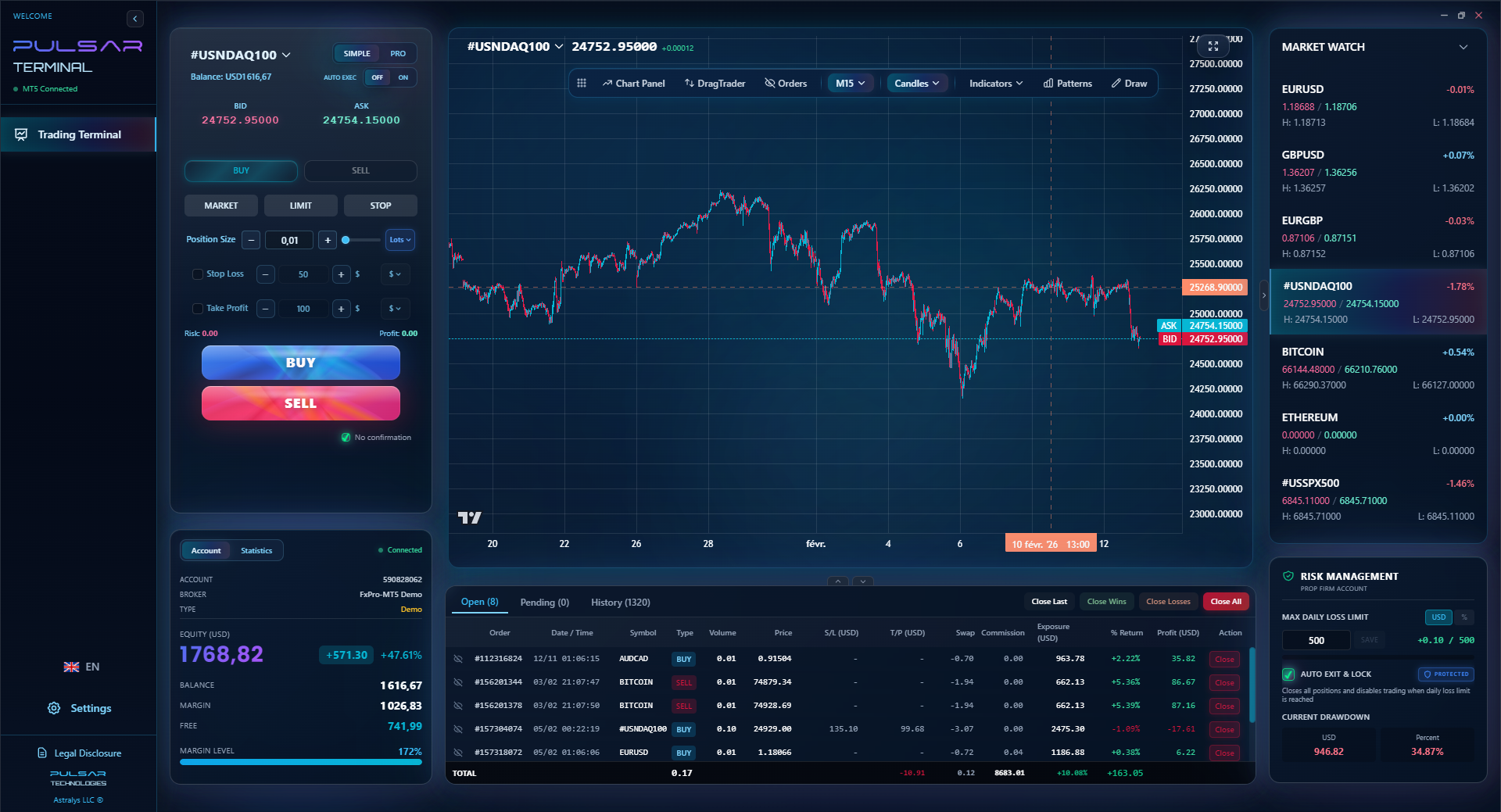
Managing complex trades on ZAR pairs is easier with tools that let you set multiple take-profit levels and trailing stops directly on your MT5 chart, removing emotional decisions in volatile markets.
Pulsar Terminal
The all-in-one MT5 companion: drag-and-drop orders, multi-TP/SL, trailing stop, grid trading, Volume Profile, and prop firm protection. Used by 1,000+ traders daily.
Based on coaching hundreds of South African traders, here are the most expensive confusions I see:
- Thinking Bank Rates Are Trading Signals: This is the biggest one. A 'good rate' from Absa for travel money has zero predictive power for where USD/ZAR will be in an hour. The markets don't care.
- Ignoring Total Cost: People see '0.55% commission' and think it's cheap. They forget the exchange rate margin, the electronic fee, and the correspondent bank fee. Always calculate the total Rand cost of any bank forex transaction.
- Using the Wrong Platform for the Goal: Trying to day-trade on a currency investment account is impossible. Trying to make a quick speculative bet through a bank's international transfer is slow and expensive. Match the tool to the task.
- Violating Exchange Controls: This is serious. Using unauthorized channels (like some informal forex dealers) to get around allowances is illegal. It might seem like a better rate, but it risks severe penalties. Always use SARB-authorized dealers (banks, licensed brokers) for any legitimate transaction.
- Not Accounting for Broker Spreads on ZAR Pairs: Even on a good broker, USD/ZAR will have a wider spread than EUR/USD. If your scalping strategy needs 5-pip profits, a 15-pip spread on the ZAR pair will kill you. Always check historical spread data for your specific pair.
“Ninety-five percent of traders fail because they manage their fantasies instead of their risk.”
Let's walk through the mental shift from a bank customer to a trader.
Step 1: Separate Your Needs. Do you need to send money to pay for an import? Use Absa, Standard Bank, or a service like Wise. Compare the total cost (all fees + final amount received). Do you want to speculate on price movements to make a profit? You need an FSCA-licensed broker.
Step 2: If Trading, Choose a Broker. Look for FSCA regulation, tight spreads on the pairs you like, and a platform you understand (MT4/5 is standard). Fund your account. This initial conversion of ZAR to USD in your trading account will involve a spread, but it's a one-time cost to enter the trading world.
Step 3: Analyze the Market, Not the Bank. Open a chart on XAU/USD or EUR/USD. Learn to read price action. Use a demo account. Study the MACD indicator or whatever tool fits your style. Your data source is now the broker's feed.
Step 4: Execute with Risk Management. This is where most fail. Use a position size calculator. Never risk more than 1-2% of your account on a single trade. Decide your stop-loss and take-profit before you click buy. A tool that lets you set a trailing stop or multiple take-profit levels directly on the chart can remove emotion. Discipline here is what separates the 5% who succeed from the 95% who blow up.
I remember my first profitable month. It wasn't because I found a secret bank rate pattern. It was because I finally ignored all the noise, focused on a simple swing trading strategy on one pair, and managed my risk ruthlessly on every single trade. The bank's rate was irrelevant.
💡 Winston's Tip
If you can't instantly state your maximum loss on an open trade, you're not trading. You're gambling with a fancy chart open.
FAQ
Q1Does Absa have a forex trading platform for speculation?
No, Absa does not offer a leveraged forex trading platform for speculative trading like MetaTrader. They provide foreign exchange services for international payments, travel money, and currency investment accounts, which are for holding foreign cash, not actively trading it.
Q2Where can I find historical Absa forex rates?
Absa does not publish a complete public archive of their historical retail exchange rates. You might find snapshots on financial data websites or by contacting them directly, but remember: these rates are retail customer prices with large spreads included. They are not suitable for analyzing the forex market for trading purposes.
Q3Is it cheaper to use Absa or a broker for converting currency?
It depends on the purpose. For a one-time physical conversion (e.g., emigrating, buying property abroad), you must compare the total cost (Absa's spread + all fees) against other authorized dealers. For active trading, a broker's spread (often below 0.1% on majors) is infinitely cheaper than a bank's retail spread (1-4%). They serve completely different needs.
Q4What is the Absa exchange rate margin?
The margin is the percentage Absa adds to the mid-market rate to set their customer rate. For popular currencies like USD and EUR, it's typically around 1% to 1.5%. For less traded currencies, it can be up to 4%. This is their primary profit on a currency conversion, separate from their stated commission fees.
Q5Can I trade forex with Absa?
Not in the way a retail trader understands it. You can open a Currency Investment Account to hold foreign currency, but you cannot use use, place stop-loss orders, or trade on short-term price fluctuations. For that, you need an account with an FSCA-licensed CFD/forex broker.
Q6Are Absa's forex rates good for travel money?
They are competitive with other major South African banks, but rarely the absolute best. It's always worth checking with FNB, Nedbank, Standard Bank, and dedicated forex bureaus. The key is to ask for the total Rand you will receive after ALL charges, not just the advertised rate.
Q7What is the single discretionary allowance for 2026?
In the March 2026 Budget Review, the Minister of Finance proposed doubling the Single Discretionary Allowance (SDA) from R1 million to R2 million per calendar year. This allowance can be used for any legal purpose without needing tax clearance from SARS. Always confirm the current limit with your bank or SARS before making plans.
Prof. Winston's Lesson
Key Takeaways:
- ✓Bank rates include a 1-4% spread, making them useless for trading.
- ✓SARB controls physical forex; FSCA brokers handle speculative CFD trading.
- ✓Always calculate the total Rand cost of any bank transaction.
- ✓Use broker market data, not retail bank rates, for your analysis.
How useful was this article?
Click a star to rate
Weekly Trading Insights
Free weekly analysis & strategies. No spam.
About the Author
David van der Merwe
Emerging Markets Trader
Johannesburg-based trader with 11 years in emerging market currencies. Specializes in ZAR pairs, FSCA-regulated trading, and South African market analysis.
Comments
Risk Disclaimer
Trading financial instruments carries significant risk and may not be suitable for all investors. Past performance does not guarantee future results. This content is for educational purposes only and should not be considered investment advice. Always conduct your own research before trading.
You Might Also Like

Cara Trading Forex Sukses: 7 Prinsip dari Trader Profesional
Cara trading forex sukses dengan 7 prinsip trader pro: manajemen modal, disiplin, journal trading, backtest. Data nyata, bukan janji profit palsu.
Jam Trading Forex Terbaik untuk Trader Indonesia: Panduan Lengkap dengan Tabel Waktu
Panduan jam trading forex untuk trader Indonesia. Tabel 4 sesi dunia, jam emas 20:00-00:00, sesi mana yang harus dihindari. Data akurat + tips dari trader berpengalaman.
Top 5 Sàn Forex Uy Tín Nhất 2026: Review Jujur dari Trader Indonesia
Top 5 sàn forex uy tín 2026 untuk trader Indonesia. Review jujur: spread, deposit, withdraw, dukungan lokal. Exness, XM, IC Markets & lebih.
Get Pulsar Terminal
All these calculators are built into Pulsar Terminal with real-time data from your MT5 account. One-click position sizing, automatic risk management, and instant calculations.
Get Pulsar Terminal