


Here's a statistic that will save you a lot of time and money: ABSA, one of South Africa's biggest banks, does not offer a retail forex trading account for speculative trading.

David van der Merwe
Emerging Markets Trader ·  South Africa
☕ 9 min read
What you'll learn:
- 1What an ABSA 'Forex Account' Actually Is (Spoiler: It's Not MT5)
- 2The Real Costs: Where ABSA Makes Its Money
- 3SARB Rules & FSCA Regulation: The Invisible Cage
- 4ABSA vs. A Real Forex Broker: A Side-by-Side Comparison
- 5When Using ABSA for Forex Actually Makes Sense
- 6What To Use Instead For Actual Forex Trading
- 7Final Verdict: Who Is This For?
Here's a statistic that will save you a lot of time and money: ABSA, one of South Africa's biggest banks, does not offer a retail forex trading account for speculative trading. Not one. If you walked in looking to scalp the USD/ZAR like you would with an FSCA-regulated broker, you're in the wrong building. What they do offer are foreign currency banking and international payment services, which serve a completely different purpose. This guide will strip away the marketing and show you exactly what an 'ABSA forex trading account' means for a South African, the real costs involved, and when you should look elsewhere.
Let's clear this up immediately. When people search for an 'ABSA forex trading account,' they're imagining a platform to buy and sell currency pairs with use, chasing pips. That's not what you get. ABSA provides authorised dealer services under South African Reserve Bank (SARB) rules. Think of it as sophisticated banking, not trading.
Their flagship product for individuals is the Currency Investment Account (CIA). This isn't a trading account. It's a multi-currency savings account where you can hold funds in up to 18 foreign currencies. You open it to hedge against rand depreciation or to park funds for future international expenses. There's no use, no charts, and no stop-loss orders. The 'return' is the interest rate (LIBID minus a margin), not capital appreciation from price moves.
For more active international investors, there's the World Trader Account. This lets you trade international shares and funds in USD, EUR, or GBP. Again, this is for asset investing, not currency speculation. Their corporate platform, Absa Access FX, is for businesses managing currency risk with forwards and limits. It's powerful, but it's not for you sitting at home trying to swing trade the EUR/USD.

Warning: If your goal is speculative forex trading - using use, technical analysis, and holding positions for hours or days - you are looking for an FSCA-licensed broker like IC Markets or Pepperstone, not a bank. Using ABSA for this will be expensive, slow, and utterly unsuited to the task.
“ABSA does not offer a retail forex trading account for speculative trading. Not one.”
This is where most people get a nasty shock. Banks don't make money from tight spreads. They make money from fees and margins. If you're used to broker spreads of 0.1 pips on major pairs, ABSA's structure will feel like a robbery.
Transfer and Conversion Fees
Let's say you want to send $10,000 overseas via ABSA's online banking.
- Commission: 0.55% of the amount = R55 (minimum R190, so you pay R190).
- Electronic Fee: A flat R100.
- Correspondent Bank Fees: Could be another R150 to R1,500 if a middleman bank is involved.
- Exchange Rate Margin: This is the big one. ABSA won't give you the real mid-market rate. They add a margin of 1.2% to 4%. For a mainstream currency like USD, let's assume a 1% margin.

Example: On $10,000 at USD/ZAR 18.50, a 1% margin means you get a rate ~18.315 instead of 18.50. That's a hidden cost of about R1,850 on top of the R290 in fixed fees. Your effective cost is over 2% of your capital before it even leaves the country.
Account-Specific Costs
- Currency Investment Account: No monthly fee, no minimum balance. Sounds great, but the 'margin' Absa takes from the LIBID interest rate is your cost.
- Foreign Currency Account: May require a minimum opening balance (e.g., $500).
The lesson? For moving money, these services are standard banking. For frequent trading, these costs will destroy any potential profit. You'd lose more on one transfer than a good broker charges in spreads for a year of active scalping.

💡 Winston's Tip
A bank's currency service is a pair of boots for a long hike. A broker's trading platform is a pair of sprinting spikes. Never confuse the footwear for the race.
“Using ABSA for trading is like using a sledgehammer to put in a screw.”
Trading through a South African bank means playing in a tightly regulated sandbox. The Financial Sector Conduct Authority (FSCA) oversees market conduct, but for international transfers, the South African Reserve Bank (SARB) calls the shots with exchange controls.
What does this mean for you?
- Capital Allowances: You have a single discretionary allowance of R11 million per calendar year for offshore investment. You need tax clearance for anything over R1 million. This isn't a problem for a $500 trade, but it's a ceiling on your activity.
- Purpose: SARB wants to know why money is leaving. 'Speculative forex trading' is not a preferred reason. 'Investing in international markets' or 'paying for imports' is. This philosophical difference is key.
- FSCA Protection: If you use an FSCA-licensed broker, you get specific protections: segregated client funds, a recourse mechanism, and use limits. With a bank account, your money is a deposit, and you're exposed to the bank's health (though ABSA is solid). The regulatory goal is different: stability vs. speculative market access.
I learned this the hard way early on. I tried to use a bank currency account to 'trade' by constantly converting ZAR to USD and back, hoping to catch swings. The fees and the terrible exchange rate margin meant I needed the USD/ZAR to move 3% just to break even on a round trip. It was a losing strategy from day one. The regulations and fee structure simply aren't built for it.
“Using ABSA for trading is like using a sledgehammer to put in a screw.”
To see the difference clearly, let's put them in a table. This isn't about which is better, but which is right for the job.
| Feature | ABSA Currency Services | FSCA-Regulated Forex Broker (e.g., IC Markets) |
|---|---|---|
| Primary Purpose | International payments, currency holding, hedging. | Speculative trading on currency price movements. |
| Platform | Online banking, NovoFX app, Absa Access FX (corporate). | MetaTrader 4/5, cTrader, proprietary platforms. |
| use | None (1:1). | Up to 1:30 for retail clients under FSCA rules. |
| Typical Cost | Fee + 1-4% exchange rate margin. | Spread (e.g., 0.1 pips on EUR/USD) + possible commission. |
| Execution | Bank processing, can be slow. | Instant market/limit order execution. |
| Charting & Tools | Basic or none for individuals. | Advanced charts, dozens of indicators, drawing tools. |
| Can you short-sell? | No. | Yes, easily. |
| Regulatory Focus | SARB exchange controls, banking stability. | FSCA market conduct, client money protection. |
As you can see, they are different tools for different jobs. Using ABSA for trading is like using a sledgehammer to put in a screw. Using a broker to pay your child's international university fees is needlessly complex and expensive.
💡 Winston's Tip
That 1% margin ABSA adds to the exchange rate? On a R100,000 conversion, that's R1,000 gone before you start. A broker's spread on the same notional might cost you R20. Choose your battlefield wisely.
“The 'ABSA forex trading account' is a misnomer. It's a currency banking service.”
So, when should you consider opening an ABSA Currency Investment Account or using their services? In a few specific scenarios, it's the perfect tool.
- You're a Long-Term Investor Hedging Against ZAR Weakness. This is the CIA's sweet spot. If you believe the rand will weaken over years, moving a portion of your savings into USD or EUR in a CIA is a smart, passive hedge. You avoid the high fees of constant trading.
- You Have Regular International Expenses. If you pay for services abroad, have family overseas, or are saving for an international trip, funding a CIA in that currency locks in a rate and avoids repeated transfer fees.
- You Need Reliability for Large Business Transactions. For importing/exporting businesses, Absa Access FX provides forward contracts to lock in exchange rates for future dates, eliminating uncertainty. This is proper risk management.
- You Want Simplicity and Security. It's a bank. It's familiar. Your funds are there, not in a trading account. For someone who just wants exposure to a foreign currency without the stress of trading, it works.

Pro Tip: If you do use a CIA, set up a standing order to convert a fixed rand amount each month. This 'rand cost averaging' smooths out your entry rate over time and automates the process. Don't try to time the market with it.
“The 'ABSA forex trading account' is a misnomer. It's a currency banking service.”
If you're reading this to learn how to trade forex, here's your path. You need an FSCA-licensed broker that offers ZAR-based accounts. This lets you deposit and withdraw in rands, but trade in the global markets.
Top Considerations for South African Traders:
- FSCA License: Non-negotiable. It's your primary protection. Check the FSCA's website for the license status.
- ZAR Account & Local Deposits: Look for brokers with easy EFT deposits/withdrawals into South African bank accounts. It cuts out international transfer fees.
- Platform: Most serious traders use MetaTrader 4 or 5. Ensure the broker supports it.
- Spreads & Commissions: Compare costs on the pairs you'll trade most, like USD/ZAR or EUR/USD. A tight spread is crucial.
Brokers like IC Markets, Pepperstone, and XM have strong reputations among experienced South African traders. They provide the use, tools, and low-cost environment you need. I run all my analysis on MT5, using tools like the MACD indicator and Volume Profile, which you simply cannot do through a bank interface.
Start with a demo account, then a small live account. Always, always use a position size calculator. My biggest early mistake was not respecting position sizing on the volatile USD/ZAR pair; a 100-pip move against you can hurt if you're over-leveraged. A proper broker gives you the tools to manage that risk precisely, something a bank account never will.
💡 Winston's Tip
The best hedge against rand volatility isn't a frantic trade. It's a disciplined, monthly transfer into a hard currency savings account. Let time and consistency do the work.
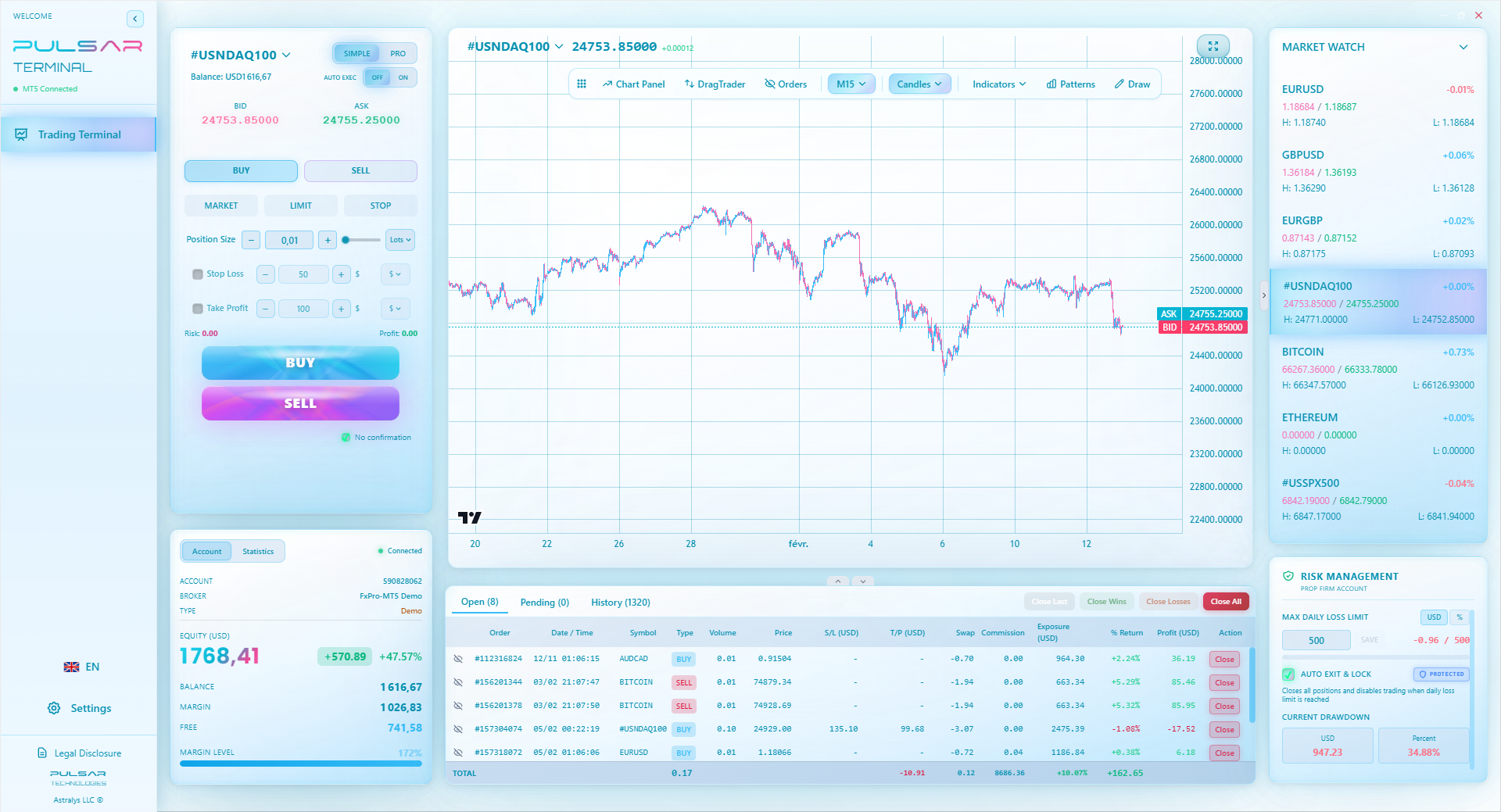
When you do trade with a proper broker, managing complex orders and risk on MT5 is far easier with a tool like Pulsar Terminal, which adds drag-and-drop orders and multi-take-profit levels directly to your charts.
Pulsar Terminal
The all-in-one MT5 companion: drag-and-drop orders, multi-TP/SL, trailing stop, grid trading, Volume Profile, and prop firm protection. Used by 1,000+ traders daily.
“You'd lose more on one transfer than a good broker charges in spreads for a year of active scalping.”
Let's be blunt. The 'ABSA forex trading account' is a misnomer. It's a currency banking service.
It's FOR you if: You're a South African saver or business owner looking to manage currency risk for long-term goals or international obligations. You value the safety of a major bank and need SARB-compliant structures. The Currency Investment Account is a good product for this.
It's NOT for you if: You want to speculate on currency price movements using use and technical analysis. You intend to hold positions for hours, days, or weeks. You want to use advanced order types, short-sell, or trade gold (XAU/USD) and indices. For that, you are in the broker market.
Don't force a square peg into a round hole. Understanding the difference between currency banking and currency trading is the first, and most important, step to managing your money effectively. Choose the tool that matches your actual objective, or you'll pay for the mistake - literally.
FAQ
Q1Can I trade forex with use on an ABSA account?
No, absolutely not. ABSA does not offer leveraged speculative forex trading to retail clients. Their Currency Investment Account and foreign currency services operate on a 1:1 basis. You can only trade the actual funds you have deposited, with no borrowing from the bank to increase position size.
Q2What is the minimum deposit for an ABSA Currency Investment Account?
There is no minimum deposit required to open the account, which is one of its benefits. However, some of their other foreign currency accounts may have minimums (e.g., $500). Remember, with no minimum, you can start small, but the exchange rate margins make tiny conversions very costly on a percentage basis.
Q3How does ABSA's exchange rate compare to the market rate?
ABSA adds a margin of 1.2% to 4% above the real mid-market rate. For common currencies like USD or EUR, expect around 1%. This means if the market rate is USD/ZAR 18.00, ABSA might offer you 17.82. This hidden cost is how they make money on conversions, and it's far wider than a forex broker's spread.
Q4Is my money safe in an ABSA forex account?
Your funds in an ABSA bank account are deposits in a major South African financial institution, which is generally very safe. However, it's not 'segregated client money' in the way an FSCA-licensed broker must hold it. Your protection is as a bank depositor, not as a trading client under specific FSCA conduct rules.
Q5Can I use the ABSA Currency Investment Account for day trading?
Technically, you could constantly convert between currencies. Practically, it's a terrible idea. The fees and exchange rate margins on each conversion would require enormous price moves just to break even. It is structurally and financially unsuited for day trading or any short-term strategy.
Q6What's the difference between ABSA Access FX and a broker platform?
Absa Access FX is a corporate platform for businesses to execute foreign exchange transactions (like forward contracts) and manage international trade finance. It is not a speculative trading platform with charts, use, and instant order execution for retail traders. It's for risk management, not profit-seeking from price fluctuations.
Q7Do I need tax clearance to open an ABSA Currency Investment Account?
To open the account itself, you typically need your ID and tax number. However, when you want to move funds offshore under your discretionary allowance (over R1 million per year), you will need a Tax Compliance Status (TCS) PIN from SARS. For smaller amounts within your allowance, it's not needed for the account opening.
Prof. Winston's Lesson
Key Takeaways:
- ✓ABSA offers banking, not trading. 0% use.
- ✓Costs include a 1-4% margin on the exchange rate.
- ✓Use it for long-term hedging, not short-term speculation.
- ✓For trading, use an FSCA broker with a ZAR account.
- ✓SARB controls limit offshore movement; know your R11m allowance.
How useful was this article?
Click a star to rate
Weekly Trading Insights
Free weekly analysis & strategies. No spam.
About the Author
David van der Merwe
Emerging Markets Trader
Johannesburg-based trader with 11 years in emerging market currencies. Specializes in ZAR pairs, FSCA-regulated trading, and South African market analysis.
Comments
Risk Disclaimer
Trading financial instruments carries significant risk and may not be suitable for all investors. Past performance does not guarantee future results. This content is for educational purposes only and should not be considered investment advice. Always conduct your own research before trading.
You Might Also Like

Cara Trading Forex Sukses: 7 Prinsip dari Trader Profesional
Cara trading forex sukses dengan 7 prinsip trader pro: manajemen modal, disiplin, journal trading, backtest. Data nyata, bukan janji profit palsu.
Jam Trading Forex Terbaik untuk Trader Indonesia: Panduan Lengkap dengan Tabel Waktu
Panduan jam trading forex untuk trader Indonesia. Tabel 4 sesi dunia, jam emas 20:00-00:00, sesi mana yang harus dihindari. Data akurat + tips dari trader berpengalaman.
Top 5 Sàn Forex Uy Tín Nhất 2026: Review Jujur dari Trader Indonesia
Top 5 sàn forex uy tín 2026 untuk trader Indonesia. Review jujur: spread, deposit, withdraw, dukungan lokal. Exness, XM, IC Markets & lebih.
Get Pulsar Terminal
All these calculators are built into Pulsar Terminal with real-time data from your MT5 account. One-click position sizing, automatic risk management, and instant calculations.
Get Pulsar Terminal