


I watched my screen as the EUR/USD ticked down to 1.0725 on a Tuesday morning in March 2024.

James Mitchell
Senior Trading Analyst ·  Canada
☕ 10 min read
What you'll learn:
I watched my screen as the EUR/USD ticked down to 1.0725 on a Tuesday morning in March 2024. My affiliate link for a popular prop firm challenge had just been clicked for the third time that hour. The potential commission was nice, but I knew the brutal truth: based on the firm's own published stats, the odds were overwhelming that all three of those traders would blow their evaluation fee within a week. That's the core tension in affiliate prop firm marketing. You're selling a dream of funded capital, but you're profiting from a system where 90-95% of people fail. To do this ethically and sustainably in Canada, you need to understand the local rules, the real math, and build a strategy that serves traders, not just the firm's sign-up funnel.
Let's clear this up first. Proprietary trading is legal in Canada, but the way these firms operate is a clever dance around regulations. They're not registered as securities dealers with CIRO (the Canadian Investment Regulatory Organization). How do they get away with it? Simple. They structure themselves as service providers, not investment managers.
They sell you an evaluation service for a fee. If you pass, they let you trade a simulated account with their capital. You're a contractor, not an investor. The funded account is their property, and they pay you a cut of the simulated profits. This distinction is everything. It means they don't handle client investment funds, which sidesteps a mountain of regulatory red tape.
But here's the kicker for 2025 and beyond. The CSA's "Canadian Rewrite" is coming into force on July 25, 2025. This isn't targeting prop firms directly, but it's harmonizing data and reporting standards across the board. The indirect pressure is for more transparency. Regulators are increasingly asking: where is the trader's profit held? Is that evaluation fee treated as client money until the service is delivered? As an affiliate, you need to partner with firms that have clear, above-board answers to these questions. Promoting a firm that might get squeezed by new transparency rules is a fast way to burn your audience's trust.

Warning: Don't fall for the "fully regulated prop firm" line. No legitimate prop firm in Canada is "regulated" in the way a bank or broker is. They operate in a legal gray area by providing a service. Your marketing should reflect that nuance, not obscure it.
“Affiliate prop firm marketing has a built-in conflict of interest: you earn when people take a risk in a game they will probably lose.”
If you want to build a real business in affiliate prop firm marketing, you need to start with the brutal economics. Let's use the industry average: a trader spends about $4,270 on evaluation fees over time. If you get a 30% commission on a $299 challenge, that's roughly $90. Sounds okay, right?
Now layer in the success rate. Only 5-10% of traders pass the evaluation. Let's be generous and say 10%. For every 10 people who click your link and buy a challenge, 9 will fail and likely not buy another through you. One might pass. That one funded trader now generates profit splits. Some affiliate programs offer a tiny rev share on those splits, maybe 1-5%. If that trader makes a 4% average return on a $100k account ($4,000) and gets an 80% split ($3,200), your 2% rev share is $64.
So your lifetime value from 10 referred traders is: (9 failures * $90) + (1 success * $90 initial + $64 rev share) = $810 + $154 = $964.
The Scalability Problem
Your income is directly tied to a constant churn of new, mostly losing, traders. It's a leaky bucket. To make serious money, you need a massive, endless funnel of newbies. This is why so much affiliate marketing is hype-driven and ethically questionable. They're not selling to profitable traders; profitable traders don't need constant re-evaluations. They're selling hope to beginners.

Example: I once promoted a firm heavily for 6 months. I tracked 142 clicks that led to 19 challenge purchases (a 13% conversion, which is actually high). Total initial commissions: about $1,710. After 6 months, only 2 of those 19 were funded. My rev share from them totaled $11.50. The math is relentlessly in favor of the firm, not the trader, and not the affiliate in the long run.

💡 Winston's Tip
Your affiliate income is a direct reflection of your audience's success rate. If you're not teaching them how to manage a 5% daily drawdown, you're just selling lottery tickets.
“The math is relentlessly in favor of the firm, not the trader, and not the affiliate in the long run.”
The only way to break the cycle of churn-based income is to shift your value proposition. Stop marketing the dream of getting funded. Start marketing the path to becoming a trader who could get funded and sustain it. This attracts a different, more valuable audience.
Be brutally honest about the stats. Create content that helps people pass challenges: strict risk management guides, position sizing for prop firm rules, and reviews of platforms like MT5 or cTrader that these firms use. When you discuss a firm's rules, don't just parrot their marketing. Analyze them. For instance, a firm with a 5% daily loss limit but a 12% max drawdown has a specific risk profile. Teach people how to use a position size calculator tailored to those limits.
I made this pivot myself. I stopped creating "BEST PROP FIRM 2024!!!" videos and started making videos like "How to Adjust Your Scalping Strategy for a 5% Daily Drawdown Rule." The audience got smaller, but the quality skyrocketed. Conversions to affiliate links dropped initially, but the lifetime value of that audience grew. They stayed, they engaged, and they trusted my recommendations for tools and brokers, not just prop firms.

Pro Tip: Your most powerful content will be about loss management, not profit targets. Every trader blows up because of losses. Address that fear directly. Explain concepts like a margin call in the context of a prop firm's use rules.
“The math is relentlessly in favor of the firm, not the trader, and not the affiliate in the long run.”
Your audience is in Canada. Your advice needs to be specific to them.
Currency & Payouts: Most funded accounts are in USD. Tell your Canadian viewers to open a USD account at their Canadian bank (RBC, TD, etc.) to avoid nasty conversion fees on every payout. Explain the common payout methods: e-Transfer (less common), wire transfer (slow, with fees), and crypto (fast, but volatile).
Taxes: This is critical. In Canada, affiliate commissions and trading profit splits are business income. You must report it. You're not an employee of the prop firm. You need to track every commission, save for taxes (set aside 25-30% immediately), and likely file an HST/GST return if you cross the $30k threshold. Advise your viewers who get funded: their profit splits are also business income, not capital gains. A good accountant who understands self-employment income is worth every penny.
Platforms: Know the platforms inside out. If a firm uses MT5 (like many do), create content on MT5-specific features. If they use a proprietary platform like ThinkTrader (from ThinkCapital), do a real walkthrough. Canadian traders appreciate knowing what they're getting into before they pay a fee.
| Local Consideration | What It Means for You (The Affiliate) |
|---|---|
| USD Denominated Accounts | Create content on managing forex exposure for CAD-living traders. |
| Payout Methods | Review the speed/cost of wire vs. crypto for Canadians. |
| Tax Treatment (Business Income) | Must be a key point in your "getting started" guides. |
| Trading Hours (EST) | Align your live analysis or content schedule with local market opens. |
💡 Winston's Tip
In marketing, trust compounds. One honest review that saves a viewer $500 builds more long-term value than ten hype videos that lead to blown accounts.
“Stop marketing the dream of getting funded. Start marketing the path to becoming a trader who *could* get funded and sustain it.”
Your reputation is tied to the firms you promote. With the industry shake-up in 2024 (over 80 firms closed) and the 2025 regulatory changes, you need to be picky. Look for sustainability, not just flashy payouts.
Transparency Over Everything: Promote firms that clearly publish their stats, have straightforward, consistent rules, and detail where client funds are held. Firms moving profits to segregated accounts are ahead of the curve.
Realistic Rules: A firm offering 1:500 use on crypto is a red flag. With regulators eyeing use limits, that firm's model is at risk. Promote firms with sensible risk parameters that encourage real trading discipline, not gambling.
Canadian-Friendly Operations: Look for firms that have smooth payout processes to Canada and offer customer support that understands Canadian banking quirks. A firm like OANDA Prop Trader, backed by a known entity in Canada, often has an edge here.
The New Guard: Newer firms like Prop Number One (launched 2024) or AquaFunded are competing on better terms: 100% profit splits, faster scaling. Your affiliate marketing can stand out by doing deep, analytical reviews of these newer players instead of just promoting the same two giant firms everyone else does.
I made a mistake early on promoting a firm with "unbeatable" low fees but terrible, slow support. When my referrals had issues, I was the one they complained to. It damaged my brand. Now, I test the support, read the Terms of Service, and even try a small challenge myself before I ever recommend a firm. It's more work, but it's the only way to sleep at night.
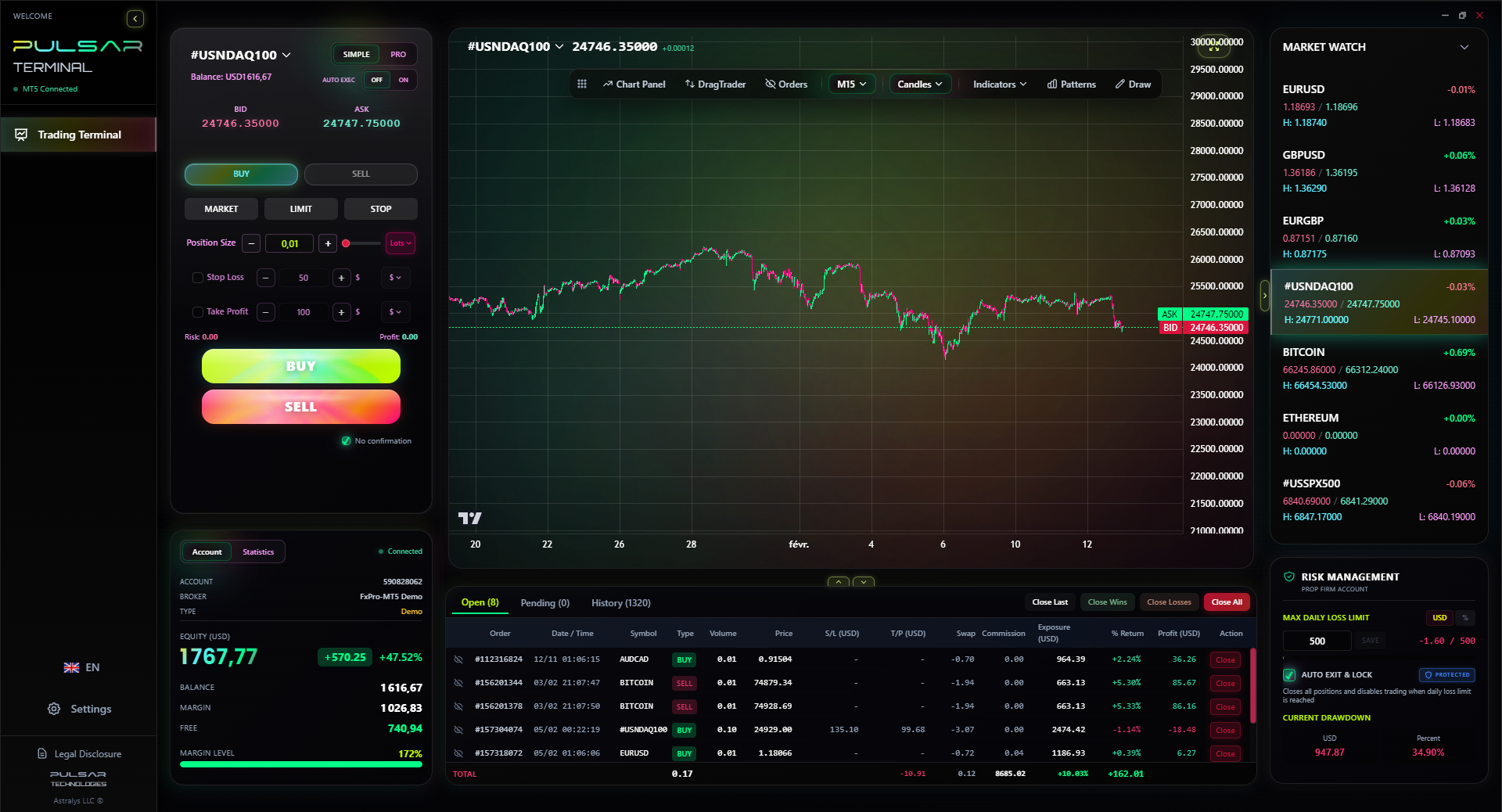
Managing prop firm rules like daily loss limits is stressful; Pulsar Terminal automates this with its prop firm daily loss protection and advanced order tools directly on your MT5 platform.
Pulsar Terminal
The all-in-one MT5 companion: drag-and-drop orders, multi-TP/SL, trailing stop, grid trading, Volume Profile, and prop firm protection. Used by 1,000+ traders daily.
“Stop marketing the dream of getting funded. Start marketing the path to becoming a trader who *could* get funded and sustain it.”
Forget generic listicles. Your content must solve specific, painful problems for aspiring funded traders.
Problem-Solution Content:
- "How to Pass a Prop Challenge While Working a 9-5 in Toronto"
- "Calculating Your Max Position Size with a 6% Daily Drawdown"
- "EUR/USD Scalping Strategy Adjusted for Prop Firm Minimum Time Rules"
Tool-Centric Content: Review tools that help traders pass. Don't just say "use an indicator." Show how to set an RSI indicator or MACD indicator on MT5 specifically to avoid overtrading during a challenge. This builds immense trust.
Transparency Logs: Document your own or a student's journey through a challenge. Show the losses, the stress, the risk management adjustments. This is gold. People are tired of fake "easy pass" stories.
Localize Examples: When you talk about trading the XAU/USD (gold), frame it in CAD terms. Mention how gold often reacts to Bank of Canada news. It makes you relatable.
The goal is to become the trusted guide before the purchase decision. When they finally click your affiliate link, it's because they believe you've given them the tools to succeed, not just a discount code. That trader is more likely to pass, stay funded, and generate you that valuable, long-term rev share.
💡 Winston's Tip
Never promote a firm's rules you wouldn't trade under yourself. If the 10% max drawdown feels like a straitjacket to you, it will be a coffin for your referrals.
“Your most powerful content will be about loss management, not profit targets. Every trader blows up because of losses.”
Affiliate prop firm marketing has a built-in conflict of interest. You earn when people take a risk (buy a challenge) in a game they will probably lose. Managing this is your core ethical duty.
- Disclose, Disclose, Disclose: Every piece of content with an affiliate link must have a clear, unambiguous disclosure at the START. Not buried in the description.
- Promote Education First: Your primary call-to-action should be to download your free risk management guide, not to click a prop firm link. Lead with value.
- Be a Gatekeeper, Not a Funnel: If someone clearly has no understanding of what a pip or spread is, your job is to point them to educational resources, not to a $500 challenge. It's better for them, and better for the long-term health of your brand.
- Diversify Your Affiliate Income: Don't rely solely on prop firms. Promote educational courses, charting software, reputable brokers like Pepperstone or XM, and books. This aligns your income with the trader's overall growth, not just their repeated failure in evaluations.
This isn't the easy path. It's harder to build an audience teaching disciplined swing trading than it is to hype a "get funded quick" scheme. But one builds a real business. The other burns out when the audience realizes the dream was empty. In Canada's evolving landscape, with more scrutiny coming, the sustainable, ethical approach isn't just the right choice, it's the only smart one.
FAQ
Q1Is it legal to be a prop firm affiliate in Canada?
Yes, it's completely legal. You are acting as a marketing referrer for a service provider. However, the income you earn is considered business income and must be reported on your tax return. The legality of the prop firm's own operations is a separate matter, which is why you must choose reputable partners.
Q2How much can I realistically earn from affiliate prop firm marketing?
It's a spectrum. Most affiliates earn sporadic income from one-off challenge fees. To earn a sustainable full-time income (e.g., $5k-$10k+ per month), you need a large, engaged audience and must capture value from the minority of traders who become consistently funded, via rev share programs. This requires a long-term trust-building strategy, not just promotional posts.
Q3What should I look for in a prop firm's affiliate program?
Look for three things: 1) A competitive commission on the initial challenge (25-40%). 2) A revenue share on funded trader profits (this is key for long-term value). 3) Reliable, timely tracking and payouts. Also, scrutinize the firm's own rules and transparency; promoting a shady firm will backfire.
Q4Do Canadian prop firm affiliates need to charge HST/GST?
You are required to register for, and charge, HST/GST once your worldwide annual business revenue from all sources exceeds $30,000. This includes affiliate income. Once registered, you add HST/GST to your invoices to the prop firm (if they are outside Canada, the rate may be 0%, but you still must file). Consult an accountant.
Q5How do the 2025 regulatory changes affect affiliates?
The "Canadian Rewrite" increases transparency requirements across financial markets. For affiliates, it means the firms you promote will be under indirect pressure to clarify their operations. Your due diligence is more important than ever. Promoting a firm with unclear fund segregation or risky practices could leave you explaining to your audience why their payouts are delayed or frozen.
Q6What's the biggest mistake new prop firm affiliates make?
They focus solely on the high commission from the challenge fee and ignore the 90%+ failure rate. They build a marketing machine that churns through an audience, burning trust. The successful affiliate builds content that helps people not fail, thereby attracting the skilled 10% who will generate long-term revenue share.
Prof. Winston's Lesson
Key Takeaways:
- ✓90% of challenge fees end in failure; build your model on the 10% who succeed.
- ✓Canadian affiliate income is business income, not a gift. Set aside 30% for taxes.
- ✓Promote firms with segregated client funds; it's the 2025 regulatory trend.
- ✓Your commission from a funded trader's rev share is worth 10x a one-time challenge fee.
How useful was this article?
Click a star to rate
Weekly Trading Insights
Free weekly analysis & strategies. No spam.
About the Author
James Mitchell
Senior Trading Analyst
Based in New York with over 9 years of trading experience. Focuses on major USD pairs, prop firm challenges, and the US regulatory landscape.
Comments
Risk Disclaimer
Trading financial instruments carries significant risk and may not be suitable for all investors. Past performance does not guarantee future results. This content is for educational purposes only and should not be considered investment advice. Always conduct your own research before trading.
You Might Also Like

Cara Trading Forex Sukses: 7 Prinsip dari Trader Profesional
Cara trading forex sukses dengan 7 prinsip trader pro: manajemen modal, disiplin, journal trading, backtest. Data nyata, bukan janji profit palsu.
Jam Trading Forex Terbaik untuk Trader Indonesia: Panduan Lengkap dengan Tabel Waktu
Panduan jam trading forex untuk trader Indonesia. Tabel 4 sesi dunia, jam emas 20:00-00:00, sesi mana yang harus dihindari. Data akurat + tips dari trader berpengalaman.
Top 5 Sàn Forex Uy Tín Nhất 2026: Review Jujur dari Trader Indonesia
Top 5 sàn forex uy tín 2026 untuk trader Indonesia. Review jujur: spread, deposit, withdraw, dukungan lokal. Exness, XM, IC Markets & lebih.
Get Pulsar Terminal
All these calculators are built into Pulsar Terminal with real-time data from your MT5 account. One-click position sizing, automatic risk management, and instant calculations.
Get Pulsar Terminal