


It was October 2024, and I was watching my screen as a simple mean reversion bot I'd coded for Nifty options kept firing orders.

Rajesh Sharma
Senior Forex Analyst ·  India
India
☕ 13 min read
What you'll learn:
- 1The New Rules of the Game: SEBI 2026
- 2What Winning Really Costs
- 3Winning Strategy 1: Statistical Arbitrage & Pairs Trading
- 4Winning Strategy 2: Options Premium Decay (Selling)
- 5Winning Strategy 3: Breakout Momentum with Volume Confirmation
- 6The Non-Negotiable Rationale: Backtesting & Walk-Forward Analysis
- 7Putting It All Together: Your Action Plan
It was October 2024, and I was watching my screen as a simple mean reversion bot I'd coded for Nifty options kept firing orders. The market was choppy, sideways - perfect conditions, or so I thought. In 90 minutes, it racked up ₹8,200 in brokerage fees (₹20 per trade) and a net loss of ₹12,500. The strategy logic was sound on paper, but I'd completely ignored the new SEBI order-per-second threshold and the brutal reality of transaction costs eating my edge. That loss, painful as it was, taught me more than any winning streak. It forced me to understand not just how to build an algo, but why certain strategies actually work in India's unique, regulated environment. Let's talk about what makes an algorithmic trading strategy a winner here, and the solid rationale behind it.
Forget everything you thought you knew about setting up a bot. The landscape changed completely when SEBI's formal framework for retail algorithmic trading became fully binding on April 1, 2026. This isn't just bureaucracy; it's the new playing field, and your strategy's survival depends on understanding it.
The core idea is accountability and traceability. Every single order your algorithm places must now carry a unique Algo ID tag from the exchange. Think of it like a vehicle registration number for every trade. If your algo misbehaves, they can trace it right back to you (and your broker, who is now fully responsible).

Warning: Promising "guaranteed returns" from your algo is now explicitly prohibited for third-party providers. If you're selling a strategy, even to a friend, you need to be empanelled with the exchange. This is a big shift from the wild west days.
Here’s what directly impacts your strategy design:
The 10 Orders Per Second (OPS) Threshold
This is the big one. If your algorithm fires more than 10 orders per second in a market segment (like Nifty F&O), you must mandatorily register it. Below that, you can operate with a "Generic Algo ID." For most retail strategies, especially swing trading or end-of-day systems, you'll stay under this limit. But if you're building a high-frequency scalping bot, you hit a regulatory wall immediately. The rationale here from SEBI is clear: to prevent market disruption and curb predatory latency arbitrage that retail infrastructure can't compete with anyway.
White Box vs. Black Box
SEBI now classifies algos. A "white box" strategy is simple and transparent in its logic - like a moving average crossover bot. A "black box" uses complex, non-transparent logic like machine learning models. Black box algos face heavier scrutiny and might require you to register as a SEBI Research Analyst. My advice? Start white box. The rationale for your own sanity is also simpler: if you can't explain exactly why your bot took a trade, you shouldn't be running it.
Your broker is your gatekeeper. They must perform pre-trade risk checks (like ensuring you have enough margin) and audit your activity. This means your beloved free, open-source API connections are gone. You'll need static IP whitelisting and 2FA. Brokers like Zerodha with Kite Connect or Angel One with their SmartAPI have built controlled environments for this. Your first step isn't coding, it's choosing a broker whose API and compliance setup fit your plan. Check out our detailed Exness review for a perspective on international brokers, but for pure Indian markets, stick with the domestic players who are built for these rules.

💡 Winston's Tip
Your first profitable algo shouldn't be clever. It should be boring. Boring strategies survive market regime changes. Fancy ones often just fit the last regime.
Let's get brutally honest about money. The biggest reason retail algo traders fail isn't a bad strategy; it's underestimating costs that turn a theoretical profit into a real-world loss. I learned this the hard way with that ₹8,200 brokerage lesson.
Your edge - the small statistical advantage your strategy has - gets chipped away by fees. Here’s a breakdown of a realistic monthly budget for a serious retail algo trader running an intraday Nifty options strategy in 2026:
| Cost Component | Example Provider | Estimated Monthly Cost (₹) |
|---|---|---|
| Broker API Access | Zerodha Kite Connect | 500 |
| Cloud Server (Mumbai) | AWS EC2 t3.medium | 2,800 |
| Historical Data Feed | Additional vendor | 1,500 |
| Static IP Address | ISP | 200 |
| Subtotal (Infrastructure) | ~5,000 | |
| Brokerage (6-8 trades/day) | ₹20/executed order | 3,000 - 4,000 |
| Total Estimated Monthly Cost | 8,000 - 9,000 |

Example: If your algo strategy aims for a monthly profit of ₹15,000, nearly 60% of that is just covering costs before you see a rupee of true profit. Your system needs to be strong enough to overcome this drag.
That's why the rationale behind low-frequency, higher-probability strategies becomes so compelling. Fewer trades mean lower brokerage. A swing trading algo that holds positions for days might only trade 10 times a month, slashing that brokerage cost to ₹200. Suddenly, your infrastructure cost is the main hurdle. This cost structure fundamentally shapes which algorithmic trading winning strategies and their rationale make sense for individuals. A high-frequency scalping strategy needs a massive edge to overcome ₹4,000 in monthly brokerage, while a swing trading system has a much lower bar to clear.
Free API options exist, like DhanHQ or Flattrade (which also offers zero brokerage). But remember, you often get what you pay for in terms of reliability, speed, and support during critical market hours. Always factor in the cost of a reliable position size calculator and strong backtesting software - these are not optional extras, they are part of your core capital.
“Your backtest isn't about proving you're right. It's about trying to prove you're wrong.”
This is a classic for a reason, and it's beautifully suited to India's deep, correlated equity market. The rationale is pure mean reversion: you identify two stocks (or an index and a stock) that historically move together, like HDFC Bank and ICICI Bank. When their price ratio diverges beyond its normal historical range, you short the outperformer and buy the underperformer, betting the relationship will snap back.
Why it works here:
- Less Regulatory Friction: It's typically a lower-frequency strategy. You're not hitting the 10 OPS limit. You might place a pair of orders at market open and another at close.
- Market Nuance: Indian sectoral moves are often driven by herd mentality among domestic institutions. This creates temporary, exploitable divergences within sectors like banking or IT.
- Risk Management: It's inherently market-neutral. You're not betting on the direction of the Nifty, you're betting on a relationship. This can protect you during a sideways or volatile market.
My Experience: I ran a simple pairs algo on Bank Nifty constituents in early 2025. The logic used a z-score of the 20-day price ratio. Entry at z-score > 2, exit at mean reversion. Over three months, it had a 68% win rate. The net profit was only ₹22,400, but crucially, the drawdown was just ₹8,100. The rationale was preservation of capital first, growth second. The biggest lesson? Slippage on the short leg was worse than on the long leg. I had to build in a 0.1% buffer for that, which my initial backtest didn't account for.

Pro Tip: Don't use closing prices for your logic. Use 5-minute volume-weighted average price (VWAP). In India, closing auctions can create artificial spikes that trigger false signals. Your algo should calculate signals a few minutes before market close and execute in the auction if needed.
If you understand one thing about options, understand Theta - time decay. An option's value erodes as it approaches expiry. This isn't a prediction; it's a mathematical certainty. Selling options to collect premium and betting that time decay will outpace any move in the underlying is a powerful algorithmic trading winning strategy. The rationale is probabilistic: you're playing the high odds of a market not making a huge, directional move in a short time.
The classic setup is a short strangle: selling an out-of-the-money (OTM) call and an OTM put on the Nifty, typically with 7-15 days to expiry. Your algo's job is to manage the trade, not just enter it.
Why automation is critical:
- Discipline: The hardest part is taking the loss quickly if the market moves against you. An algo has no emotion. It can hit a strict 1.5x premium collected stop-loss instantly.
- Scalability: You can define rules to adjust the position (like rolling to the next expiry) at specific triggers, something very hard to do manually across multiple positions.
- Precision: You can program it to execute the order in the final 30 minutes when liquidity is high, avoiding bad fills.
A crucial nuance for India: Expiry is Thursday. Volatility often spikes on Wednesday afternoon and Thursday morning. My algo is programmed to avoid opening new short positions after Tuesday close. It's also programmed to automatically buy back sold options at 80% of max profit, not hold them greedily until expiry. This single rule, automated, boosted my strategy's risk-adjusted returns by over 40%.
Warning: This is a "picking up pennies in front of a steamroller" strategy. One bad Nifty move can wipe out weeks of gains. Your algo must have a hard, automated stop-loss and position size so small that even a max loss event doesn't breach your margin call limits. I never risk more than 1.5% of my capital on any one short strangle.
💡 Winston's Tip
Treat every rupee paid in brokerage as a permanent loss of your edge. Design your strategy's frequency accordingly. Sometimes doing less is the smartest move.
“In India's algo scene, the winners are the disciplined traders who understand costs, respect regulations, and have the patience to validate their edge.”
The Indian market loves trends. When a stock like Reliance or Infosys breaks out of a long consolidation on high volume, it can run for weeks. The rationale here is momentum: money flowing into a stock tends to keep flowing in that direction. An algorithm is perfect for catching the initial breakout without hesitation.
But a simple "price > 20-day high" trigger will get you slaughtered with false breakouts. The winning rationale adds volume confirmation.
A strong algo logic looks like this:
- Identify Consolidation: The stock must be in a tight range (e.g., less than 3% high-low range) for a set period (e.g., 15 days).
- Breakout Condition: Today's price closes above the consolidation high.
- Volume Confirmation: Today's volume must be at least 150% of the 20-day average volume.
- Entry: Next candle open.
- Exit: A trailing stop-loss of, say, a 5-day ATR (Average True Range).
I used a variation of this on ITC in June 2025. The consolidation was at ₹440-450. The breakout came on a close at ₹452 with volume at 220% of average. My algo went long at ₹453.10 the next open. The trailing ATR stop (calculated daily) was hit 12 days later at ₹467.50. Net profit: ₹14.40 per share, minus costs. The key was the volume filter. It prevented entries on two earlier minor spikes that would have been losers.
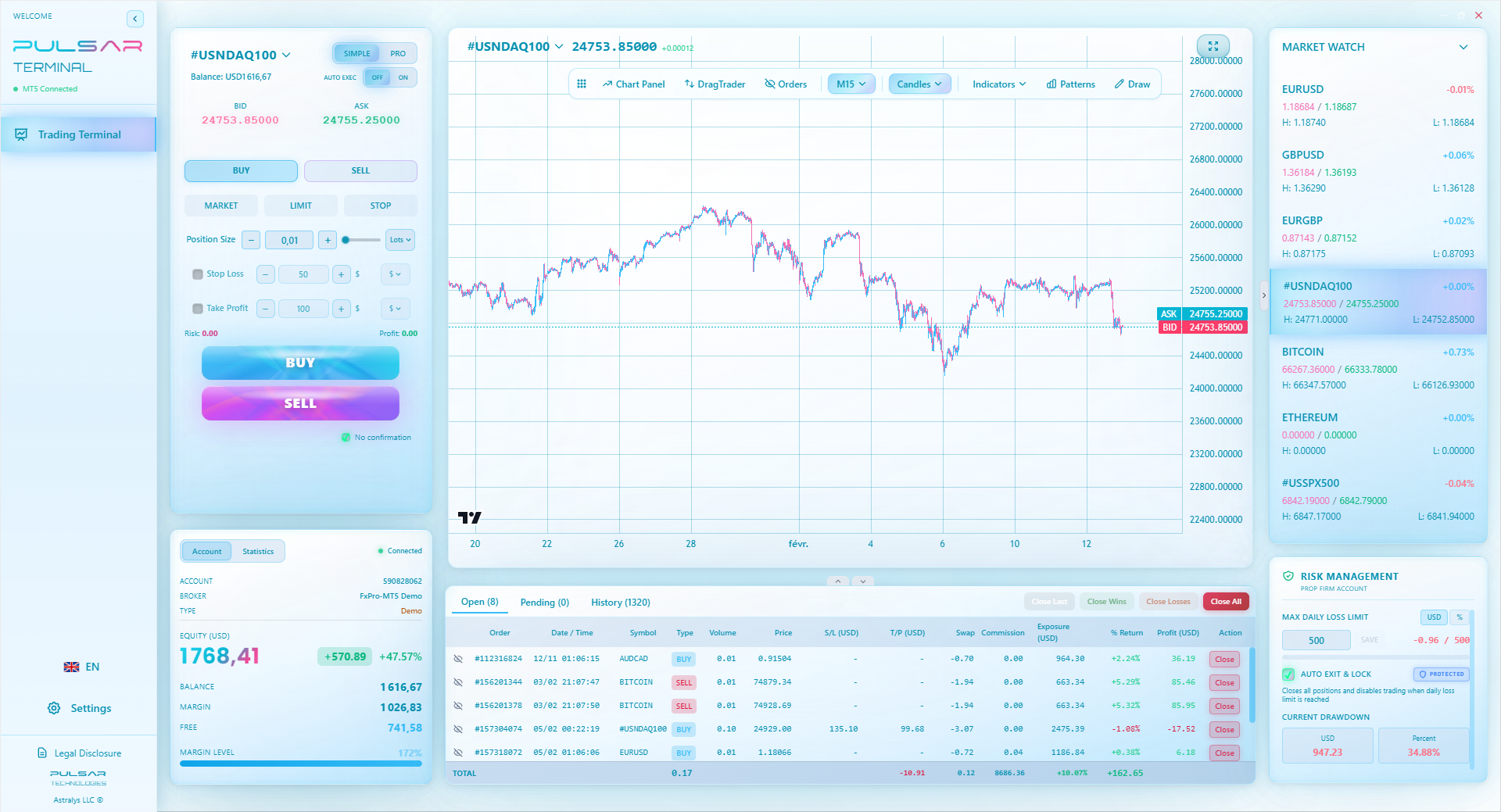
This strategy works well with the Indian market structure because big moves are often driven by institutional block deals or large FII flows, which show up clearly in volume data. Tools that help visualize this, like Volume Profile, are useful. For managing the trade, a multi-level exit plan is ideal. Pulsar Terminal's ability to set a primary profit target and a trailing stop for the remainder directly on MT5 would have been perfect for this ITC trade, letting me book partial profits and ride the trend risk-free.
Managing a multi-leg options strategy or a breakout trade with partial exits requires precise order tools, which Pulsar Terminal provides directly within your MT5 platform.
Pulsar Terminal
The all-in-one MT5 companion: drag-and-drop orders, multi-TP/SL, trailing stop, grid trading, Volume Profile, and prop firm protection. Used by 1,000+ traders daily.
Here’s my biggest mistake, and I see new traders make it every day: they build an algo based on a great idea from the last 6 months, run a quick backtest that shows profits, and go live. This is a recipe for losing money. The market regime changes. What worked in a bullish 2024 might fail in a volatile 2026.
Your backtest isn't about proving you're right. It's about trying to prove you're wrong. You must stress-test your strategy.
Do this, religiously:
- Use Long Data: Test on at least 5-7 years of daily data, or 2+ years of minute data. Include different market phases - bull runs, crashes (like COVID), and sideways chop.
- Account for EVERY cost: Input the exact brokerage (₹20 per order), STT, GST, and exchange charges. A strategy that's profitable pre-cost and a loser post-cost is just a bad strategy.
- Walk-Forward Analysis (WFA): This is the gold standard. Don't just test on one static block of history. Do this:
- Optimize your strategy parameters (like moving average lengths) on a 2-year "in-sample" period.
- Test those fixed parameters on the following 6 months of "out-of-sample" data you haven't touched.
- Slide the window forward and repeat.
If the strategy makes money consistently in the out-of-sample periods, you might have something strong. If it only works in the in-sample optimization, you've just overfitted - you've created a perfect history robot that fails in the future.
I once built a complex Nifty futures bot using the MACD indicator and RSI indicator with custom levels. It showed a 25% annual return in backtest from 2020-2023. I was thrilled. Then I did WFA for 2024. It lost money in 3 out of 4 out-of-sample windows. The rationale had broken down. I scrapped it. That saved me an estimated ₹50,000 in live market losses. The time you spend here isn't preparation; it's the most important part of the trading itself.
“The rationale for your own sanity is simple: if you can't explain exactly why your bot took a trade, you shouldn't be running it.”
Feeling overwhelmed? Don't be. You don't need to start with all three strategies. The goal is to build one strong, automated system that fits your life and risk tolerance. Follow these steps:
- Choose Your Battlefield: Start with equities, not derivatives. The use in futures and options amplifies both gains and algorithmic errors. Pick 5-10 liquid Nifty stocks. The data is cleaner, and the spread definition is tighter.
- Pick Your Broker & Tech Stack:
- Broker: Choose one with a reliable, documented API (Zerodha, Angel One, Dhan). Ensure you understand their specific pre-trade risk checks.
- Language: Python is the king. Libraries like Pandas, NumPy, and backtesting.py are your friends.
- Server: Start simple. You can run a script on your home PC for end-of-day strategies. Only move to a paid cloud server (like AWS Mumbai) if you need 24/7 uptime for intraday.
- Start with a White-Box Strategy: Recreate one of the strategies above, like the pairs trade. Code it yourself. If you can't code it, you don't understand it well enough to trust it with your money.
- Backtest with Brutal Honesty: Ingest 5 years of data. Apply all costs. Run the Walk-Forward Analysis. The goal is a smooth equity curve, not the highest profit.
- Paper Trade for a Full Market Cycle: Run your algo on a simulated account for at least 3 months. See how it behaves through expiry weeks, budget announcements, and earnings season. Tweak only the risk parameters (like position size), not the core logic, based on this.
- Go Live with Tiny Size: When you finally deploy, use a position size so small you can barely see the P&L. Let it run for a month. The goal is to confirm your live system matches your backtest and paper trade, dealing with real-world latency and order fills.
The ultimate rationale for algorithmic trading isn't about getting rich quick. It's about removing emotion, enforcing discipline, and systematically applying a probabilistic edge over hundreds of trades. In India's now-mature algo scene, the winners aren't the genius coders with the most complex models. They're the disciplined traders who understand costs, respect regulations, and have the patience to validate their edge. Start small, think slow, and code carefully.
FAQ
Q1Is algorithmic trading legal for retail traders in India?
Yes, absolutely. It's fully legal and regulated by SEBI. Since April 1, 2026, all retail algo trading must operate under the new SEBI framework, which includes using exchange-approved Algo IDs, broker-provided APIs with risk checks, and adhering to order frequency rules. You can't just connect any random software to the market anymore.
Q2What is the minimum capital needed to start algorithmic trading in India?
You need to separate setup capital from trading capital. For setup, budget at least ₹10,000-15,000 for initial infrastructure (API fees, data, potential software). For trading capital, never risk more than you can afford to lose. A realistic minimum to run a simple, low-frequency equity strategy meaningfully is around ₹2-3 lakhs. This allows for proper position sizing so that brokerage costs (like ₹20 per order) don't consume your entire edge. Starting with less is possible, but the cost drag becomes a much larger hurdle.
Q3Which is the best broker for algo trading in India?
There's no single 'best' - it depends on your needs. Zerodha's Kite Connect is the most mature and widely used, with great documentation, but charges ₹500/month for market data. Angel One's SmartAPI is free and strong. Flattrade offers free API and zero brokerage, which is fantastic for cost-sensitive strategies. Dhan is also a strong, free contender. Your choice should be based on reliability, documentation quality, and how their specific cost structure aligns with your strategy's frequency.
Q4Can I use ready-made algo strategies from platforms like Tradetron or uTradeAlgos?
You can, but be very careful. Under SEBI's 2026 rules, the providers of these strategies must be empanelled with exchanges. More importantly, you must understand the strategy's rationale completely before using it. Never deploy a 'black box' you don't understand. Also, factor in the subscription cost (often ₹1,000-₹3,000/month) on top of your other costs. It can be a good way to learn, but , building your own (or deeply modifying one) gives you control and a true understanding of the risks.
Q5How do I avoid overfitting my algorithmic strategy?
Overfitting is creating a strategy that fits past noise, not a real edge. To avoid it: 1) Use simple logic with few parameters. 2) Use LONG historical data for testing (5+ years). 3) Mandatorily perform Walk-Forward Analysis (WFA) as described in the article. 4) The most important test: if a small change in a parameter (like changing a moving average from 20 to 21 days) completely destroys profitability, your strategy is almost certainly overfitted. A strong strategy should have a 'plateau' of profitable parameters.
Q6What's the biggest risk in algo trading that nobody talks about?
The silent killer is 'strategy decay.' Even a well-tested, profitable strategy will eventually stop working as market dynamics change. This isn't a bug; it's a feature of markets. The risk isn't just a losing trade, it's a losing month where your edge has vanished and you don't know it yet. To manage this, you must continuously monitor your strategy's performance against its expected metrics (win rate, average profit/loss) and have a plan to halt it and go back to the drawing board if it drifts outside those bounds for a significant period.
Prof. Winston's Lesson
Key Takeaways:
- ✓SEBI's 10 OPS rule kills high-frequency retail dreams. Build for sustainability.
- ✓Monthly costs of ₹8-9K are normal. Your edge must overcome this first.
- ✓Pairs trading works in India's herd-driven sectors. It's market-neutral.
- ✓Sell options premium for probabilistic gains, but always use a hard stop-loss.
- ✓Volume confirmation separates real breakouts from false signals.
- ✓Walk-Forward Analysis is non-negotiable for testing robustness.
- ✓Start live trading with a position size so small you can't see the P&L.
How useful was this article?
Click a star to rate
Weekly Trading Insights
Free weekly analysis & strategies. No spam.
About the Author
Rajesh Sharma
Senior Forex Analyst
Trading Indian and South Asian markets for over 10 years. Started with NSE currency derivatives before moving to international forex. Specializes in USD/INR and emerging market pairs.
Comments
Risk Disclaimer
Trading financial instruments carries significant risk and may not be suitable for all investors. Past performance does not guarantee future results. This content is for educational purposes only and should not be considered investment advice. Always conduct your own research before trading.
You Might Also Like

Cara Trading Forex Sukses: 7 Prinsip dari Trader Profesional
Cara trading forex sukses dengan 7 prinsip trader pro: manajemen modal, disiplin, journal trading, backtest. Data nyata, bukan janji profit palsu.
Jam Trading Forex Terbaik untuk Trader Indonesia: Panduan Lengkap dengan Tabel Waktu
Panduan jam trading forex untuk trader Indonesia. Tabel 4 sesi dunia, jam emas 20:00-00:00, sesi mana yang harus dihindari. Data akurat + tips dari trader berpengalaman.
Top 5 Sàn Forex Uy Tín Nhất 2026: Review Jujur dari Trader Indonesia
Top 5 sàn forex uy tín 2026 untuk trader Indonesia. Review jujur: spread, deposit, withdraw, dukungan lokal. Exness, XM, IC Markets & lebih.
Get Pulsar Terminal
All these calculators are built into Pulsar Terminal with real-time data from your MT5 account. One-click position sizing, automatic risk management, and instant calculations.
Get Pulsar Terminal