


You keep hearing about 'alpha' in forex.

David van der Merwe
Emerging Markets Trader ·  South Africa
☕ 9 min read
What you'll learn:

You keep hearing about 'alpha' in forex. Everyone's chasing it. But what does 'alpha forex' actually mean for you, sitting in Johannesburg or Cape Town, trading with your hard-earned rand? Is it just another fancy term, or is it the real key to moving from a losing trader to a consistently profitable one? Let's cut through the noise. I'll explain what alpha is in plain English, show you how I've tried (and sometimes failed) to find it in the ZAR pairs, and give you a realistic path to build your own edge.
Forget the complex finance textbooks. In trading, alpha is simply your personal edge. It's the extra return you generate that can't be explained by just the market moving up or down. Think of the overall market movement as 'beta' – that's the tide that lifts all boats. Alpha is your skill at sailing better than everyone else, regardless of the tide.
For us in South Africa, this is crucial. Trading USD/ZAR or EUR/ZAR isn't just about global trends; it's about understanding local liquidity, Reserve Bank announcements, and political noise that international traders might miss. That local knowledge? That's a potential source of alpha.
I made the mistake early on of confusing luck with alpha. Back in 2018, I went long on USD/ZAR at 13.80 purely on a gut feeling about a US rate hike. It rocketed to 14.50. I thought I was a genius – that I had 'alpha'. Then I tried the same 'gut feel' on GBP/ZAR and lost R8,000 in a week. That wasn't alpha. That was randomness. True alpha is consistent and explainable.

Warning: A winning trade doesn't mean you have alpha. A winning strategy over hundreds of trades, that you can articulate and repeat, might.
“True alpha is consistent and explainable. A winning trade doesn't mean you have it.”
You won't find alpha by staring at the same EUR/USD chart as millions of others. You need to look where others aren't, or see what they don't. Here are a few places a South African trader can hunt.
Exploit Time Zone and Liquidity Gaps
Our JSE open (9:00 SAST) creates interesting windows. European traders are just starting their day, and London is only an hour ahead. The liquidity in ZAR pairs often dips slightly during our lunchtime (12:00-14:00 SAST), before the US wakes up. I've found some of my most reliable scalping strategy setups in USD/ZAR during that midday lull, where exaggerated moves often get corrected.
Understand the 'ZAR Factor'
International models often treat the Rand as just another emerging market currency. But we know it's more volatile, more sensitive to local politics (think 'Eskom' or 'load shedding'), and prone to sudden gaps. Developing a sense for when these events are priced in versus when the market is overreacting is pure alpha. I keep a simple diary of major local news and the subsequent ZAR move. After a while, patterns in the market's emotional response emerge.
Carry Trade Nuances
Everyone knows the carry trade: borrow a low-yield currency, buy a high-yield one. The Rand often fits the high-yield side. But the alpha isn't in just doing the carry trade; it's in timing your exits before the inevitable 'risk-off' moments that crush EM currencies. Using a combination of the RSI indicator on the weekly chart and global volatility indices has helped me avoid some nasty drawdowns.

Pro Tip: Your broker matters. If you're trading ZAR pairs, you need tight spreads. I've found brokers like IC Markets and Pepperstone offer consistently good pricing on USD/ZAR, which is essential for capturing small edges.

💡 Winston's Tip
Alpha decays. If you're not slightly embarrassed by your trading journal from six months ago, you're not learning fast enough.
“Your local knowledge of Eskom and SA politics is a potential source of alpha that a trader in London doesn't have.”
Alpha doesn't come from a single magical indicator. It comes from a strong process. This is where most traders, including my past self, fail. We look for the signal and ignore the system around it.
First, you need a hypothesis. For example: 'USD/ZAR tends to have a false breakout on the first test of a major weekly high or low during Asian session liquidity.'
Then, you test it. Not with 10 trades, but with 100. Backtest it, then forward-test it in a demo account. I spent three months testing a simple MACD indicator divergence strategy on EUR/ZAR. The initial 20 trades were great. By trade 80, the statistical edge was barely positive after accounting for the spread definition. That wasn't alpha. I had to scrap it.
Your process must include ruthless risk management. An alpha-generating idea means nothing if a single trade blows up your account. Always use a position size calculator. I never risk more than 1% of my account on any single ZAR trade, no matter how 'sure' I am. The volatility here will humble you fast.
Finally, journal everything. The market's mood on a Tuesday after a long weekend is different. Note it down. Your emotional state matters too. I have a rule: no new trades after 2 PM if I'm already in a losing position for the day. It prevents revenge trading, which is the ultimate alpha destroyer.

“Your local knowledge of Eskom and SA politics is a potential source of alpha that a trader in London doesn't have.”
Let me save you some money and frustration by sharing where I've paid my tuition fees to the market.
Chasing 'Hot Tips': A friend at a braai once whispered about a 'sure thing' in the Turkish Lira. I put on a small trade without understanding anything about the currency. It was a mess. I lost. Alpha comes from your knowledge, not someone else's.
Overtrading: This is the big one. In 2020, stuck at home, I thought more trades = more chances for alpha. I was taking 5-10 scalps a day on USD/ZAR. The result? I was basically just paying spreads and commissions. My broker was making more alpha than I was. Real edge appears in quality, not quantity.
Ignoring Transaction Costs: That 50-pip win on GBP/ZAR feels good until you realise the spread was 15 pips and you paid a commission. Your net gain is 35 pips. If your strategy only averages 40-pip wins, you have almost no buffer. Always calculate your profit after costs. This is why understanding the true cost of a pip definition on exotic pairs is non-negotiable.
Not Adapting: The market changes. The alpha in buying ZAR on every S&P 500 dip worked great in 2017. It stopped working in 2022. If your strategy's results are decaying, it's not alpha anymore. Be ready to go back to the drawing board.

Example: A R100,000 account, risking 1% per trade. Your stop loss on a USD/ZAR trade is 200 pips (about R1.50 per pip). Your position size should be: R1,000 risk / (200 pips * R1.50) = 3.33 mini lots. Always use a calculator.
💡 Winston's Tip
The spread isn't a fee, it's the first test. If your idea can't overcome the bid-ask spread consistently, it holds no alpha.
“Overtrading is the fastest way to turn potential alpha into guaranteed broker commissions.”
I'm not going to give you a 'secret system'. But I will share a simple framework I used to develop my first genuine edge. It combines swing trading fundamentals with a ZAR-specific filter.
The Instrument: Stick to the most liquid ZAR pair: USD/ZAR. More liquidity means tighter spreads and less slippage, protecting your potential alpha.
The Timeframe: Use the 4-hour chart for direction and the 1-hour chart for entry. This suits a swing trading style that doesn't require you to be glued to the screen.
The Alpha Filter: Here's the local knowledge part. Before taking any long-term buy signal on USD/ZAR, check the SA 10-year government bond yield (you can find it easily). If the yield is spiking dramatically (say, above 11.5%), it often signals local panic that can overpower technicals. I've avoided bad buys by waiting for the bond market to settle.
The Core Strategy: Wait for USD/ZAR to approach a key weekly support or resistance level. Look for a price action rejection signal (like a pin bar or a bullish/bearish engulfing candle) on the 4-hour chart. Confirm with a simple momentum indicator like the RSI showing divergence. Your entry is on a retest of the extreme of that rejection candle.
Risk Management: Place your stop loss 50 pips beyond the extreme of the weekly level. Aim for a risk-to-reward ratio of at least 1:2. Manage the trade. Don't just set and forget. If price moves 1R in your favour, consider moving your stop to breakeven to protect against a sudden reversal from a SARB comment.
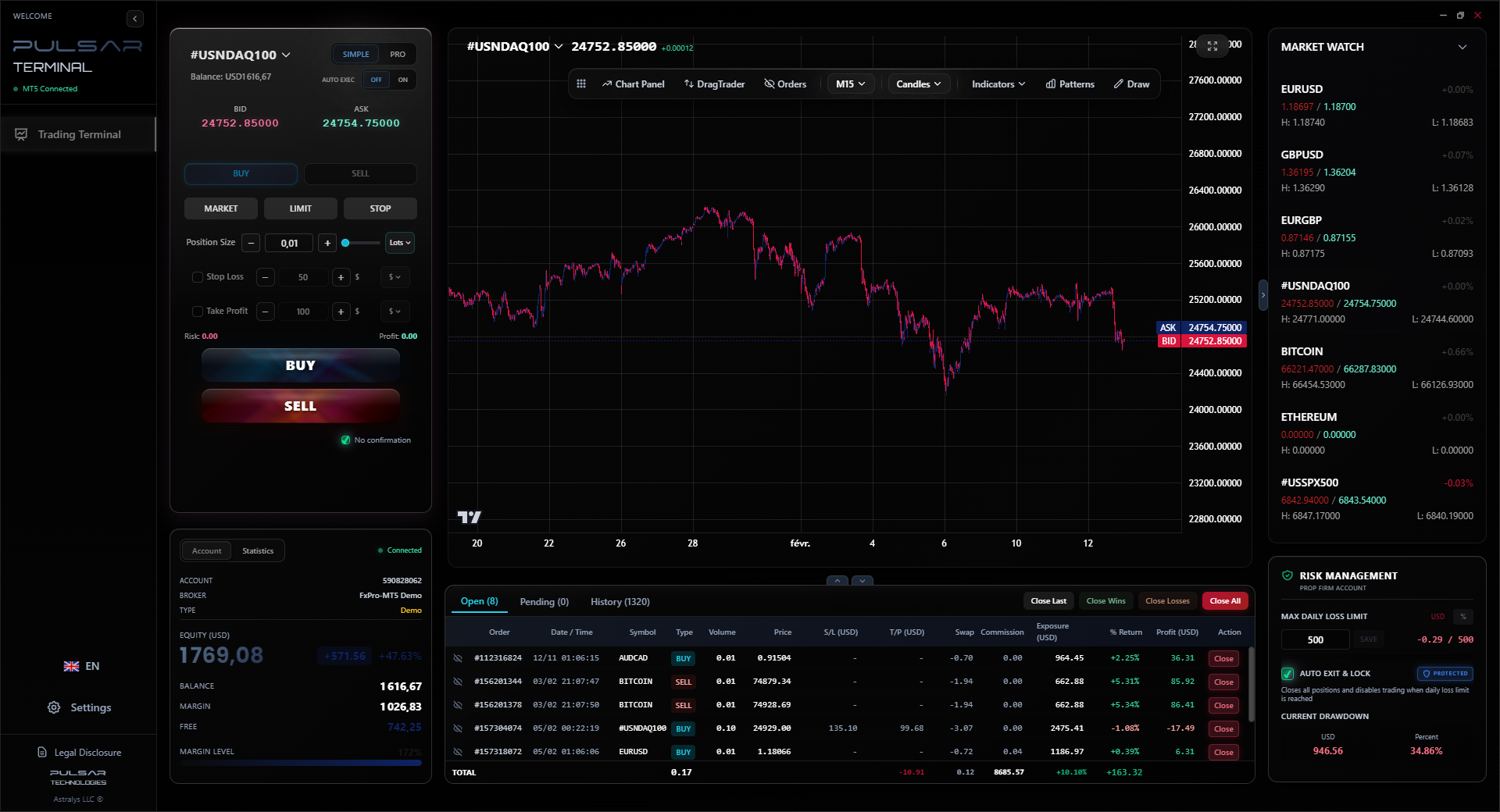
Managing multiple take-profit levels and moving stops to breakeven manually is error-prone; Pulsar Terminal automates this on your MT5 chart, letting you focus on finding your next alpha opportunity.
Pulsar Terminal
The all-in-one MT5 companion: drag-and-drop orders, multi-TP/SL, trailing stop, grid trading, Volume Profile, and prop firm protection. Used by 1,000+ traders daily.
“Overtrading is the fastest way to turn potential alpha into guaranteed broker commissions.”
You can have the best strategy in the world, but without the right mindset, you'll give back all your alpha. This is a psychological game.
You must internalise that losses are part of the cost of doing business. If your strategy has a 55% win rate, you will lose 45 times out of 100. Those losing streaks will make you doubt everything. I once had 7 losses in a row on what was a statistically sound strategy. I almost quit. The 8th trade was a winner that made back all the losses and more. You have to trust your process more than your emotions.
Avoid outcome-based thinking. Focus on whether you followed your plan perfectly. Did you use the correct position size? Did you enter at the right level? If yes, then a losing trade is a good trade. It provided data. A poorly executed winning trade is dangerous - it rewards bad behaviour.
Finally, be patient. Alpha isn't generated daily. Some months will be flat. Your job is to protect capital during those times so you're ready when your edge appears in the market. Think of yourself as a leopard in the bush, not a honey badger chasing every single movement.
Pro Tip: Schedule regular 'strategy reviews', not 'P&L reviews'. Every Sunday, I look at my trades from the week and ask: 'Did I follow my rules?' I ignore the profit column. This keeps me disciplined and focused on the process that generates alpha over time.
💡 Winston's Tip
Your best source of alpha is often the mistake you just made. Journal it, dissect it, and find the pattern to exploit or avoid.
“Focus on whether you followed your plan perfectly. A losing trade can be a good trade.”
The market is a living thing. It learns. What worked last year might be arbitraged away this year. Your quest for alpha is never finished.
Set aside time for research. I dedicate the first hour of my trading day to reading, not charting. I scan Reuters, Bloomberg for SA news, and check the forward rate agreements for clues on interest rate expectations. This qualitative data often gives context the charts can't.
Don't be afraid to paper-trade new ideas. When I wanted to incorporate elements of order flow, I spent months testing it in a demo account alongside my live account. It prevented me from blowing up my capital while learning.
Connect with other serious traders, not for tips, but for perspective. Discussing why a trade worked or failed with someone who has a different approach can reveal blind spots in your own process.
Remember, the goal isn't to find a single source of alpha forever. It's to become the type of trader who can consistently identify and adapt to new sources of edge. That adaptability itself is the ultimate alpha.

FAQ
Q1Is 'alpha forex' just another word for a profitable strategy?
Almost, but not quite. A strategy can be profitable simply because the overall market is rising (that's beta). Alpha is the extra profit your specific strategy makes, beyond what the general market movement gives you. It's your unique skill or edge.
Q2As a beginner in South Africa, should I focus on finding alpha immediately?
No. Your first goal is survival and learning the basics. Focus on understanding risk management, how to use a position size calculator, and what a margin call is. Once you're consistently not losing money, then you can start the deliberate search for alpha.
Q3Can technical analysis alone give me alpha in forex?
It's very difficult. Millions of traders see the same support levels and RSI signals. The alpha often comes from how you combine technicals with other factors - like timing (session overlaps), understanding market microstructure, or incorporating a fundamental filter (like SA bond yields) that most pure chartists ignore.
Q4How long does it take to know if you have a true alpha-generating strategy?
You need a statistically significant sample size. For a swing trading strategy, that's at least 30-50 trades, but preferably 100+. One good month is luck. One good year starts to hint at skill. Track every trade carefully to know your true win rate and average profit/loss.
Q5Why is USD/ZAR often recommended for South Africans looking for alpha?
It's the most liquid ZAR pair, meaning lower transaction costs (spreads), which is critical when trying to capture a small edge. You also have a natural information advantage understanding local news flow compared to an international trader, which you can potentially convert into alpha.
Q6What's the biggest psychological barrier to maintaining alpha?
Ego. When you have a string of wins, you start to believe it's all you, and you might increase risk or abandon your rules. When you have losses, you doubt your edge and might change a working strategy prematurely. Sticking to a pre-defined process is the only antidote.
Prof. Winston's Lesson
Key Takeaways:
- ✓Alpha is your edge beyond general market movement.
- ✓Exploit local knowledge and liquidity gaps for ZAR alpha.
- ✓Test any strategy over 100+ trades, not 10.
- ✓Never risk more than 1% per trade on volatile ZAR pairs.
- ✓Process discipline beats sporadic moments of genius.
How useful was this article?
Click a star to rate
Weekly Trading Insights
Free weekly analysis & strategies. No spam.
About the Author
David van der Merwe
Emerging Markets Trader
Johannesburg-based trader with 11 years in emerging market currencies. Specializes in ZAR pairs, FSCA-regulated trading, and South African market analysis.
Comments
Risk Disclaimer
Trading financial instruments carries significant risk and may not be suitable for all investors. Past performance does not guarantee future results. This content is for educational purposes only and should not be considered investment advice. Always conduct your own research before trading.
You Might Also Like

Cara Trading Forex Sukses: 7 Prinsip dari Trader Profesional
Cara trading forex sukses dengan 7 prinsip trader pro: manajemen modal, disiplin, journal trading, backtest. Data nyata, bukan janji profit palsu.
Jam Trading Forex Terbaik untuk Trader Indonesia: Panduan Lengkap dengan Tabel Waktu
Panduan jam trading forex untuk trader Indonesia. Tabel 4 sesi dunia, jam emas 20:00-00:00, sesi mana yang harus dihindari. Data akurat + tips dari trader berpengalaman.
Top 5 Sàn Forex Uy Tín Nhất 2026: Review Jujur dari Trader Indonesia
Top 5 sàn forex uy tín 2026 untuk trader Indonesia. Review jujur: spread, deposit, withdraw, dukungan lokal. Exness, XM, IC Markets & lebih.
Get Pulsar Terminal
All these calculators are built into Pulsar Terminal with real-time data from your MT5 account. One-click position sizing, automatic risk management, and instant calculations.
Get Pulsar Terminal