


Here's a hard truth most trading sites won't tell you: over 70% of South African retail forex traders lose money in their first year.

David van der Merwe
Emerging Markets Trader ·  South Africa
☕ 12 min read
What you'll learn:
- 1What 'Apex Forex' Really Means (And What It Doesn't)
- 2The South African Rulebook: FSCA & Why It's Your Best Friend
- 3Picking Your Broker: ZAR Accounts, Spreads & The Local Leaders
- 4Building a Strategy That Works in South Africa
- 5The Apex Mindset: Psychology & Risk Management
- 6Taxes, Banking & The Practical Stuff
- 7Common Pitfalls & How to Sidestep Them
Here's a hard truth most trading sites won't tell you: over 70% of South African retail forex traders lose money in their first year. The dream of reaching that 'apex forex' level - where you trade with consistent skill and control - feels miles away. But what if the problem isn't you, but the generic, one-size-fits-all advice you're getting? Trading from SA isn't the same as trading from London or New York. Our rules are different, our currency (the ZAR) is volatile, and our broker landscape has unique pitfalls. I've traded through it all for over a decade. This guide cuts through the noise. We'll talk real FSCA regulations, broker spreads in Rands, and strategies that actually work with our market hours. Let's build your path to the apex, the right way.
First off, let's clear something up. You might be searching for 'apex forex' thinking it's a specific broker or a secret strategy. It's not. In the trading world, 'reaching the apex' is a mindset. It's that point where your decisions are disciplined, your risk is managed automatically, and your emotions don't wreck your trades. It's the opposite of the frantic, hope-based trading that burns most accounts.
For us in South Africa, the apex has a local flavor. It means understanding that the USD/ZAR pair can move 500 pips in a week when politics get spicy. It means knowing which brokers the FSCA has actually licensed, not just which ones have the flashiest ads. It's about trading around our timezone (GMT+2), which means London opens at 10 am our time and New York at 4 pm. That lunchtime lull? It's a real thing.
I learned this the hard way. Early on, I copied a European scalping strategy that required constant attention at 3 am our time. I was a zombie, my judgment was shot, and I blew R15,000 in two weeks. That wasn't trading. That was gambling with a sleep deficit. True apex forex is about finding an edge that fits your life, not destroying it.

Warning: Be very wary of any 'apex forex' system sold as a guaranteed money-maker. If someone is selling you a dream with a price tag, they're probably making more from the sale than from trading. The real apex is built on knowledge and process, not a purchased secret.
“True apex forex is about finding an edge that fits your life, not destroying it.”
This is the most important section. If you remember one thing, remember this: only trade with an FSCA-licensed broker. The Financial Sector Conduct Authority is our financial watchdog. A broker with an FSCA license (you'll see an FSP number) isn't just legit, it's bound by rules that protect YOU.
What FSCA Regulation Actually Does for You
When a broker is regulated here, they must follow strict rules. Your money is held in a separate, segregated bank account. This means if the broker goes bust (it happens), your capital isn't part of their assets to pay off debts. They also have to maintain a certain level of capital themselves, proving they're financially solid. They're subject to audits and must treat you fairly. Trading with an unregulated offshore broker is like handing your cash to a stranger in a dark alley and hoping they'll play fair. I've had friends who couldn't withdraw their profits from unregulated platforms. With an FSCA broker, you have a direct path for complaint and recourse.
The use Cap (It's There to Save You)
The FSCA also limits use for retail clients. You might see brokers elsewhere offering 1:1000. Here, it's typically capped around 1:200 or 1:400 for forex. This feels restrictive when you're starting out and want to make big money from a small account. Trust me, it's a blessing. High use is the fastest way to a margin call. On a R10,000 account, 1:1000 use means a 10-pip move against you can wipe you out. The FSCA's cap forces a bit of sanity into your position size calculator math.

Pro Tip: Always verify the FSCA license yourself. Go to the FSCA website, use their search tool, and type in the broker's local company name. Don't just trust the logo on the broker's site. A real license is non-negotiable.

💡 Winston's Tip
Your first R10,000 in the market is for paying tuition, not buying a car. Expect to learn costly lessons with it. The goal is to have some capital left when you graduate.
“Trading with an unregulated offshore broker is like handing your cash to a stranger in a dark alley.”
Okay, so we only look at FSCA brokers. But which one? You need to compare apples to apples, focusing on costs that hit your Rands.
The ZAR Account Advantage
This is a game-changer for South Africans. Look for a broker that offers a ZAR-denominated trading account. This means you deposit Rands, your profit and loss are displayed in Rands, and you withdraw Rands. Why does this matter? If you deposit USD, your bank will charge you a conversion fee (often 2-3%) going in AND coming out. That's a huge, silent tax on your trading. With a ZAR account, you only face the broker's spread on the currency pair.
Understanding the Real Costs
Forget the 'from 0.0 spreads' marketing. Look at the typical spread on the pairs you'll actually trade. For EUR/USD, a good spread with a major FSCA broker is 0.6 to 1.5 pips. For USD/ZAR, expect 30 to 80 pips because it's less liquid. Also, check if they charge a commission. An ECN account might have a 0.1 pip spread but charge $3.50 per lot. Do the math for your typical trade size.
Here’s a quick, real-world snapshot from my experience checking accounts in early 2026:
| Broker (FSCA Licensed) | Min. Deposit (ZAR) | EUR/USD Spread (Typical) | ZAR Account? | Key Platform |
|---|---|---|---|---|
| Exness | ~R800 | 0.7 pips | Yes | MT4, MT5 |
| XM | ~R750 | 0.9 pips | Yes | MT4, MT5 |
| IC Markets | ~R1,500 | 0.6 pips + commission | Yes | MT4, MT5, cTrader |
| Pepperstone | ~R1,800 | 0.6 pips + commission | Yes | MT4, MT5, cTrader |
I've personally used accounts with Exness and IC Markets. The tight spreads at IC Markets are fantastic for my scalping strategy, but their platform can be overwhelming for a beginner. Exness was my starting point years ago - super simple, and getting my first R5,000 withdrawal into my FNB account took less than 24 hours, which built huge trust.
The Platform Decision: MT4, MT5, or cTrader?
Most brokers offer MetaTrader. MT4 is the old reliable, with every indicator and expert advisor you can imagine. MT5 is more powerful (more timeframes, better backtesting) and is becoming the standard. cTrader is slick, fast, and loved by pure price action traders. Try the demo of each. Your journey to apex forex is smoother on a platform you enjoy using.
“Trading with an unregulated offshore broker is like handing your cash to a stranger in a dark alley.”
You can't just import a strategy from a YouTube trader in the US. Our context is different. Let's build a framework.
Timezone Trading
Our GMT+2 zone is a hidden advantage. The London session (10 am - 7 pm SAST) is your bread and butter. It has high liquidity and clear moves. The overlap with New York (4 pm - 11 pm SAST) is the most volatile period - great for momentum, risky if you're not focused. I do 80% of my trading between 10 am and 7 pm. Trying to trade the Asian session (3 am - 10 am) consistently nearly broke me.
Trading the ZAR Pairs (USD/ZAR, EUR/ZAR)
These are our 'home' pairs, but they're exotic. Spreads are wide, so forget scalping. They are perfect for swing trading. They react heavily to local news: SARB interest rate decisions, budget speeches, political drama. I once caught a 1200-pip move on USD/ZAR after a surprise ratings downgrade, holding the trade for 8 days. The key is patience and using wider stop-losses (150-300 pips). Don't trade these with the same mentality as EUR/USD.
A Simple, Testable SA Strategy
Here's a basic structure I used successfully for years:
- Pair: Stick to major pairs during your active hours. EUR/USD, GBP/USD. Keep it simple.
- Analysis: Use the 1-hour chart for direction. Is price above the 200-period moving average? That's your bias. Then, drop to the 15-minute chart to find your entry.
- Entry Signal: Wait for price to pull back to a key support or resistance level, then look for a reversal candlestick pattern (like a pin bar or engulfing candle).
- Risk Management: This is the apex part. Your stop-loss goes 10 pips beyond the recent swing high/low. Your take-profit is set at a 1:1.5 or 1:2 risk-to-reward ratio. Use a position size calculator so you're never risking more than 1% of your account.
I backtested this on EUR/USD over 6 months of London session data and found a 52% win rate with a 1:1.5 reward. Not glamorous, but consistently profitable. The profit came from strict risk management, not magical entries.

Example: Account: R20,000. Risk per trade: 1% = R200. Stop-loss distance: 25 pips. Pip value for a mini lot (0.1) on EUR/USD is ~R1.50. Position size = R200 / (25 pips * R1.50) = 5.33 mini lots. Round down to 5 mini lots (0.5 standard lots). Your risk is locked in.
💡 Winston's Tip
The spread isn't just a cost, it's a headwind. If your strategy can't overcome the typical spread on your chosen pair, it's a losing strategy before you even start.
“Your risk management rules are your sacred text. They are the automation that leads to apex forex performance.”
This is where the real separation happens. Anyone can learn an indicator. Very few can master their own brain.
The biggest psychological trap in SA? 'Making back what you lost.' The Rand weakens, your friend brags about his Bitcoin profit, and you feel behind. You start revenge trading, doubling your lot size after a loss to recover quickly. I've been there. In 2018, after three losing trades in a row, I broke my rules and threw R5,000 at a USD/ZAR trade with no stop-loss. I lost it all in an hour when a positive news headline hit. That shame was my best lesson.
Your risk management rules are your sacred text. They are the automation that leads to apex forex performance. Decide your maximum daily loss (e.g., 3% of your account) and weekly loss (e.g., 7%). If you hit it, you stop. Close the platform. Go for a walk. The market will be there tomorrow.
Tools can help enforce this discipline. Using a trailing stop to lock in profits on a runner, or setting a breakeven stop once a trade is in profit by 1x your risk, removes emotional decisions. This is where technology becomes a psychological aid.
Pro Tip: Keep a trading journal. Not just 'bought EUR/USD, made 20 pips.' Write down your emotional state: 'Felt anxious because I missed the earlier move, entered prematurely.' Review it weekly. You'll see your destructive patterns clearer than any chart pattern.
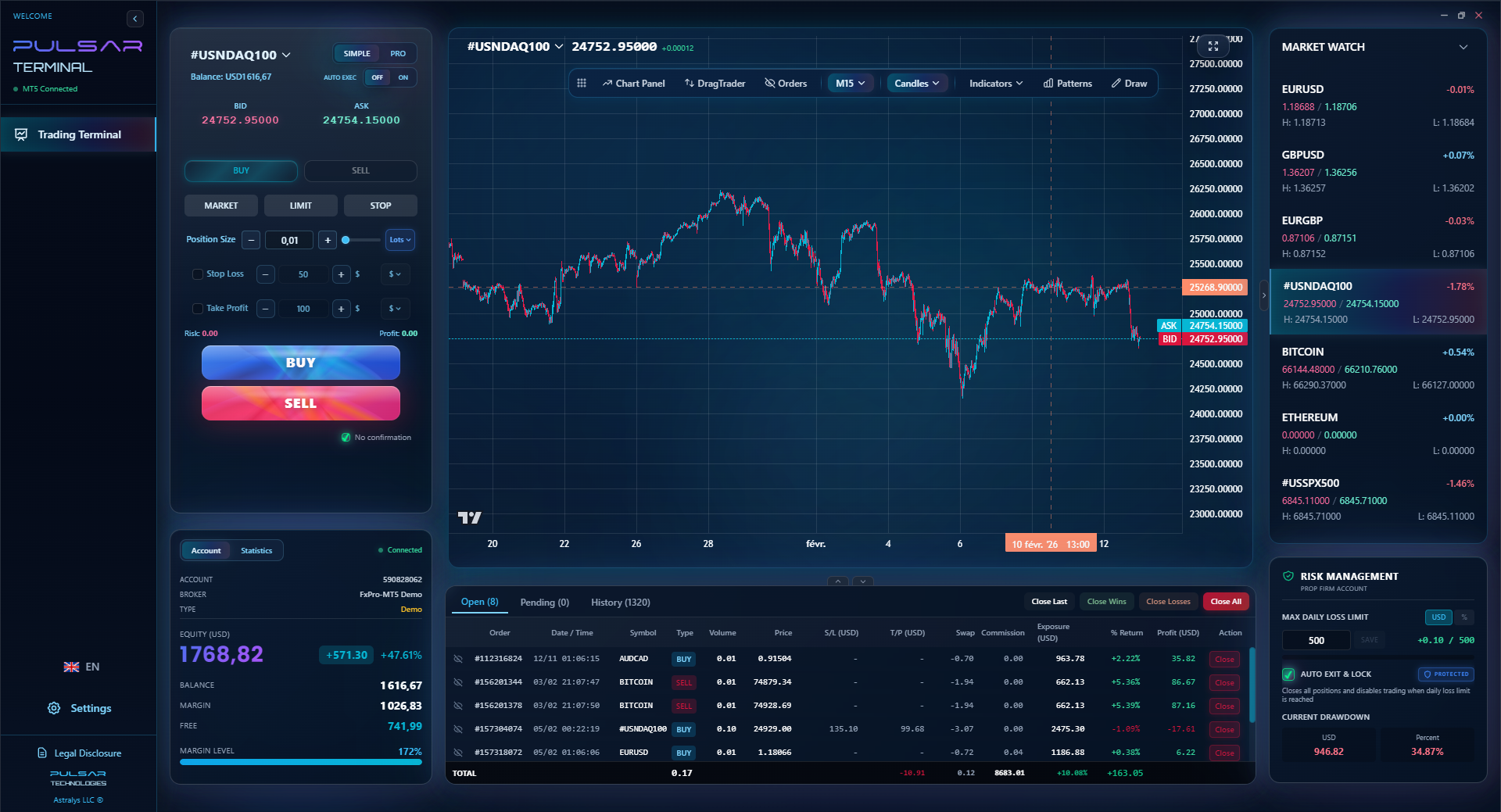
Sticking to your risk rules like a daily loss limit is what separates pros from amateurs, and tools like Pulsar Terminal can automate this protection directly on your MT5 platform.
Pulsar Terminal
The all-in-one MT5 companion: drag-and-drop orders, multi-TP/SL, trailing stop, grid trading, Volume Profile, and prop firm protection. Used by 1,000+ traders daily.
“Your risk management rules are your sacred text. They are the automation that leads to apex forex performance.”
Let's get boring but essential. You make money? SARS will want to know.
Forex trading profits are considered income from a business (if you trade regularly) or capital gains. Most retail traders fall under the 'business' category. You need to declare your net profit (total profit minus total losses, minus allowable expenses like data, trading courses, platform fees) in your annual tax return. It's added to your other income and taxed at your marginal rate. Get a good accountant who understands trading. Trying to hide it is not worth the hassle.
For banking, use the payment methods your broker supports for SA. Instant EFT (via providers like Ozow) is fantastic for quick deposits. For withdrawals, the same EFT back to your bank account is usually free and takes 1-3 business days. I avoid international SWIFT transfers; the fees are brutal.
Finally, continuous learning is part of the practical cost. Allocate a small percentage of your profits to education - books, reputable courses, or even subscribing to a advanced charting tool. I still do this. It keeps you sharp and adapting.
💡 Winston's Tip
The most important line on your chart is your pre-determined stop-loss. It's not a suggestion. It's the fire exit. Use it every single time.
“Clean charts lead to clear decisions. I used to have 12 indicators on my screen. It was noise.”
Let's end by naming the landmines so you don't step on them.
- The Prop Firm Hype: Prop firm challenges are everywhere. They promise you access to large capital. The catch? Their rules are insanely strict (tiny daily loss limits, no holding over weekends). Many are designed for you to fail and keep your challenge fee. If you try one, treat the fee as an educational cost, not an investment. The discipline needed to pass is actually great apex forex training, but know the odds are stacked.
- Signal Services from 'Gurus': If someone is truly a profitable trader, they are trading, not selling signals for R500 a month. These services create dependency and stop you from learning. Your own tested strategy will always serve you better.
- Overcomplicating the Charts: I used to have 12 indicators on my screen. It was noise. Now I use maybe two: sometimes the RSI indicator for overbought/oversold zones, and often just pure price action with horizontal lines. Clean charts lead to clear decisions.
- Ignoring Global News: Even if you trade EUR/USD, a major US economic release (like Non-Farm Payrolls) at 3:30 pm our time will cause chaos. Use an economic calendar. I got stopped out of a good trade 10 seconds before a Fed announcement once. Now, I simply don't hold positions through high-impact news unless I'm intentionally trading the volatility.
The path to apex forex isn't a straight line. It's a series of lessons, losses, small wins, and constant refinement. Start small, protect your capital like it's your last R100, and focus on the process over the profit. The profits will follow the skill.
FAQ
Q1Is forex trading legal in South Africa?
Yes, absolutely. It's a legal and regulated activity. The key is to only use a broker that is licensed by the Financial Sector Conduct Authority (FSCA). This ensures your funds are protected and the broker operates under strict local rules.
Q2What is the best forex broker for South African beginners?
There's no single 'best,' but for beginners, I often suggest looking at FSCA-regulated brokers like Exness or XM. They offer ZAR accounts (saving on bank fees), low minimum deposits (around R800), and have user-friendly platforms like MT4. Their customer support is also generally good for new traders. Always test their demo account first.
Q3How much money do I need to start forex trading in South Africa?
You can start with as little as R500-R1000 with some brokers. However, I strongly advise starting with an amount you are 100% prepared to lose while learning. Realistically, to properly practice risk management (e.g., not risking more than 1-2% per trade), a starting capital of R10,000-R20,000 gives you much more breathing room and a realistic trading experience.
Q4How are forex trading profits taxed in South Africa?
For regular traders, profits are typically treated as income from a business. You must declare your net profit (total profits minus total losses and allowable expenses) in your annual tax return (ITR12). It is then taxed at your personal income tax rate. It's crucial to keep detailed records of all trades and speak to a tax professional.
Q5Can I trade the South African Rand (ZAR) as a currency pair?
Yes, and it's very popular. The most traded pair is USD/ZAR. However, treat it as an exotic pair. It has much wider spreads (often 30-80 pips) and is highly sensitive to local political and economic news. It's better suited for swing trading with wider stop-losses rather than short-term scalping.
Q6What's the biggest mistake new South African forex traders make?
Using excessive use. Just because a broker offers 1:400 doesn't mean you should use it. New traders see it as a way to make huge money from a small deposit, but it amplifies losses even faster. They often blow their account before they've even learned what a pip definition is. Start with low use (like 1:10 or 1:20) to learn.
Q7Is MetaTrader 4 or MetaTrader 5 better for trading?
MT4 is legendary for forex and is simpler, with a massive library of indicators and automated scripts (EAs). MT5 is the newer, more powerful version that can also trade stocks and futures, has more timeframes, and better backtesting. For pure forex, MT4 is still excellent. For a more future-proof and complete tool, go with MT5. Most FSCA brokers offer both.
Prof. Winston's Lesson
Key Takeaways:
- ✓FSCA regulation is non-negotiable for fund safety.
- ✓Use a ZAR account to avoid 3% bank conversion fees.
- ✓Risk a maximum of 1% of your capital per trade.
- ✓Trade the London session (10am-7pm SAST) for best liquidity.
- ✓USD/ZAR requires 150-300 pip stop losses, not 20.
How useful was this article?
Click a star to rate
Weekly Trading Insights
Free weekly analysis & strategies. No spam.
About the Author
David van der Merwe
Emerging Markets Trader
Johannesburg-based trader with 11 years in emerging market currencies. Specializes in ZAR pairs, FSCA-regulated trading, and South African market analysis.
Comments
Risk Disclaimer
Trading financial instruments carries significant risk and may not be suitable for all investors. Past performance does not guarantee future results. This content is for educational purposes only and should not be considered investment advice. Always conduct your own research before trading.
You Might Also Like

Cara Trading Forex Sukses: 7 Prinsip dari Trader Profesional
Cara trading forex sukses dengan 7 prinsip trader pro: manajemen modal, disiplin, journal trading, backtest. Data nyata, bukan janji profit palsu.
Jam Trading Forex Terbaik untuk Trader Indonesia: Panduan Lengkap dengan Tabel Waktu
Panduan jam trading forex untuk trader Indonesia. Tabel 4 sesi dunia, jam emas 20:00-00:00, sesi mana yang harus dihindari. Data akurat + tips dari trader berpengalaman.
Top 5 Sàn Forex Uy Tín Nhất 2026: Review Jujur dari Trader Indonesia
Top 5 sàn forex uy tín 2026 untuk trader Indonesia. Review jujur: spread, deposit, withdraw, dukungan lokal. Exness, XM, IC Markets & lebih.
Get Pulsar Terminal
All these calculators are built into Pulsar Terminal with real-time data from your MT5 account. One-click position sizing, automatic risk management, and instant calculations.
Get Pulsar Terminal