


Thinking about joining Apex Trader Funding to trade futures with 'their' money? You're probably wondering if their new 'Apex 4.0' model is a golden ticket or a cleverly disguised trap.

James Mitchell
Senior Trading Analyst
☕ 9 min read
What you'll learn:
Thinking about joining Apex Trader Funding to trade futures with 'their' money? You're probably wondering if their new 'Apex 4.0' model is a golden ticket or a cleverly disguised trap. I've traded with prop firms for over a decade, and I've seen more traders blow up funded accounts than pass the initial challenge. Let's cut through the marketing and look at the hard numbers, the rule changes, and what this really means for your wallet.
Apex Trader Funding is a proprietary trading firm based in Austin, Texas. Founded in 2021, it quickly became one of the most popular names in the US for futures traders looking to get funded. The basic pitch is simple: you pass a trading evaluation, and they give you a funded account to trade with their capital. You keep a large chunk of the profits.
But here's the critical part most people miss. Apex isn't a broker. They're what's called a 'prop firm,' and in the US, they operate in a regulatory gray area. They structure themselves as an educational service provider trading their own proprietary capital. This means they largely avoid direct oversight from the SEC or CFTC that your standard broker faces. That's not inherently bad, but it's a different kind of risk you need to understand. Your relationship is with Apex, not with the exchange.
Their entire model changed on March 1, 2026, with the launch of 'Apex 4.0.' This wasn't a minor update. It was a complete overhaul of their pricing, rules, and profit structure. The old monthly subscription model is gone, replaced by a one-time payment system with a strict lifetime profit cap. Understanding this shift is the key to knowing if Apex is right for you now.
Forget everything you heard about the old Apex. The Apex 4.0 model is a different beast. The core change is the move from recurring fees to a one-time payment, but the devil is in the details, especially the profit cap.
The One-Time Payment (OTP) Structure
You now pay a single, upfront fee for an evaluation account. If you pass, you pay an additional 'activation fee' to get your funded Performance Account. For example, the cheapest entry point is a $25,000 Intraday Trail account. The evaluation might cost around $118, and the activation fee is $79. That's $197 total to get started, with no more monthly bills. The catch? If you fail the evaluation, you must buy a new one. There are no cheap resets anymore.
The Lifetime Profit Cap
This is the biggest, most controversial change. Your funded account now has a maximum total lifetime payout. Once you hit that cap, the account is closed. Let's use their example: a $100,000 Performance Account has a maximum total payout of $18,000 across all withdrawals. You get 100% of that $18,000 (minus fees), but you cannot earn a penny more from that account. Ever. It's not a 90/10 split; it's a hard stop.

Warning: This fundamentally changes the risk/reward. In the old model, a $100k account could theoretically generate income for years. Now, its total value is capped at $18k. You must factor this cap into your position size calculator to see if the math works for your strategy.
Payout Rules
Payouts can be requested every 5 trading days, which is frequent and a plus. You need a minimum of 5 'qualifying days' (days where you hit a minimum profit target) before each request, and the minimum withdrawal amount is $500. This structure encourages consistent, smaller gains rather than home-run swings.

💡 Winston's Tip
The profit cap isn't a rule, it's a valuation. It tells you exactly what the firm thinks your future earnings are worth to them. Do you agree with their price?
“The trailing drawdown creates a 'high watermark' pressure. A pullback that eats into your paper profits feels like a loss, even though you're still in the green.”
Let's talk dollars and cents, because this is where dreams meet reality. I'll give you a real example from my own testing.
I purchased a $50,000 evaluation under the new Apex 4.0 rules to see the process. The one-time fee was $247. I passed and paid the $79 activation fee. Total out-of-pocket: $326. My goal was to hit the first payout threshold to test the process.
Commission Costs: This is a silent killer. You're not trading for free. On the Tradovate platform, trading one E-mini S&P 500 contract (like the ES) costs about $3.10 round turn ($1.55 per side). On Rithmic, it's closer to $4.00 round turn. If you're a scalping strategy trader making 10 trades a day, that's $31 to $40 in commissions daily, coming straight out of your running profit. Micro contracts are cheaper ($1.98 round turn), but the profit per trade is smaller.
The Cap Calculation: Let's do the math they don't highlight. For a $100,000 account with an $18,000 lifetime cap, you are risking $197+ (your evaluation/activation cost) to win a maximum of $18,000. That's a potential reward-to-risk ratio of about 91-to-1, which sounds amazing. But you have to generate all the profits to get there, paying commissions all the way, without hitting the daily loss limit or breaking any rules. The pressure is immense.
My Personal Mistake: On my test account, I got greedy after two good days. On day three, I increased my size from 1 micro contract to 1 mini contract on the ES, trying to accelerate the process. A 2-point move against me, which I would normally ride out with a micro, triggered a mental stop I didn't have physically set. I panicked, closed for a $100 loss, and blew my daily loss limit for that account. Lesson relearned: stick to your plan, especially when you're playing with someone else's rulebook. The spread definition and commissions alone will eat you alive if you're not precise.
Passing the Apex evaluation is your only ticket to the funded game. They offer two main types: End-of-Day (EOD) Trail and Intraday Trail. The Intraday is generally tougher but has no overnight holding risk.
The Rules (Simplified):
- Profit Target: You need to hit a specific profit target. For a $50k account, it's often $3,000.
- Trailing Drawdown: This is your safety net. It starts a certain distance from your starting equity and only moves up when your profit increases. It never moves down. For a $50k Intraday account, the starting drawdown might be $2,500. If you hit your profit target without your equity ever touching this trailing line, you pass.
- Daily Loss Limit: You also have a separate, fixed daily loss limit (e.g., $1,250 for a $50k account). Hit this, and you fail immediately, even if you're far from your trailing drawdown.

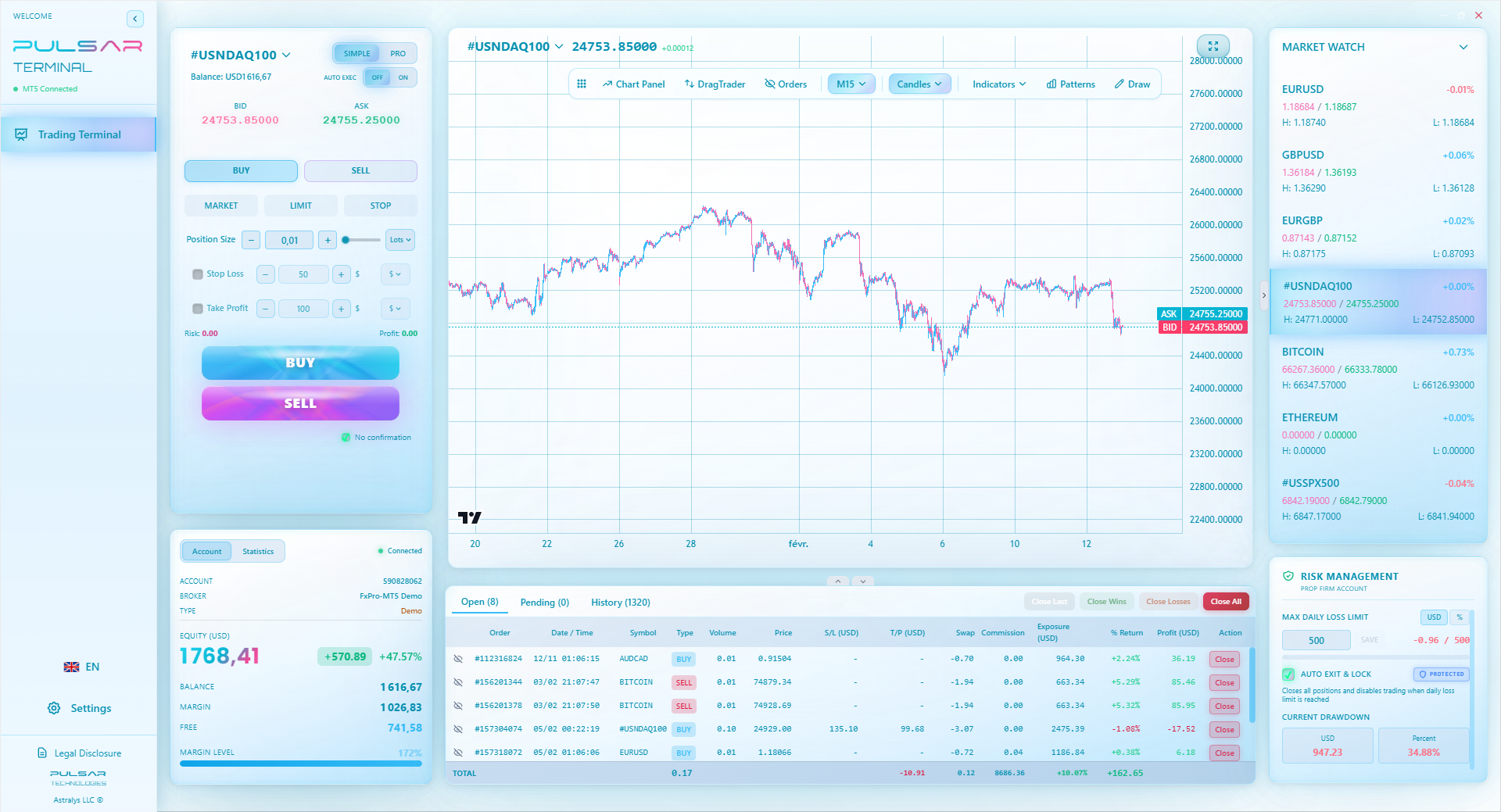
Pro Tip: Treat the evaluation like a job interview for the most risk-averse employer on earth. Your primary goal is not to maximize profit; it's to avoid the loss limits. Use tiny size. I'm talking one micro Nasdaq (MNQ) or micro S&P (MES) contract. Your edge isn't size; it's consistency over time. A tool that can help manage this risk is crucial. Passing a prop firm challenge requires strict loss management, which tools like Pulsar Terminal can help automate directly on MT5.
The psychology here is everything. The trailing drawdown creates a 'high watermark' pressure. Once you're up $1,000, your drawdown has also risen. A pullback that eats into that $1,000 profit feels like a loss, even though you're still in the green. You have to fight the urge to 'protect' paper profits by exiting early. This is where a solid swing trading mindset, focused on the process not the P&L, is worth its weight in gold.
💡 Winston's Tip
Treat the activation fee not as a cost, but as the premium on a call option. Your maximum profit is capped, but your loss is limited to the fee. It's a defined-risk trade.
Managing the strict daily loss limits of a prop firm challenge is easier with automated tools that enforce your rules directly on the trading platform.
Pulsar Terminal
The all-in-one MT5 companion: drag-and-drop orders, multi-TP/SL, trailing stop, grid trading, Volume Profile, and prop firm protection. Used by 1,000+ traders daily.
“Your primary goal in the evaluation is not to maximize profit; it's to avoid the loss limits.”
After trading their new model, here's my blunt assessment.
Pros:
- Lower Upfront Cost: The one-time fee model is more accessible than old monthly subscriptions.
- Frequent Payouts: Getting paid every 5 days is excellent for cash flow.
- Platform Choice: Access to Tradovate and Rithmic is a real benefit for US futures traders.
- No Simulated P&L: They claim you trade directly into the live markets, which can feel more authentic.
Cons:
- The Lifetime Cap: This is a deal-breaker for many serious traders. It turns a funded account into a short-term project, not a long-term business partnership. You are capped on your upside.
- No Resets: Fail an evaluation, buy a new one. This gets expensive fast if you're struggling.
- Commission Costs: They are on the higher side, which erodes the profits from the capped account even faster.
- Regulatory Uncertainty: The CFTC and other bodies are looking closely at prop firms. Rules could change, affecting your account.
Verdict: Apex Trader Funding 4.0 is a mixed bag. It's a fantastic, low-cost simulator with a potential cash prize. It's a terrible vehicle for building long-term trading wealth due to the profit cap.
Who is it for? The beginner or intermediate trader who wants a structured, real-money environment to test their discipline with the chance to earn a few thousand dollars. It's a paid learning experience with a potential reward.
Who should avoid it? The consistently profitable trader looking for a long-term capital partner. The cap severely limits your earnings potential. You'd be better off building your own account slowly or looking at other firms with traditional profit splits, even if their entry is tougher. Before you choose any broker for your own account, always read detailed reviews like our Exness review or IC Markets review to compare real conditions.
If the Apex 4.0 cap doesn't sit right with you, what else is out there? The prop firm landscape is crowded, but few are straightforward.
Other US-Focused Prop Firms: Firms like Topstep also offer futures evaluations. They often have more traditional (but strict) rules and profit splits without a hard lifetime cap. Their fees can be higher, and their drawdown rules are notoriously tight. You need to read the rulebook like a lawyer.
International Prop Firms: Many firms based offshore offer forex and CFD funding, like FTMO or The5%ers. These often have higher profit splits (80/90%) and no hard lifetime cap, but they come with their own complexities: different tax implications, potentially slower withdrawals, and they don't offer direct US futures market access, which might be your preferred instrument.
The Real Alternative: Build Your Own Account. This is the hardest path, but the only one with unlimited upside. Start with a small, real-money account at a reputable broker like Pepperstone or XM for forex, or a direct futures broker. Risk 0.5% per trade. Reinforce your profits. The growth is exponential, and every dollar is yours. I blew my first three small accounts before this lesson stuck. My fourth account started with $500. I traded one micro lot on EUR/USD, focusing purely on risk management. It took 18 months to get to $5,000, but the skill built was permanent. A prop firm can't give you that discipline; it can only test it.
, the best 'funding' is your own saved capital and your own proven, disciplined strategy. Everything else is just a test.
FAQ
Q1Is Apex Trader Funding legit?
Yes, Apex Trader Funding is a legitimate company that pays traders who pass their evaluation and follow the rules. However, 'legit' doesn't mean 'easy money.' Their new Apex 4.0 model includes a lifetime profit cap, which significantly limits your total earnings from a funded account.
Q2What is the lifetime profit cap in Apex 4.0?
It's a maximum total amount you can withdraw from a funded Performance Account. For example, a $100,000 account has a maximum total payout of $18,000. Once you've been paid that total, the account is closed. This is a major change from their old model of unlimited profit splits.
Q3Can I trade stocks or forex with Apex?
No. Apex Trader Funding only provides access to trade futures contracts (like the E-mini S&P 500, crude oil, Treasury notes) on US exchanges. They do not offer stock, forex, or cryptocurrency trading.
Q4How much does it cost to start?
Under Apex 4.0, you pay a one-time fee for an evaluation. The cheapest evaluation for a $25,000 account costs around $197 total ($118 evaluation + $79 activation fee if you pass). There are no monthly fees, but if you fail the evaluation, you must purchase a new one.
Q5What's the difference between EOD Trail and Intraday Trail?
The End-of-Day (EOD) Trail calculates your drawdown only at the market close (5:00 PM ET). You can hold positions overnight. The Intraday Trail calculates drawdown continuously throughout the day and resets each morning; you cannot hold positions overnight. Intraday rules are generally stricter but remove overnight gap risk.
Q6How and when do I get paid?
In the Apex 4.0 model, you can request a payout every 5 trading days. You need a minimum of 5 qualifying trading days (meeting a daily profit minimum) before each request, and the minimum payout amount is $500. Payouts are processed via third-party services like Deel.
Q7What happens if I hit a daily loss limit?
You fail the evaluation immediately. Your account will be closed, and you will need to purchase a new evaluation to try again. There is no reset option under the standard Apex 4.0 plans.
Prof. Winston's Lesson
Key Takeaways:
- ✓A funded account with a cap is a short-term project, not a business.
- ✓Commissions are a silent 3rd partner in every trade you make.
- ✓The daily loss limit fails more traders than the profit target.
- ✓Your own saved capital is the only funding with unlimited upside.
How useful was this article?
Click a star to rate
Weekly Trading Insights
Free weekly analysis & strategies. No spam.
About the Author
James Mitchell
Senior Trading Analyst
Based in New York with over 9 years of trading experience. Focuses on major USD pairs, prop firm challenges, and the US regulatory landscape.
Comments
Risk Disclaimer
Trading financial instruments carries significant risk and may not be suitable for all investors. Past performance does not guarantee future results. This content is for educational purposes only and should not be considered investment advice. Always conduct your own research before trading.
You Might Also Like

Cara Trading Forex Sukses: 7 Prinsip dari Trader Profesional
Cara trading forex sukses dengan 7 prinsip trader pro: manajemen modal, disiplin, journal trading, backtest. Data nyata, bukan janji profit palsu.
Jam Trading Forex Terbaik untuk Trader Indonesia: Panduan Lengkap dengan Tabel Waktu
Panduan jam trading forex untuk trader Indonesia. Tabel 4 sesi dunia, jam emas 20:00-00:00, sesi mana yang harus dihindari. Data akurat + tips dari trader berpengalaman.
Top 5 Sàn Forex Uy Tín Nhất 2026: Review Jujur dari Trader Indonesia
Top 5 sàn forex uy tín 2026 untuk trader Indonesia. Review jujur: spread, deposit, withdraw, dukungan lokal. Exness, XM, IC Markets & lebih.
Get Pulsar Terminal
All these calculators are built into Pulsar Terminal with real-time data from your MT5 account. One-click position sizing, automatic risk management, and instant calculations.
Get Pulsar Terminal