


I lost R4,200 in bank fees before I even placed my first trade.

David van der Merwe
Emerging Markets Trader ·  South Africa
☕ 11 min read
What you'll learn:
- 1What "Applying for Forex" Really Means in South Africa
- 2The Step-by-Step Application Process
- 3Understanding the Real Costs (Beyond the Spread)
- 4Choosing the Right Broker: Local Insights
- 5Common Pitfalls to Avoid (From My Experience)
- 6The Tax Question: What SARS Expects
- 7Is Forex Trading Right for You in South Africa?
I lost R4,200 in bank fees before I even placed my first trade. That was back in 2015. I'd saved up R50,000, eager to apply for forex trading, and I wired the money to an international broker without understanding South Africa's exchange controls. The bank took their cut, SARS wanted documentation I didn't have, and the broker's currency conversion added another layer of cost. By the time the funds landed, my trading capital was already down nearly 10%. That painful lesson taught me that applying for forex here isn't just about picking a broker. It's about navigating a specific set of local rules, costs, and pitfalls that can eat your profits before you even start.
When we say "apply for forex," we're not talking about one single form. It's a process. For a South African, it means three things happening at once: getting yourself legally set up to trade, choosing and signing up with a regulated broker, and understanding how to move your money across borders without getting wrecked by fees.
I made the classic beginner's error. I saw a flashy ad for a broker with "tight spreads," signed up in five minutes, and then tried to force my South African reality into their international system. The broker was legit, but the path for my money wasn't. You need to work backwards from our local regulations.
The core of it is this: you need an FSCA-licensed broker. The Financial Sector Conduct Authority is our watchdog. If a broker isn't on their list, walk away. No matter how good the use sounds. I learned this the hard way, too, with a smaller "offshore" broker that suddenly froze withdrawals. That's a story for another day, but it cemented my rule: FSCA regulation is non-negotiable. It means client funds are segregated, and you have a local channel for complaints.

Warning: It is illegal to buy or sell currency outside authorized channels like banks or licensed dealers. Using informal "forex bureaus" or peer-to-peer schemes for trading deposits can get you into serious trouble with SARS and the SARB.

💡 Winston's Tip
Your first application should be to your own bank. Request their full forex fee schedule. Knowing the cost of moving money is more important than knowing the MACD formula on day one.
“I lost R4,200 in bank fees before I even placed my first trade.”
Let's break down the actual steps, in the right order. This is the sequence I wish I'd followed from the start.
Step 1: Sort Out Your Personal Finances First
Before you even look at a broker, check your bank's forex fees. Call them. Ask for their 2025 schedule for "foreign currency outgoing payments" and "exchange control applications." You need to know this cost. For a R100,000 transfer, fees can range from R250 to over R1,000 depending on the bank and payment type. This is a direct, unavoidable cost of applying for forex trading from South Africa.
Step 2: Choose Your FSCA-Regulated Broker
This is where most of the "application" happens. You'll visit the broker's site and click "Open Account." The forms are similar everywhere. They'll ask for:
- Full name and SA ID number.
- Physical address (a P.O. Box usually isn't enough for FICA).
- Employment status and estimated annual income.
- Trading experience and objectives.
You'll also need to upload FICA documents: a clear copy of your SA ID and a recent proof of residence (like a utility bill or bank statement less than 3 months old).
The key is choosing the right broker for your style. If you're a scalper looking for the tightest possible spreads, you'll want a broker like IC Markets or Pepperstone with raw ECN accounts. If you're a beginner who values fixed costs, a broker with a simple commission-free account might be better. Don't just look at the minimum deposit. Look at the effective cost per trade.
Step 3: Fund Your Account
This is the trickiest part for South Africans. You have two main options:
- Local ZAR Transfer: Many top brokers like XM and Exness offer local South African bank accounts for deposits. You do an EFT in Rand, they convert it to USD or EUR on their side. This is often faster and can be cheaper, but you need to check their conversion rate.
- International SWIFT Transfer: You instruct your bank to send USD/EUR directly to the broker's overseas account. This requires dealing with your bank's forex desk and potentially filing for an AIT (Approval of International Transfer) from SARS if over R1 million. For smaller amounts, you can use your annual discretionary allowance.

Pro Tip: Always do a small test deposit first. Send R1,000 or $50. Confirm it lands in your trading account correctly and that you understand all the fees deducted. Only then send your main capital.
“The FSCA's 30:1 use limit isn't a restriction; it's a life jacket in a stormy market.”
When I first started, I was obsessed with finding a 0.0 pip spread. I thought I'd cracked the code. I didn't. The spread is just one line item. Here’s what actually eats into your returns when you apply for forex trading here.
1. The Funding Cost: Let's use real 2025 numbers. Say you deposit R100,000 via a SWIFT transfer in USD.
- Your bank sells you USD at their rate, which includes a spread of 1.8% to 2.6%. That's R1,800 to R2,600 gone immediately.
- Your bank charges a wire fee. Capitec charges R250 for a standard payment. Nedbank's commission might be a percentage.
- The receiving broker's bank might take a $15-$30 intermediary fee.
You could easily lose 3% before trading. Using a broker's local ZAR account often cuts this down significantly.
2. The Trading Cost: This is the spread + commission + swap. Let's compare two scenarios for trading 1 standard lot of EUR/USD:
| Broker Account Type | Avg. Spread | Commission | Total Cost per Round Turn |
|---|---|---|---|
| Raw ECN (e.g., Tickmill) | 0.11 pips | $6 ($3 per side) | 0.71 pips (or ~$7.10) |
| Commission-Free (e.g., Standard Account) | 0.8 pips | $0 | 0.8 pips (or ~$8.00) |
For a scalping strategy doing 10 trades a day, that difference adds up. For a swing trader holding for days, the overnight swap fees become more important.
3. The Withdrawal Cost: It works in reverse. The broker sends you USD, your bank converts it to ZAR at their buy rate (another hidden spread), and may charge a receiving fee. Always factor in the round-trip cost of moving money.

Example: In 2020, I made a R25,000 profit. I was thrilled. Then I withdrew it. Between the broker's $30 fee, the bank's 2% conversion spread, and a R350 receiving fee, I netted about R23,800. A R1,200 haircut. That's when I started using a position size calculator that included an estimated "friction cost" of 2% on all my trades. It changed my profit targets completely.
“The FSCA's 30:1 use limit isn't a restriction; it's a life jacket in a stormy market.”
The "best" broker depends entirely on how you trade. Here’s my take, based on years of trading through different firms and talking to other local traders.
For Beginners & Conservative Traders: You want simplicity and stability. Look for fixed spreads, good educational resources, and a user-friendly platform. AvaTrade is strong here with its FSCA license (FSP 45984) and fixed spreads around 0.9 pips on EUR/USD. You won't get the absolute cheapest trade, but you won't get nasty surprises during news events either. IG is also excellent for education and has a stellar reputation.
For Active & Scalp Traders: Your life is cost and execution speed. You need a true ECN broker. Pepperstone and IC Markets are the local favorites for a reason. Their Razor/Raw accounts offer spreads at 0.0 pips on majors with a small commission. I've run my scalping strategy on both, and the order fills are consistently fast. Just remember, you need a solid strategy to overcome the commission costs.
For Those Who Trade Exotics like USD/ZAR: You're trading our home pair. Liquidity is lower, so spreads are wider - often 5 pips or more. You need a broker with reliable execution and fair pricing on these pairs. Pepperstone and FP Markets are known for decent access to exotics.
The Minimum Deposit Trap: A $5 minimum deposit (like Exness or XM offer) is great to test the platform. But it's a demo account with real money. To trade properly, especially using sensible position sizing, you need meaningful capital. I'd say a realistic starting point for a live account is R10,000-R20,000. Anything less and fees will consume you.
💡 Winston's Tip
Open two demo accounts: one with a fixed-spread broker and one with a raw ECN broker. Trade the same system on both for a month. The difference in simulated P&L will teach you more about costs than any article.
“For a South African, applying for forex is a lesson in financial bureaucracy before it's a lesson in charts.”
I've made the mistakes so you don't have to. Here are the big ones.
Pitfall 1: Ignoring Exchange Controls. This is the big one. You have an annual discretionary allowance of R2 million. For amounts over R1 million, you need SARS tax clearance. I once tried to send R1.5 million without the clearance for a prop firm challenge. The bank blocked it, the process took weeks, and I missed my opportunity. Plan your funding well in advance.
Pitfall 2: Chasing Maximum use. The FSCA caps use at 30:1 for retail clients. Some offshore brokers might offer 500:1. It's tempting. I used it early on. A 500:1 use means a 0.2% move against you wipes out your account. I learned about margin calls the very hard, very expensive way. The 30:1 limit is there to protect you. Use it. If you need more use, you're not sizing your trades correctly.
Pitfall 3: Not Verifying the FSCA License. Don't just take the broker's word for it. Go to the FSCA website, use their search tool, and type in the FSP number. Make sure the name matches exactly. I almost got caught by a clone firm that had a website 99% identical to a real broker's, with a fake FSP number.
Pitfall 4: Trading USD/ZAR Like a Major Pair. It's not EUR/USD. Spreads are wide, liquidity can dry up, and it's highly sensitive to local political news. I used to try and scalp it. The spreads alone made it unprofitable. Treat it as an exotic, use wider stops, and be mindful of local market hours.
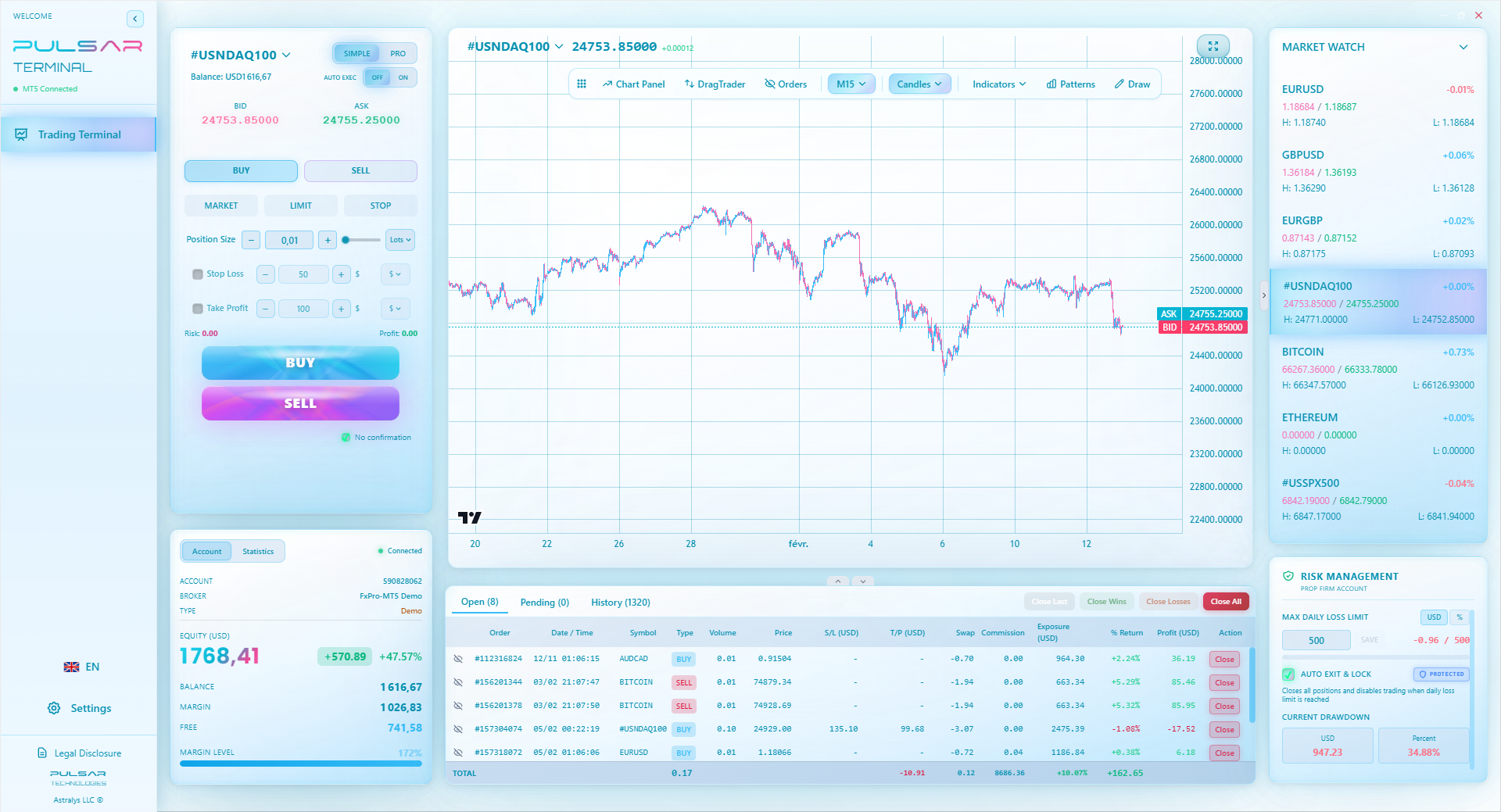
Managing risk and sticking to your rules is the hardest part of trading, which is why I use tools like Pulsar Terminal to automate my stop-loss and take-profit levels directly on MT5, removing emotion from the equation.
Pulsar Terminal
The all-in-one MT5 companion: drag-and-drop orders, multi-TP/SL, trailing stop, grid trading, Volume Profile, and prop firm protection. Used by 1,000+ traders daily.
“For a South African, applying for forex is a lesson in financial bureaucracy before it's a lesson in charts.”
This isn't formal tax advice, but from my experience and conversations with accountants who specialize in traders: your forex profits are likely subject to income tax, not Capital Gains Tax (CGT).
The South African Revenue Service (SARS) views frequent trading as a revenue-generating activity. If you're trading regularly (which you probably are), the profits form part of your gross income. You can deduct certain expenses - like platform fees, data subscriptions, and even a portion of home office costs if you qualify.
The critical part is record-keeping. From day one, you must:
- Keep all deposit and withdrawal statements from your bank and broker.
- Export your trade history (your broker should provide a detailed statement).
- Note any fees paid.
I use a simple spreadsheet: Date, Trade, P&L in USD, P&L in ZAR (using the spot rate on the day I closed the trade). At the end of the tax year, I give this to my accountant with all the supporting docs. Trying to reconstruct it a year later is a nightmare. The first time I had to do it, it took me three solid weekends.
If you're trading through a company structure, it's different. The company pays corporate tax on profits. This is where you absolutely need a professional.
“Your forex profits are likely subject to income tax. SARS views a active trader as a business, not an investor.”
Let's be brutally honest. Applying for forex trading is easy. Succeeding at it is brutally hard. The market doesn't care that you're from Johannesburg or Cape Town. The global banks and algos will take your money just as quickly as they'll take anyone else's.
Before you fill out that first application form, ask yourself:
- Do I have risk capital? This is money I can afford to lose completely. It's not my rent money, my kid's school fees, or my emergency fund. My rule was always: if losing it would keep me awake at night with anxiety, it's not risk capital.
- Am I prepared to learn for 6-12 months without making real money? That's how long a decent demo period should be. Not a week. Not a month. You need to experience different market conditions - trends, ranges, high volatility.
- Can I handle the volatility of the Rand? Our currency is volatile. If you're funding in ZAR and trading USD pairs, a sharp move in USD/ZAR can affect your capital base even before you trade.
I'll tell you why I stuck with it. I love the puzzle. The combination of macroeconomics, psychology, and pure price action hooked me. But for every year I've been profitable, there were two years of breaking even or losing. This isn't a side hustle. It's a skill-based profession with a very high failure rate. Go in with your eyes wide open.
💡 Winston's Tip
Before your first live trade, write down your maximum acceptable loss for the week. When you hit it, stop. Not tomorrow. Not after one more trade. Now. This single habit will save you more money than any indicator.
FAQ
Q1Is forex trading legal in South Africa?
Yes, it's completely legal, provided you trade through a broker regulated by the Financial Sector Conduct Authority (FSCA). Trading with unregulated offshore entities or using illegal money exchange services is against the law.
Q2What is the minimum amount needed to start forex trading in South Africa?
While some brokers let you open an account with as little as $5 (about R90), that's not practical for real trading. To trade properly with sensible risk management, a realistic starting capital is between R10,000 and R20,000. This allows for meaningful position sizes without being destroyed by percentage-based fees.
Q3Can I use my R2 million discretionary allowance to fund my forex account?
Yes, you can. This allowance is for any legitimate foreign exchange purpose, including investing/trading offshore. For amounts between R1 million and R2 million, you don't need SARS tax clearance, but your bank will require you to declare the purpose. Always keep records for SARS.
Q4Why are my bank's forex rates so much worse than the market rate I see?
The rate you see on trading platforms like the EUR/USD guide is the interbank rate. Banks add a margin (often 1.8%-2.6%) for retail customers. This is how they make money on currency conversion. It's a major hidden cost when funding international trading accounts.
Q5Do I pay tax on my forex trading profits?
Almost certainly, yes. SARS typically views active trading as a business, making profits taxable as income. You must declare this income and can deduct related expenses. Keep careful records of all trades, deposits, withdrawals, and fees from day one.
Q6What's the difference between an ECN and a Market Maker broker?
An ECN (Electronic Communication Network) broker connects your order directly to other participants in the market (banks, funds, other traders). They charge a commission but offer raw spreads. A Market Maker may act as the counterparty to your trade, often offering fixed, commission-free spreads. For high-volume traders, ECNs are usually cheaper. For beginners, a reputable Market Maker can offer simplicity.
Q7Is MetaTrader 4 or 5 better for South African traders?
MT4 is incredibly popular and has more custom indicators, but MT5 is more powerful, offering more timeframes, an economic calendar, and better backtesting. Most local brokers support both. I'd recommend starting with MT5 if you're new, as it's the platform of the future. The choice matters less than learning to use your chosen platform inside out.
Prof. Winston's Lesson
Key Takeaways:
- ✓Verify the FSCA license yourself, never trust a broker's claim.
- ✓Factor in a 2-3% 'friction cost' for all bank transfers and conversions.
- ✓Use the 30:1 use limit as a guide for sensible position sizing.
- ✓Start with at least R10,000 to make trading through fees viable.
- ✓Keep trade logs in ZAR from day one for tax purposes.
How useful was this article?
Click a star to rate
Weekly Trading Insights
Free weekly analysis & strategies. No spam.
About the Author
David van der Merwe
Emerging Markets Trader
Johannesburg-based trader with 11 years in emerging market currencies. Specializes in ZAR pairs, FSCA-regulated trading, and South African market analysis.
Comments
Risk Disclaimer
Trading financial instruments carries significant risk and may not be suitable for all investors. Past performance does not guarantee future results. This content is for educational purposes only and should not be considered investment advice. Always conduct your own research before trading.
You Might Also Like

Cara Trading Forex Sukses: 7 Prinsip dari Trader Profesional
Cara trading forex sukses dengan 7 prinsip trader pro: manajemen modal, disiplin, journal trading, backtest. Data nyata, bukan janji profit palsu.
Jam Trading Forex Terbaik untuk Trader Indonesia: Panduan Lengkap dengan Tabel Waktu
Panduan jam trading forex untuk trader Indonesia. Tabel 4 sesi dunia, jam emas 20:00-00:00, sesi mana yang harus dihindari. Data akurat + tips dari trader berpengalaman.
Top 5 Sàn Forex Uy Tín Nhất 2026: Review Jujur dari Trader Indonesia
Top 5 sàn forex uy tín 2026 untuk trader Indonesia. Review jujur: spread, deposit, withdraw, dukungan lokal. Exness, XM, IC Markets & lebih.
Get Pulsar Terminal
All these calculators are built into Pulsar Terminal with real-time data from your MT5 account. One-click position sizing, automatic risk management, and instant calculations.
Get Pulsar Terminal