


I lost R14,200 in 45 minutes with an Australian broker.

David van der Merwe
Emerging Markets Trader ·  South Africa
☕ 11 min read
What you'll learn:
- 1Why Australian Brokers Look So Good (On Paper)
- 2The Real Costs for South Africans (It's Not Just the Spread)
- 3Platforms, Execution, and the Two Types of Brokers
- 4use & Margin: A South African Reality Check
- 5Who Should Actually Use an Australian ASIC Broker?
- 6Your Step-by-Step Due Diligence Checklist
- 7Final Verdict & Realistic Alternatives

I lost R14,200 in 45 minutes with an Australian broker. It was 2015, and I thought their ASIC license was a golden ticket. I loaded up a huge position on AUD/USD during what I thought was a clear breakout. The spread widened from 1.2 to over 8 pips instantly on the Sydney open, my stop-loss got hunted, and I was liquidated before I could blink. That trade taught me a hard lesson: a regulator's badge doesn't stop you from making stupid, expensive decisions. For South Africans looking at Australian forex brokers, the appeal is obvious - strong regulation, a familiar language, and a solid reputation. But the reality is more complicated, and if you don't understand the specific mechanics and costs, you're just funding someone else's retirement.
Let's cut through the marketing. South African traders are drawn to Australian brokers for one primary reason: the Australian Securities and Investments Commission (ASIC). After some of our local scandals, that ASIC logo feels like a fortress of safety. And it is, to a point. ASIC mandates client money segregation, regular audits, and has a track record of enforcing its rules. It's a world away from the offshore 'regulators' some brokers use. You're also dealing with companies in a major financial timezone (GMT+10), which aligns decently with Asian market hours that many of us trade. The platforms offered are typically the global standards - MetaTrader 4 and 5 - so there's no unfamiliar software to learn. The language is English, support is 24/5, and the overall presentation is professional. It creates a powerful illusion of security. I felt it too. That illusion made me ignore my own position size calculator and risk 5% of my account on that fateful AUD/USD trade. The platform didn't fail me. The broker didn't scam me. My own poor risk management, combined with a misunderstanding of their market model, wiped me out.
The ASIC Safety Net (And Its Limits)
ASIC's rules are strong. Your funds are held in segregated trust accounts with major Australian banks. If the broker goes under, your money isn't part of their liquidated assets. That's a real comfort. However, ASIC does not guarantee your trading losses. They don't intervene if you blow up your account through bad trades. Their protection is against broker insolvency and malpractice, not against your own lack of discipline. In 2021, ASIC also implemented stricter use limits for retail clients (max 30:1 on major forex pairs). This is a good thing for preserving capital, but it frustrates traders used to the 500:1 or even 2000:1 offered by some offshore or South African brokers. You need more margin to control the same position size.

Warning: An ASIC license means your broker is well-regulated. It does NOT mean the markets will be easier to trade or that your strategy will suddenly work. The charts are the same; your psychology is the same.

💡 Winston's Tip
A regulator protects you from the broker's bankruptcy, not from your own. Your first line of defense is always your position size.
This is where the dream meets reality. You need to think in ZAR, not just in USD or AUD. Let's break down where your money actually goes.
1. The Spread & Commission: This is the most advertised cost. Australian brokers like IC Markets or Pepperstone offer raw spreads from 0.0 pips plus a commission. Sounds great, right? On EUR/USD, you might pay 0.1 pips + $7 commission per round lot ($100k). That's $7.10 total. But you're funding your account in ZAR. To deposit R20,000, your bank or payment provider will charge a forex conversion fee (often 2-3%) to change it to USD or AUD. You've already lost R400-R600 before placing a single trade.
2. The Hidden Tax: Currency Conversion. This is the silent killer. Your profit and loss are in the pair's quote currency (usually USD). When you withdraw, that USD profit is converted back to ZAR. You pay the forex fee again. If you're a frequent depositor/withdrawer, these fees compound. I learned this the hard way early on. I made a $300 profit on a few scalping trades, but after two deposits and a withdrawal, the bank fees had eaten over $80 of it.
3. Funding and Withdrawal Fees. Bank wire transfers to Australia are expensive (R200+). While many brokers offer free deposits via credit/debit card or local transfer partners, you still face the currency conversion. Some brokers offer ZAR-denominated accounts, but these are rare among pure Australian ASIC entities.

Example: You deposit R10,000. Bank fee: 2.5% = R250 gone. You now have ~$530 USD (at ~R18.50/$). You trade EUR/USD, pay $7 in commissions, and make a $100 profit. You now have $623. You withdraw. Conversion back to ZAR at 2.5% fee = ~$15.55 fee. You receive ~$607.45, which is about R11,238. Your net profit on a R10k deposit, after a winning trade, is only R1,238. A 12.4% return got chopped down by fees to a 12.4% nominal gain, but the friction cost is huge.

“An ASIC license means your broker is well-regulated. It does NOT mean the markets will be easier to trade.”
You'll mostly find MT4/MT5. The difference is in the execution model, which directly impacts your fills and potential costs.
Market Makers (MM) vs. True ECN/STP: Most reputable Australian brokers are ECN/STP. This means they pass your order directly to liquidity providers (big banks). You get real market prices, but you pay a commission. Market Makers can be ASIC-regulated too. They take the other side of your trade internally. This isn't inherently evil - it provides liquidity for smaller trades - but it creates a conflict of interest. Your loss is their profit.
Execution Quality: This is critical. An ECN broker should offer fast execution with minimal slippage. During high volatility (like news events), even ECN spreads will widen massively. My R14k loss was on an ECN account. The spread widened because liquidity dried up, not because the broker manipulated it. The key is knowing what you signed up for. If you're a news trader, you need a broker known for stable execution during events, not just the cheapest spreads.
The South African Connection: Some global brokers like XM or Exness have both ASIC-regulated entities and other entities (like global or Seychelles). They might offer South African clients an account under a different license with higher use and easier ZAR deposits. You are NOT getting the full ASIC protection if your account is not explicitly with their ASIC-licensed company. Always check your account agreement.

Pro Tip: Before funding, do a test. Open a demo account during a major news event (like US NFP). Watch the EUR/USD or XAU/USD spread. Does it jump from 1 to 50 pips? Does your pending order get filled with 5 pips of slippage? That's the real-world condition you'll trade in.
💡 Winston's Tip
If you can't clearly articulate the total cost of a round-trip trade - including deposit and withdrawal fees - you're not ready to fund the account.
ASIC's 30:1 use cap for retail clients is a major point of contention. On a $10,000 account, 30:1 lets you control a $300,000 position. That's still huge risk. But compared to the 500:1 offered elsewhere, it feels restrictive. Here's the math in Rands.
To open 1 standard lot (100,000 units) of EUR/USD at 30:1 use: Margin Required = (100,000 / 30) = ~3,333 EUR. At EUR/USD = 1.0800, that's ~$3,600 USD. At R18.50/$, that's R66,600 in margin required.
To control the same 1 lot at 500:1 use: Margin Required = (100,000 / 500) = 200 EUR. That's ~$216 USD, or just R3,996.
See the difference? With lower use, you need much more capital to take the same market position. This forces you to either trade smaller sizes or commit more capital. For South Africans trading with smaller ZAR-denominated accounts, this can be a significant barrier. It's designed to protect you. In my early days, I would have blown up accounts faster with 500:1. The 30:1 cap likely saved me from even bigger losses later on. It makes a margin call slightly harder to hit, but it doesn't prevent you from losing 100% of your trade capital if you don't use stops.
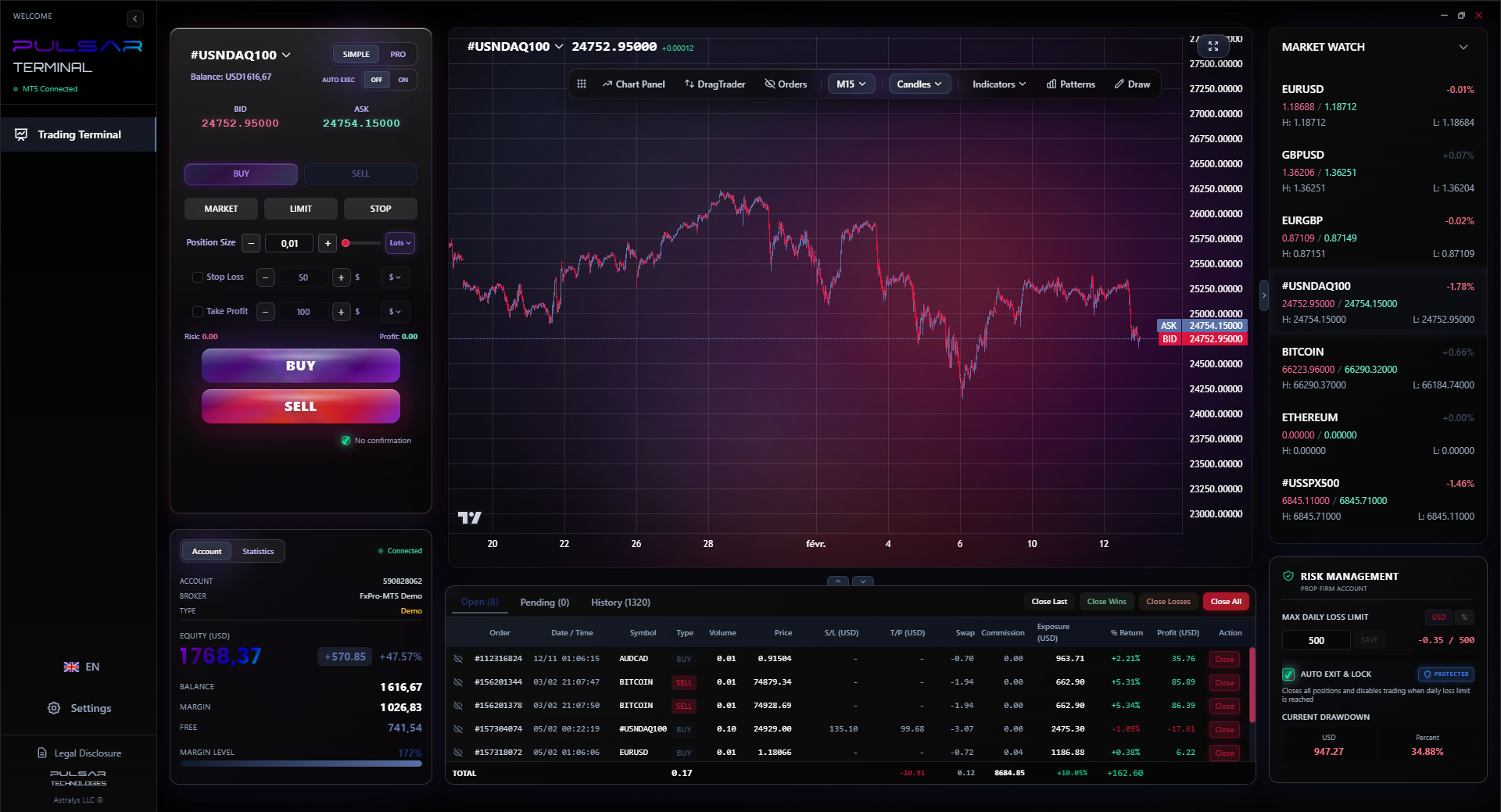
Managing risk with lower leverage requires precise order tools, and Pulsar Terminal's drag-and-drop orders and multi-TP/SL features make complex position management on MT5 simple and fast.
Pulsar Terminal
The all-in-one MT5 companion: drag-and-drop orders, multi-TP/SL, trailing stop, grid trading, Volume Profile, and prop firm protection. Used by 1,000+ traders daily.
“The 30:1 use cap likely saved me from even bigger losses. It makes a margin call harder to hit, but it doesn't prevent you from losing 100% of your trade capital.”
Given the costs and use limits, Australian forex brokers aren't for everyone. They are a specific tool for a specific type of trader.
You might be a good fit if:
- You have a larger trading capital (let's say, consistently over R100,000). The currency conversion fees become a smaller percentage drag.
- You are a medium-to-long term swing trader or investor. Your lower trade frequency means fewer commissions and less worry about ultra-tight spreads on every entry.
- You value regulatory safety above all else and are willing to pay for it in the form of higher margin requirements and funding friction.
- You are trading strategies that require absolute trust in order execution and no dealing desk intervention.
You should probably look elsewhere if:
- Your trading capital is under R50,000. The fees will eat you alive.
- You are a high-frequency scalper who needs ultra-low latency and the absolute lowest cost per trade. The ZAR conversion overhead kills your edge.
- You rely on very high use to make smaller accounts work. This is a dangerous strategy anyway, but the ASIC cap will feel suffocating.
- You want seamless ZAR deposits/withdrawals without forex hassle. A reputable South African FSCA-regulated broker or a global broker with a local entity will serve you better.
The bottom line? Australian brokers are for the disciplined, reasonably well-capitalised trader who treats safety as a non-negotiable. They are not a shortcut to success.
💡 Winston's Tip
The allure of 'safety' often leads traders to ignore the practical costs that destroy their edge. Safety has a price; make sure you can afford it.
Before you send a single Rand, do this.
- Verify the ASIC License: Go to the official ASIC Connect Professional Register (search online). Type in the broker's Australian company name (e.g., "Pepperstone Group Limited"). Confirm the ABN and that the license is current. Don't just trust the logo on their website.
- Read the Financial Services Guide (FSG) & Product Disclosure Statement (PDS): These are legal documents. Boring, but vital. They detail exactly how they handle your money, their execution policy, and all fees.
- Contact Support with a Technical Question: Don't ask about bonuses. Ask something specific like, "What is your policy on slippage for stop-loss orders during the ECB press conference?" Gauge their knowledge and responsiveness.
- Test on Demo, Then Start Small: Use a demo account for at least two weeks, trading your real strategy. Then, if it feels right, make the smallest possible deposit (e.g., R2,000). Place a few real trades, then practice a withdrawal. Feel the entire cycle before committing serious capital.
- Document Everything: Screenshot your account registration, deposit confirmation, trade receipts, and withdrawal requests. Keep a simple spreadsheet of your deposits in ZAR and the USD/AUD equivalent you received. Track the real cost.
Ignoring this process is how you end up confused, frustrated, and out of money. I skipped step 4 with my first broker, and it cost me.
“True safety in trading comes from your own risk management, not just your broker's license.”
Australian forex brokers represent the high-water mark for regulatory security in the retail forex world. For a South African with substantial capital who prioritizes this security above all else, they are a premier choice. The peace of mind knowing your broker is audited and your funds are segregated is tangible. But you pay for it - in hard currency conversion costs, in higher margin requirements, and in operational friction.
For most South African retail traders starting out, the friction cost is simply too high. You are better off starting with a reputable broker that either:
- Is regulated by the South African FSCA and offers ZAR accounts (minimizing conversion fees).
- Is a large, global broker with a strong multi-regulatory footprint that offers a dedicated ZAR account or local payment rails, even if under a different jurisdiction.
The goal is to reduce the barriers between your strategy and the market. If funding your account costs you 3% and withdrawing costs another 2%, your strategy needs a 5% edge just to break even. That's a monumental task. Choose the broker that aligns with your actual capital, your strategy's frequency, and your need for safety. Don't just chase a regulator's badge because it sounds safe. True safety in trading comes from your own risk management, not just your broker's license.
My last piece of advice? Whatever broker you choose, your first investment should be time with a position size calculator. That tool has saved me more money than any regulator ever could.
FAQ
Q1Can I legally use an Australian forex broker from South Africa?
Yes, it's perfectly legal. Australian brokers actively accept clients from South Africa. The legal onus is on the broker to comply with their ASIC regulations while serving you. You just need to meet their account opening requirements, which usually involve standard KYC (Know Your Customer) documentation like your ID and proof of residence.
Q2What is the minimum deposit for an Australian broker?
It varies, but it's generally low, often around $100 USD (roughly R1,850) or even less. However, I strongly advise against depositing the bare minimum. After currency conversion fees, you'll have so little actual trading capital that proper risk management becomes almost impossible. It's a setup for overtrading.
Q3Do Australian brokers offer ZAR accounts?
Rarely. Most Australian ASIC-licensed entities denominate accounts in USD, AUD, EUR, or GBP. Some large international broker brands might offer ZAR accounts through a different entity (e.g., based in the Seychelles), but that account won't be under the ASIC license. Always check which entity you are contracting with.
Q4Is my money safer with ASIC than with the South African FSCA?
The frameworks are different. ASIC has a longer, more established global reputation for strict enforcement and mandatory client fund segregation in top-tier banks. The FSCA is competent and improving, but its global perception and some past local broker failures make ASIC seem more strong to many. Both aim to protect clients from broker insolvency, not from trading losses.
Q5How do I deposit ZAR into an Australian broker account?
You'll typically use an international bank wire (expensive), a credit/debit card (with forex fees), or a third-party payment processor like Wise (formerly TransferWise) or a specific forex partner the broker works with. The broker's website will list options. The cheapest method usually involves converting your ZAR to USD/AUD yourself via a low-cost service before sending.
Q6Why is use so low with Australian brokers?
This is a direct ASIC rule to protect retail clients. Implemented in 2021, it caps use at 30:1 for major forex pairs (and lower for others). The regulator's view is that excessive use is the primary reason retail traders lose money quickly. They are not wrong.
Q7Can I use my South African bank account for withdrawals?
Yes. Withdrawals are usually processed back to the original source of funding. If you deposited via a Visa card linked to your SA bank account, the USD profits will be converted back to ZAR by your bank and credited to you, minus their fees. The process can take 2-5 business days.
Prof. Winston's Lesson
Key Takeaways:
- ✓ASIC protection is against broker failure, not your bad trades.
- ✓Currency conversion fees can easily add a 3-5% drag on South African capital.
- ✓30:1 use requires 16x more margin than 500:1 for the same trade size.
- ✓Always verify the specific entity you are contracting with, not just the brand name.
- ✓Test withdrawal with minimum deposit before committing serious capital.
How useful was this article?
Click a star to rate
Weekly Trading Insights
Free weekly analysis & strategies. No spam.
About the Author
David van der Merwe
Emerging Markets Trader
Johannesburg-based trader with 11 years in emerging market currencies. Specializes in ZAR pairs, FSCA-regulated trading, and South African market analysis.
Comments
Risk Disclaimer
Trading financial instruments carries significant risk and may not be suitable for all investors. Past performance does not guarantee future results. This content is for educational purposes only and should not be considered investment advice. Always conduct your own research before trading.
You Might Also Like

Cara Trading Forex Sukses: 7 Prinsip dari Trader Profesional
Cara trading forex sukses dengan 7 prinsip trader pro: manajemen modal, disiplin, journal trading, backtest. Data nyata, bukan janji profit palsu.
Jam Trading Forex Terbaik untuk Trader Indonesia: Panduan Lengkap dengan Tabel Waktu
Panduan jam trading forex untuk trader Indonesia. Tabel 4 sesi dunia, jam emas 20:00-00:00, sesi mana yang harus dihindari. Data akurat + tips dari trader berpengalaman.
Top 5 Sàn Forex Uy Tín Nhất 2026: Review Jujur dari Trader Indonesia
Top 5 sàn forex uy tín 2026 untuk trader Indonesia. Review jujur: spread, deposit, withdraw, dukungan lokal. Exness, XM, IC Markets & lebih.
Get Pulsar Terminal
All these calculators are built into Pulsar Terminal with real-time data from your MT5 account. One-click position sizing, automatic risk management, and instant calculations.
Get Pulsar Terminal