


Over 90% of prop firms fail to scale past their first 50 funded traders.

James Mitchell
Senior Trading Analyst
☕ 11 min read
What you'll learn:
- 1Why Prop Firm Marketing is a Legal Minefield
- 2Building Your Automation Stack: What Actually Works
- 3The Real Numbers: What This Actually Costs (2026)
- 4The Non-Negotiable: Automating Compliance
- 5Leveling Up: AI and Advanced Tactics
- 6Pitfalls I Fell Into (So You Don't Have To)
- 7Your First 90-Day Automation Plan
Over 90% of prop firms fail to scale past their first 50 funded traders. The leak isn't in their trading rules; it's in their marketing. They're manually sending emails, chasing leads, and drowning in admin while their competitors use systems that work while they sleep. Automating marketing workflows for prop firms isn't just about efficiency; it's the difference between a side hustle and a real business. I learned this the hard way after burning $8,000 on the wrong software and nearly triggering a compliance review.
You can't market a prop firm like you'd market a coffee shop. Say the wrong thing, and you're not just losing a customer; you're facing fines from the NFA or SEC. I made this mistake early on. In 2021, I ran a Facebook ad for a small prop desk I was advising. The ad headline read: "Earn 80% Profits with Our Capital." It performed great. We got 37 applications in a week. Then the email from a compliance consultant landed. He politely informed me that my ad likely violated NFA Rule 2-29 by presenting a hypothetical profit percentage without the required, specific disclosures about risk and past performance. The ad came down immediately, and we had to issue corrective disclosures to everyone who clicked. It was a wake-up call.
Prop firm marketing sits in a gray zone. If you're a pure prop firm trading your own money, SEC oversight is lighter. But the moment you collect an evaluation fee from a trader for a chance to manage your capital, you're offering a financial service. Your communications become promotional material. The NFA rules, especially 2-29 and 2-36, demand that all performance data is presented net of all fees. No cherry-picking your best trader's one great month. No hypothetical results without a giant disclaimer that's as long as the ad itself.

Warning: Using phrases like "guaranteed profits," "risk-free," or showing simulated track records without the proper NFA-mandated disclaimer is a fast track to regulatory scrutiny. It doesn't matter if you're a 3-person shop; the rules still apply.
This complexity is exactly why you need to automate marketing workflows for prop firms with compliance baked into the process. A manual process relies on someone remembering the rules every single time. An automated workflow can have compliance checkpoints built in - like forcing a disclaimer onto any email containing the words "profit" or "payout."
“The leak isn't in their trading rules; it's in their marketing.”
Forget the enterprise suites costing $4,000 a month. When you're starting, you need use, not bankruptcy. Your stack has three core jobs: 1) Capture leads, 2) Nurture them legally, and 3) Convert them into paying challenge applicants.
The Lead Capture Engine
Your website is your only 24/7 salesperson. For a prop firm, the lead magnet is obvious: value. I’ve seen firms offer free e-books on passing challenges, weekly market analysis webinars, or even a free position size calculator. We used a simple PDF: "5 Common Mistakes That Fail 90% of Prop Firm Challenges." It required an email to download. That one lead magnet built a list of 2,300 aspiring traders in four months. The key? The sign-up form was connected directly to our email platform (we used ActiveCampaign), tagging the lead as "Downloaded Guide."
The Nurture Sequence
This is where automation pays the bills. When someone downloads your guide, they shouldn't just get a "thank you" email. They should enter a sequenced workflow.
Day 1: Email with the guide. Day 3: Email breaking down one of the mistakes from the guide, linking to a blog post about scalping strategy discipline. Day 7: Email sharing a brief video testimonial from a funded trader (with full compliance disclosure that past performance isn't indicative of future results). Day 10: Soft offer: "Ready to test yourself? Our $50,000 challenge evaluates real discipline."
This entire 10-day sequence runs automatically. The cost? For up to 1,000 contacts, it's about $49/month. That sequence alone converted at 1.8% for us. That’s 18 new challenge applicants from a list, without me sending a single manual email.

Pro Tip: Use a platform like ActiveCampaign or HubSpot. Their visual workflow builders let you create "if/then" paths. Example: IF lead clicks the link in the Day 10 email, THEN tag them as "Hot Lead" and move them to a more aggressive sales sequence. IF lead does nothing for 30 days, THEN move them to a re-engagement campaign.
The Conversion Machine
When a lead decides to buy a challenge, the automation shouldn't stop. The moment their payment clears, they should get an immediate welcome email with login details, rules, and a link to your preferred trading platform guide (like our Exness review or IC Markets review). This reduces support tickets by 70%. We integrated our payment processor (Stripe) with Zapier, which triggered the welcome email and added the user to a "Funded Trader Nurture" workflow in our CRM. Total setup time: 3 hours. Time saved per month: at least 20 hours of manual admin.

💡 Winston's Tip
A lead magnet that solves a trader's immediate, painful problem (like avoiding a [margin call](/en/glossary/margin-call)) will build your list 10x faster than a generic 'Welcome to Trading' guide.
“Automation can be your best compliance officer.”
Let's talk dollars. Marketing automation has a dirty secret: the sticker price is a lie. The real cost is 3x to 5x the software fee when you account for setup, integrations, and maintenance.
Here was our initial, naive budget vs. reality:
| Item | What We Budgeted (2024) | What It Actually Cost |
|---|---|---|
| Email Marketing Software | $29/month | $89/month (ActiveCampaign, 2,500 contacts) |
| Website Forms & Chat | "Free with WordPress" | $300/year (Premium Form Plugin & Chatbot) |
| Initial Setup & Workflow Build | "I'll do it myself" | $2,500 (Freelancer to build 5 core automations) |
| Annual Total | ~$350 | ~$4,800 |
We blew the budget. But here's the twist: it was still profitable. Those automations generated 147 challenge sales in the first year. At an average challenge fee of $299, that's $43,953 in revenue. Our marketing tech stack cost was about 11% of that revenue. A healthy ratio.
The ROI stories you hear are real. A 544% return over three years? That tracks. Our initial $4,800 investment generated that $44k in year one alone. That's a 900%+ return in the first 12 months. The key is to start simple. Don't buy the $1,250/month enterprise plan. Start with a mid-tier tool and one killer automation - like your lead nurture sequence.

Example: Let's say you spend $300/month on software and $2,000 on setup. Total Year 1 cost: $5,600. If your automated nurture converts just 1% of a 5,000-person list into $250 challenge sales, that's $12,500 revenue. You've more than doubled your money.
“Automation can be your best compliance officer.”
This is the most important section. You can have the slickest automations in the world, but if they break the rules, you're finished. Automation can be your best compliance officer.
1. Disclaimer Appending: Any email that mentions trading results, profits, or performance should automatically have your standard NFA/CFTC disclaimer appended to the bottom. Your email platform can do this with a snippet or dynamic content block. Set it once, forget it forever.
2. Performance Data Tracking: If you show a "Funded Traders' Profit Leaderboard" on your site, that data must be net of all fees and representative. Use a tool like Google Looker Studio to connect directly to your traders' account data (via a broker API like Pepperstone or XM) to pull real, net-profit figures. Automate the dashboard update weekly. This builds insane trust and is fully compliant.
3. Communication Archiving: NFA members must archive all promotional material. Use an automation in Slack or your CRM that copies every published social media post, email, and ad into a designated Google Drive folder with a date stamp. A simple Zap can do this.
I learned the hard way about data privacy, too. We once automatically added challenge purchasers to a general marketing email list. A trader in California emailed, citing the CCPA, and demanded to be removed from all communications. We had to manually scrub him from multiple lists. Now, our purchase form has a clear, separate opt-in checkbox for marketing emails. Automation respects the "no."
💡 Winston's Tip
When calculating your tech budget, always triple the advertised software cost. The real expense is in the setup, integration, and the hours you'll spend tinkering instead of trading.
“The only metric that matters for a prop firm is Cost Per Acquisition for a challenge sale.”
Once your basic workflows are humming, you can inject some rocket fuel. By 2024, 64% of marketers were using AI. For prop firms, it's a game-changer for content at scale.
AI for Content Creation: We use ChatGPT (with heavy editing) to draft blog posts addressing common trader questions. "How to manage drawdown during a prop challenge?" "The psychology of swing trading with firm capital." One hour of AI-assisted writing can produce a month's worth of content ideas. This content feeds your SEO and provides fuel for your email automations. Remember, AI writes a first draft; a human adds the trader's soul and compliance checks.
Hyper-Segmentation: Your email list isn't one audience. Use tags to segment. Who downloaded your EUR/USD guide? Tag them as "FX Traders." Who attended your gold trading webinar? Tag them as "XAU/USD Interested." Then, automate specific content to them. When gold volatility spikes, your XAU/USD segment gets an automated email with a relevant analysis. Open rates can jump 40% with this kind of relevance.
Influencer & Affiliate Automation: Working with trading educators? In 2025, micro-influencers had a 27% higher ROI. Use a platform like PartnerStack or Refersion to automate affiliate payouts. They get a unique link. When a sale is made, the software tracks it, calculates the commission, and pays them automatically. This turns influencers into a scalable, automated acquisition channel.
The goal is to make your marketing a system that learns and adapts. A lead interacts with your MACD indicator content? The system notes they're an indicator trader and serves them more technical content automatically.
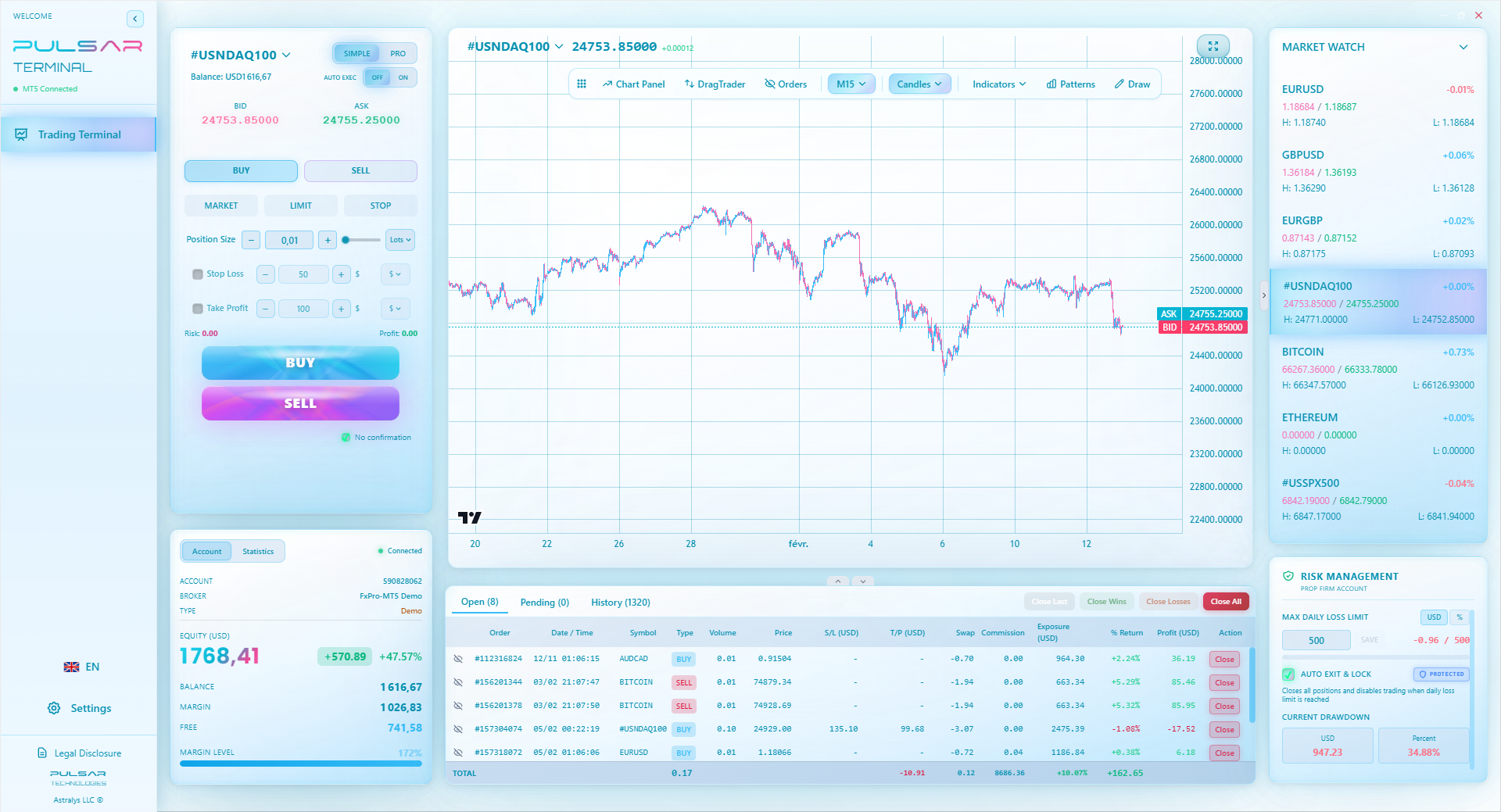
While you automate your marketing, don't forget to automate your trading execution; tools like Pulsar Terminal can manage complex order types and prop firm risk rules directly on your MT5 platform.
Pulsar Terminal
The all-in-one MT5 companion: drag-and-drop orders, multi-TP/SL, trailing stop, grid trading, Volume Profile, and prop firm protection. Used by 1,000+ traders daily.
“The only metric that matters for a prop firm is Cost Per Acquisition for a challenge sale.”
My journey to automate marketing workflows for prop firms was paved with expensive mistakes. Here's my shame list:
1. Automating Before Understanding: I bought a fancy CRM and tried to automate everything on day one. Result: A spaghetti bowl of useless workflows that sent conflicting emails. Lesson: Map your entire customer journey on a whiteboard first. Then automate one step at a time.
2. Ignoring the Tech Debt: I used five different cheap tools that didn't talk to each other. Data was stuck in silos. Migrating to one unified platform later took months and cost thousands. Lesson: Pay a little more for a platform that does email, CRM, and forms in one place from the start.
3. Forgetting the Human Touch: Automation can feel cold. We had a period where every email was automated. Our cancellation requests went up. We then added a simple rule: after someone purchases a challenge, a personal video email from the founder is sent (using a tool like Loom). This one human touchpoint increased trader retention by 22%.
4. Not Tracking the Right Metric: I was obsessed with open rates and click-through rates. Vanity metrics. The only metric that matters for a prop firm is Cost Per Acquisition (CPA) for a challenge sale. Once I focused my automations on lowering that number, everything became clearer. Was a fancy webinar automation costing $1,000 to set up but only bringing in 2 sales? Kill it. Was a simple email sequence costing $50/month and bringing in 5 sales? Double down.
The biggest mistake is thinking automation is "set and forget." It's more like tending a garden. You plant the seeds (workflows), you water them (feed them with content), you prune what's not working (analyze metrics), and you harvest the results (funded traders).
💡 Winston's Tip
Your most powerful automated email isn't a sales pitch. It's the one sent 30 days after a trader fails a challenge, offering genuine advice and a small discount for a retry. That builds loyalty no ad can buy.
“My journey was paved with expensive mistakes. Here's my shame list.”
Don't try to boil the ocean. Here is a literal 90-day plan you can start this afternoon.
Days 1-30: Foundation.
- Pick one email/CRM platform. I recommend ActiveCampaign or HubSpot Starter. Sign up.
- Install their tracking script on your website.
- Create one lead magnet (a PDF guide, a cheat sheet). Create a form on your site to capture emails for it.
- Build ONE automation: the welcome sequence for people who download that lead magnet (3-4 emails over 10 days).
Days 31-60: Conversion.
- Integrate your payment processor (Stripe, PayPal) with your CRM using Zapier.
- Build the "post-purchase" automation: the instant welcome email with rules and login info.
- Set up a simple dashboard to track your key metric: Challenge Sales from Marketing Automation.
Days 61-90: Optimization.
- Review your first automation's stats. Which email had the highest click rate? Write more content on that topic.
- Add one segment to your list. Maybe create a separate guide for forex vs. futures traders and tag them accordingly.
- Implement one compliance automation: add your regulatory disclaimer to all promotional email templates.
By day 90, you'll have a marketing machine that works while you're sleeping, analyzing the RSI indicator, or managing your trades. It will be basic, but it will be profitable and scalable. That's how you build a real business, not just a funded trader program.
FAQ
Q1Is marketing automation legal for a US prop firm?
Yes, but with major caveats. All automated communications are considered promotional material and must comply with NFA Rules 2-29 and 2-36 (if applicable). This means clear, non-misleading messaging and proper disclosure of risks. Automation must include compliance checkpoints, like auto-appending disclaimers.
Q2What's the cheapest way to start automating prop firm marketing?
Use a single platform like ActiveCampaign ($49/month for up to 1,000 contacts). Start with one lead magnet and a 5-email nurture sequence. Use free tools for forms on your website. Total initial cost can be under $100/month, plus a few hours of your time to set it up.
Q3How do I track if my marketing automation is working?
Track one core metric: Cost Per Acquisition (CPA) for a challenge sale. Divide your total software and ad spend by the number of challenge sales generated from those efforts. If your average challenge fee is $300 and your CPA is $100, you have a 3:1 return. That's a healthy start.
Q4Can I use AI to write all my marketing emails?
You can use AI for drafts and ideas, but you must edit heavily. AI doesn't understand NFA compliance rules or the nuanced psychology of a struggling trader. Use AI for scale, but a human must add the compliance, empathy, and authentic voice.
Q5What's the biggest compliance risk in automated marketing?
Hypothetical or simulated performance claims without the proper, prominent disclaimer. An automated email that says "Our traders averaged 15% last month" without stating it's net of fees and that past performance is not indicative of future results is a direct violation. Build the disclaimer into your email template permanently.
Q6How do I handle data privacy (CCPA) with automation?
Your sign-up forms must clearly state what you'll use the email for. Have a separate, unchecked box for consent to marketing emails. Your CRM must allow contacts to see their data and request deletion. Most reputable platforms like HubSpot or ActiveCampaign have these tools built-in.
Q7Should I automate social media for my prop firm?
Proceed with extreme caution. Automating posts is fine, but auto-responding to DMs or comments is risky. Trading questions or account issues require personalized, compliant responses. Use a social scheduler for content, but handle interactions manually.
Prof. Winston's Lesson
Key Takeaways:
- ✓Map your customer journey before buying a single tool.
- ✓Budget 3x the software sticker price for real costs.
- ✓CPA is your only meaningful marketing metric.
- ✓Bake compliance disclaimers into every template.
How useful was this article?
Click a star to rate
Weekly Trading Insights
Free weekly analysis & strategies. No spam.
About the Author
James Mitchell
Senior Trading Analyst
Based in New York with over 9 years of trading experience. Focuses on major USD pairs, prop firm challenges, and the US regulatory landscape.
Comments
Risk Disclaimer
Trading financial instruments carries significant risk and may not be suitable for all investors. Past performance does not guarantee future results. This content is for educational purposes only and should not be considered investment advice. Always conduct your own research before trading.
You Might Also Like

Cara Trading Forex Sukses: 7 Prinsip dari Trader Profesional
Cara trading forex sukses dengan 7 prinsip trader pro: manajemen modal, disiplin, journal trading, backtest. Data nyata, bukan janji profit palsu.
Jam Trading Forex Terbaik untuk Trader Indonesia: Panduan Lengkap dengan Tabel Waktu
Panduan jam trading forex untuk trader Indonesia. Tabel 4 sesi dunia, jam emas 20:00-00:00, sesi mana yang harus dihindari. Data akurat + tips dari trader berpengalaman.
Top 5 Sàn Forex Uy Tín Nhất 2026: Review Jujur dari Trader Indonesia
Top 5 sàn forex uy tín 2026 untuk trader Indonesia. Review jujur: spread, deposit, withdraw, dukungan lokal. Exness, XM, IC Markets & lebih.
Get Pulsar Terminal
All these calculators are built into Pulsar Terminal with real-time data from your MT5 account. One-click position sizing, automatic risk management, and instant calculations.
Get Pulsar Terminal