


Thinking about setting up a forex robot and letting it print money while you sleep? I get it.

David van der Merwe
Emerging Markets Trader ·  South Africa
☕ 10 min read
What you'll learn:
- 1What Autotrading Forex Actually Is (And Isn't)
- 2The South African Landscape: FSCA, Scams, and Reality
- 3The Real Costs & Risks (Beyond Just Losing Money)
- 4How to Evaluate an Autotrading System (Without Getting Scammed)
- 5Building vs. Buying: Which Path is For You?
- 6Practical First Steps for a South African Trader
Thinking about setting up a forex robot and letting it print money while you sleep? I get it. The promise is intoxicating. But here's the question you need to answer first: are you looking for a genuine trading tool, or are you just hoping to buy a magic money machine? In South Africa, where get-rich-quick schemes are a national pastime, autotrading forex sits in a dangerous grey area. I've coded my own bots, bought expensive ones, and watched friends lose their shirts to 'guaranteed' systems. Let's cut through the hype.
Autotrading forex isn't one thing. It's a spectrum, and where you land on it determines your risk of getting cleaned out.
At its core, it's any system that opens and closes trades without you clicking the button. This breaks down into three main types:
1. Expert Advisors (EAs) / Forex Robots: These are pieces of software, usually for MetaTrader 4 or 5, that follow a coded set of rules. You attach them to a chart, and they trade. The quality ranges from sophisticated algorithms built by quant traders to absolute garbage sold by marketers.
2. Copy Trading / Social Trading: This is where you automatically mirror the trades of another trader. Platforms like eToro popularized this. You pick a 'Strategy Provider,' allocate funds, and your account follows theirs. It's less about code and more about trusting someone else's gut (or algorithm).
3. Trading Bots & APIs: More advanced. These are standalone programs, often written in Python, that connect to a broker's API. They can scan multiple markets, manage complex portfolios, and execute trades across different brokers. This is the realm of serious developers and prop firms.
What autotrading ISN'T: a guaranteed income. The market doesn't care about your code. If your strategy is flawed, automating it just means losing money faster and more efficiently. I learned this the hard way early on. I had a decent manual scalping strategy for EUR/GBP. I automated it. Backtests looked amazing. Live trading? It got chopped up in sideways markets because my code couldn't interpret market context like I could. I turned a strategy that made R15,000 over three months manually into a bot that lost R8,000 in two weeks.

Warning: The biggest lie in autotrading is the backtest. Sellers will show you a chart going straight up. What they don't show is the curve-fitting - coding the robot to perfectly match past data. It's like teaching for the test instead of understanding the subject. It fails spectacularly in the future.

💡 Winston's Tip
The most profitable line of code you'll ever write is the one that says 'IF DailyLoss > 2%, THEN StopTrading'. Risk management isn't a feature; it's the entire product.
Trading in South Africa operates under the Financial Sector Conduct Authority (FSCA). This is critical for autotrading.
The Regulatory Grey Zone: The FSCA regulates financial service providers (brokers, managers). If you're just downloading an EA for your personal MT5 account, you're generally in the clear. However, the moment you start managing money for others using an automated system, or selling a system with the promise of returns, you're treading on dangerous ground. You need a license. Many local 'gurus' selling 'bot packages' for R20,000 are operating illegally.
The Scam environment: South Africa is fertile ground for autotrading scams. They follow a pattern:
- Flashy Marketing: Lambos, waterfront homes (often stock photos).
- Testimonials: Fake or paid-for reviews from 'clients' in Cape Town or Joburg.
- The 'Limited-Time' Offer: Pressure to buy now before the price increases.
- The Product: An overpriced, poorly documented EA or a course on how to set up a basic bot.
- The Result: The bot fails. Support vanishes. Your money is gone.
I had a friend, let's call him James, who paid R25,000 for a 'Gold Miner' EA from a local seminar. It was supposed to trade XAU/USD. It blew his R50,000 account in a month because it had no stop-loss logic during a high-volatility news event. The seller's response? "You didn't use the right VPS provider."
Using International Brokers: Many South Africans use international brokers like Exness, IC Markets, or Pepperstone for better conditions and platform access. This is legal for individuals. The key is that the broker itself should be regulated by a reputable overseas body (ASIC, CySEC, FCA). Your autotrading activities on these platforms are between you and the broker's terms of service.

Pro Tip: Before buying any autotrading system, ask the seller for their FSP number. If they're selling to South Africans and making financial promises, they should have one. If they hesitate, run.
“If you don't have a profitable manual strategy first, automation just gives you a faster, more efficient way to lose.”
Let's talk numbers. The risk isn't just your initial capital. It's death by a thousand cuts.
The Hidden Cost Structure:
| Cost Factor | Typical Range (ZAR) | Why It Matters |
|---|---|---|
| System Purchase | R1,500 - R50,000+ | Upfront, non-recoverable. High price ≠ quality. |
| VPS (Virtual Private Server) | R150 - R600/month | Essential for 24/5 trading. Non-negotiable for EAs. |
| Broker Spreads & Commissions | Variable | Your bot trades frequently. High spreads kill scalping EAs. A 2-pip spread vs. a 0.8-pip spread is a massive difference. |
| Drawdown Risk | Can be 100% of account | The biggest risk. A faulty bot can ignore a margin call and wipe you out. |
Strategy Decay: Markets change. A strategy that works brilliantly in a ranging market will fail in a strong trend, and vice-versa. Your bot doesn't know this. You need to constantly monitor and adjust. It's not a 'set and forget' - it's 'set and babysit.'
Technical Failures: Internet drops. VPS has a hiccup. Your broker has a requote during a news event. The bot gets stuck in a loop. I once had a grid trading bot (a type of autotrading forex strategy) running on USD/ZAR. A sudden, massive spike from a political announcement caused my broker's servers to lag. The bot kept placing orders as the price ran away, but the 'close' commands were delayed. I went from a R5,000 profit to a R12,000 loss in 90 seconds. The bot did exactly what it was coded to do, but the real-world infrastructure couldn't keep up.
Psychological Danger: This is the sneakiest risk. When a manual trade loses, you feel it. You learn. When a bot loses, it feels like a technical glitch. You blame the code, the VPS, the broker - anything but the strategy. This prevents real learning and leads to chasing the next 'perfect' robot.
If you're still determined, here's a forensic checklist. Treat this like a forensic audit.
Demand a Live, Verified Track Record
A Myfxbook or FXBlue link is the bare minimum. It must be live, not a demo or a backtest. Look for:
- Duration: At least 12-18 months of live history.
- Consistency: Small, steady gains are better than huge, erratic spikes.
- Drawdown: Maximum drawdown should be under 20-25%. Anything over 30% is a rollercoaster.
- Average Loss vs. Average Win: The win should be bigger than the loss.
Understand the Strategy
Don't buy what you don't understand. Ask:
- What pairs does it trade? (A bot that trades 30 pairs is often over-extended).
- What's the core logic? (e.g., Does it use MACD indicator crossovers, RSI indicator divergence, price action?)
- Is it a scalper, day trader, or swing trading bot?
- How does it manage risk? Where does it place stop-losses?
Test It Yourself (The Only Way)
- Demo Test: Run it on a demo account for at least 2-3 months. Match the demo account balance and use to what you'd use live.
- Forward Test (Most Important): This is a live account with tiny, tiny capital. Use a cent account or a live account with the absolute minimum deposit. I forward test every system with R1,000 (or $50) for a minimum of 100 trades. The goal isn't to make money; it's to see if the real-world performance matches the track record. Watch for slippage, execution quality, and how it handles news.

Example: Let's say a bot claims a 60% win rate with a 1:2 risk/reward. Over 100 trades risking R100 per trade:
- 60 winning trades: 60 wins * (R100 risk * 2) = R12,000 profit
- 40 losing trades: 40 losses * R100 = R4,000 loss
- Net Profit: R8,000 Now, run your R1,000 forward test. Does the bot's actual behavior produce a similar structure of wins and losses? Or is it all cluster losses?
💡 Winston's Tip
When evaluating a system, ignore the profit curve. Stare at the drawdown curve. That's the pain you'll have to sit through. If you can't handle that drawdown emotionally, the system will break you before it makes you a cent.
“Aim for an automated system to produce a consistent 5-15% per year, not 5% per month. The latter is almost always a scam.”
This is the crossroads. Most people should neither build nor buy. But if you're committed, here's the breakdown.
Buying a Commercial EA:
- Pros: Immediate. No coding required. Potentially access to a tested strategy.
- Cons: Expensive. Black box (you don't know the logic). High risk of scams. Strategy decay unknown. No customisation.
- Best for: Someone with capital to risk on experimentation, who understands the evaluation process above, and views the cost as tuition, not investment.
Building Your Own (The Hard Way): This is my preferred route, but it's a mountain to climb.
- Pros: Full control. You understand every line of logic. You can adapt and improve. It's a valuable skill.
- Cons: Steep learning curve (MQL4/MQL5, Python). Requires a profitable manual strategy first. Thousands of hours of testing.
- How to Start:
- Have a Profitable Manual Strategy First. This is non-negotiable. You can't automate luck. You need rules so clear a computer can follow them.
- Learn the Basics of MQL5. Code your strategy's entry, exit, and risk management rules. Start simple.
- Backtest, then Forward Test. Use MT5's Strategy Tester, but don't trust it blindly. Then forward test with tiny money.
- Incorporate strong Risk Management. This is 90% of the code. Position sizing (position size calculator is key), maximum daily loss, correlation limits.
I built my first successful bot for trading the EUR/USD guide London open. The manual strategy took me a year to refine. Coding it took 3 months. Forward testing and tweaking took another 6. The first live version made R42,000 in 4 months on a R200,000 account. The key was the risk management code that limited daily loss to 1.5% no matter what.
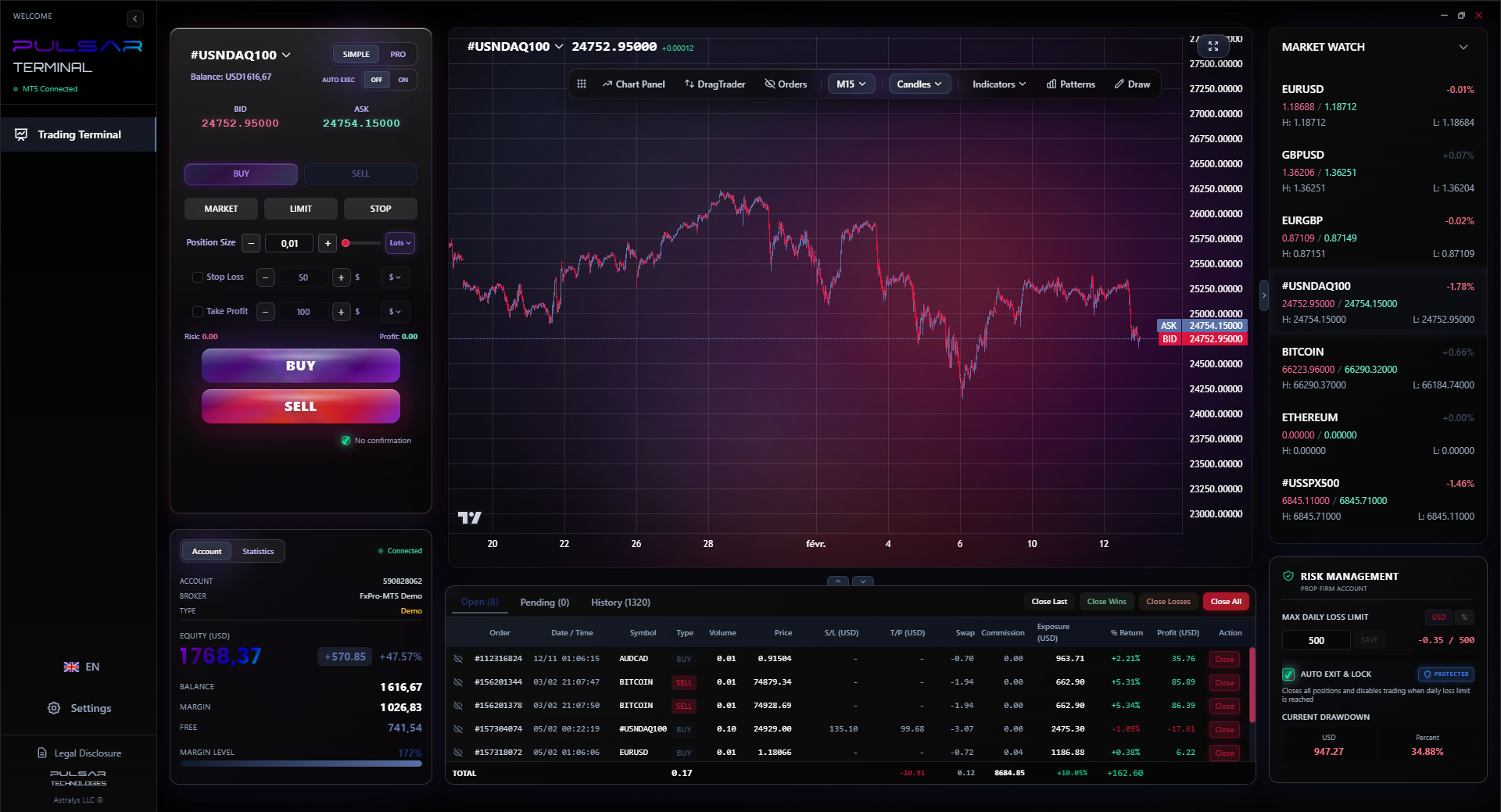
When building your own bot, managing complex exit logic like multiple take-profits and trailing stops is half the battle, which is why tools like Pulsar Terminal that automate this on MT5 are so valuable.
Pulsar Terminal
The all-in-one MT5 companion: drag-and-drop orders, multi-TP/SL, trailing stop, grid trading, Volume Profile, and prop firm protection. Used by 1,000+ traders daily.
Okay, you've read the warnings and you still want to dip a toe in. Here's a sane, low-risk path.
-
Start with Copy Trading on a Regulated Platform: Open an account with a broker like XM or Pepperstone that offers copy trading. Deposit a small amount you can afford to lose - R5,000, not R50,000. Follow 3-5 different strategy providers with varying styles for 6 months. Don't chase the top performer; look for the most consistent. This teaches you about strategy variance and drawdowns with real money on the line.
-
Learn to Code a Simple Indicator: Before a full EA, learn to code a custom indicator in MQL5. It forces you to understand logic and syntax without the pressure of live trades. There are great free courses on YouTube.
-
Run a Popular Free EA on a Cent Account: Find a well-known, free EA (like a moving average crossover bot) with open-source code. Study the code. Run it on an IC Markets or Exness cent account with $100. Watch it like a hawk for a month. You'll learn more about execution, spreads, and the boredom of monitoring than any course can teach you.
-
Ruthlessly Manage Your Expectations: Aim for an automated system to produce a consistent 5-15% per year, not 5% per month. The latter is almost always a scam. Use automation to execute a boring, disciplined strategy, not to hunt for unicorns.
Remember, the goal of autotrading forex should be to remove emotion and inconsistency, not to replace skill and understanding. If you don't have the skill first, automation just gives you a faster, more efficient way to lose.
FAQ
Q1Is autotrading forex legal in South Africa?
Yes, for personal use it is legal. Using an Expert Advisor on your own MetaTrader account with a local or international broker is fine. However, selling an autotrading system as a financial product or managing other people's money with it requires an FSCA license. Many sellers operate without one.
Q2What is the best forex robot for South African traders?
I won't recommend a specific 'best' robot because there isn't one. The 'best' system is one built on a strategy you understand and that fits current market conditions. Be deeply skeptical of any website claiming to have the #1 robot. Focus on learning to evaluate track records and forward test with tiny amounts of capital instead.
Q3Can I make a living from autotrading forex?
Extremely unlikely, especially starting out. The traders who sustainably make a living from automation are usually the ones who built their own systems after years of manual trading. They treat it like a business with significant capital (R1 million+). For most, aiming for a small, consistent supplemental income is a more realistic goal.
Q4How much money do I need to start autotrading?
You need two pools of money: system costs (R0-R50,000+) and risk capital. For the risk capital, never start with money you need. A sensible minimum for a forward test is R1,000-R2,000 in a cent account. For a live account where the results might be meaningful, you'd need at least R50,000-R100,000 to properly implement risk management without being destroyed by the spread definition and minimum trade sizes.
Q5What's better: copy trading or forex robots?
They have different risks. Copy trading depends on the continued skill and emotional state of a human trader. That trader can have a divorce, get greedy, or change strategy. A forex robot is consistent but can't adapt to changing market regimes. Copy trading is easier to start with; robots offer more control if you know how to build/manage them.
Q6Do I need a VPS for autotrading?
Absolutely, 100% yes. If your bot trades 24/5, your home PC and internet are not reliable enough. A VPS in the same data centre as your broker (often London or New York) ensures minimal latency and uptime. This is a non-negotiable operational cost, typically R150-R600 per month.
Prof. Winston's Lesson
Key Takeaways:
- ✓Treat every bought EA as a scam until proven otherwise via 3-month forward test.
- ✓Your maximum drawdown limit is more important than your profit target.
- ✓A VPS is not an optional cost; it's part of your trading capital.
- ✓Automation amplifies your strategy's flaws with brutal efficiency.
How useful was this article?
Click a star to rate
Weekly Trading Insights
Free weekly analysis & strategies. No spam.
About the Author
David van der Merwe
Emerging Markets Trader
Johannesburg-based trader with 11 years in emerging market currencies. Specializes in ZAR pairs, FSCA-regulated trading, and South African market analysis.
Comments
Risk Disclaimer
Trading financial instruments carries significant risk and may not be suitable for all investors. Past performance does not guarantee future results. This content is for educational purposes only and should not be considered investment advice. Always conduct your own research before trading.
You Might Also Like

Cara Trading Forex Sukses: 7 Prinsip dari Trader Profesional
Cara trading forex sukses dengan 7 prinsip trader pro: manajemen modal, disiplin, journal trading, backtest. Data nyata, bukan janji profit palsu.
Jam Trading Forex Terbaik untuk Trader Indonesia: Panduan Lengkap dengan Tabel Waktu
Panduan jam trading forex untuk trader Indonesia. Tabel 4 sesi dunia, jam emas 20:00-00:00, sesi mana yang harus dihindari. Data akurat + tips dari trader berpengalaman.
Top 5 Sàn Forex Uy Tín Nhất 2026: Review Jujur dari Trader Indonesia
Top 5 sàn forex uy tín 2026 untuk trader Indonesia. Review jujur: spread, deposit, withdraw, dukungan lokal. Exness, XM, IC Markets & lebih.
Get Pulsar Terminal
All these calculators are built into Pulsar Terminal with real-time data from your MT5 account. One-click position sizing, automatic risk management, and instant calculations.
Get Pulsar Terminal