


Let's cut through the noise.

Olumide Adeyemi
West African Trading Pioneer ·  Nigeria
☕ 8 min read
What you'll learn:
- 1What Exactly Is a Forex Card? (And Why You Want One)
- 2The Nigerian Reality: Why You Can't Get an Axis Bank Card
- 3Your Actual Funding Options from Nigeria
- 4Cost Breakdown: The Hidden Tax on Your Trading
- 5A Bigger Problem: Trading in Naira vs. USD
- 6Choosing a Broker: The Nigerian Checklist
- 7Your Action Plan: What to Do Today
Let's cut through the noise. Most Nigerian traders searching for an 'Axis Bank Forex Card' are looking for a magic bullet to fund international brokers. Here's the hard truth upfront: Axis Bank is an Indian financial institution. As a Nigerian resident, you cannot simply walk into a branch in Lagos or Abuja and open an account. This guide isn't about a product you can easily get. It's about understanding the concept of a multi-currency forex card, why Nigerians seek it, and what your actual, workable alternatives are for getting capital to brokers like Exness or IC Markets.
A forex card, or a travel card, is a prepaid debit card you load with foreign currency before you travel. It's designed to give you better exchange rates and lower fees than using your regular naira debit card abroad. For traders, the appeal is obvious: it's a potential vessel to hold USD, EUR, or GBP, which you could then theoretically use to fund a trading account.
Think of it like a digital wallet for specific currencies. You lock in a rate when you load it, shielding you from later fluctuations (for better or worse). The dream scenario? Load it with USD via a Bureau de Change, then use the card details to make a deposit to your chosen broker. It sounds clean. In practice, especially from Nigeria, it's riddled with complications.

Warning: The primary purpose of these cards is travel and spending, not international financial transfers for trading. Banks and card networks have systems to detect and block transactions to known CFD/Forex brokers. Assuming it will work for funding is your first mistake.
This is the core of the issue. Axis Bank does not offer retail banking services to non-resident Indians (NRIs) or foreign nationals in Nigeria. You need to be physically present in India with the required KYC documents (like an Aadhaar card) to open an account and request the card. No Nigerian address proof will suffice.
The searches for this card stem from a deep-seated need: a reliable, low-cost method to move money across borders in a country with strict capital controls. When your local bank card gets declined on Pepperstone's payment page for the fifth time, you start looking for exotic solutions. I've been there. I once spent two weeks trying to route money through a friend's European account, losing on fees and time better spent analyzing charts.
Your search should shift from a specific Indian bank's product to understanding the mechanisms that are available to you. The goal isn't the card itself; it's achieving the function: getting foreign currency to your broker.

💡 Winston's Tip
Stop looking for backdoor funding solutions. The time you waste is opportunity cost. Find a broker that opens the front door for Nigerian traders and walk right in.
“The dream of an Axis Bank Forex Card is a symptom of a real problem: moving money across borders in a restricted environment.”
Stop chasing ghosts. Here are the real paths Nigerian traders use. I've personally funded accounts with all of these methods over the years.
Local Payment Methods
Many top international brokers now cater directly to the Nigerian market. They integrate local payment processors that allow you to deposit in Naira, which is converted at the point of transaction. This is often the smoothest route. Check if your broker supports:
- Direct bank transfer (in Naira)
- Flutterwave or other local fintech gateways
- USSD payments
Brokers like XM and Exness have made significant strides here. The conversion rate might not be stellar, but the success rate is high, which is what matters when you need to enter a trade.
Cryptocurrency Transfers
This has become the go-to for a huge segment of traders. You buy USDT (Tether) on a local P2P platform, then withdraw it directly to your broker's crypto wallet address. It's relatively fast, bypasses traditional banking channels, and fees are predictable.
From my experience: In 2023, I funded an account with IC Markets using USDT. Bought USDT at ₦1,480/$, transferred it. The whole process, from naira in my local bank to USD in my trading account, took under 45 minutes. The alternative bank wire would have taken 3-5 business days with higher fees.
International Wire Transfer (SWIFT)
The classic method. You go to your Nigerian bank, fill out a Form A for personal remittance, provide your broker's banking details, and wait. It's paperwork-heavy, slow (up to a week), and expensive. You'll pay a flat fee (often $30-50) plus a terrible exchange rate spread from your bank. I only use this for large, infrequent transfers where the fixed fee becomes a smaller percentage.

Pro Tip: Before you deposit a single kobo, always do a test withdrawal. Use the same method you deposited with. Knowing you can get your money back is more important than getting it in. A smooth withdrawal process is the hallmark of a reputable broker.
Let's talk numbers. Every funding method has a cost, which directly eats into your trading capital. If you're a scalping strategy trader working with small margins, this is critical.
Here’s a rough comparison for depositing the equivalent of $1,000:
| Method | Estimated Total Cost (Fees + Poor FX Rate) | Time to Reach Broker | Reliability for Nigerians |
|---|---|---|---|
| Local Naira Deposit | 2% - 5% ($20 - $50) | Minutes to Hours | High |
| Cryptocurrency (USDT) | 1% - 3% ($10 - $30) | 10 - 60 Minutes | Very High |
| Int'l Wire (SWIFT) | 4% - 8% ($40 - $80) | 3 - 7 Business Days | Medium (Subject to CBN Approval) |
| 'Forex Card' Dream | Unknown (Likely 3%+) + High Block Risk | N/A | Extremely Low |
The 'Forex Card' column is speculative because the transaction would likely be blocked. But even if it worked, you'd pay a load fee, a forex margin, and potentially a transaction decline fee. These costs are silent killers. A 5% fee means you start your $1,000 trade at -$50. You're already in a hole. This is why managing your position size calculator is non-negotiable; you can't afford to waste capital on avoidable fees.
💡 Winston's Tip
Your funding cost is your first trade. A 5% fee means you're entering a 100k trade with an immediate 5,000 unit loss. Factor it into your risk.
“A 5% deposit fee means you start your $1,000 trade at -$50. You're already in a hole.”
Here's a vulnerability most new traders miss. Let's say you deposit ₦1.5 million when the rate is ₦1,500/$. That's $1,000 in your trading account. You're a genius and turn that $1,000 into $1,500. Time to withdraw! But in that time, the naira has strengthened to ₦1,300/$. Your $1,500 is now worth ₦1,950,000. A ₦450,000 profit? Not bad.
But what if the naira weakened to ₦1,700/$? Your $1,500 is now worth ₦2,550,000. That's a ₦1,050,000 profit on paper! Except... you need that money in Nigeria. The weakening naira just gave you a massive, unrealized currency gain on top of your trading profit. The reverse is also a brutal risk. You could have a winning trade in USD but still lose naira value if the exchange rate moves against you.
This dual-layer risk (market risk + currency risk) is something traders in stable-currency countries don't face. You must be aware of it. It's another reason why holding a foreign currency asset (like a USD trading account) can be part of a broader financial strategy, not just a trading vehicle. Your broker choice matters here; some let you hold a multi-currency account wallet.
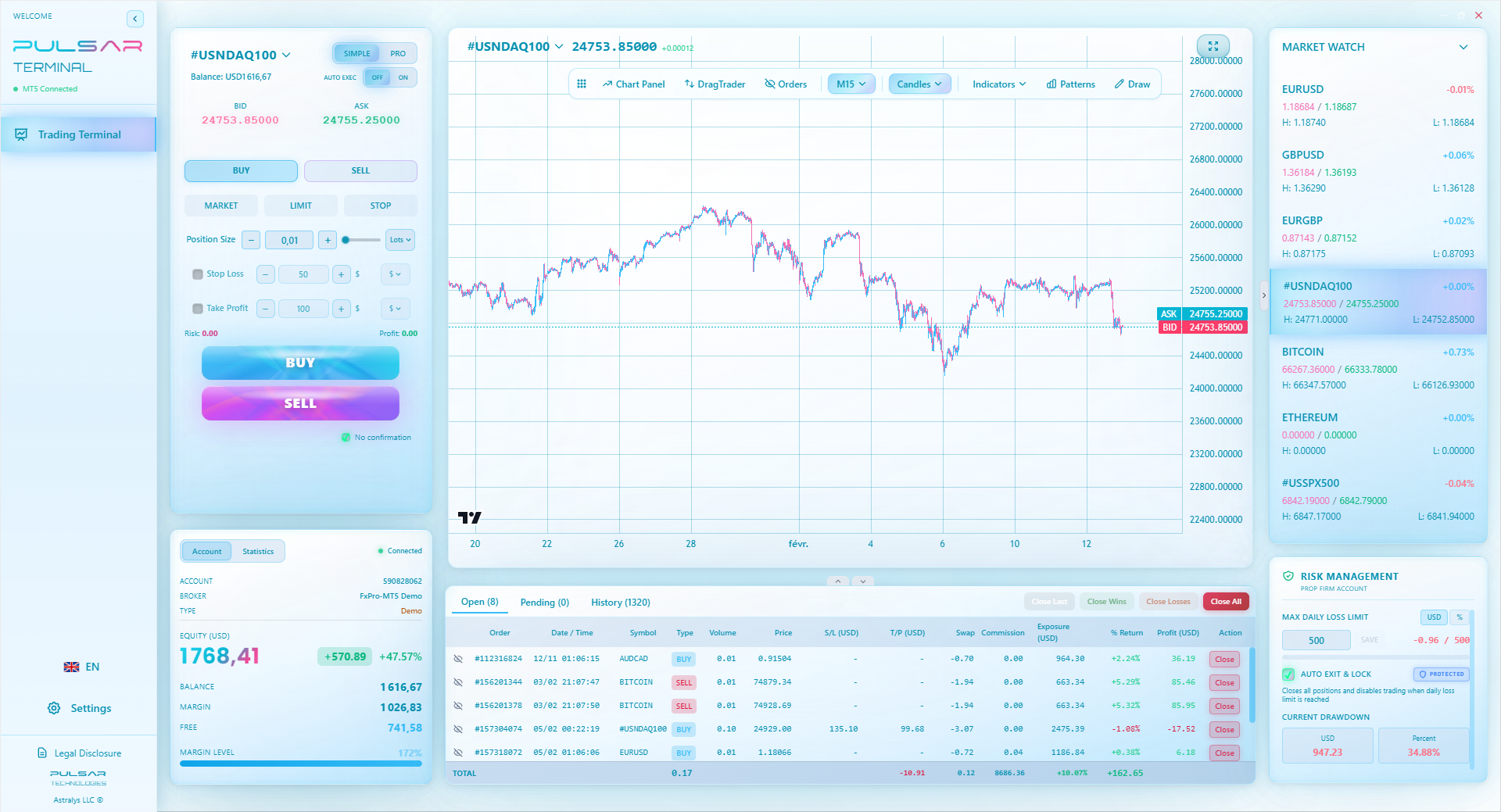
Managing the dual risk of trades and currency swings is complex; Pulsar Terminal's advanced order types let you set precise multi-level take-profits to lock in gains at key levels, no matter what the Naira is doing.
Pulsar Terminal
The all-in-one MT5 companion: drag-and-drop orders, multi-TP/SL, trailing stop, grid trading, Volume Profile, and prop firm protection. Used by 1,000+ traders daily.
Forget the Axis Bank card. Focus on brokers that solve the funding problem for you. Your selection criteria must be local-first.
- Naira Deposit/Withdrawal: This is the number one filter. Does the broker offer a direct, seamless Naira option? Check their payment methods page for Nigeria specifically.
- Local Customer Support: Is there a Nigerian phone number or support team that operates during your hours? When you have a withdrawal issue at 10 PM on a Friday, you need help.
- Regulation & Reputation: Yes, global regulation (ASIC, FCA) is good, but also check their reputation among Nigerian traders. Online forums and communities are goldmines for real feedback.
- Trading Conditions: Look at the average spread definition on the pairs you trade, like EUR/USD. Does it widen massively during Lagos market hours?
I've had good execution experiences with both Exness review and IC Markets review from Nigeria. Their local payment integrations were the deciding factor. Do your own due diligence, but start with their deposit page.
“The market doesn't care how your money got there. It only cares if your analysis is right or wrong.”
Enough theory. Here's your to-do list.
- Audit Your Current Broker: Can you deposit and withdraw in Naira easily? If not, list it as a con.
- Open a Crypto Wallet: Even if you don't plan to use it immediately, get set up on a reputable P2P platform. Buy a small amount of USDT (like $20 worth) to understand the flow. It's the future of cross-border value transfer for traders like us.
- Calculate Your True Costs: Look at your last 3 deposits. Calculate the total cost in percentage terms (Amount in Naira you paid / USD value that arrived in account). You might be shocked.
- Protect Your Capital: However you fund your account, your first job is preservation. Understand exactly what a margin call is and how to avoid it. No funding method will save you from poor risk management.
- Forget the Forex Card Mirage: Redirect the energy you were using to search for an Axis Bank Forex Card into mastering a single strategy, like swing trading a specific instrument. That's where your edge will come from, not from a payment method.
The market doesn't care how your money got there. It only cares if your analysis is right or wrong. Simplify the funding, so you can focus on the trading.
FAQ
Q1Can I, as a Nigerian, legally get an Axis Bank Forex Card?
No, not directly. Axis Bank requires you to be physically present in India with valid Indian KYC documents to open an account. It is not a product offered to Nigerian residents.
Q2What is the best way to fund a forex trading account from Nigeria?
For most traders, the best balance of speed, cost, and reliability is using cryptocurrency (like USDT) via a P2P platform. The second-best option is using a broker's integrated local Naira deposit gateway if they offer one.
Q3Will using a foreign forex card get my broker account blocked?
It's a high risk. Brokers are required to verify your identity and residence. Using a payment method from a country you don't reside in (like an Indian card for a Nigerian resident) is a major red flag for compliance and can lead to your account being frozen during withdrawal.
Q4How do I avoid high fees when converting Naira to USD for trading?
Shop around. Compare the final USD amount you receive after all fees between your bank's wire rate, local broker gateways, and the P2P crypto market rate. The P2P market often offers the closest to the true market exchange rate.
Q5Is it safe to use cryptocurrency to fund my trading account?
It is generally safe if you use the correct, unique wallet address provided by your broker for deposits. Always double-check the address. The risk is not in the method itself, but in user error. Start with small test amounts.
Q6Why do my Nigerian debit card transactions to brokers fail?
Most Nigerian banks have systems that block international transactions to merchants categorized as 'Financial Trading' or 'CFDs' due to Central Bank directives and internal risk policies. It's not a problem with your card, but with the bank's permissioning system.
Prof. Winston's Lesson
Key Takeaways:
- ✓Axis Bank Forex Cards are inaccessible to Nigerian residents.
- ✓Cryptocurrency (USDT) is the most efficient funding method for most.
- ✓Always calculate the total cost of funding as a percentage.
- ✓Your broker must support seamless Naira deposits/withdrawals.
- ✓Currency risk is a hidden second layer to your P&L.
How useful was this article?
Click a star to rate
Weekly Trading Insights
Free weekly analysis & strategies. No spam.
About the Author
Olumide Adeyemi
West African Trading Pioneer
One of Nigeria's most active forex trading educators. 8 years of experience trading from Lagos. Specializes in low-capital strategies and prop firm challenges for African traders.
Comments
Risk Disclaimer
Trading financial instruments carries significant risk and may not be suitable for all investors. Past performance does not guarantee future results. This content is for educational purposes only and should not be considered investment advice. Always conduct your own research before trading.
You Might Also Like

Cara Trading Forex Sukses: 7 Prinsip dari Trader Profesional
Cara trading forex sukses dengan 7 prinsip trader pro: manajemen modal, disiplin, journal trading, backtest. Data nyata, bukan janji profit palsu.
Jam Trading Forex Terbaik untuk Trader Indonesia: Panduan Lengkap dengan Tabel Waktu
Panduan jam trading forex untuk trader Indonesia. Tabel 4 sesi dunia, jam emas 20:00-00:00, sesi mana yang harus dihindari. Data akurat + tips dari trader berpengalaman.
Top 5 Sàn Forex Uy Tín Nhất 2026: Review Jujur dari Trader Indonesia
Top 5 sàn forex uy tín 2026 untuk trader Indonesia. Review jujur: spread, deposit, withdraw, dukungan lokal. Exness, XM, IC Markets & lebih.
Get Pulsar Terminal
All these calculators are built into Pulsar Terminal with real-time data from your MT5 account. One-click position sizing, automatic risk management, and instant calculations.
Get Pulsar Terminal