


I lost R4,200 in 45 minutes on a quiet Tuesday.

David van der Merwe
Emerging Markets Trader ·  South Africa
☕ 10 min read
What you'll learn:
- 1Why Bank Holidays Are a Liquidity Trap (Not a Day Off)
- 2The South African Trader's Holiday Calendar: Key Dates
- 3Confessions: My Worst Holiday Trading Blunders
- 4A Practical Strategy for Holiday Trading (Hint: It's Mostly Avoiding)
- 5broker-selection-holidays
- 6The South African Rules: More Than Just Holidays
- 7Your Bank Holiday Forex Action Plan
I lost R4,200 in 45 minutes on a quiet Tuesday. It was Heritage Day, a South African public holiday. The USD/ZAR chart looked calm, so I put on a big position, thinking I'd catch a small move. Liquidity evaporated. The spread on my broker's platform blew out from 25 pips to over 90. A minor news headline hit the wires, and the price spiked through my stop loss at the worst possible rate. The market wasn't closed, but it might as well have been for anyone trying to trade normally. That's the real danger of bank holidays forex trading: it's not about the market being closed, it's about it being broken.
Most traders think a bank holiday just means a quiet day. They're wrong. It's a fundamental shift in market mechanics. Liquidity - the ease of buying and selling at a fair price - dries up. The major players, the banks and institutional funds that provide that liquidity, shut their trading desks. What's left is a thin, skittish market run by algorithms and a handful of desperate punters.
For a ZAR trader, this happens twice. First, on South African public holidays like Freedom Day or Heritage Day, liquidity in ZAR pairs (USD/ZAR, EUR/ZAR) plummets. The local banks that make the market are closed. Second, and just as crucially, on major international holidays like US Thanksgiving, Christmas, or UK Summer Bank Holiday. If London or New York is shut, global liquidity for majors like EUR/USD or GBP/USD tanks. Your ZAR trade might be fine, but if it's correlated to a major pair moving weirdly in a holiday-thinned market, you can get smoked.
The result isn't just less movement. It's worse movement. Prices can gap. Spreads, the difference between the buy and sell price, can widen to ridiculous levels. Your broker's spread definition page might quote 0.8 pips on EUR/USD, but on Good Friday afternoon? I've seen it hit 5 pips. A stop loss isn't a guarantee at a specific price; it's a market order that gets filled at the next available price. In a illiquid market, that 'next available price' can be a disaster.

Warning: A stop loss is not a force field. In low liquidity, your stop can get filled far beyond your intended price, a phenomenon called 'slippage.' On a holiday, a 10-pip stop can easily become a 30-pip loss before you blink.

💡 Winston's Tip
A quiet market isn't a safe market. It's a trap. Low volume amplifies every tiny order into a price spike. The holiday 'chop' isn't random noise; it's the sound of the market's structure breaking down.
“The danger of bank holidays forex trading isn't the market being closed; it's the market being broken.”
You need to know two calendars: yours and everyone else's. Mark these South African public holidays. On these days, assume ZAR trading is hazardous.
| Holiday | 2026 Date | Primary Market Impact |
|---|---|---|
| New Year's Day | 1 Jan | Global holiday, very thin markets. |
| Human Rights Day | 21 Mar | Reduced ZAR liquidity. |
| Good Friday | 3 Apr | Major global holiday. London/US closed. Extreme low liquidity. |
| Family Day | 6 Apr | Follows Easter weekend. Often quiet. |
| Freedom Day | 27 Apr | Reduced ZAR liquidity. |
| Workers' Day | 1 May | JSE closed. Reduced ZAR liquidity. |
| Youth Day | 16 Jun | Reduced ZAR liquidity. |
| National Women's Day | 9 Aug | Reduced ZAR liquidity. |
| Heritage Day | 24 Sep | Reduced ZAR liquidity. |
| Day of Reconciliation | 16 Dec | Reduced ZAR liquidity. |
| Christmas Day | 25 Dec | Major global holiday. All major centers closed. |
| Day of Goodwill | 26 Dec | UK Boxing Day holiday. Thin markets. |
The International Killers
These are the big ones that freeze the global market. Even though SA is open, trading is often pointless.
- US Thanksgiving (Nov 27, 2026): The New York session closes early. The afternoon is a ghost town.
- Christmas to New Year's (Dec 25 - Jan 1): A week of skeletal crews and unpredictable, low-volume moves. Many prop firms reduce use or impose special rules.
- UK Summer Bank Holiday (Aug 31, 2026): London, the world's forex capital, is closed. Volume drops dramatically.
The smart move? Use these days for analysis, not trading. Update your swing trading plans, backtest strategies, or just take a break. Fighting the holiday market is a great way to fund someone else's holiday.
“A stop loss isn't a force field. In low liquidity, it's a suggestion the market often ignores.”
Let me be the cautionary tale. Textbook knowledge doesn't stick until you've paid the tuition.
Mistake 1: The Christmas Eve Scalp (2022). It was Dec 24th. London was closed, New York was on a half-day. I thought I'd be clever and scalping the EUR/USD for a quick 5 pips. I entered long at 1.0615 with a 1.0620 target. The spread was already 4 pips. The price ticked up to 1.0619... and then a single, large sell order hit the illiquid market. It gapped down 12 pips instantly. My stop at 1.0605 was utterly meaningless. My fill was 1.0603. A planned 5-pip win (minus the huge spread) turned into a 12-pip loss in milliseconds. I paid for not respecting the calendar.
Mistake 2: Heritage Day ZAR Reversal (2023). This was the R4,200 lesson I mentioned. USD/ZAR had been in a downtrend. On Heritage Day morning, it looked like it was bouncing. I went long at R18.85, expecting a move back to R19.00. My stop was at R18.80. The spread, normally 25 pips, was sitting at 40. A minor comment from a SARB official hit the news wires. In a normal market, it might cause a 30-pip move. In the holiday market, with no depth, it spiked the pair down 70 pips in a minute. My stop was triggered at R18.72 - a full 8 cents worse than my order. The loss was nearly double what I'd calculated. I learned that volatility isn't about big daily ranges; it's about violent, unpredictable spikes when nobody's home to provide orderly prices.
These aren't bad luck. They're the predictable outcome of trading when the market's plumbing is shut off. Your broker's margin call protections won't save you from these kinds of fills.
“A stop loss isn't a force field. In low liquidity, it's a suggestion the market often ignores.”
Okay, so you're stubborn. Or maybe you see a setup you just can't ignore. If you must trade around bank holidays forex, here's the only sane framework.
Rule 1: Halve Your Position. Then Halve It Again. Your normal position size calculator output is for normal markets. Holiday markets are defective. If your usual lot size is 1.0, trade 0.25. This isn't to make less money; it's to survive the inevitable spread widening and slippage. A 30-pip loss on a quarter position hurts. On a full position, it blows up your week.
Rule 2: Avoid ZAR Pairs on SA Holidays, Avoid Majors on UK/US Holidays. It's simple. If it's a SA holiday, trade EUR/USD or XAU/USD (gold), where liquidity is more global. If it's a US holiday, maybe look at AUD pairs with the Asian session open. Never trade the currency of the country that's on holiday.
Rule 3: Use Limit Orders, Not Market Orders. Never, ever place a market order on a holiday. The spread will eat you. Place limit orders to buy below the market or sell above it. You might not get filled, but that's better than getting filled at a terrible price. This is where patience is forced upon you.
Rule 4: Widen Your Stops Dramatically. Your technical analysis showing a 15-pip stop? Make it 40 pips. The noise is exponentially higher. If your strategy doesn't work with a 40-pip stop, the trade is invalid for holiday conditions. Full stop.

Pro Tip: The best trade before a long holiday weekend is often to close existing positions. You remove the risk of a Sunday gap opening against you. I now always square up before Good Friday or Christmas. The peace of mind is worth more than the potential missed pip.
💡 Winston's Tip
Your pre-holiday checklist is more important than your trading strategy for that day. Position size, broker notices, margin changes. Neglect this admin, and your brilliant analysis won't matter.
“The best trade before a long holiday weekend is often to close existing positions.”
Not all brokers handle holidays equally. This is a critical, often overlooked part of broker due diligence. You need to check two things on their website: their holiday trading schedule and their policy on margin and use.
Many brokers, including major ones like IC Markets or Pepperstone, publish detailed calendars showing when specific instruments will be unavailable or have margin requirements increased. For example, they might increase margin requirements for ZAR pairs from 2% to 5% on a South African holiday. This is for their protection and yours - it forces you to use less use.
Some brokers, particularly those catering to prop firm challenges, have automated tools to manage risk. If you're trading a prop account with strict daily loss limits, a holiday spike can breach your limit in one bad fill. Tools that can automatically hedge or close positions based on real-time equity drawdown become useful. It's like having a risk manager watching your screen while you're asleep.

Example: Broker A offers 500:1 use on USD/ZAR normally. On Freedom Day, their schedule shows use is reduced to 100:1 for that pair. If you don't check, you might find you're over-leveraged and get a margin call on what you thought was a safe position. Always check the news section of your broker's site before a known holiday.
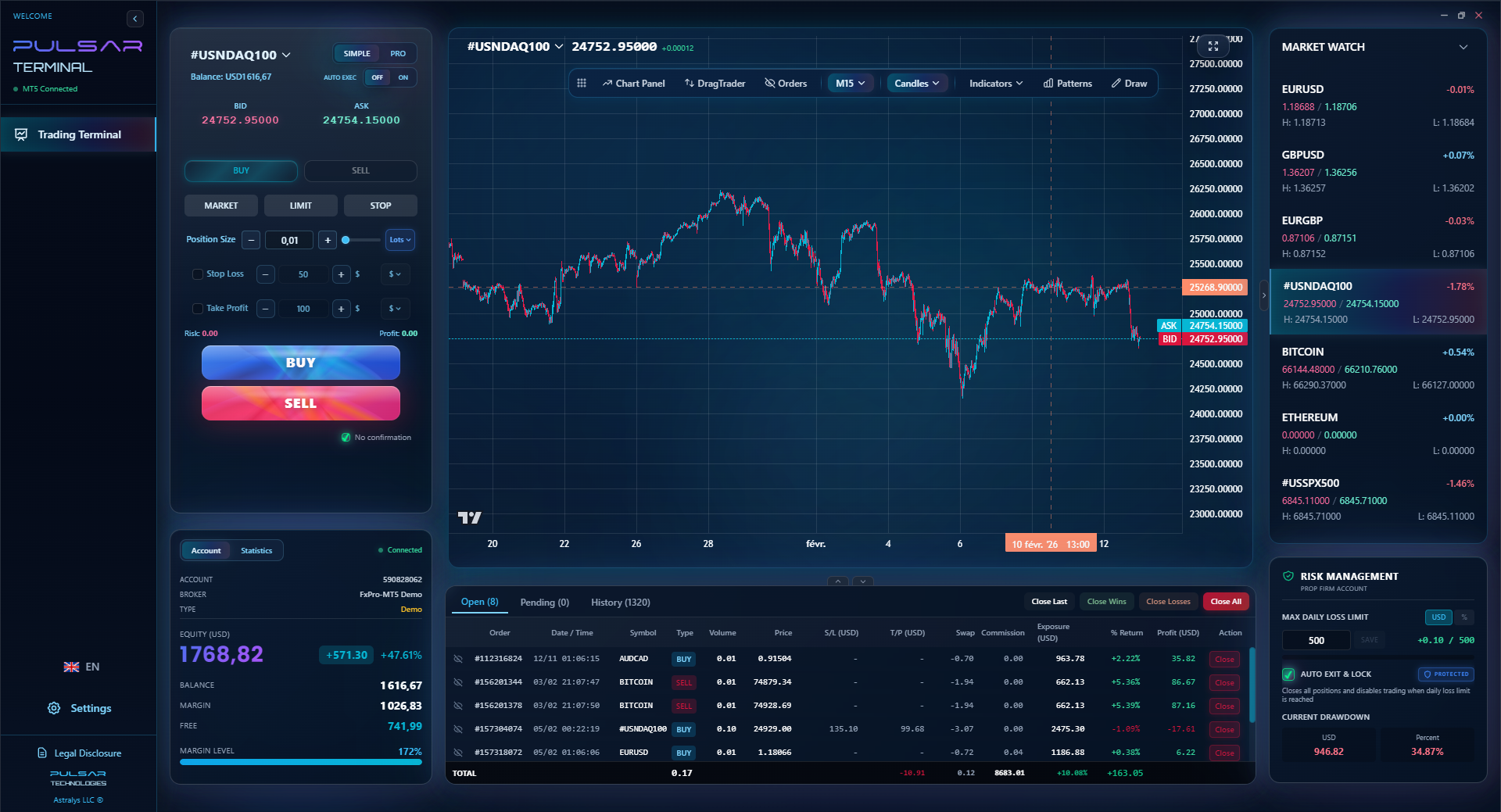
Managing risk over volatile holiday periods is critical, and Pulsar Terminal's prop firm daily loss protection feature can automatically hedge or close positions to guard against those unpredictable holiday spikes.
Pulsar Terminal
The all-in-one MT5 companion: drag-and-drop orders, multi-TP/SL, trailing stop, grid trading, Volume Profile, and prop firm protection. Used by 1,000+ traders daily.
“The best trade before a long holiday weekend is often to close existing positions.”
Trading around holidays happens within South Africa's unique regulatory box. The Financial Sector Conduct Authority (FSCA) regulates brokers, but the South African Reserve Bank (SARB) controls the flow of money. This affects your holiday planning in a subtle way.
You fund your international trading account using your single discretionary allowance (R1 million per year) or foreign capital allowance. Crucially, you can't use your SA credit card to fund directly. This means if you have a losing trade on a Friday before a long holiday weekend and need to top up your margin, the EFT to your international broker might take 2-3 business days. If Monday is a public holiday, you're stuck.
Always maintain a larger cash buffer in your trading account ahead of holiday periods. Needing to move money in a pinch over a long weekend is a recipe for panic. Also, remember the SARB rule: if you travel and bring back foreign cash, you must resell it to a bank within 30 days. It's a reminder that the authorities are watching cross-border flows closely, a context that always underpins ZAR trading.
Stick with FSCA-regulated brokers like XM or Exness for your local operations. It ensures they adhere to local holiday schedules and client fund protections, which is one less thing to worry about when the markets get weird.
💡 Winston's Tip
The smart money uses holiday periods for research and planning, not execution. They're analyzing the [RSI indicator](/en/indicators/rsi) on longer timeframes, not staring at a frozen 5-minute chart. Be smart money.
“Holiday trading isn't about making money. It's about not losing money to a malfunctioning market.”
Let's make this stupidly simple. Print this out.
One Week Before a Major Holiday:
- Check the economic calendar. Note the SA and major international (US, UK, EU) holidays.
- Review all open positions. Decide which, if any, you will hold over the holiday. Consider closing them.
- Check your broker's website for holiday trading hours and margin changes.
The Day Before the Holiday:
- Reduce or close positions. Square up.
- Ensure your account has ample equity. No margin calls over a quiet weekend.
- Set alerts for Sunday night's open, but don't plan to trade immediately.
On the Holiday Itself:
- If you must trade, cut position size by 75%.
- Use only limit orders.
- Widen stops by 200-300%.
- Focus on instruments NOT related to the closed financial center.
- Better yet, don't trade. Analyze. Use the time to study MACD indicator divergences on weekly charts or plan your next quarter.
The goal isn't to conquer the holiday market. It's to survive it with your capital intact so you can trade effectively when the real players return on Tuesday. The most successful traders aren't the ones who make money every day; they're the ones who successfully avoid losing money on the days when the odds are fundamentally broken.
FAQ
Q1Can I trade forex on a South African public holiday?
Technically, yes, the global forex market is open. But you shouldn't trade ZAR pairs. Liquidity from South African banks is gone, leading to wide spreads and erratic price action on USD/ZAR or EUR/ZAR. It's dangerous and expensive.
Q2What is the most dangerous bank holiday for forex traders?
Good Friday is the worst. It's a major holiday in the UK, US, and most of Europe. London and New York - the two largest forex centers - are closed. Global liquidity evaporates, making any trade highly susceptible to gaps and massive slippage.
Q3How do bank holidays affect my stop-loss orders?
They make them unreliable. A stop loss becomes a market order when triggered. In the thin, illiquid market of a holiday, the 'next available price' to fill your order could be significantly worse than your stop price. You can experience slippage of 20, 30, or even 50 pips easily.
Q4Should I trade during the Christmas to New Year period?
Most professional traders scale right back or stop completely. Markets are dominated by skeleton staff, year-end book squaring, and low volume. Moves can be exaggerated and illogical. It's a time for high risk and low reward. Avoid.
Q5Do forex brokers change their rules on holidays?
Yes, absolutely. Most reputable brokers will increase margin requirements (reduce use) for affected currency pairs and may widen their quoted spreads. Always check your broker's official holiday schedule and trading conditions notice before a holiday.
Q6As a South African, can I fund my account over a long weekend if I need to?
No, not practically. EFTs to international brokers take business days. If you need margin on a Friday before a Monday holiday, the funds likely won't arrive until Tuesday. This is why maintaining a larger cash buffer before holiday periods is a key part of risk management.
Q7Is there a 'best' pair to trade on a South African holiday?
If you must trade, focus on pairs unrelated to the closed center. On a SA holiday, avoid ZAR. Look at pairs like AUD/JPY during the Asian session or EUR/CHF. But remember, all global liquidity is interconnected, so caution is still paramount.
Prof. Winston's Lesson
Key Takeaways:
- ✓Halve your position size twice before a holiday trade.
- ✓Widen stop losses by 200-300% in thin markets.
- ✓Never use market orders on a bank holiday.
- ✓Check your broker's holiday margin schedule every time.
- ✓A R4,200 loss taught me to respect the calendar.
How useful was this article?
Click a star to rate
Weekly Trading Insights
Free weekly analysis & strategies. No spam.
About the Author
David van der Merwe
Emerging Markets Trader
Johannesburg-based trader with 11 years in emerging market currencies. Specializes in ZAR pairs, FSCA-regulated trading, and South African market analysis.
Comments
Risk Disclaimer
Trading financial instruments carries significant risk and may not be suitable for all investors. Past performance does not guarantee future results. This content is for educational purposes only and should not be considered investment advice. Always conduct your own research before trading.
You Might Also Like

Cara Trading Forex Sukses: 7 Prinsip dari Trader Profesional
Cara trading forex sukses dengan 7 prinsip trader pro: manajemen modal, disiplin, journal trading, backtest. Data nyata, bukan janji profit palsu.
Jam Trading Forex Terbaik untuk Trader Indonesia: Panduan Lengkap dengan Tabel Waktu
Panduan jam trading forex untuk trader Indonesia. Tabel 4 sesi dunia, jam emas 20:00-00:00, sesi mana yang harus dihindari. Data akurat + tips dari trader berpengalaman.
Top 5 Sàn Forex Uy Tín Nhất 2026: Review Jujur dari Trader Indonesia
Top 5 sàn forex uy tín 2026 untuk trader Indonesia. Review jujur: spread, deposit, withdraw, dukungan lokal. Exness, XM, IC Markets & lebih.
Get Pulsar Terminal
All these calculators are built into Pulsar Terminal with real-time data from your MT5 account. One-click position sizing, automatic risk management, and instant calculations.
Get Pulsar Terminal